



Table of contents

Agencies that outsource content through white label providers produce 3x more output per writer without expanding headcount — and their clients never know the difference. Here is a complete guide to how white label content writing streamlines your processes and accelerates agency growth.
Key Takeaways
- White label content writing lets agencies deliver branded content created by external specialists under the agency's name, eliminating the hiring, training, and management overhead of building an in-house writing team while maintaining quality and client trust.
- Agencies using white label content providers reduce content production costs by 40–60% compared to hiring equivalent in-house writers, because they convert fixed salary expenses into variable costs that scale with client demand (Content Whale, 2026).
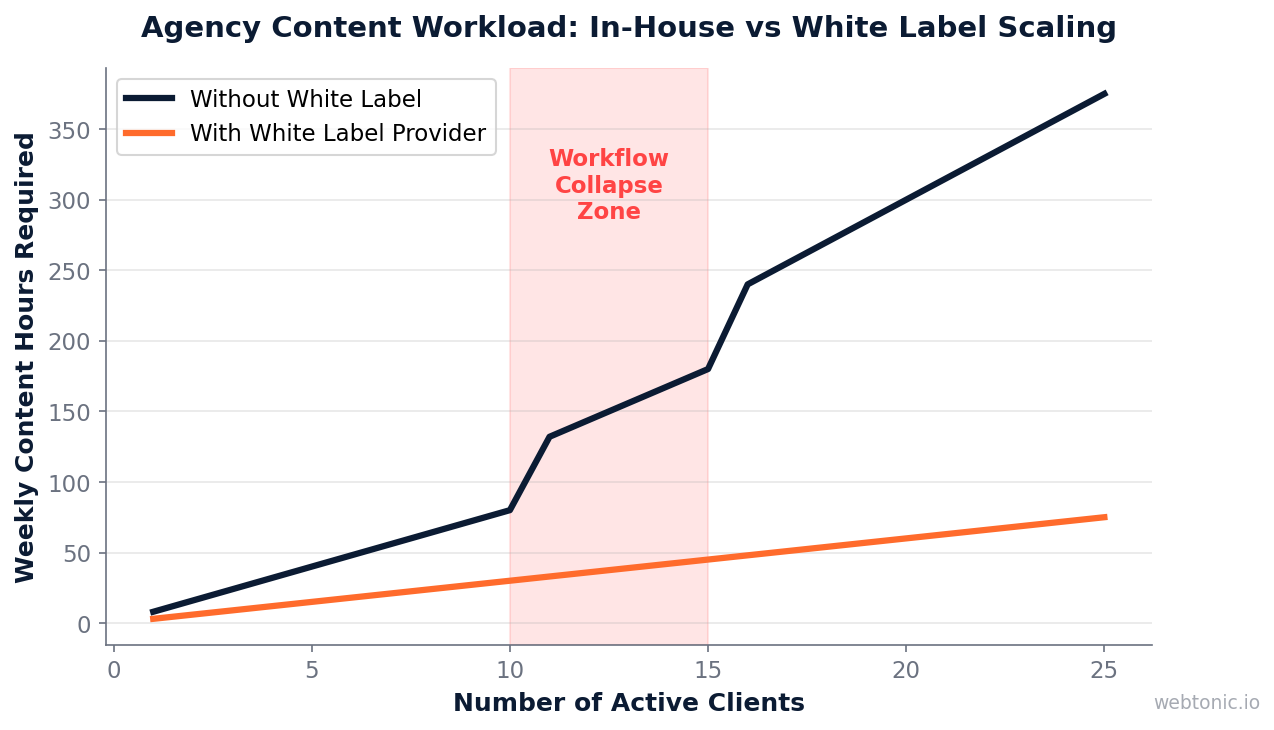
- Most agency content workflows collapse between 10 and 15 clients because every manual step multiplies linearly with each new account — white label partnerships remove the bottleneck by providing ready-to-publish content without additional internal coordination (Artikle.ai, 2026).
- White label SEO content drives measurable organic traffic results when the provider follows documented content briefs with target keywords, internal linking maps, and brand voice guidelines — agencies retain strategic control while outsourcing the execution layer.
- The global content marketing industry is valued at $94 billion, and agencies that scale production through white label partnerships capture a larger share by servicing more clients without proportional headcount increases.
- Quality control is the primary risk in white label content writing — agencies that implement structured review processes with documented style guides, editorial checklists, and feedback loops consistently report 90%+ first-draft acceptance rates from their providers.
What Is White Label Content Writing?
White label content writing is a service model where an external content provider creates written assets — blog posts, web pages, email campaigns, social media content, and more — that an agency delivers to its clients under the agency's own brand name. According to SocialPilot's 2026 agency guide, white label content services help agencies handle growing content demand without expanding their in-house team, allowing them to scale faster, reduce costs, and focus more on strategy while maintaining consistent content delivery.
The "white label" distinction means the end client never interacts with or knows about the external provider. The agency's brand, voice, and standards are applied to every piece of content. The provider functions as an invisible extension of the agency's production capacity — an outsourced writing department that operates under the agency's name, follows the agency's guidelines, and delivers work the agency presents as its own.
According to SEOwind's white label content guide, the model works best when agencies maintain strategic control (keyword strategy, content calendars, brand positioning) while outsourcing the execution layer (research, writing, editing). This separation lets agency leaders focus on client relationships, strategy development, and business growth rather than managing a roster of in-house writers.
How White Label Content Writing Streamlines Agency Processes
The efficiency gains from white label content writing extend far beyond simply "having someone else write the articles." The streamlining effect operates across five operational dimensions that compound as the agency scales.
1. Eliminates the Hiring and Training Bottleneck
Hiring in-house content writers requires job postings, interviews, onboarding, training on client industries, and ongoing management. According to LinksManagement's agency scaling guide, the average time to hire a qualified content writer is 4–8 weeks, and it takes another 2–3 months before they produce at full capacity. White label providers deliver production-ready content within days of receiving a brief, eliminating the months-long ramp-up that constrains agency growth. When a new client signs, the agency can begin delivering content immediately without scrambling to hire.
2. Converts Fixed Costs Into Variable Costs
An in-house writer earning $55,000–$75,000 annually (plus benefits, equipment, and management overhead) represents a fixed cost regardless of client volume. According to Content Whale's agency content economics analysis, agencies using white label providers reduce content production costs by 40–60% because they pay per piece or per word rather than carrying fixed salaries. During slow months, costs drop automatically. During growth periods, production scales without hiring delays. This variable cost structure protects agency margins and reduces financial risk when onboarding new clients.

| Cost Factor | In-House Writer | White Label Provider |
|---|---|---|
| Annual Cost (per writer) | $65,000–$95,000 (salary + benefits + overhead) | $25,000–$45,000 (variable, per-project billing) |
| Ramp-Up Time | 3–5 months to full productivity | 1–2 weeks after onboarding |
| Scalability | Linear — each new client may require additional hires | Instant — providers scale capacity on demand |
| Industry Expertise | Limited to individual writer's experience | Access to specialists across 50+ industries |
| Risk | Turnover disrupts delivery; sick days create gaps | Provider manages staffing continuity |
3. Removes the Production Scheduling Bottleneck
The operational reality of content production is scheduling: assigning briefs, managing deadlines, handling revisions, and coordinating publication across multiple clients. According to Artikle.ai's agency scaling blueprint, most agency content workflows collapse between 10 and 15 clients because every manual step multiplies linearly with each new account. White label providers absorb the production management workload — the agency sends briefs, receives finished content, and handles only the strategic layer. This frees project managers and account directors to focus on client communication and strategy rather than chasing writer deadlines.

4. Provides Access to Subject Matter Expertise
Agencies serve clients across multiple industries — healthcare, legal, SaaS, ecommerce, real estate, manufacturing. No in-house writing team can credibly cover every vertical. According to Globital Marketing's provider selection guide, established white label content providers maintain writer pools with specialists across 50+ industries, each with the domain knowledge needed to produce authoritative, E-E-A-T-compliant content. When an agency wins a new client in healthcare, they don't need to hire a healthcare writer — their provider assigns one from their existing pool.
5. Standardizes Quality Through Systematic Processes
Mature white label providers operate with documented production workflows — editorial checklists, plagiarism scans, SEO compliance checks, readability scoring, and multi-stage editing. According to DesignLoud's white label content guide, agencies that implement structured review processes with their providers report 90%+ first-draft acceptance rates. This systematization means content quality becomes predictable and consistent rather than dependent on any single writer's performance on a given day. Explore our web development services to see how content integrates with technical execution.
Implementing White Label Content Writing in Your Agency
Successfully integrating a white label content provider requires deliberate setup. Based on frameworks from Prose Media's agency implementation guide and Content Whale's economics analysis, here is the implementation process that maximizes quality and efficiency.
- Create detailed content briefs for every piece. The brief is the quality control mechanism. Include target keyword and secondary keywords, word count range, target audience description, brand voice guidelines, internal linking requirements, competitor content to outperform, and specific data or sources to reference. Agencies that provide vague briefs get vague content — the quality of white label output is directly proportional to the specificity of the brief.
- Document brand voice guides per client. A 1–2 page brand voice document covering tone (formal vs. conversational), vocabulary preferences (technical terms to use or avoid), formatting standards (heading structure, paragraph length), and example sentences eliminates 80% of revision requests on the first submission.
- Establish a feedback loop with measurable criteria. Don't send back content with "make it better" — use specific, actionable feedback tied to documented standards. Track revision rates per client and per content type to identify where briefs need improvement versus where the provider needs training.
- Start with a pilot project before full commitment. Order 5–10 pieces across your most demanding clients before committing to a volume agreement. This tests the provider's ability to match different brand voices, handle technical subjects, and meet deadlines under real-world conditions.
- Build the workflow into your project management system. Create templates for content briefs, review checklists, and delivery tracking in your existing project management tool. Automate brief delivery and deadline reminders. The goal is making the white label workflow as seamless as assigning work to an in-house writer.
| Content Type | White Label Suitability | Typical Turnaround |
|---|---|---|
| SEO Blog Posts | Excellent — most common white label content type | 3–5 business days |
| Website Service Pages | Good — requires detailed brand voice documentation | 5–7 business days |
| Email Sequences | Moderate — needs strategic input on funnel stage and CTA | 3–5 business days |
| Technical Whitepapers | Specialized — requires industry-specific subject matter experts | 7–14 business days |
| Social Media Copy | Variable — best for batch creation, not real-time engagement | 2–3 business days |
White Label Content and SEO: The Strategic Connection
White label content writing delivers the strongest ROI when it's integrated with a documented SEO strategy. According to RazorCopy's agency content guide, the agencies that achieve the best results from white label content are those that maintain strategic control of the SEO layer — keyword research, content gap analysis, topic clustering, and internal linking architecture — while outsourcing the writing execution.
The practical workflow: the agency's SEO strategist identifies target keywords, search intent, and competitive gaps. These inform the content briefs sent to the white label provider. The provider writes the content optimized for the specified keywords and structure. The agency reviews for strategic alignment, makes any adjustments, and publishes under the client's brand. This separation of strategy and execution lets each party do what they do best — the agency maintains its competitive advantage in SEO strategy while the provider delivers the production volume that strategy requires.

At Web Tonic, we use a similar model internally — combining strategic oversight with scalable production workflows to deliver consistent, SEO-optimized content across all our client accounts.
Common Mistakes When Using White Label Content
White label content writing accelerates agency operations when implemented correctly, but common mistakes can undermine the benefits. Based on insights from BizToolkit's 2026 pricing analysis, these are the pitfalls to avoid:
- Choosing a provider based solely on price. The cheapest white label content often requires so many revisions that the total cost (including internal review time) exceeds what a mid-tier provider would have charged for publication-ready content. Evaluate providers on first-draft acceptance rate, not per-word price.
- Skipping the brand voice documentation step. Agencies that send briefs without documented brand voice guidelines receive generic content that requires heavy editing to match each client's tone. This editing overhead eliminates the time savings that white label was supposed to create.
- Removing the editorial review layer entirely. White label content should be reviewed before client delivery — even from trusted providers. A 10–15 minute review per piece catches occasional misalignments, factual errors, and tone mismatches that could damage client relationships. Never send white label content directly to clients without review.
- Overloading a single provider with diverse content types. A provider excellent at SEO blog posts may not deliver the same quality for technical whitepapers, email sequences, or social media copy. Match providers to their strengths rather than expecting one provider to cover every content type equally well.
- Failing to measure content performance. Track organic traffic, keyword rankings, engagement metrics, and conversion rates for white label content. If performance data shows the content isn't meeting SEO or engagement targets, adjust briefs and provider feedback — don't assume the model itself is failing. For tracking help, explore our data intelligence services.
Frequently Asked Questions
What is white label content writing?
White label content writing is a service where an external content provider creates written materials — blog posts, web pages, email campaigns, social media content, case studies, and more — that a marketing agency or business delivers to its end clients under its own brand name. The end client never knows that an external provider wrote the content. The agency maintains strategic control (topics, keywords, brand voice) while the provider handles the research, writing, and editing. This model lets agencies scale their content production capacity without hiring additional in-house writers, converting fixed employment costs into variable per-project expenses that scale with demand.
How does white label content writing save agencies money?
White label content writing reduces agency content costs by 40–60% compared to equivalent in-house staffing. An in-house content writer costs $65,000–$95,000 annually when accounting for salary, benefits, equipment, management time, and overhead — and that cost is fixed regardless of client volume. White label providers charge per piece or per word, meaning costs scale directly with output. During slow periods, expenses drop automatically. During growth phases, production scales without the 4–8 week hiring delay and 3–5 month ramp-up period that new hires require. The financial flexibility alone makes white label content writing a strategic advantage for agencies managing variable client workloads.
How do agencies maintain quality with white label content?
Quality control in white label content writing depends on three systems: detailed content briefs (target keywords, audience, tone, structure, examples of expected quality), documented brand voice guides per client (tone, vocabulary, formatting standards), and structured review processes (editorial checklists, revision tracking, performance measurement). Agencies that implement all three consistently report 90%+ first-draft acceptance rates from their providers. The key insight is that content quality is primarily a function of brief quality — providers can only deliver what they're directed to create. Vague briefs produce generic content; specific briefs produce targeted, on-brand content that requires minimal revision.
Is white label content writing ethical?
Yes — white label content writing is a standard, widely accepted business practice in the marketing industry. It operates on the same principle as any other white label service: a specialized provider creates a product that another business resells under its own brand. Agencies are transparent with their providers about the arrangement, and the content is original and created specifically for each client. The agency's role is providing the strategic direction, quality oversight, and client relationship management that ensures the content serves the client's business goals. This is fundamentally different from plagiarism or content spinning — white label content is custom-created, original work produced under a legitimate business arrangement.
When should an agency start using white label content?
Agencies should consider white label content writing when they experience any of these signals: their in-house team consistently misses content deadlines, they are turning away new business because they lack production capacity, content production costs exceed 30% of project revenue, writers are stretched across too many client industries to maintain quality, or the agency founder is still writing client content instead of focusing on strategy and business development. The ideal time to start is before hitting capacity constraints — pilot the relationship with 5–10 pieces while your team still has bandwidth to evaluate quality and refine the workflow. Contact Web Tonic to discuss how outsourced content integrates with a comprehensive marketing strategy.
Sources
socialpilot.co — White Label Content Creation: Complete Agency Guide (2026)
seowind.io — White-Label Content Creation for Agencies
content-whale.com — Content Writing for Agencies: When to Outsource vs Hire
linksmanagement.com — White Label Content Writing: How Agencies Scale
artikle.ai — Scale Agency Content Production Across 20+ Clients
globitalmarketing.com — Choosing a White Label Content Agency
designloud.com — White Label Content Writing Guide
prosemedia.com — White Label Content SEO Without Hiring
razorcopy.com — Why Hire a White Label Content Creation Agency


