Table of contents

A case study is a documented account of one subject — a customer, a company, a patient, an event — that follows a fixed path: situation, problem, method, result, lesson. Get that path right and the writing is mechanical.
Key Takeaways
- Every credible case study answers 5 questions in order: who, what went wrong, what was done, what changed, and what it means for the reader.
- Budget roughly 1,000 to 1,500 words for a business case study and 2,500 to 4,000 for an academic one, with the result section never below 20% of the total.
- Collect 3 numbers minimum — a baseline, an after figure, and a time window — before you write a single sentence.
- Only 16% of readers read a page word for word, which is why the outcome belongs in the headline, not the conclusion.
- Gallup found just 23% of employees believe their organisation delivers on its promises to customers, so verifiable proof outperforms adjectives.
What a case study is — and the three kinds people mean
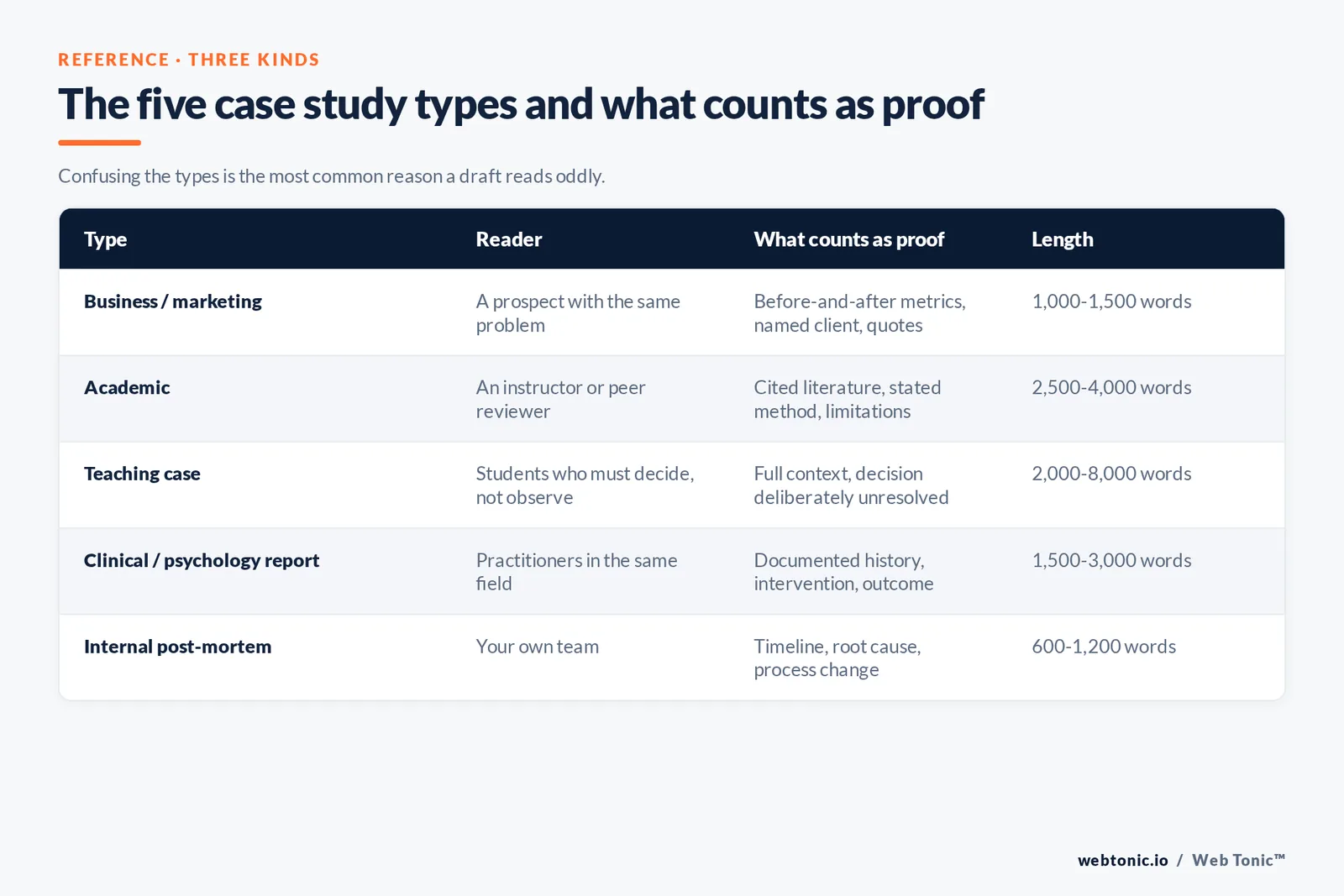
A case study is an in-depth examination of a single instance of something, used to draw a transferable conclusion. That is the shared definition across disciplines; what differs is the evidence that counts as proof. Scribbr's methodology guide frames it as a research design for exploring a bounded case in depth, while IBM's explainer treats it as a proof artefact used in buying decisions.
Confusing the three types is the single most common reason a draft reads oddly. A marketing case study written like a research paper feels evasive; a research paper written like marketing copy fails review.
| Type | Reader | What counts as proof | Typical length | Standard format |
|---|---|---|---|---|
| Business / marketing case study | A prospect who has the same problem | Before-and-after metrics, named client, direct quotes | 1,000–1,500 words | Challenge, solution, results, quote, CTA |
| Academic case study | An instructor or peer reviewer | Cited literature, stated method, discussed limitations | 2,500–4,000 words | APA, MLA or Chicago with a literature review |
| Teaching case (business school) | Students who must decide, not observe | Full context with the decision deliberately unresolved | 2,000–8,000 words | Narrative plus exhibits, no recommended answer |
| Clinical or psychology case report | Practitioners in the same field | Documented history, intervention, measured outcome | 1,500–3,000 words | Presentation, assessment, treatment, discussion |
| Internal post-mortem | Your own team | Timeline, root cause, what changed in the process | 600–1,200 words | Timeline, cause, actions, owner, date |
Harvard Business Publishing's guidance on writing teaching cases is worth reading even if you write marketing case studies, because it is ruthless about one thing: the case must contain a real decision with real constraints. Corporate Finance Institute makes the same point from the analysis side.
The 9-step process for writing a case study
This sequence works for a customer story and a graduate assignment alike. The order matters more than the prose: eight of the nine steps happen before you draft.
- Step 1 — Define the question the case must answer. Write it as one sentence: "Can a two-location clinic double bookings without raising ad spend?" If you cannot phrase it, you do not have a case yet.
- Step 2 — Select the subject deliberately. Pick the case because it is representative, extreme or a critical test — never because it is convenient. A single well-chosen case beats 3 vague ones.
- Step 3 — Get permission in writing. For business case studies, agree up front on the client name, the metrics you may publish and whether percentages can replace absolute figures.
- Step 4 — Gather the baseline. Pull the "before" numbers from the original source of truth (analytics, CRM, patient record, ledger), not from memory. Record the exact date range.
- Step 5 — Interview the subject. Run 30 to 45 minutes of recorded conversation. Aim for 2 or 3 quotable sentences, not a transcript you have to salvage later.
- Step 6 — Reconstruct the method honestly. List what was actually done, in order, including the thing that failed first. Method credibility is what separates a case study from a testimonial.
- Step 7 — Verify the results and their window. Every figure needs a baseline, an after value and a period. "Leads up 40%" is an assertion; "leads up 40%, 112 to 157, over 90 days" is evidence.
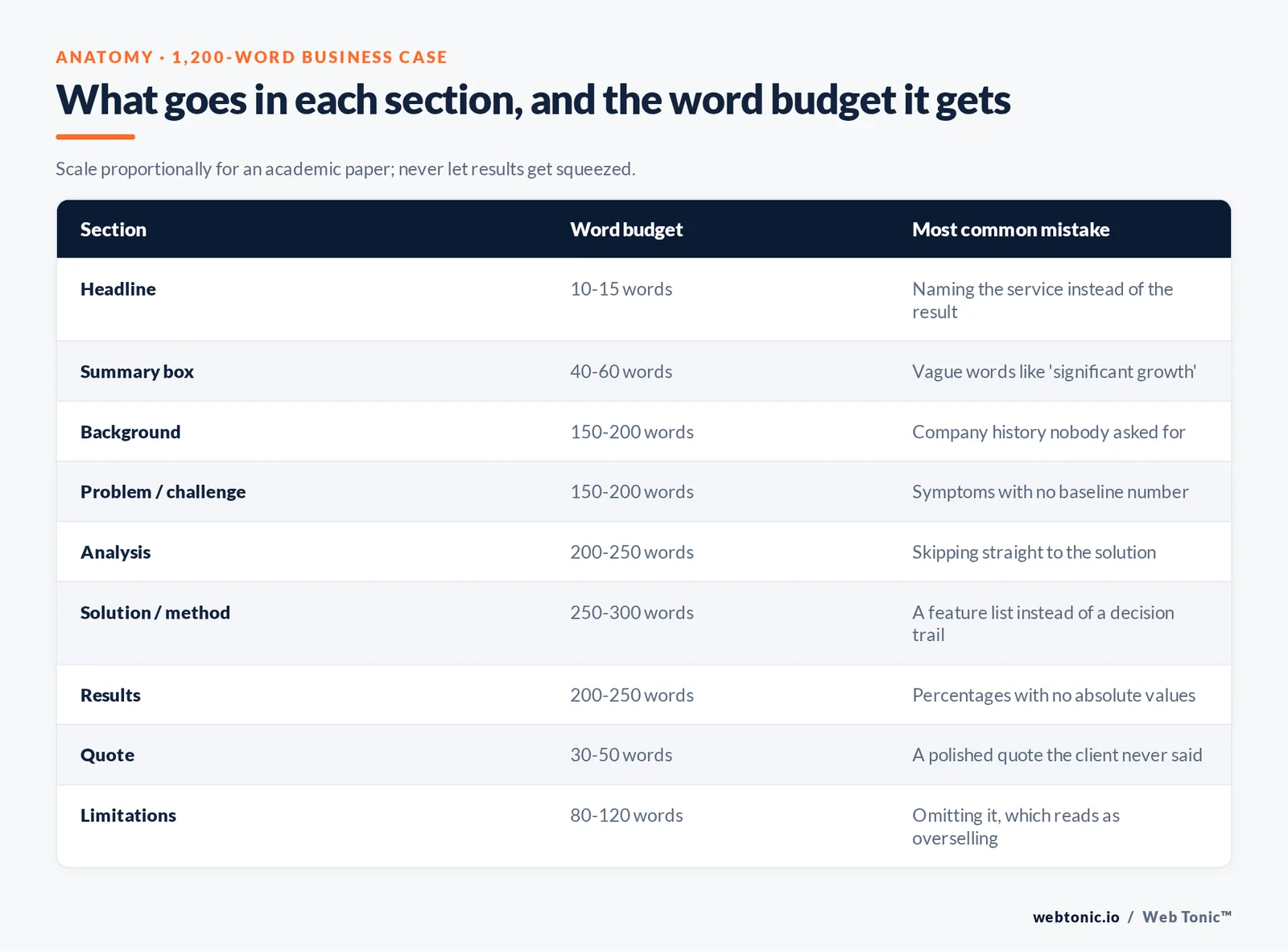
- Step 8 — Outline before drafting. Assign a word budget per section (see the anatomy table below) so the results section does not get squeezed into two lines.
- Step 9 — Draft, then cut 15%. The first draft always over-explains the background. Cut there first; never cut the numbers.
Writing centres teach the same discipline for academic work. The University of Wisconsin Writing Center handbook and UNC's tips and tools library both put analysis planning before drafting, which is exactly where most case studies are won or lost.
Case study anatomy: what goes in each section
Use this as a fill-in structure. The word budgets assume a 1,200-word business case study; scale them proportionally for an academic paper.
| Section | Job it does | Word budget | Most common mistake |
|---|---|---|---|
| Headline | States the outcome and the subject type | 10–15 words | Naming the service instead of the result |
| Summary box | Three metrics a skimmer can take away | 40–60 words | Vague words like "significant growth" |
| Background | Who the subject is and what constrained them | 150–200 words | Company history nobody asked for |
| Problem / challenge | The measurable gap before the work started | 150–200 words | Describing symptoms without a baseline number |
| Analysis | Why the problem existed, with evidence | 200–250 words | Skipping straight to the solution |
| Solution / method | What was done, in sequence, and why | 250–300 words | A feature list instead of a decision trail |
| Results | Before, after, time window, per metric | 200–250 words | Percentages with no absolute values |
| Quote | Independent voice confirming the change | 30–50 words | A polished quote the client never said |
| Limitations or lessons | What would not transfer, and why | 80–120 words | Omitting it, which reads as overselling |
| Call to action | The next step for a reader with the same problem | 20–30 words | A generic "contact us" with no offer |
The limitations section is the counter-intuitive one. Naming what the case does not prove raises the credibility of everything else on the page, which is why research writing has required it for decades and marketing is slowly catching up.
Data and evidence: what to collect before you write
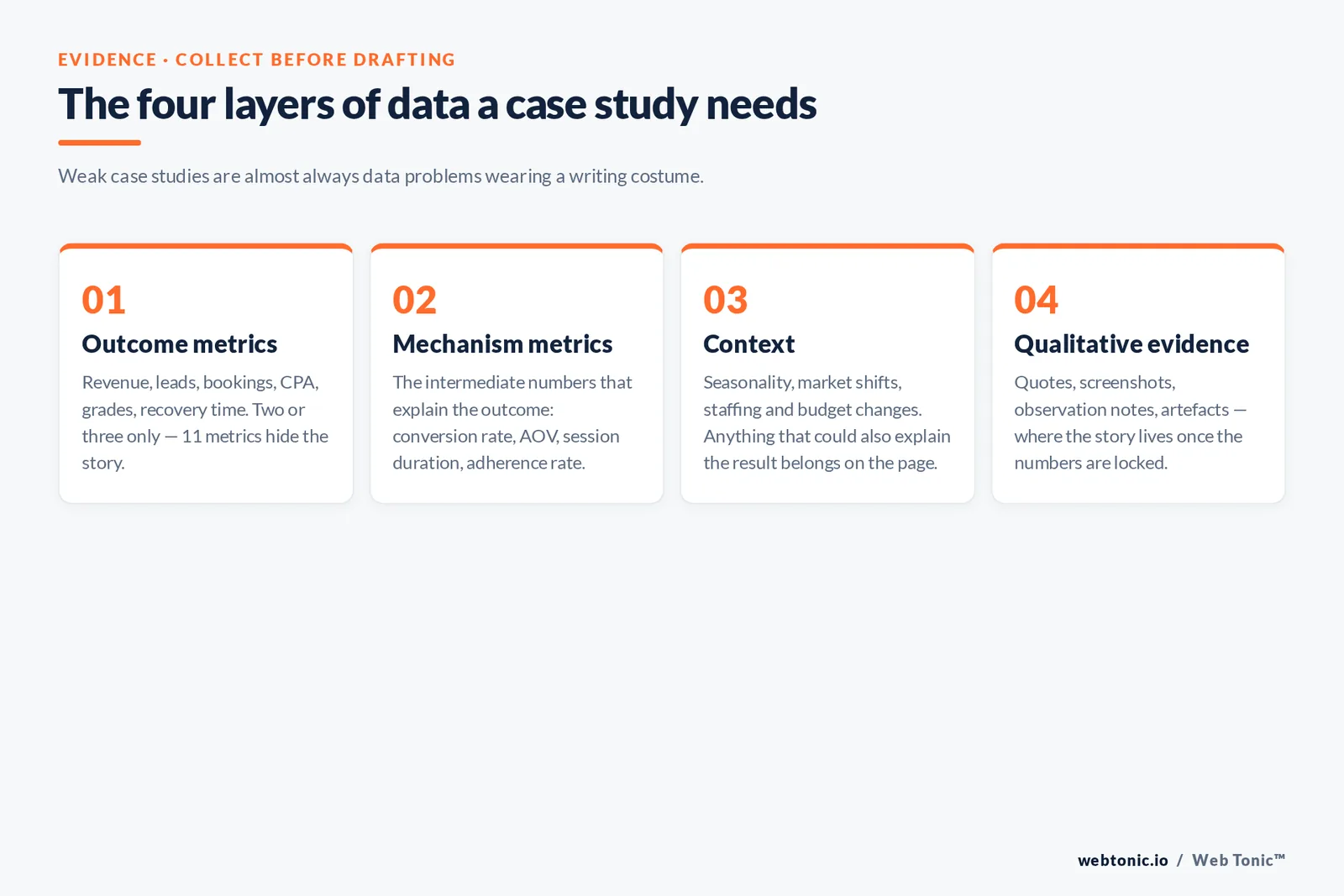
Weak case studies are almost always data problems wearing a writing costume. Collect four layers, in this order:
- Layer 1 — Outcome metrics. Revenue, leads, bookings, cost per acquisition, grades, recovery time. 2 or 3 only; a table of 11 metrics hides the story.
- Layer 2 — Mechanism metrics. The intermediate numbers that explain the outcome: conversion rate, average order value, session duration, adherence rate.
- Layer 3 — Context. Seasonality, market shifts, staffing changes, budget changes. Anything that could also explain the result belongs on the page.
- Layer 4 — Qualitative evidence. Quotes, screenshots, observation notes, artefacts. This is where the story lives once the numbers are locked.
For business cases, the honest version of Layer 3 is what protects you. If a competitor exited the market mid-study, say so. Search demand shifts alone can move results: Google Trends takes two minutes to check and often reframes a "campaign win" as a category-wide lift. For measurement discipline across channels, this is the work our data intelligence team does before any reporting claim goes out.
Reader behaviour also dictates presentation. Nielsen Norman Group's long-running research found that 79% of users scan rather than read, and only 16% read word for word — the basis for its inverted-pyramid recommendation of putting the conclusion first.
Interview questions that produce usable quotes
Nine questions, in this order, reliably fill a case study in a single call. The trick is asking for numbers early, while the interviewee is still in factual mode.
- Question 1: What was happening in the business before this project — and what number were you watching?
- Question 2: What had you already tried that did not work?
- Question 3: What made you decide to act when you did?
- Question 4: What was your biggest worry going in?
- Question 5: Walk me through what actually changed, week by week.
- Question 6: Which result surprised you most?
- Question 7: What did this let you do that you could not do before?
- Question 8: What would you tell someone in the same position 12 months ago?
- Question 9: Is there anything you would not want published?
Question 9 saves the approval cycle. Ask it and the sign-off usually arrives in 1 round instead of 3. Mind Tools' case-based learning guide is a useful companion here, since it explains how readers actually reason through a case once you hand it to them.
How the case study changes by business type
The structure is stable; the proof and the length are not. This table maps the format to what the buyer in each category actually needs to see.
| Business type | Headline metric | Best format | Proof that closes |
|---|---|---|---|
| B2B SaaS | Time to value or seats activated | 1,200-word written case plus a one-page PDF | Named champion, integration detail, ROI window |
| Marketing agency | Cost per acquisition and revenue | Written case with 2 charts | Before-and-after screenshots with date ranges |
| Local service business | Booked jobs per month | 400-word story plus photos | Customer name, neighbourhood, job photos |
| Ecommerce brand | Conversion rate and AOV | Short case embedded on the product page | Verified reviews and a usage timeline |
| Professional services | Outcome of the engagement | Anonymised case with sector and size | Method transparency and named constraints |
| Healthcare / clinical | Measured clinical outcome | Structured case report | Documented assessment, consent, follow-up |
| Education / nonprofit | Participation or completion rate | Narrative case with one exhibit | Third-party evaluation or programme data |
| Student assignment | Depth of analysis, not results | APA, MLA or Chicago paper | Cited literature and stated limitations |
One decision recurs in every row: name the subject or anonymise. Named cases convert better; anonymised cases ship faster and clear legal more easily. If approval is the bottleneck, publish the anonymised version now and upgrade it later — a case study sitting in review earns nothing. Broader positioning work around these assets sits in our growth marketing practice, and the full range is on our services page.
Academic case studies: formatting and the literature review
Academic case study writing adds two requirements a business case does not have: a literature review that positions your case against existing work, and a citation style applied consistently. For APA, the authority is the Purdue OWL general format guide — double spacing, 1-inch margins, a running head and a reference list where every entry maps to an in-text citation. MLA and Chicago differ in mechanics, not in logic.
Structure an academic case study in 7 parts: abstract, introduction with the research question, literature review, method (why a case design and how the case was selected), findings, discussion, limitations and conclusion. The method section is where marks are won — state whether the case is exploratory, explanatory or descriptive, and how you handled the fact that a single case cannot establish causality. MIT Sloan Management Review's marketing collection is a good model library for case-based argument that stays rigorous while remaining readable.
Psychology and clinical case reports follow the same skeleton with a stricter consent and de-identification standard, and they usually report outcomes at fixed intervals rather than as a single "after" figure.
Nine mistakes that make a case study unusable
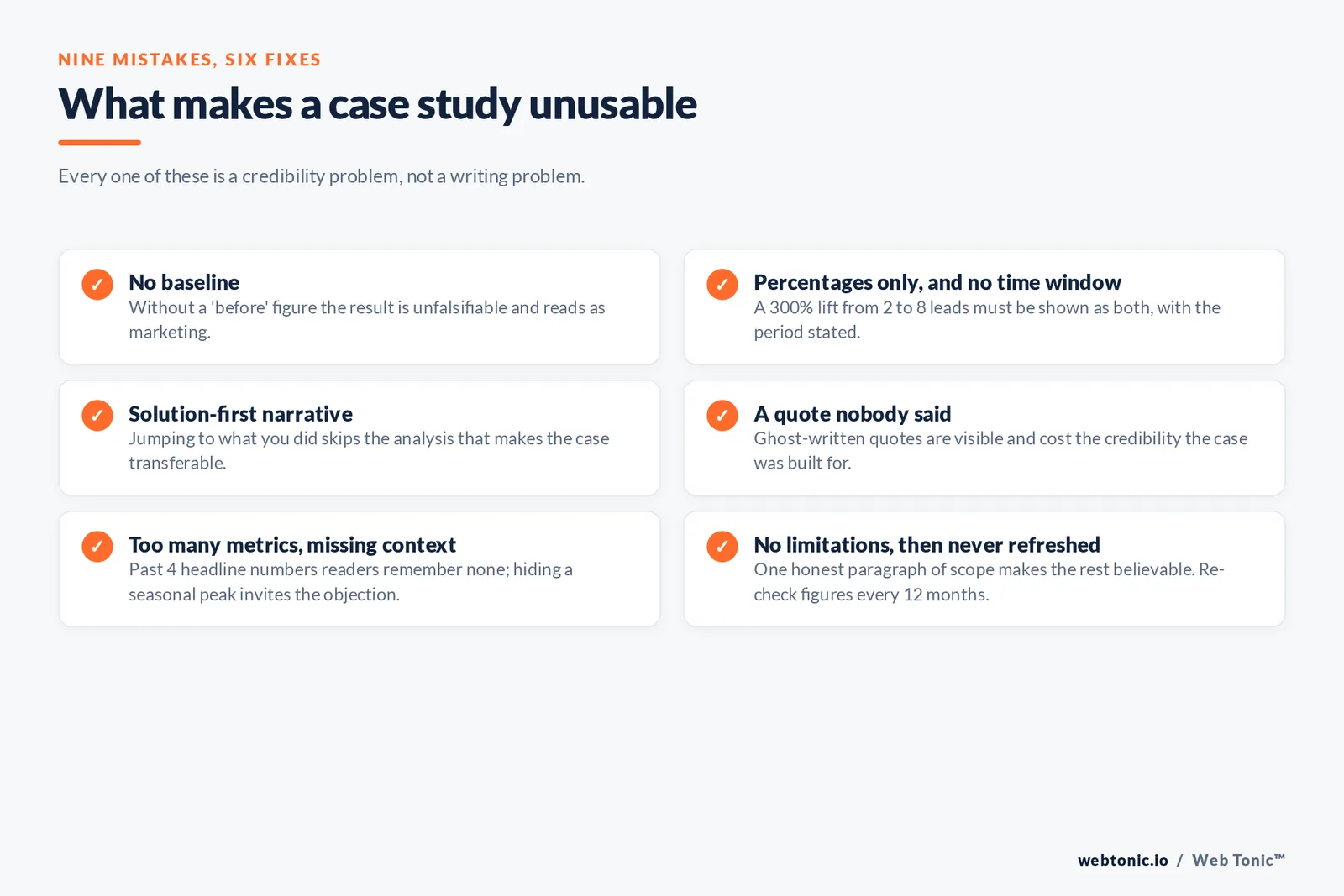
- Mistake 1 — No baseline. Without a "before" figure, the result is unfalsifiable and reads as marketing.
- Mistake 2 — Percentages only. A 300% lift from 2 to 8 leads is honest but must be shown as both.
- Mistake 3 — No time window. Results without a period cannot be compared to the reader's own situation.
- Mistake 4 — Solution-first narrative. Jumping to what you did skips the analysis that makes the case transferable.
- Mistake 5 — A quote nobody said. Ghost-written quotes are visible and cost you the credibility the case was built for.
- Mistake 6 — Too many metrics. More than 4 headline numbers and readers remember none.
- Mistake 7 — Missing context. Hiding a seasonal peak or a pricing change invites the objection you did not answer.
- Mistake 8 — No limitations. One paragraph of honest scope makes the rest more believable.
- Mistake 9 — Publishing once and forgetting it. Refresh figures every 12 months or mark the case with its date.
A published case study is also a distribution asset: repurpose it as a sales one-pager, a short video, a webinar segment and 3 social posts. Search-side, it can rank for "[service] case study" and competitor comparison queries, and it gives sales something concrete to send after a first call. We use the same source-of-truth discipline described in Demand Gen Report's research library: one verified dataset, many formats. If you would rather have the interview and the write-up handled for you, that is a conversation for our team, and more examples of this format live on the Web Tonic blog.
FAQ
How long should a case study be?
A business case study works best at 1,000 to 1,500 words, long enough to establish a baseline, method and result while staying skimmable. Academic case studies typically run 2,500 to 4,000 words because they must include a literature review and a method justification. Length is not the quality signal — the ratio is. If the results and analysis sections together are under 40% of the total, the case is too heavy on background.
What is the best structure for a case study?
Background, problem with a baseline number, analysis of why the problem existed, method in sequence, results with before-and-after figures and a time window, a direct quote, limitations, then a call to action. Academic versions add an abstract, a literature review and a formal method section. Put the outcome in the headline regardless of type, because most readers scan before they commit to reading.
How do I choose the right subject for a case study?
Choose for the argument, not for convenience. Pick a representative case if you want to show the typical result, an extreme case if you want to show what is possible, or a critical case if you want to test whether an approach holds under difficult conditions. For business case studies, add three practical filters: the client will approve publication, the numbers exist in a system you can audit, and the situation resembles that of your best-fit prospects.
Can a single case study prove that something works?
No, and claiming so weakens it. One case shows that an outcome is possible under specific conditions and explains the mechanism plausibly. That is genuinely useful evidence for a buyer and a legitimate research contribution, but it cannot establish causality on its own. Say what the case does not prove, then publish two or three more from adjacent situations — a small set of consistent cases is far more persuasive than one dramatic story.
How do I write a case study when the client will not be named?
Anonymise the identity but keep everything that makes the case verifiable: sector, company size, market, budget band, time window and the actual figures. Write "a 40-person B2B software company in the Midwest" instead of the name. Get written approval on the anonymised description and the metrics, and if absolute revenue is off limits, publish indexed figures or percentages with the absolute base range instead.
Sources: Scribbr methodology guide; IBM Think; Harvard Business Publishing Inspiring Minds; Corporate Finance Institute; Purdue OWL APA formatting guide; University of Wisconsin Writing Center handbook; UNC Writing Center; Nielsen Norman Group; MIT Sloan Management Review; Mind Tools; Google Trends; Demand Gen Report; Gallup customer engagement research.