Table of contents
Verification now happens two ways: a free legacy review for notable figures, and a paid Meta Verified subscription that starts around $11.99–$14.99 a month. Both end in the same blue check on your page.
This guide covers what the verified badge actually does, the eligibility criteria, how to submit a request step by step, why requests get denied, and what to do next if yours is.
Key Takeaways
- Meta Verified for individuals costs about $11.99 monthly on the web and $14.99 via iOS or Android in the US.
- Business tiers ladder up — roughly $21.99 to $499.99 monthly depending on the plan and team size.
- The free legacy path still exists and is judged on notability: press coverage in multiple independent outlets.
- You must be 18+, have a government ID matching your Instagram name, a photo of your face, and full-name and bio completeness.
- Reviews usually return within a week; some subscription approvals land within 48 hours.
- Audience size is not an official criterion — a 2,000-follower authentic business can qualify where a 200,000-follower meme page cannot.
- Sellers promising Instagram verification break Meta's terms and the fastest route to losing the account.
What the blue check on Instagram actually means
The Instagram verified badge is an authenticity marker, not a quality award. It tells people that the page they are looking at is the real presence of the person, brand or business it claims to be. It is not a statement that the page is important, popular or endorsed by Instagram.
That distinction matters commercially. It reduces impersonation risk, shortens the trust gap in DMs, and — in practice — lifts reply rates on outbound creator and partnership outreach. It does not, on its own, change how the ranking systems distribute your content. Meta has been explicit since the subscription launched that Meta Verified bundles impersonation protection, direct support and some visibility features, which is a different promise from "more reach". The original announcement is still on the Meta newsroom.
One nuance most guides skip: since the paid tier arrived, being verified is now ambiguous to viewers. It no longer proves notability, only identity. Audiences increasingly read the page itself — followers, content history, website — as the real credibility signal.
| What people believe | What is actually true |
|---|---|
| The badge boosts reach | No ranking boost is documented; some subscription features surface your account in search and recommendations |
| You need 10,000 people following you | No such minimum exists in the published criteria |
| Verification is permanent | A subscription blue check lapses when you cancel; legacy badges can be removed for name changes or violations |
| One application, ever | You can reapply after 30 days if a free application is declined |
| An expert agency can fast-track it | Reselling verified badges are a policy violation and risk account loss |
The two routes open to you
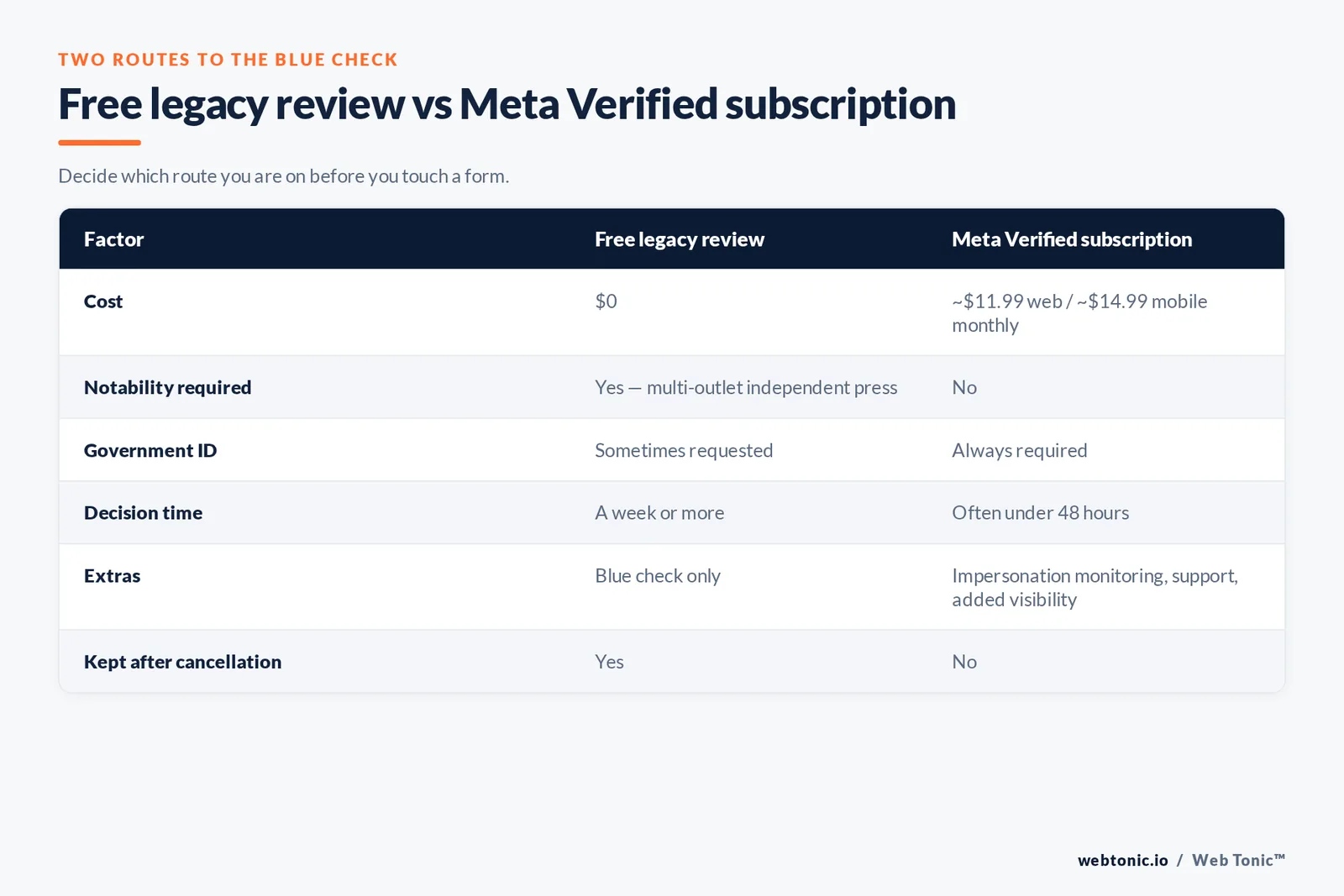
Decide which route you are on before you touch a form, because the criteria differ.
Route 1 — the free legacy review. Still available in-app. Judged on authenticity, uniqueness, completeness and notability. Notability is the wall: Meta wants you to be "well-known" and "highly searched for", evidenced by coverage in independent press. Paid or promotional articles do not count.
Route 2 — Meta Verified subscription. Pay monthly, submit a government ID, and get verified plus impersonation monitoring and account support. No notability test. This is the practical path for the overwhelming majority of businesses and creators, and coverage from Sprout Social and Socialinsider reaches the same conclusion.
| Factor | Free legacy review | Meta Verified subscription |
|---|---|---|
| Cost | $0 | ~$11.99 web / ~$14.99 mobile monthly |
| Notability required | Yes — multi-outlet press | No |
| Government ID | Sometimes requested | Always required |
| Decision time | A week or more | Often under 48 hours |
| Extras | Blue check only | Impersonation monitoring, account support, added visibility features |
| Kept after cancellation | Yes | No |
Eligibility: what you need before you apply
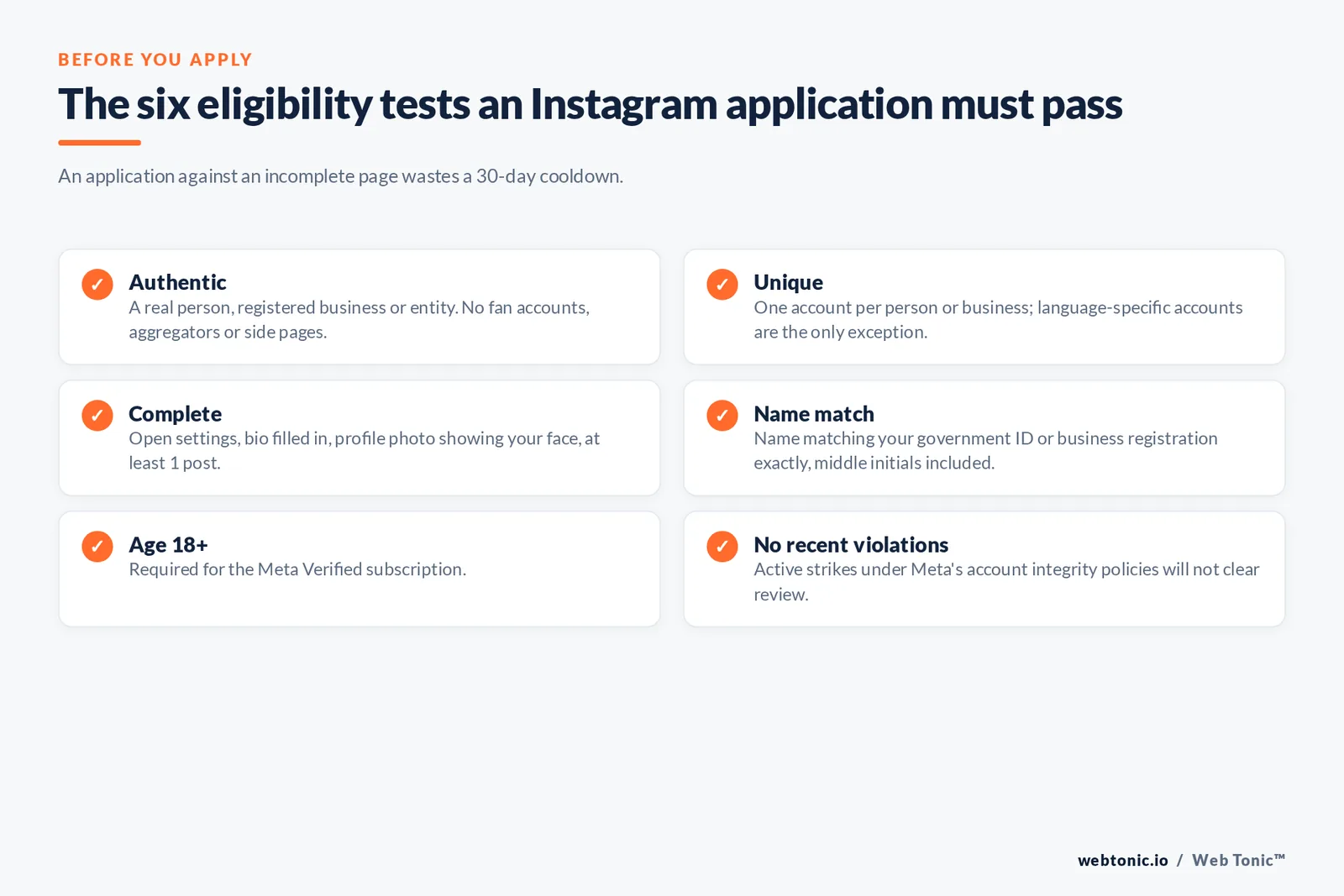
Get these in order first. An application submitted against an incomplete page is a wasted 30-day cooldown.
- Authentic — a real person, registered business or entity. No fan accounts, no aggregators, no pet-of-the-brand side pages.
- Unique — one account per person or business, with language-specific accounts the only exception.
- Complete — open settings, bio filled in, profile photo showing your face for personal accounts, and at least 1 post.
- Name match — name matching your government ID or business registration exactly, including middle initials if the ID has them.
- Age — 18 or older for the subscription.
- No recent violations — anyone with active strikes under Meta's account integrity policies will not clear review.
For the free route, add one more: a folder of 3–5 independent press links from the last 12 months. Coverage in outlets like BBC Technology or TechCrunch carries far more weight than trade blogs or press-release syndication.
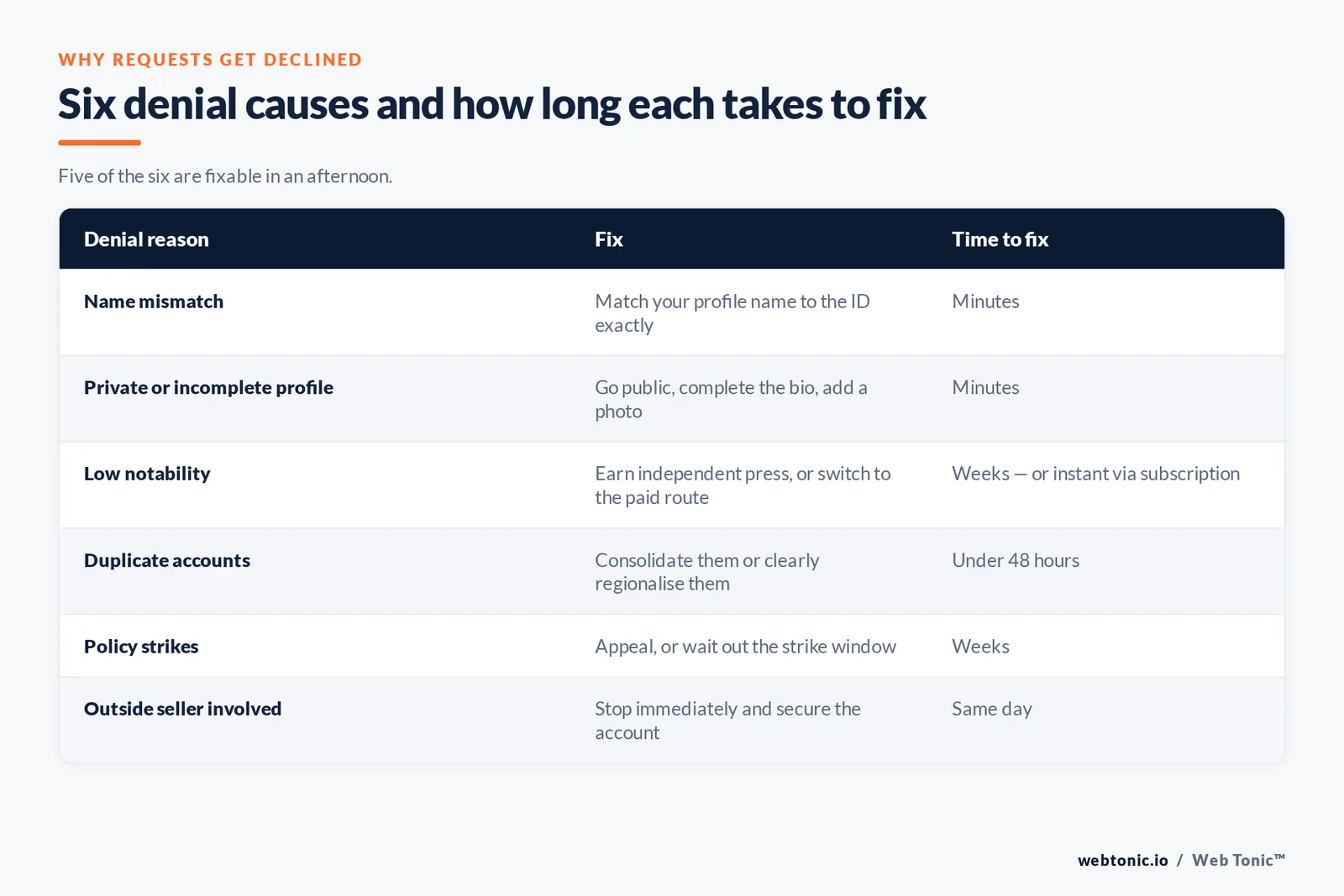
How to request verification, step by step
- Step 1 — clean up. Settings switched to open, a real photo, bio complete, website filled, recent posts. Do this before anything else.
- Step 2 — open Settings. Tap the hamburger menu on your page, then Settings and activity.
- Step 3 — find the right entry point. Tap Accounts Center → Meta Verified for the subscription, or Account type and tools → Request verification for the free legacy review.
- Step 4 — choose the page. If your Instagram and Facebook pages sit in the same Accounts Center, you can bundle both at a discount.
- Step 5 — submit your ID. A government-issued photo ID: passport, driving licence or national ID card. The name must match the Instagram name exactly.
- Step 6 — add supporting evidence (free route only). Category, country, other names you are known by, and press links.
- Step 7 — submit and wait. Decisions arrive as an in-app notification. Do not resubmit while one is pending; duplicates can slow the queue.
If your goal behind the badge is credibility that converts, it is one input among several — positioning, content consistency and paid distribution do more. That is the work we handle in growth marketing and performance creative.
Why applications get declined
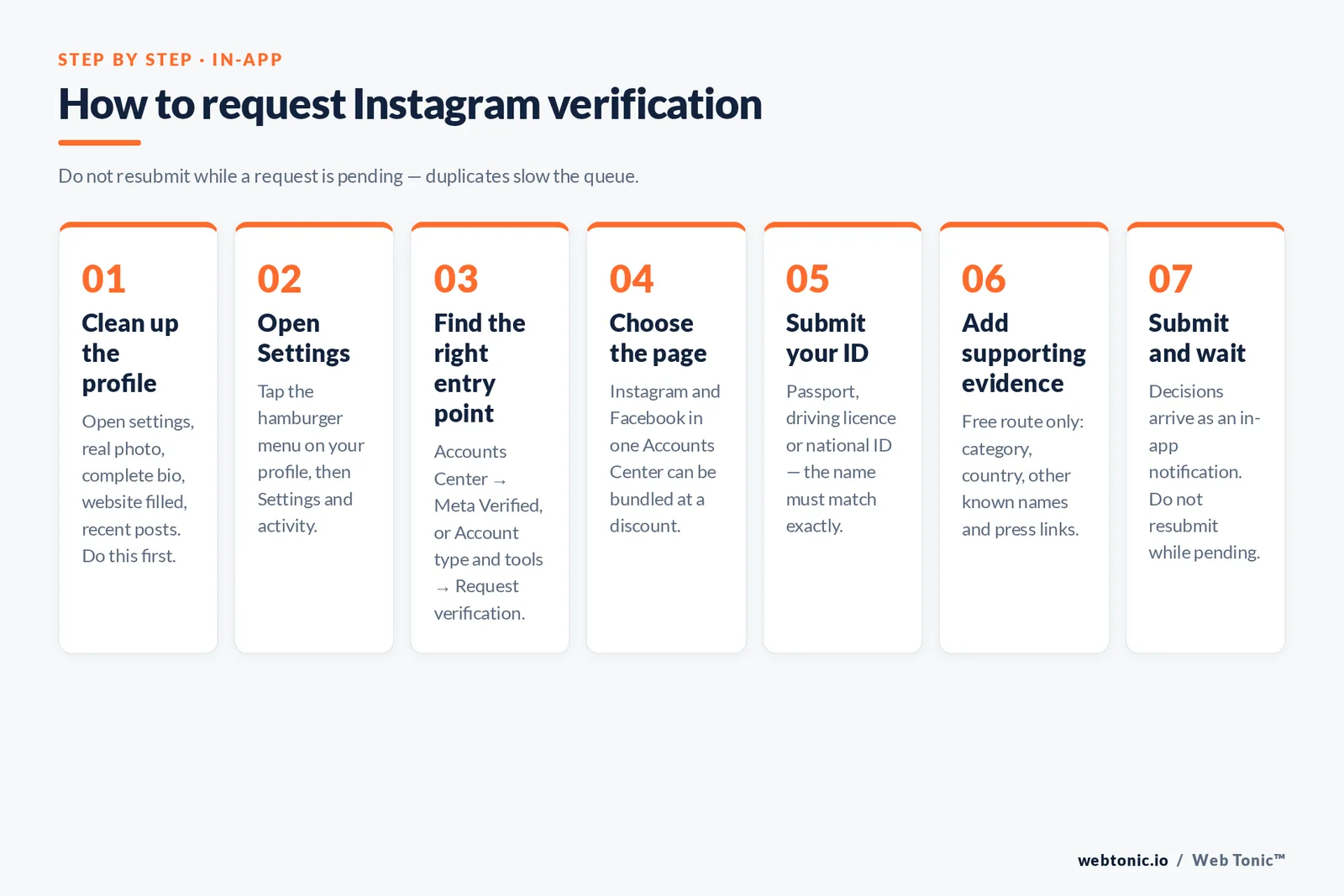
Declines cluster into six causes, and five of them are fixable in an afternoon.
Name mismatch is the single most common: the ID says one thing, your Instagram name says another. Private account or an incomplete bio triggers an automatic fail against the completeness test. Insufficient notability ends most free-route requests — you either have independent press or you do not. Duplicate presence, where two accounts represent the same entity, blocks the uniqueness test. Recent policy strikes stall the review outright. And an outside seller — anyone selling you one — can cost you the account, not just the request.
You can apply again after 30 days on the free route. Use the wait properly: publish consistently, earn one real piece of coverage, and align the name across your website, ID and profile. Trademark registration through the USPTO also strengthens a business entity's authenticity file.
| Denial reason | Fix | Time to fix |
|---|---|---|
| Name mismatch | Match your name to the ID exactly | Minutes |
| Private / incomplete profile | Go public, complete bio, add photo | Minutes |
| Low notability | Earn independent press, or switch to the paid route | Weeks — or instant via subscription |
| Duplicate accounts | Consolidate or clearly regionalise them | Under 48 hours |
| Policy strikes | Appeal or wait out the strike window | Weeks |
| Outside seller involved | Stop immediately; secure the account | Same day |
Who the badge is recommended for
Three groups get real, measurable value here, and one group is simply buying reassurance.
Public figures and experts — consultants, doctors, coaches — gain the most, because their reputation is the product and impersonation directly costs them work. Brands with employees posting publicly benefit next: when an expert on your team is verified, partners and journalists researching the company find a coherent, trustworthy set of pages rather than a guessing game. Local businesses selling in DMs come third; it measurably lifts reply rates because those messaging strangers want proof they are messaging the right business.
The fourth group — occasional posters with no commercial funnel — is paying for a status marker. That is a legitimate choice, but it is not a growth tactic. If your goal is wider discovery, the same monthly spend is best deployed against media distribution.
| Who you are | Is being verified recommended? | Why |
|---|---|---|
| Expert or public figure | Yes — high value | Reputation is the asset; impersonation costs real work |
| Brand with featured employees | Yes | Partners and press researching your name find one clear set of pages |
| Business selling in DMs | Yes | Verified pages lift reply rates from cold prospects |
| Creator chasing brand deals | Usually | Simple credibility signal in pitch emails and media kits |
| Occasional poster | No | No reach benefit; the money works harder as distribution |
A note on the standards Instagram applies for what counts as authentic: the entity in the ID and the entity in the bio must be the same, and the content history should support the claim. An expert in fitness who has been posting three years of training content passes that test in seconds. A new page with two posts does not, whichever of the two ways you apply.
Is it worth the money?
Run the arithmetic rather than the vibe. At roughly $14.99 a month, the subscription costs about $180 per year for an individual profile. It is clearly worth it if you are impersonated (the monitoring and priority help are the real product), if you sell through DMs, or if you pitch partnerships where an unverified handle costs you replies on outreach.
It is weak value if you post occasionally, sell nowhere near the platform, or expect reach. $180 deployed as Instagram ad spend buys roughly 15,000–25,000 impressions at a $7–$12 CPM, which is a more direct purchase of attention. Audience-composition context from Statista's Instagram dossier and platform usage data in Pew Research's social media fact sheet help size whether your audience is even here.
For creators monetising through brand deals, note that a paid partnership still needs disclosure under FTC influencer guidance — being verified is not a disclosure. And if brand impersonation is your core worry, the identity registration path documented by the US Copyright Office supports takedowns the check alone will not.
What to do in the 30 days before you reapply
Treat it as a short campaign; the work is simple and the timing matters more than the effort. Week 1: fix name, bio, profile photo, website link. Week 2: publish 4–5 posts that establish a clear, single subject so your page reads as one coherent subject. Week 3: set aside two hours for researching journalists and podcasts in your niche, then pitch them — one placement in an independent outlet changes the notability picture more than 10,000 new followers. Week 4: resubmit, or subscribe and move on. Either way, the presence you end up with is stronger than the one that got declined, which is the actual return on the exercise. Posting consistently through those four weeks is the single best use of the time. More practical playbooks sit on the Web Tonic blog, and you can talk to us if you want the press angle built properly.
Frequently Asked Questions
How many followers do you need to be verified?
There is no published minimum. Meta's criteria are authenticity, uniqueness, completeness and — for the free route — notability. Creators with a few thousand people following them get verified regularly, and much larger pages get declined regularly.
How long does the review take?
Meta Verified subscription decisions often land within 48 hours, sometimes the same day. Free legacy reviews typically return within a week, though longer is common. If a free application is declined, you can apply again after 30 days.
Can you still get verified on Instagram for free?
Yes. The legacy request flow still exists under Account type and tools, and it costs nothing. The bar is notability: you need to be a well-known, highly searched person or entity with coverage in multiple independent news outlets.
Does the verified badge disappear if I cancel Meta Verified?
Yes. A subscription blue check is tied to an active subscription and is removed once the subscription lapses. Legacy badges earned through the free notability review remain unless you change your account name or breach policy.
Are services that sell verification legitimate?
No. Meta does not sell verification through resellers or agencies, and paying outside sellers violates Meta's terms. The realistic outcomes are wasted money, a compromised login, or permanent loss of access.
Sources: Meta newsroom (Meta Verified announcement) · Instagram · Sprout Social Instagram verification guide · Socialinsider Instagram verification analysis · Statista Instagram dossier · Pew Research social media fact sheet · TechCrunch Instagram coverage · BBC Technology · USPTO trademarks · US Copyright Office · FTC influencer disclosure guidance. Pricing checked July 2026; Meta Verified rates vary by country and platform.