Table of contents
Reactions on short-form video follow watch time. The fastest way to get more of them is not posting more often — it is making the first two seconds worth staying for, then giving viewers a reason to react. Engagement by view now averages 4.20%, up 9% year on year, even as average views fall.
Key Takeaways
- Reactions grew 9% year on year across page sizes, while average reach dropped 23% — reach is harder, but reactions per view are up.
- Engagement rate by view sits near 4.20%, so a video with 10,000 impressions should reasonably produce around 400 reactions.
- Brands increased posting frequency 40% in a year, and follower growth still fell 33% — volume alone no longer buys engagement.
- Sends climbed 13% overall and 44% for accounts above 100K followers; shareable ideas out-earn merely pleasant ones.
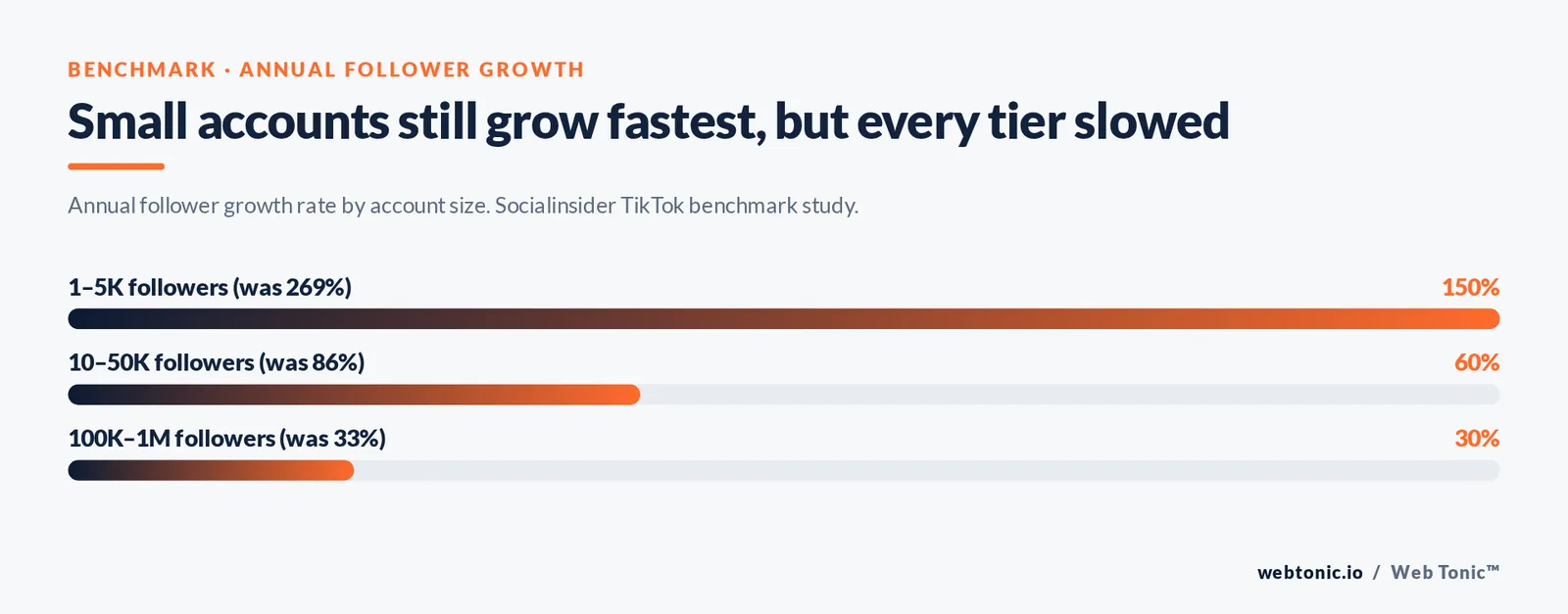
- Follower growth for small accounts fell from 269% to 150% annually — still the fastest-growing tier on the platform.
- Third-party engagement-boosting services breach the platform's terms, and removed engagement plus a suppressed account is the normal outcome.
How the platform decides who sees your clip
The For You feed is a recommendation system, not a follower feed. The system ranks each upload against signals it gathers in the first minutes after posting: how long people watched, whether they rewatched, whether they liked, commented, shared or followed, plus metadata signals such as captions, sounds and hashtags. TikTok's own explanation of how the For You feed works is explicit that audience size is not a direct ranking factor.
That single fact is why a brand-new account can out-perform an established page. It also reframes the goal: you are not asking the app for likes, you are producing watch time that the app rewards with distribution, which then produces likes. Buffer's breakdown of the TikTok algorithm reaches the same conclusion — completion and rewatch behaviour do the heavy lifting.
Three practical consequences follow. First, a clip that holds 60% of viewers to the end will nearly always beat a better-produced one that loses half its audience in 3 seconds. Second, reactions arrive disproportionately in the final third of a watch, so shortening a clip often raises its tally. Third, a weak upload posted from a strong page still underperforms, which is why chasing followers before fixing content is the wrong order of operations.
What normal engagement actually looks like
Before you judge your own results, calibrate against platform data. The figures below come from Socialinsider's TikTok benchmark study, which analysed engagement across account sizes.
| Metric | Latest figure | Change | What it means for likes |
|---|---|---|---|
| Engagement rate by view | 4.20% | +9% YoY | Reactions per impression are rising platform-wide |
| Recent quarterly engagement | 3.85% | −8% QoQ | Expect quarter-to-quarter noise, not a trend |
| Likes | Up across all tiers | +9% | The easiest reaction to earn |
| Comments | Up overall | +3% (+11% for 100K+) | Comment prompts still work, at smaller scale |
| Shares | Fastest-growing action | +13% (+44% for 100K+) | Shareable ideas import new audiences |
| Average reach | Declining | −23% YoY | Flat reactions on falling reach is progress |
| Posting frequency (brands) | Higher | +40% | The feed is more crowded than last year |
| Follower growth, 1–5K accounts | 150% annually | Down from 269% | Small accounts still grow fastest |
| Follower growth, 10–50K accounts | 60% annually | Down from 86% | Mid-tier growth requires niche focus |
| Follower growth, 100K–1M accounts | 30% annually | Down from 33% | Large accounts convert reach, not novelty |
Two context points make those numbers usable. The user base is enormous — Sprout Social's platform statistics and DataReportal's global digital report both put usage in the billions of monthly actives, while Pew Research's social media fact sheet shows how concentrated adoption is among younger US adults. So the audience is not the constraint. Attention is.
Twelve no-cost ways to earn more reactions
Every tactic below is free and organic. They are ordered by how quickly they usually show up in your analytics.
| Tactic | Effort | Why it earns likes |
|---|---|---|
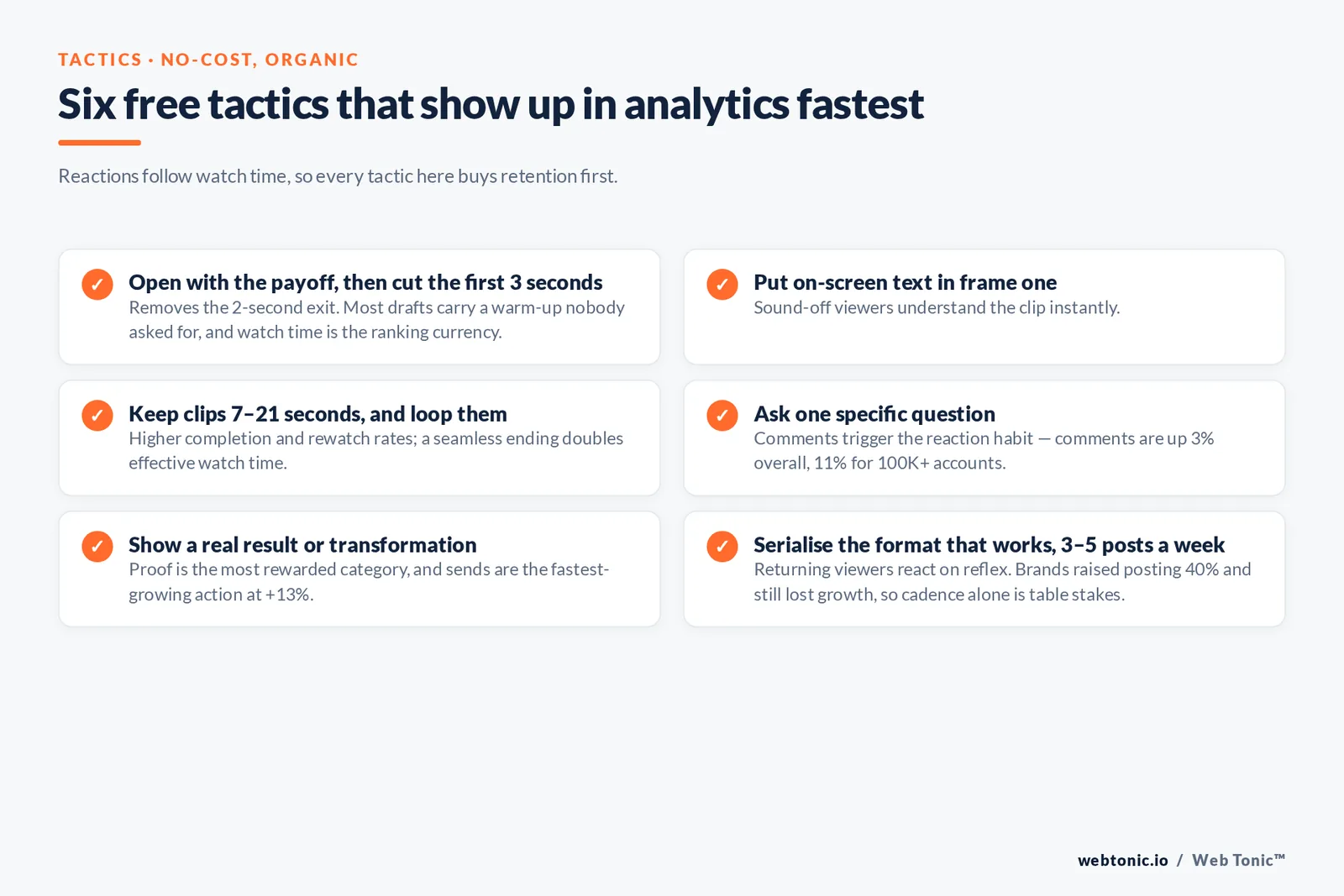
| 1. Open with the payoff | Low | Removes the 2-second exit; watch time is the ranking currency |
| 2. Cut the first 3 seconds | Low | Most drafts have a warm-up nobody asked for |
| 3. Add on-screen text in frame one | Low | Sound-off viewers understand instantly |
| 4. Keep clips 7–21 seconds | Low | Higher completion and rewatch rates |
| 5. Post a loop | Medium | Seamless endings double effective watch time |
| 6. Use one trending sound per week | Low | Sound-based discovery adds a second surface |
| 7. Ask one specific question | Low | Comments trigger the reaction habit |
| 8. Reply to comments with video | Medium | Creates new posts with built-in demand |
| 9. Serialise a format | Medium | Returning viewers react on reflex |
| 10. Show a real result or transformation | Medium | Proof is the most rewarded category |
| 11. Collaborate with 2–3 similar creators | High | Borrowed audiences convert quickly |
| 12. Post 3–5 times per week, consistently | High | More entries in the recommendation lottery |
The platform's own creating-videos help centre covers the mechanics of each editing feature referenced above, and the Creator Academy is the primary source for format guidance. Note tactic 12 carefully: posting frequency across brands rose 40% while growth fell, so cadence is table stakes rather than an advantage.
Ten hooks that reliably hold viewers
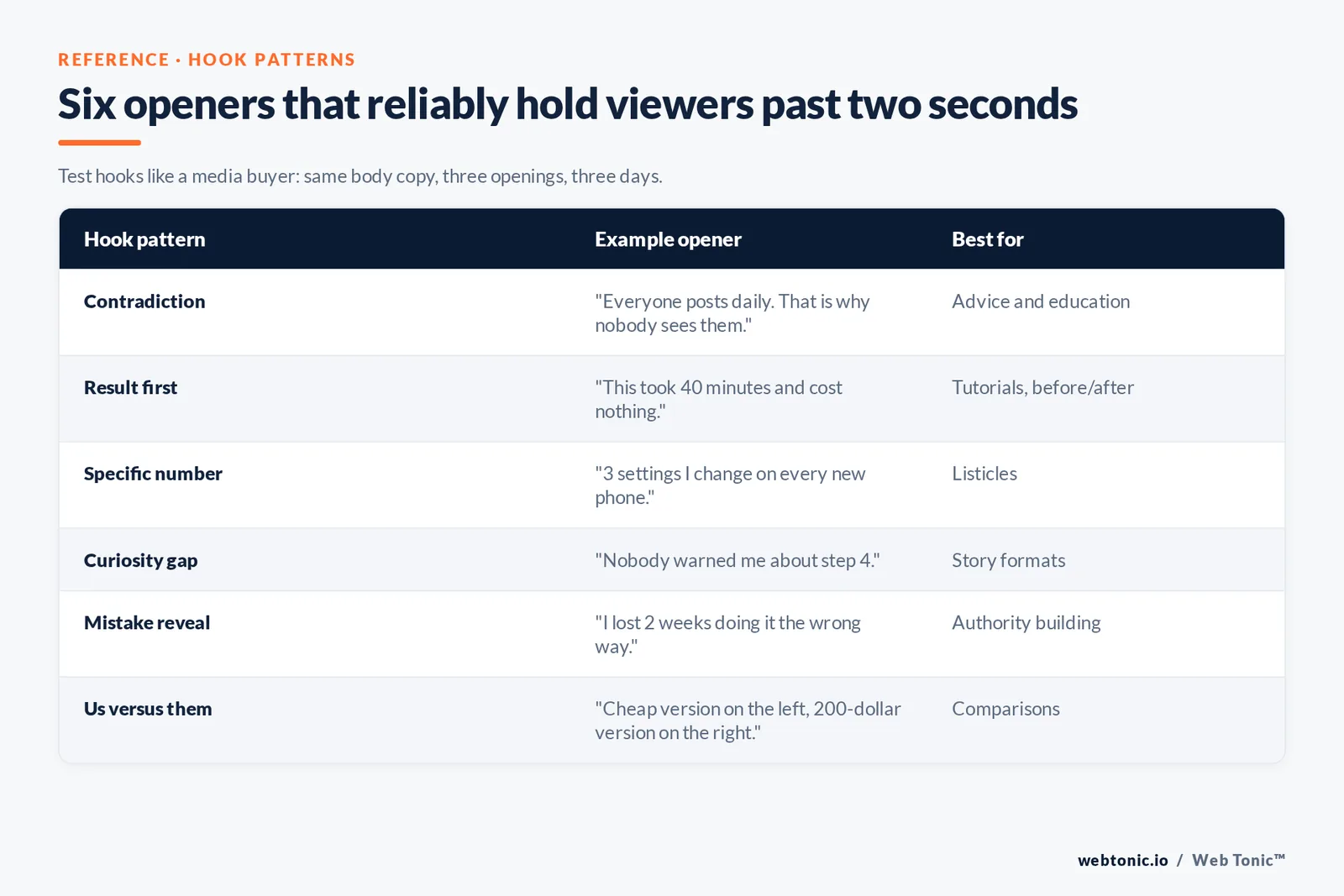
The hook is the highest-leverage 2 seconds in short-form. These patterns are platform-agnostic but tuned to a fast feed.
| Hook pattern | Example opener | Best for |
|---|---|---|
| Contradiction | "Everyone posts daily. That is why nobody sees them." | Advice and education |
| Result first | "This took 40 minutes and cost nothing." | Tutorials, before/after |
| Specific number | "3 settings I change on every new phone." | Listicles |
| Direct callout | "If you run a small shop, stop doing this." | Niche audiences |
| Curiosity gap | "Nobody warned me about step 4." | Story formats |
| Mistake reveal | "I lost 2 weeks doing it the wrong way." | Authority building |
| Visual shock | Silent, dramatic first frame with text overlay | Products, crafts, food |
| Question to camera | "Would you pay 30 dollars for this?" | Comment-driven reach |
| Us versus them | "Cheap version on the left, 200-dollar version on the right." | Comparisons |
| Time pressure | "You have 15 seconds to fix your profile." | Tips and checklists |
Test hooks the way a media buyer tests creative: same body copy, 3 different openings, posted across 3 days. This is standard practice in performance creative work, and it applies identically to organic short-form.
When to post, and how much it really matters
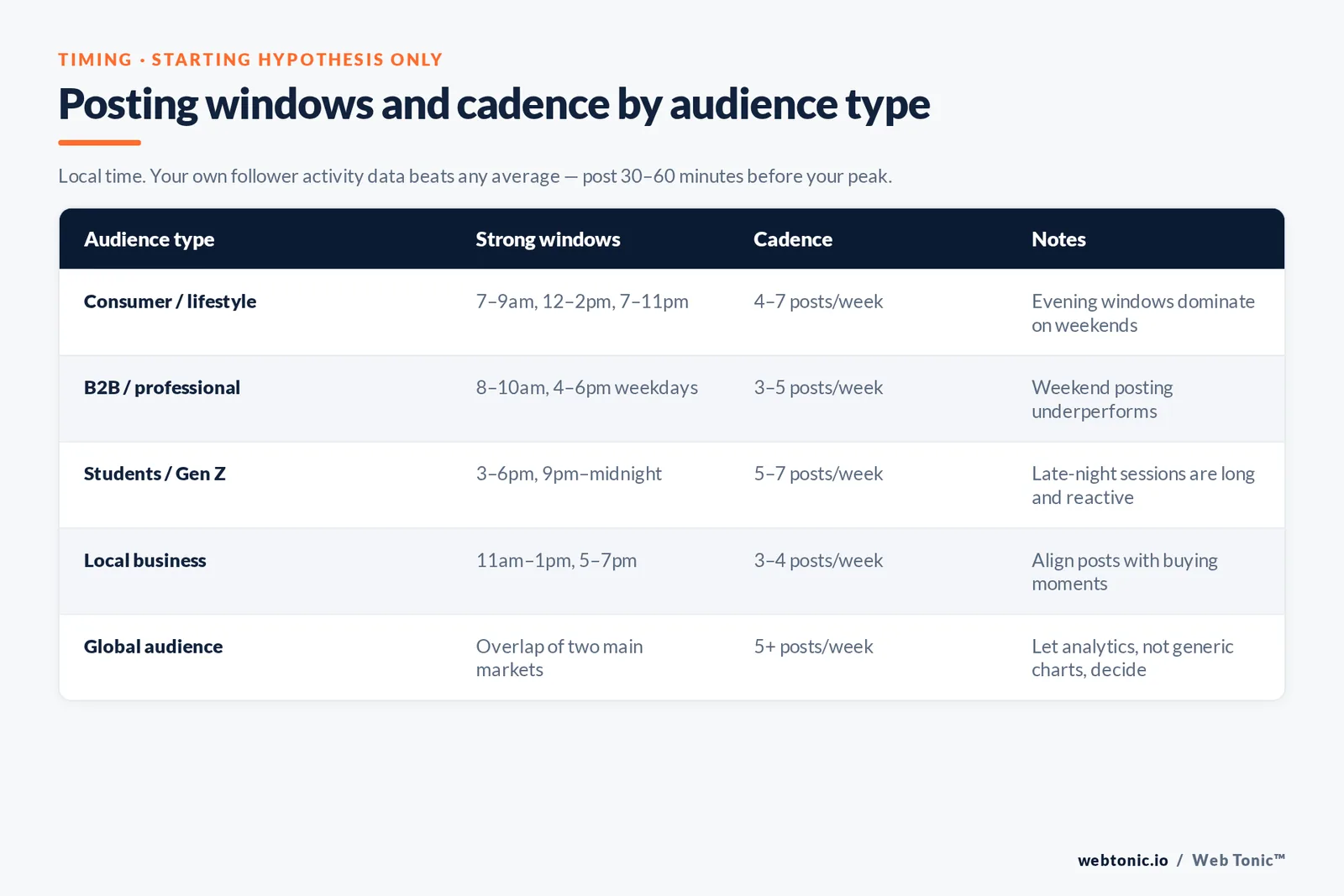
Timing is a modest lever compared with content quality, but it is free. Because the system tests a new upload with a small audience first, posting when your specific audience is active improves that early sample.
| Audience type | Strong windows (local time) | Cadence | Notes |
|---|---|---|---|
| Consumer / lifestyle | 7–9am, 12–2pm, 7–11pm | 4–7 posts/week | Evening windows dominate on weekends |
| B2B / professional | 8–10am, 4–6pm weekdays | 3–5 posts/week | Weekend posting underperforms |
| Students / Gen Z | 3–6pm, 9pm–midnight | 5–7 posts/week | Late-night sessions are long and reactive |
| Local business | 11am–1pm, 5–7pm | 3–4 posts/week | Align posts with buying moments |
| Global audience | Overlap of two main markets | 5+ posts/week | Let analytics, not generic charts, decide |
Treat the table as a starting hypothesis only. Sprout Social's best-times research aggregates millions of posts, but your own follower activity data beats any average. Check it in the TikTok analytics dashboard under follower activity, then post 30 to 60 minutes before the peak.
Do Promote and paid ads actually earn reactions?
Yes — but they buy different things, and neither fixes weak content. Promote turns an existing organic post into a simple ad from inside the app; the Promote documentation lists the objectives available, including more video views, more profile visits and more website visits.
Rule 1 — Only promote a proven post. If a clip underperforms organically, paid distribution buys a bigger sample of the same rejection.
Rule 2 — Expect reach first, reactions second. Paid impressions convert at a lower rate than organic ones because intent is weaker.
Rule 3 — Use a small budget as a research tool. A 5 to 20 dollar test on 3 posts tells you which hook deserves a full campaign.
Rule 4 — Do not promote to buy credibility. A post with 100,000 paid impressions and 200 reactions reads worse than one with 4,000 organic impressions and 300.
Rule 5 — Disclose paid partnerships. If a creator is compensated, disclosure is required; the FTC's guidance for social media influencers is the reference standard in the US.
For brands running both organic and paid short-form, the two should share one creative pipeline rather than two calendars — the same principle we apply in growth marketing engagements.
Why engagement-boosting services are a bad trade
Search results on this topic are full of apps and websites promising instant followers and reactions, usually in exchange for your login or an in-app purchase. Three reasons to avoid them.
Risk 1 — Terms of service. Artificial engagement violates the platform's community rules; removed engagement and reduced distribution are standard consequences, and enforcement reporting is published through the newsroom.
Risk 2 — Account security. Handing credentials to an unaffiliated app is the most common way accounts are lost. None of these services are endorsed by or affiliated with the platform, whatever their store listing implies.
Risk 3 — Broken measurement. Inflated counts with no watch time teach the recommendation system that your posts attract low-quality engagement, and destroys the analytics you need to improve.
The legitimate equivalent of an engagement shortcut is a repeatable format: once one video type works, produce 10 more of it before inventing something new. If you want that system built for a brand rather than a personal account, that is the work behind our social and creative services.
The five numbers to watch in your analytics
| Metric | Where it lives | Healthy signal | What to change if it is weak |
|---|---|---|---|
| Average watch time | Per post | Rising across your last 10 posts | Shorten it and rewrite the hook |
| Watched in full | Per video | Above 40% on short posts | Cut the middle section, add a loop |
| Engagement rate by view | Calculated | Near or above 4.20% | Add a clear reaction prompt |
| Traffic source: For You | Per video | Majority of reach | Improve early retention, not hashtags |
| New followers per post | Account overview | Consistent, not spiky | Serialise your best-performing format |
Review these weekly, not daily. A single post's performance is noise; 10 of them is a signal. And remember that a 23% decline in average reach is a platform-wide trend — holding your reaction count steady this year is a genuine improvement, not a plateau.
Five mistakes that cost people engagement
Mistake 1 — Reposting watermarked content. Recycled clips from other networks get less distribution and read as low effort.
Mistake 2 — Stacking 20 hashtags. Hashtags are a weak signal compared with retention; 3 to 5 relevant ones is enough.
Mistake 3 — Deleting posts too fast. Old uploads can resurface days or weeks later; deleting after 24 hours kills that upside.
Mistake 4 — Changing niche every week. The system needs consistency to learn who to show you to.
Mistake 5 — Ignoring the profile. A clear bio, a readable name and 3 pinned highlights convert viewers into followers who react to everything you post next.
FAQ
How can I get more likes on TikTok without paying?
Focus entirely on early retention: open with the payoff, add on-screen text in the first frame, keep clips short enough to be rewatched, and end with a specific reaction prompt. Post three to five times a week and serialise whichever format performs best. Because ranking is driven by watch time rather than audience size, this works on brand-new accounts.
What is a good engagement rate on TikTok?
Engagement by view averages around 4.20%, so roughly 400 reactions per 10,000 impressions is normal. Smaller accounts often exceed that because their audiences are more concentrated. Compare your own trend across ten posts rather than judging a single post against a platform average.
Does TikTok Promote really increase likes?
Promote reliably increases reach, and reactions follow at a lower rate than organic distribution because the audience is less self-selected. It works best as amplification for a post that already performed well organically, and as a cheap way to test which hook deserves a full ad campaign. It cannot rescue content that failed organically.
Are apps that promise free TikTok likes safe?
No. They breach TikTok's platform rules, frequently ask for login credentials, and the engagement they deliver is typically removed. The lasting damage is to measurement, because artificial likes with no watch time distort the data you need to improve real performance.
How many followers do I need to get lots of likes?
Follower count is not a direct ranking factor in the For You feed, so a post from a small page can reach a large audience. Followers matter for compounding: they give each new post a reliable early audience. Build them as a result of consistent content, not as a prerequisite.
What kind of content gets the most likes?
Content that shows a real result, reveals a mistake, or resolves a curiosity gap quickly. Sends are the fastest-growing action, up 13% overall, so posts worth forwarding to a friend tend to accumulate the most likes over time.
Sources: TikTok Support (For You feed, creating videos, analytics); TikTok Creator Academy; TikTok Newsroom; TikTok Ads Help (Promote); Socialinsider TikTok benchmarks; Sprout Social TikTok statistics and best-times research; Buffer; DataReportal Digital 2026; Pew Research Center; US Federal Trade Commission.