Table of contents
TikTok's own commissioned research found 70% of surveyed EU5 users had booked a trip or experience after seeing travel content on the platform, and a disclosed hostel-brand campaign reported reaching 1.6 million new users on a EUR 35,000 budget. Both numbers are real and both need context before a media buyer sets a budget against them - this page supplies that context.
Key Takeaways
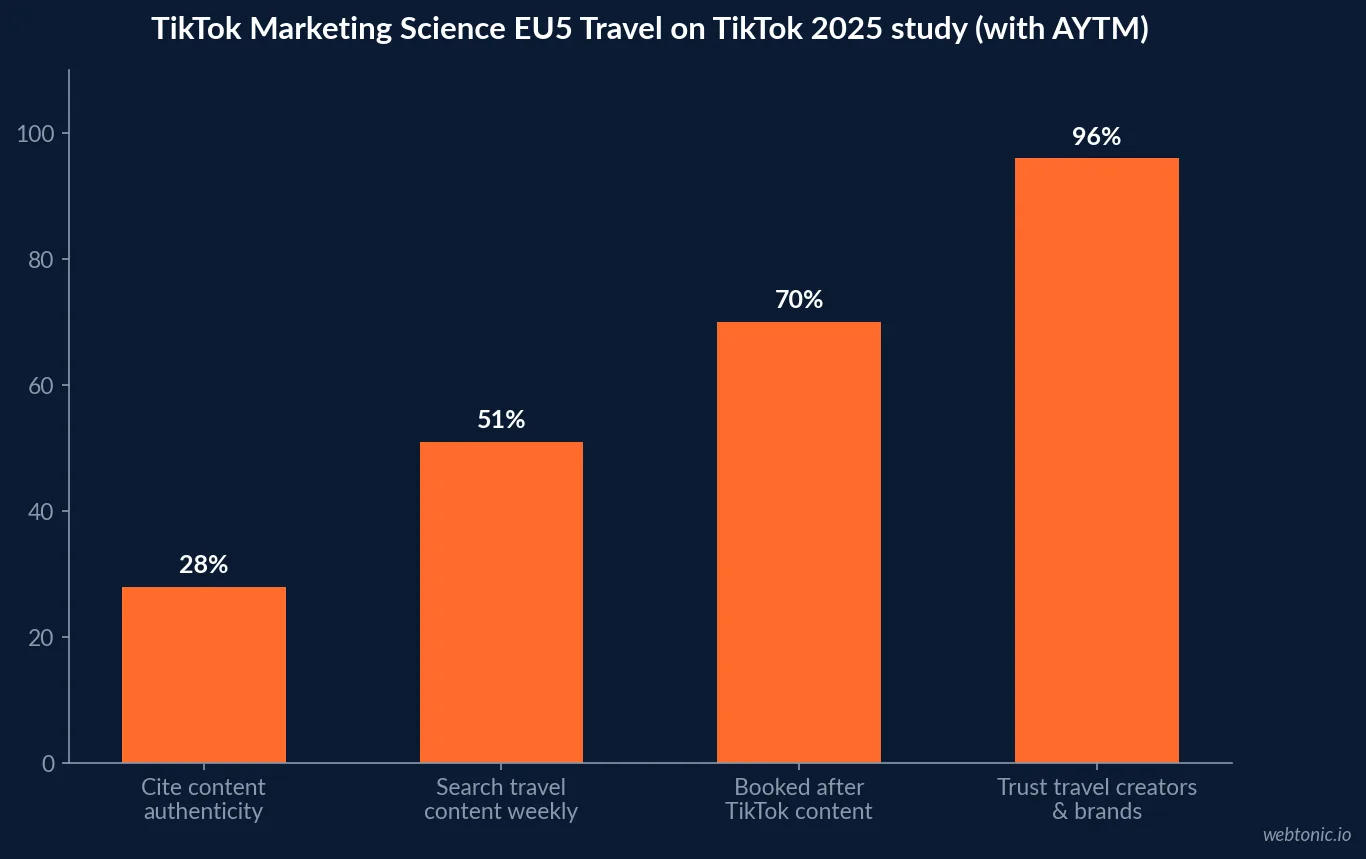
- 70% of surveyed users booked a trip or experience after TikTok content (TikTok Marketing Science EU5 Travel on TikTok 2025, with AYTM).
- 54% of those bookings happened in the past 12 months.
- 59% of UK users who book after TikTok discovery do so within one week.
- 51% of users search travel content on TikTok at least weekly.
- Three in four travelers use TikTok as a search engine to plan itineraries.
- 96% of users say they trust travel creators and brands active on the platform.
- 28% cite content authenticity as their specific reason for booking.
- A disclosed hostel campaign spent just EUR 35,000 on TikTok and won a TikTok Award for it (a&o Hostels, 2025).
- That campaign generated 30 million impressions and 1.6 million first-time users.
- Direct website traffic rose 10% in the same campaign window, with trade press citing roughly USD 705,000 in resulting revenue.
- The good engagement-rate target for travel brands on TikTok is 3.0% to 3.5% (Dash Social, sample of 1,361 accounts).
- Reach for travel brands on TikTok rose 14% year over year while raw views stayed flat.
- 62% of global travelers are now familiar with AI trip-planning tools, a related discovery-behavior shift (Skift State of Travel 2026).
- TikTok's own booking feature, TikTok Go, routes transactions to OTA partners rather than processing them natively, launched in 2026.
What TikTok's own research actually measured
The headline figure - 70% of users booking after TikTok content - comes from the TikTok Marketing Science EU5 Travel on TikTok 2025 study, published on TikTok for Business's own channel and run with the research firm AYTM. It is a vendor-commissioned survey of TikTok's own user base, not an independently audited attribution study, and media buyers should read it the way they would any platform's self-reported research: directionally true, favorably framed. The behavioral detail underneath the headline is what makes it useful for planning - 51% of users search travel content weekly, three in four use the app as a planning search engine, and 96% say they trust the creators and brands they see there.
| TikTok EU5 Travel on TikTok 2025 metric | Figure | Planning implication |
|---|---|---|
| Users who booked after TikTok content | 70% | Attribute discovery-stage budget, not last-click credit |
| Of those, booked in the past 12 months | 54% | Recency suggests an active, not historical, effect |
| Users searching travel content weekly | 51% | Sustained always-on presence beats one-off bursts |
| Users treating TikTok as a planning search engine | ~75% | SEO-style keyword and hashtag targeting applies |
| Users who trust travel creators/brands on the platform | 96% | Creator partnerships outperform brand-only ads |
| Users citing authenticity as the booking reason | 28% | Native-feeling Spark Ads beat polished pre-roll |
The one campaign with real disclosed cost numbers
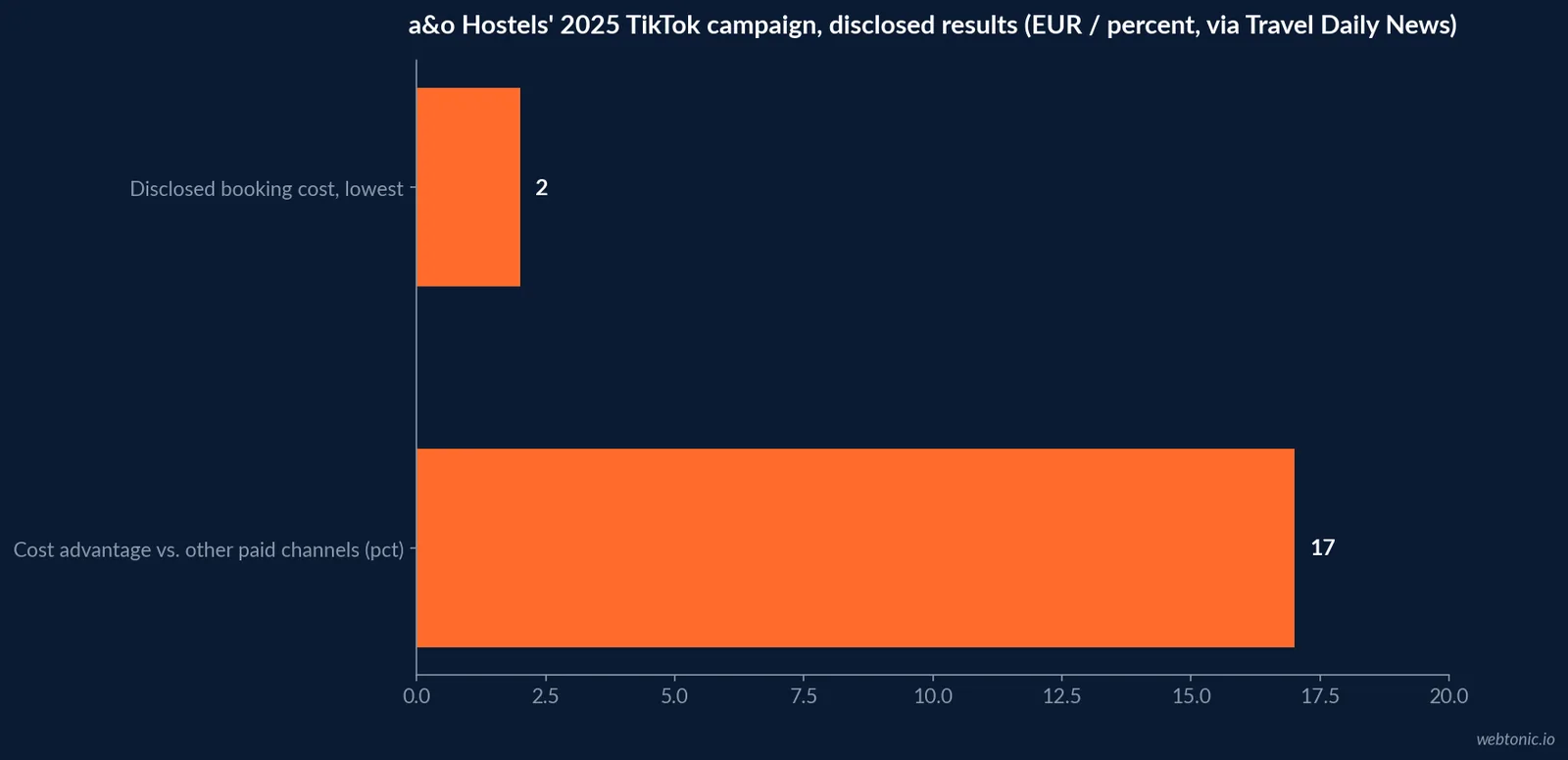
Most "TikTok drove bookings" case studies in hospitality do not publish a cost per acquisition. The exception, confirmed in a&o Hostels' own TikTok Award press release, is the 2025 "Where to Go" campaign, which combined short-form, creator-led content with Spark Ads amplification and TikTok's Travel Feed. Disclosed results: a EUR 35,000 budget, 30 million impressions, a 10% increase in direct website traffic, and roughly 1.6 million first-time users reached who had not previously engaged with the brand. Trade coverage of the same campaign puts resulting revenue at roughly USD 705,000 against a spend just over USD 40,000 - a striking ratio, but from one brand's single seasonal push, not an industry average.
Use this as a plausible best-case reference point for a discovery-stage test budget, not as a guaranteed CPA to underwrite a media plan against.
| a&o Hostels 'Where to Go' campaign (2025, disclosed) | Result | Source |
|---|---|---|
| Campaign media budget | EUR 35,000 | a&o Hostels TikTok Award press release |
| Impressions generated | 30 million | a&o Hostels TikTok Award press release |
| First-time users reached | ~1.6 million | a&o Hostels TikTok Award press release |
| Increase in direct website traffic | 10% | a&o Hostels TikTok Award press release |
| Revenue attributed by trade press | ~USD 705,000 | Trade coverage (Travel And Tour World) |
How TikTok ad spend fits inside the wider paid-social budget
TikTok Travel Ads do not get bought in isolation, and it helps to size them against the paid-social pool they compete with. The 2026 IAB Digital Video Ad Spend and Strategy Report found US social video ad spend (which includes short-form platforms) growing 13% in 2026 and overtaking connected-TV spend for the first time - a cross-industry figure, not a travel one, but evidence that short-form video inventory is getting more competitive and more expensive to win attention on generally, TikTok included. On the direct-comparison side, LocaliQ/WordStream's 2026 benchmark data put travel's Facebook traffic-campaign cost per click at USD 0.42, the second-cheapest of any tracked industry - useful as the nearest apples-to-apples paid-social comparison point since TikTok itself does not publish industry-level CPC benchmarks.
| Paid-social context for a TikTok budget decision (2026) | Figure | Source |
|---|---|---|
| US social video ad spend growth (cross-industry) | +13% YoY | IAB 2026 Digital Video Ad Spend Report |
| Social video overtaking CTV spend for the first time | 2026 | IAB |
| Travel's Facebook traffic-campaign cost per click (nearest comparable) | USD 0.42 | LocaliQ/WordStream 2026 |
What a good creative result looks like before you spend on ads
Paid distribution amplifies whatever the organic content is already doing, and Dash Social's 2026 Travel and Hospitality Industry Benchmark report, built from a sample of 1,361 travel and hospitality TikTok accounts, gives media buyers a creative bar to clear: a good engagement rate for the vertical runs 3.0% to 3.5%, and reach rose 14% year over year even though raw video views held flat - meaning the platform is surfacing travel content to more new people per view, not just rewarding volume. Ads built from content that is already clearing that engagement band will generally outperform a brand-only asset dropped straight into paid.
| TikTok organic benchmark for travel/hospitality (Dash Social, 2026, n=1,361 accounts) | Figure |
|---|---|
| Good engagement-rate target | 3.0%-3.5% |
| Year-over-year reach growth | +14% |
| Year-over-year raw video view growth | Flat |
Where TikTok fits, and does not, in the booking funnel
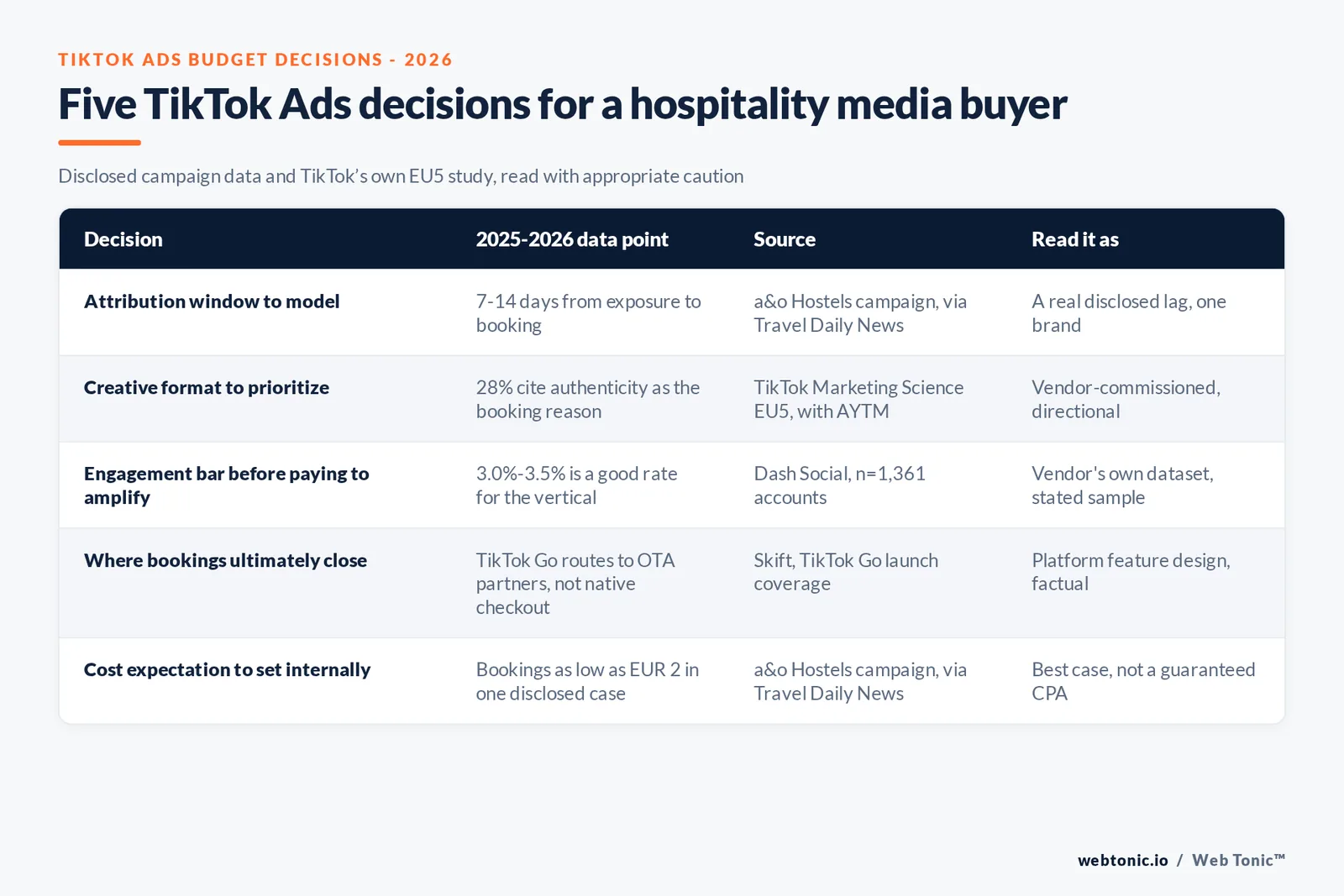
The honest framing, echoed by Skift's own review of the category and PhocusWire's funnel analysis, is that TikTok is compressing the inspiration and research stages of travel planning without yet replacing the booking stage. TikTok's own TikTok Go feature, launched in 2026, makes this explicit: it lets users compare rates and book through partner OTAs (Booking.com, Expedia, Viator, GetYourGuide, Tiqets and Trip.com) rather than processing the transaction natively inside the app. For a media buyer, that means TikTok Travel Ads should be planned and measured as a top-of-funnel discovery channel feeding a direct site or an OTA listing, with the 7-to-14-day conversion window from the a&o case as the realistic attribution lag to build into reporting.
Our growth marketing practice sets up that kind of cross-channel attribution window before recommending a TikTok test budget, and our data and analytics team wires the CAPI-style event integration a TikTok Travel Ads test actually needs to measure that lag correctly. See also our take on what paid social actually costs for the comparison channel most hospitality budgets are drawn from.
Budgeting checklist for a first hospitality TikTok Ads test
- Size the test against reach, not last-click ROAS. With a 7-to-14-day conversion window in the only disclosed campaign, same-day attribution will undercount results.
- Fund creator content over polished brand film. 28% of bookers cite authenticity as the specific reason, and 96% say they trust the creators they see.
- Benchmark creative against the 3.0%-3.5% engagement band before paying to amplify it. Low-engagement organic content rarely turns into efficient paid media.
- Route the booking path deliberately. TikTok Go sends bookers to OTA partners by default - decide up front whether that serves or undercuts a direct-booking strategy.
- Treat the a&o Hostels figures as a best-case reference, not a forecast. A EUR 35,000 budget producing 30 million impressions comes from one brand's one campaign, not an audited industry average.
Frequently Asked Questions
How many travelers actually book because of TikTok content?
TikTok's own commissioned research, the TikTok Marketing Science EU5 Travel on TikTok 2025 study run with AYTM, found 70% of surveyed users had booked a trip or experience after seeing content on the platform, with 54% doing so in the past 12 months. A separate UK-focused edition of the same research program found 59% of UK users who book after discovering a destination on TikTok do so within one week. Both are vendor-commissioned surveys and should be read as directional, not independently audited conversion data.
What does a real hospitality TikTok campaign's cost per result look like?
The most complete disclosed figures come from a&o Hostels' 2025 'Where to Go' campaign, confirmed in the brand's own TikTok Award press release: a EUR 35,000 budget, 30 million impressions, 1.6 million first-time users reached, and a 10% increase in direct website traffic, with trade coverage citing roughly USD 705,000 direct booking conversions in the campaign period against three attributed bookings from YouTube. That is one brand's disclosed result, not an industry median, and media buyers should treat it as a plausible best case rather than a guaranteed benchmark.
What engagement rate should a hospitality brand expect on TikTok?
Dash Social's 2026 Travel and Hospitality Industry Benchmark report, built from a sample of 1,361 travel and hospitality companies' TikTok accounts, puts a good engagement-rate target at 3.0% to 3.5%, with reach up 14% year over year even as raw video views stayed flat. That is an organic and paid-adjacent content benchmark, not a media-buying cost metric, but it sets the creative bar an ad has to clear to earn algorithmic distribution.
Is TikTok replacing Google and OTAs for travel bookings?
No, and treating it that way overstates the platform's role. Skift's own December 2025 review and PhocusWire's funnel analysis both describe TikTok as reshaping the top of the booking funnel - inspiration and discovery - while OTAs and search still close most transactions. TikTok's newly launched TikTok Go booking feature routes transactions to OTA partners like Booking.com and Expedia rather than processing them natively, which is itself evidence the platform is not yet a direct-booking replacement channel.
What is a defensible starting ad budget allocation for hospitality on TikTok?
There is no published per-property or per-market benchmark to cite here, so the honest answer is to size the test against a disclosed comparable: a&o Hostels' campaign spent just EUR 35,000 and reached roughly 1.6 million first-time users with 30 million impressions. Media buyers should treat TikTok Travel Ads, TikTok's Smart+-powered format launched for the category, as a discovery-stage test budget sized against a defined new-audience reach goal, not as a like-for-like swap for existing Meta or Google spend.
Sources
TikTok for Business - From Bucket List to Booking: The Travel Trends Report 2025 (TikTok Marketing Science / AYTM)
a&o Hostels - TikTok Award 2025 press release (Where to Go campaign figures)
Travel And Tour World - a&o Hostels TikTok marketing strategy coverage
Dash Social - 2026 Travel and Hospitality Industry Benchmarks
Skift - TikTok Go travel booking launch
Skift Research - State of Travel 2026
IAB - 2026 Digital Video Ad Spend and Strategy Report
LocaliQ/WordStream - 2026 Google Ads and paid social benchmarks