Table of contents
Travel-category search ads convert at a 9.32% click-through rate in 2026, 40% above the 6.64% all-industry average - one of the strongest engagement signals of any vertical tracked. That paid proxy, combined with how mobile and AI-assisted the research phase has become, sets the real bar for hospitality SEO in 2026: it's a category people actively want to click into, if the page earns the click.
Key Takeaways
- Travel search ads average a 9.32% click-through rate, the highest of the categories compared here.
- That's 40% above the 6.64% all-industry search CTR average.
- Travel's average search CPC is just USD 2.14, among the cheapest tracked categories.
- 60% of destination-information searches happen on mobile devices.
- 40% of all visits to US travel sites now come from mobile.
- Over 70% of travelers with smartphones use them to research travel.
- Search interest in "AI travel assistant" grew 350% year over year.
- "AI flight booking" search interest spiked 315% in the same period.
- 45% of consumers now ask AI tools for local business recommendations, up from 6% a year earlier.
- AI now outranks Yelp and TripAdvisor for local discovery, behind only Google and Facebook.
- Independent hotels keep only 36.6% of bookings direct; 63.4% go through an OTA.
- US properties hold 53.3% direct bookings, the strongest major market measured.
- Portugal properties hold just 20.3% direct, the most OTA-dependent market measured.
- US total travel spending is forecast at USD 1.37 trillion in 2026, 87% domestic.
- US travel spending growth slows to just 1% inflation-adjusted in 2026 before 3% in 2027-28.
- Tripadvisor logged pet-friendly bookings up 260% year over year in its 2026 Trendcast.
Why paid CTR is the honest starting benchmark
No vendor publishes an organic hospitality CTR benchmark for 2026, so the most defensible proxy is the paid one: LocaliQ/WordStream's 2026 Search Advertising Benchmarks, built from over 13,000 campaigns across 23 industries, puts Travel's average click-through rate at 9.32% against a 6.64% all-industry average - and its average cost per click at just USD 2.14, among the cheapest of any category measured. High engagement at a low cost is exactly the signal that makes organic investment worth the effort: the audience is already primed to click, the question is whether your listing earns the position.
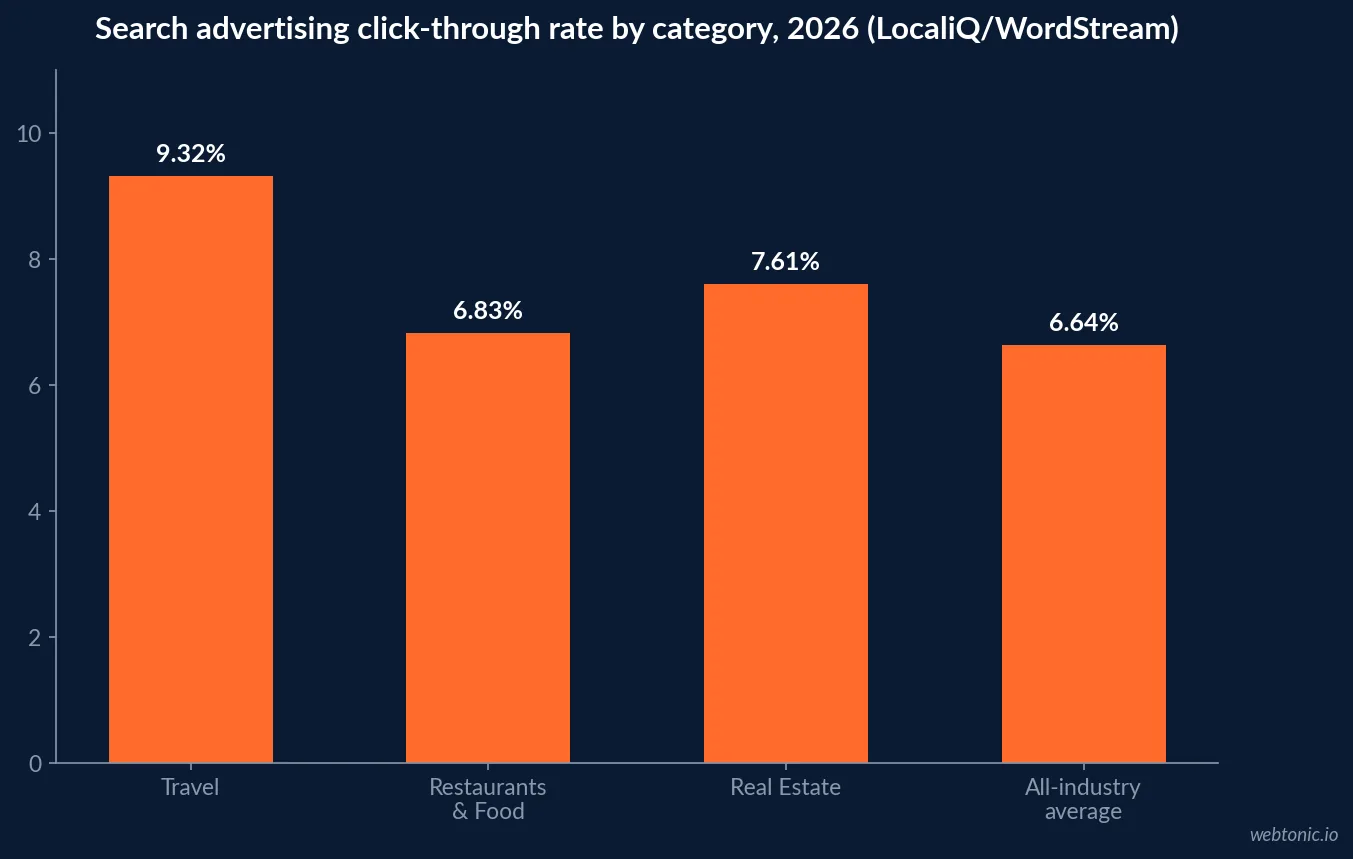
| Category (2026, LocaliQ/WordStream) | Average search CTR | Average search CPC |
|---|---|---|
| Travel | 9.32% | USD 2.14 |
| Real Estate | 7.61% | USD 3.22 |
| Restaurants & Food | 6.83% | USD 2.05 |
| All-industry average | 6.64% | USD 5.42 |
| Physicians & Surgeons | 6.61% | USD 4.76 |
The research phase is a mobile phase
Think with Google's travel research found 60% of destination-information searches come from mobile devices, and mobile now accounts for 40% of all visits to US travel sites. Over 70% of travelers with smartphones use them specifically to research travel, and search is the most common channel through which travelers discover the brand they ultimately book with. Separately, 88% of travelers with smartphones say they would switch to another site or app if the current one doesn't meet their needs - a load-time and usability tax that hits organic rankings directly through engagement signals.
| Mobile research signal (Think with Google) | Figure |
|---|---|
| Destination-information searches from mobile | 60% |
| All US travel site visits from mobile | 40% |
| Smartphone travelers who use them to research trips | over 70% |
| Smartphone travelers who'd switch sites if unsatisfied | 88% |
| Leisure travelers who've booked travel on a smartphone | 31% |
The AI-search shift is no longer theoretical
Google's own 2026 travel trends analysis of Flights and Search data found search interest in "AI travel assistant" and "AI concierge" up 350% year over year, with "AI flight booking" search interest spiking 315%. Separately, BrightLocal's 2026 Local Consumer Review Survey found 45% of consumers now ask AI tools for local business recommendations, up from just 6% the year before - and that AI has already overtaken Yelp and TripAdvisor as a discovery channel, trailing only Google and Facebook. Content that answers a specific travel question in a structured, citable way is now competing for an AI-generated answer slot, not just a page-one link.
Ranking well doesn't guarantee the booking
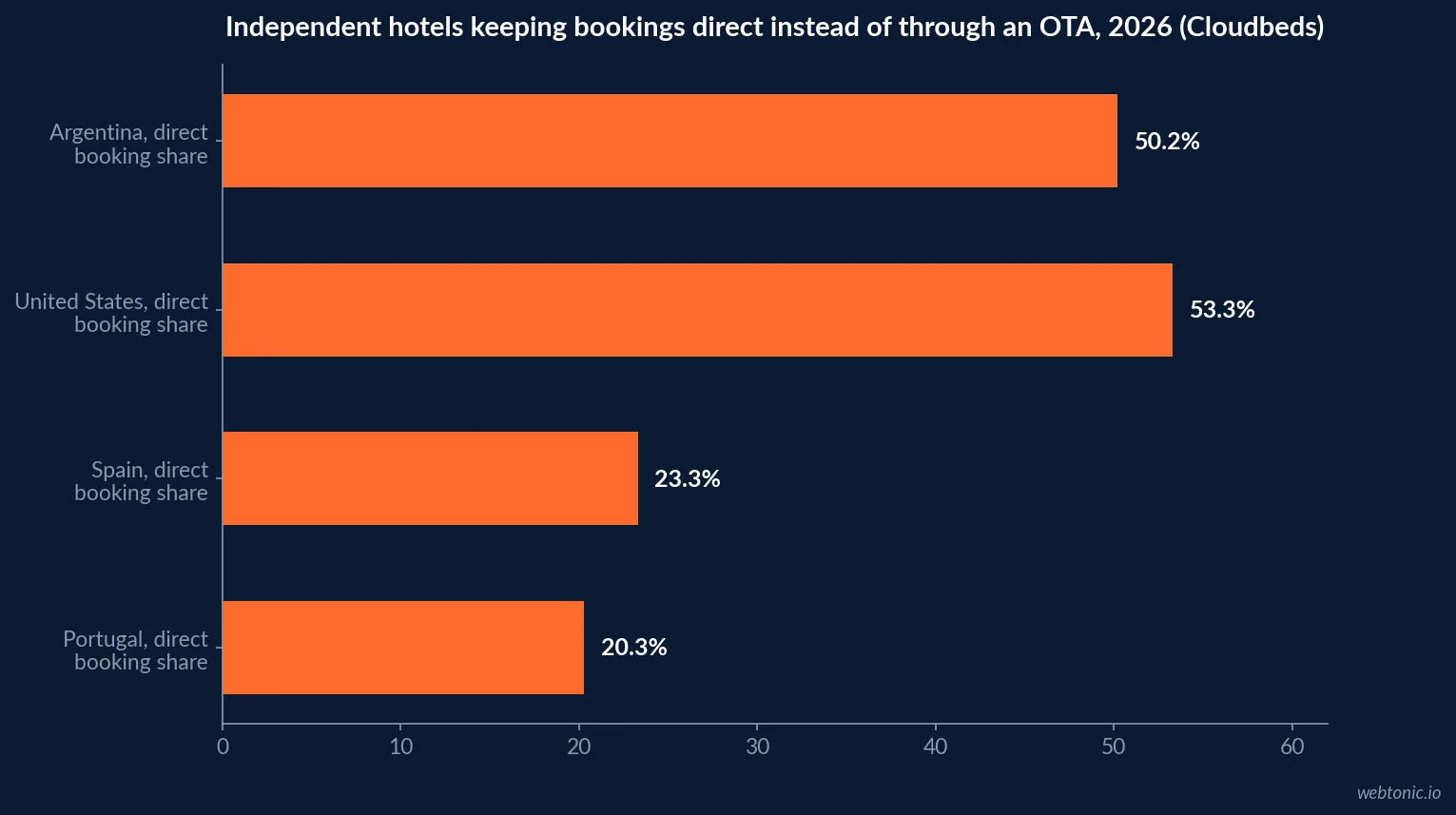
Cloudbeds' 2026 State of Independent Hotels report, built from 90 million bookings across 180 countries, found independent hotels keep only 36.6% of bookings direct globally, with 63.4% going through an OTA. The US holds the strongest direct share among major markets at 53.3%, while Portugal (20.3% direct) and Spain (23.3% direct) lean heavily on third-party channels. An SEO plan that ranks the brand site well still has to out-compete an OTA listing that frequently outranks it for the exact same branded and generic queries.
| Market (Cloudbeds 2026) | Direct booking share | OTA booking share |
|---|---|---|
| United States | 53.3% | 46.7% |
| Argentina | 50.2% | 49.8% |
| Spain | 23.3% | 76.7% |
| Portugal | 20.3% | 79.7% |
| Global average | 36.6% | 63.4% |
What the demand backdrop actually looks like
The US Travel Association's Spring 2026 forecast projects total US travel spending at USD 1.37 trillion in 2026, 87% of it domestic, with international inbound spending reaching USD 178 billion. Growth is real but measured: spending is expected to rise just 1% inflation-adjusted in 2026 before accelerating to 3% in both 2027 and 2028. Skift Research's State of Travel 2026 frames the global category at roughly USD 11 trillion, still growing but no longer accelerating the way it was in the immediate post-pandemic years.
| Demand signal (2026) | Figure | Source |
|---|---|---|
| US total travel spending forecast | USD 1.37 trillion | US Travel Association, Spring 2026 |
| US domestic share of that spending | 87% | US Travel Association, Spring 2026 |
| US travel spending growth, 2026 vs. 2027-28 | 1% then 3% | US Travel Association, Spring 2026 |
| Global travel industry size | roughly USD 11 trillion | Skift Research, State of Travel 2026 |
| Pet-friendly experience bookings, YoY | +260% | Tripadvisor 2026 Trendcast |
What content actually earns the click in 2026
Tripadvisor's 2026 Trendcast, built from booking and behavioral data across its platform, found pet-friendly travel bookings up 260% year over year and extreme-adventure bookings up 79%, with marathon-linked visits up as much as 300% for the Chicago Marathon alone. That's a shift toward specific, bookable experiences rather than generic destination pages - which maps directly onto what ranks: pages answering a narrow, real question (a pet policy, a race-weekend package) outperform broad "things to do in [city]" pages built for volume rather than intent.
The technical layer AI and rich-result surfaces actually read
Google's Hotel Prices program requires structured data using schema.org's Hotel and HotelRoom types in JSON-LD, with required properties covering name, address, offers and nested pricing details - and Google explicitly validates that the marked-up values match what's visible on the page before trusting it for price accuracy. This is the same machine-readable layer that AI-assistant tools draw on when answering a specific booking question, which makes clean structured data a prerequisite for showing up in the AI-search surfaces growing fastest in the data above, not just a rich-snippet nicety.
Where hospitality sites still lose the visitor after they've ranked
Baymard Institute's 2026 Travel Accommodations UX Benchmark, built from 590-plus research-based parameters across 9 in-depth case studies covering OTA, hotel and property-rental sites and apps, found overall UX performance ranging from "poor" to "mediocre," with many sites failing at the first step by not prioritizing the booking search on the homepage. Sites got the basics right - visual consistency, pricing visibility, clear imagery - but consistently missed on transparent pricing, effective filters and review functionality. An SEO plan that wins the click but lands on a page with that profile is trading a ranking win for a booking loss.
| UX benchmark finding (Baymard 2026) | What it means for organic traffic |
|---|---|
| Booking search not prioritized on homepage | Ranked traffic bounces before it can convert |
| Weak pricing transparency | Visitors leave to price-check on an OTA instead |
| Ineffective filters | Longer sessions that read as engagement but don't convert |
| Weak review functionality on-site | Trust signal moves to a third-party review platform |
| Overall benchmark range | "Poor" to "mediocre" across 9 case studies |
Building the SEO plan around these five points
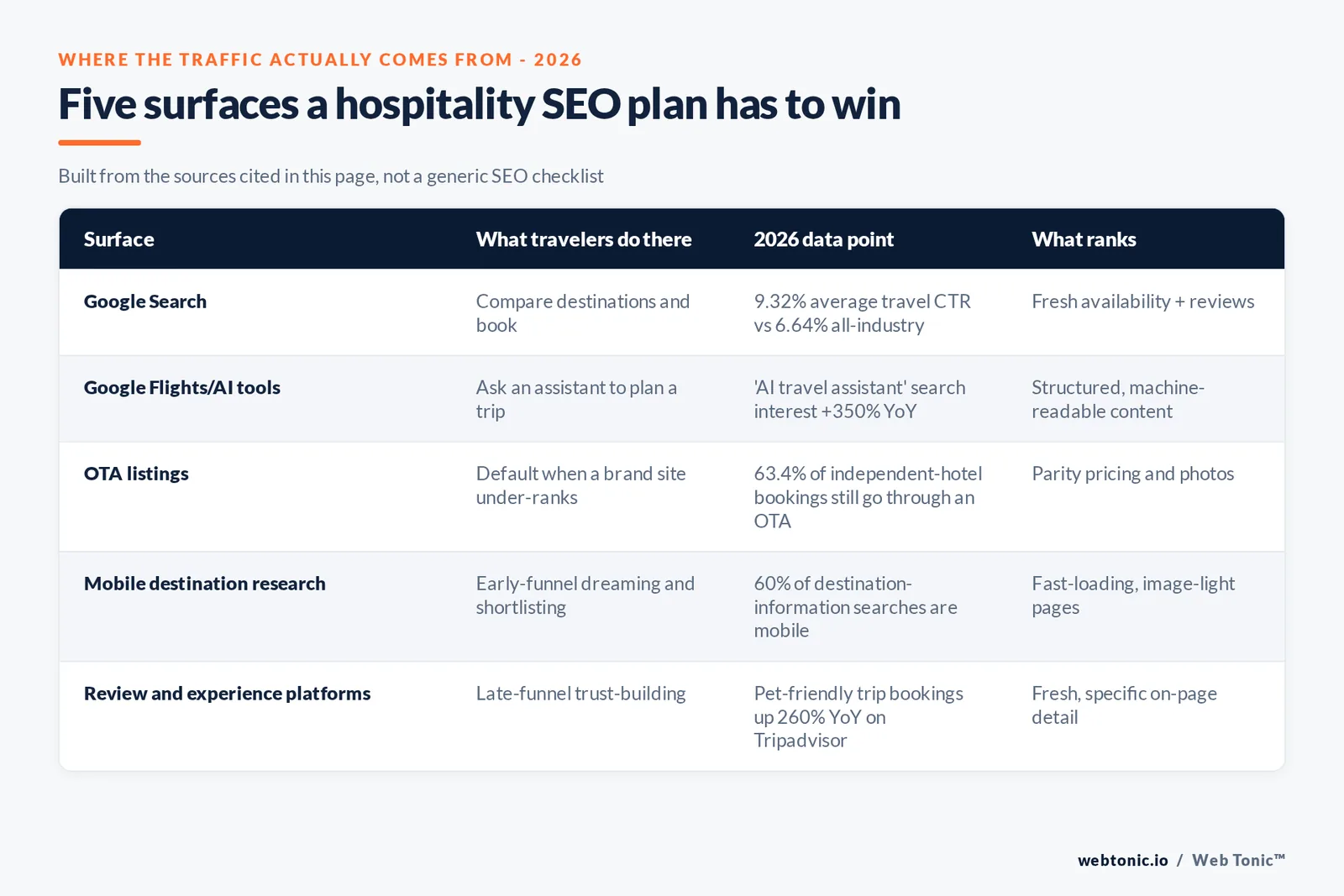
Treat mobile page speed as a ranking input, not a nice-to-have, given the 88% switching rate. Structure content to answer AI-assistant-style questions directly, since that discovery channel grew fastest of any measured here. Compete on booking-page conversion as hard as on ranking position, since OTAs still win the majority of clicks even on well-ranked queries. And build content around specific bookable experiences rather than generic destination guides. Our growth marketing practice builds hospitality content plans around exactly this mix; see our guide to building a paid search strategy for how the paid and organic sides should work together, or talk to us about a hospitality-specific audit.
Frequently Asked Questions
What's a realistic organic click-through rate for a travel or hotel brand?
There's no travel-specific organic CTR benchmark published for 2026, but the closest paid proxy is informative: LocaliQ/WordStream's 2026 search advertising data puts Travel's average click-through rate at 9.32%, well above the 6.64% all-industry average and higher than Restaurants & Food (6.83%) or Real Estate (7.61%). Organic CTR typically runs several times higher than paid CTR for the same query intent, so a well-optimized listing or destination page should meaningfully outperform that paid floor once it holds a strong position.
How much of hospitality search traffic is now mobile?
A large majority of the early research phase. Think with Google's mobile travel research found that 60% of destination-information searches come from mobile devices, and 40% of visits to US travel sites overall come from mobile. Over 70% of travelers with smartphones use them specifically to research travel, and search is the most common way travelers discover the brand they eventually book with. A page that isn't fast and legible on mobile is losing the discovery moment before it can rank.
Is AI search actually changing how people find hospitality content?
Yes, and quickly. Google's own 2026 travel trends analysis found search interest in 'AI travel assistant' and 'AI concierge' grew 350% year over year, and 'AI flight booking' search interest spiked 315%. BrightLocal's 2026 Local Consumer Review Survey separately found 45% of consumers now use AI tools for local business recommendations generally, up from 6% a year earlier - and that AI now outranks Yelp and TripAdvisor as a discovery channel behind only Google and Facebook.
How much of the demand a hotel ranks for actually books direct?
Less than half, on average. Cloudbeds' 2026 State of Independent Hotels report, built from 90 million bookings across 180 countries, found a 36.6% direct booking rate against a 63.4% OTA booking rate globally. The split varies sharply by market: US properties keep 53.3% direct, while Portugal (20.3% direct) and Spain (23.3% direct) rely far more heavily on OTAs. SEO that ranks a brand site well still competes with OTA listings that often outrank it for the same query.
Does more travel demand automatically mean more organic search demand?
Not proportionally. The US Travel Association's Spring 2026 forecast projects total US travel spending reaching USD 1.37 trillion in 2026, 87% of it domestic, with growth of just 1% inflation-adjusted this year before accelerating to 3% in 2027-28. Skift Research frames the global travel industry at roughly USD 11 trillion, still growing but not accelerating the way it did in the immediate post-pandemic years. Overall travel volume is resilient but not surging, which means SEO gains in this category increasingly come from taking share inside a stable market, not from a rising tide.
Sources
LocaliQ/WordStream - 2026 Search Advertising Benchmarks by Industry
Think with Google - How Mobile Shapes the Travel Customer Journey
Google - 2026 Travel Trends and Top Destinations
BrightLocal - Local Consumer Review Survey, AI trust mini-report 2026
Cloudbeds - The 2026 State of Independent Hotels
U.S. Travel Association - Spring 2026 Travel Forecast
Skift Research - State of Travel 2026
Tripadvisor - Trendcast 2026
Google for Developers - Hotel Price structured data reference
Baymard Institute - Travel Accommodations UX Benchmark 2026