Table of contents

Google's share of where consumers go to check on a local business fell from 83% to 71% in a single year, according to BrightLocal's 2026 survey, while AI tools for local recommendations went from a rounding error to 45% of consumers. For hotels and travel businesses, that shift lands on top of TripAdvisor's own long-standing finding that reviews decide a large share of accommodation bookings.
Key Takeaways
- Google's share of local review discovery fell from 83% to 71% year over year.
- Use of AI tools for local recommendations jumped from 6% to 45%.
- Apple Maps usage nearly doubled, from 14% to 27%.
- Local news sites as a review source fell from 48% to 29%.
- 97% of consumers read online reviews before choosing a business, per BrightLocal.
- 41% of consumers now "always" read reviews, up from 29% a year earlier.
- 81% of travelers always or frequently read reviews before booking a place to stay.
- 79% would book the higher-rated of two identical hotels.
- 52% would never book a hotel with zero reviews.
- The average traveler reads about nine reviews before deciding on a hotel.
- 78% of travelers focus on the most recent reviews when deciding.
- US hotel occupancy hit 69.7% in July 2026, up 2.3% year over year.
- Average daily rate reached USD 171.74 in July 2026, up 5.7%.
- RevPAR climbed to USD 119.77, an 8.2% year-over-year gain.
- Only 35% of small businesses actively manage their Google Business Profile, per BrightLocal.
- Domestic leisure travel spending is forecast at USD 909 billion in 2026.
- The TripAdvisor review study surveyed more than 23,000 users across 12 markets.
Local discovery has fragmented past Google
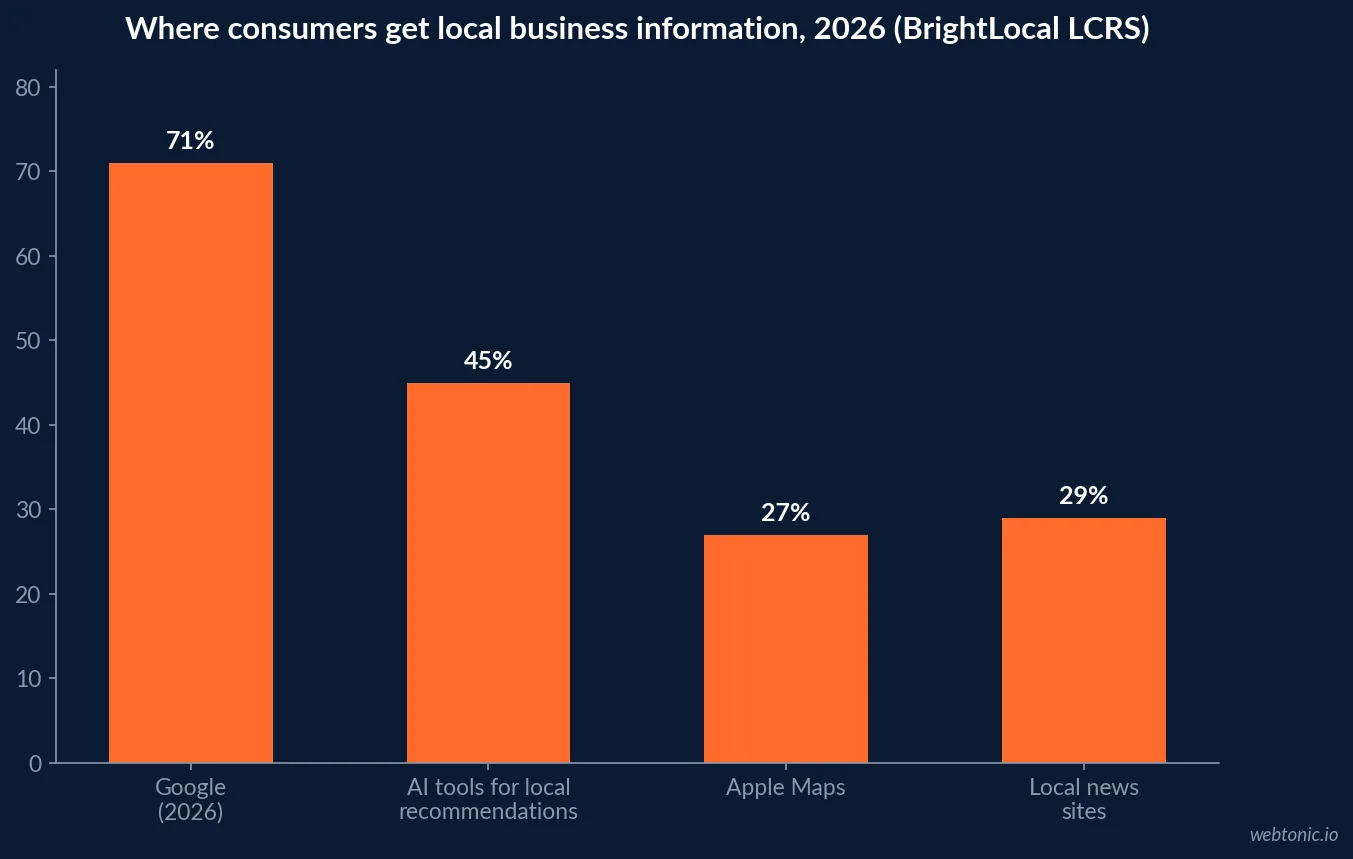
BrightLocal's 2026 Local Consumer Review Survey, a representative panel of 1,002 US adults, found that 97% of consumers read online reviews for local businesses and 41% now "always" read them, up sharply from 29% the year before. What changed most is where they read them. Google's share as a source fell from 83% in 2025 to 71% in 2026, Apple Maps usage nearly doubled from 14% to 27%, and use of generative AI tools for local recommendations rose from 6% to 45% — while local news sites fell from 48% to 29%.
None of that makes Google optional. It still carries the largest single share by a wide margin. It does mean a hotel's local SEO plan built purely around a Google Business Profile is now missing roughly three in ten discovery moments that a year ago would have gone through Google.
| Local discovery source (2026) | Share of consumers | Change vs 2025 | Source |
|---|---|---|---|
| 71% | Down from 83% | BrightLocal LCRS 2026 | |
| AI tools for local recommendations | 45% | Up from 6% | BrightLocal LCRS 2026 |
| Apple Maps | 27% | Up from 14% | BrightLocal LCRS 2026 |
| Local news sites | 29% | Down from 48% | BrightLocal LCRS 2026 |
| Any online reviews (all sources) | 97% | Broadly stable | BrightLocal LCRS 2026 |
What TripAdvisor's own research says about hotel bookings specifically
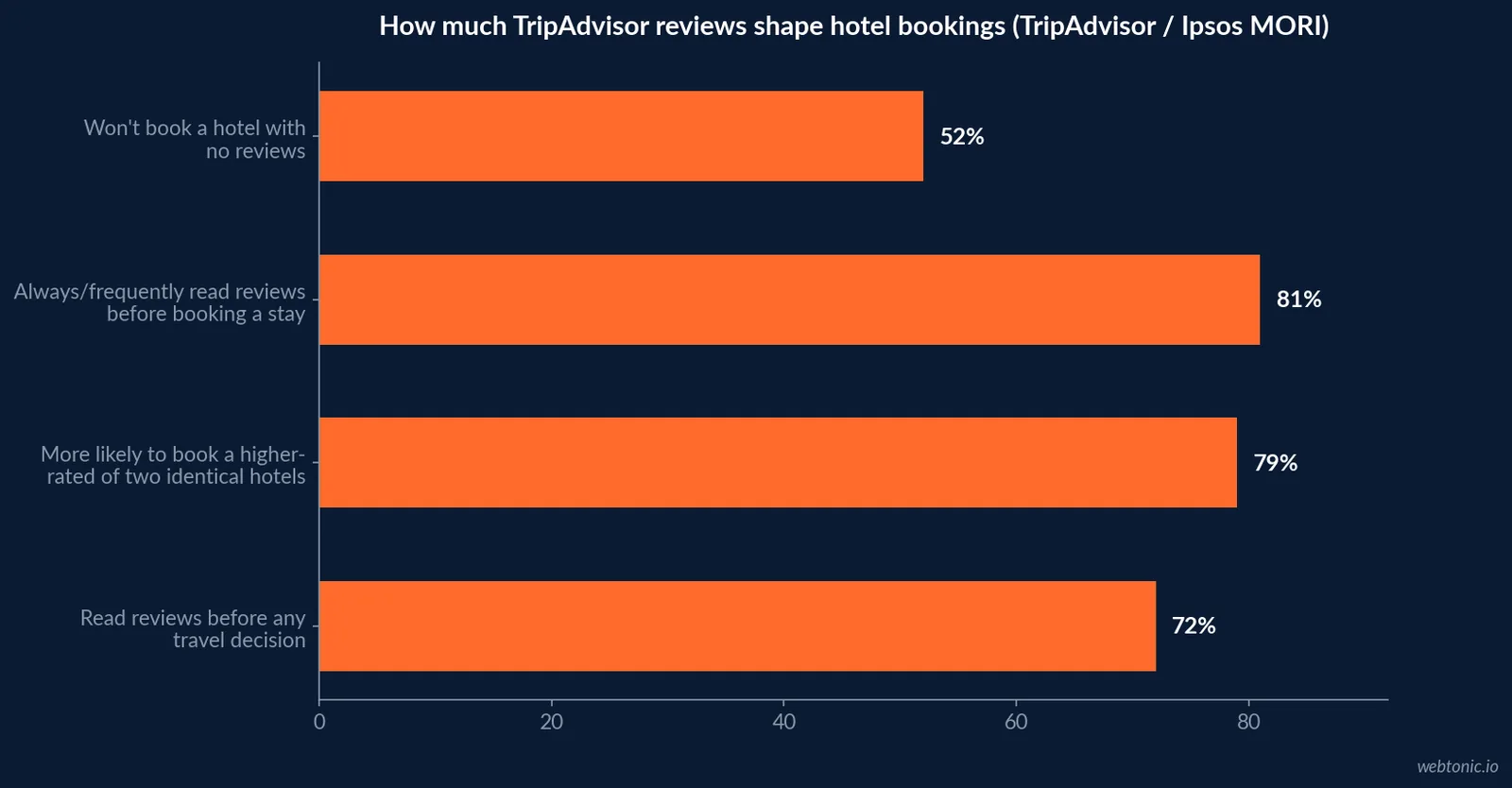
BrightLocal's data is cross-industry, not travel-specific — worth stating plainly since the pattern still applies directly to hotels booked through Maps and search. For accommodation bookings specifically, TripAdvisor's own research with Ipsos MORI, surveying more than 23,000 users across 12 markets, found 81% always or frequently read reviews before booking a place to stay, higher than the 72% figure for travel decisions generally. 79% said they are more likely to book the higher-rated of two otherwise identical hotels, and 52% said they would never book a hotel with no reviews at all. That survey dates to 2019 — it is still TripAdvisor's most recent full public study on review influence, and still the number it cites publicly today.
| TripAdvisor / Ipsos MORI finding | Figure | What it measures |
|---|---|---|
| Read reviews before booking a stay | 81% | Accommodation-specific, above the 72% general travel figure |
| Prefer the higher-rated of two identical hotels | 79% | Rating as the tiebreaker, not price |
| Would never book a hotel with zero reviews | 52% | A hard floor requirement, not a preference |
| Focus on the most recent reviews | 78% | Recency matters more than volume alone |
| Reviews read on average before deciding | ~9 | A meaningful review count is table stakes |
Why market conditions raise the stakes on getting this right
US hotel performance data from CoStar's STR benchmarking service put July 2026 occupancy at 69.7%, up 2.3% year over year, average daily rate at USD 171.74 (up 5.7%) and revenue per available room at USD 119.77, up 8.2%. The U.S. Travel Association's Spring 2026 forecast separately puts domestic leisure travel spending at USD 909 billion for 2026.
Rising occupancy means more properties are competing for a shrinking pool of remaining rooms during peak weeks, which is exactly when local pack visibility and review strength decide which property gets looked at first. A local SEO gap costs more in a tightening market than in a soft one.
| Market indicator (2026) | Figure | Change | Source |
|---|---|---|---|
| US hotel occupancy, July | 69.7% | +2.3% YoY | CoStar / STR |
| Average daily rate, July | USD 171.74 | +5.7% YoY | CoStar / STR |
| Revenue per available room, July | USD 119.77 | +8.2% YoY | CoStar / STR |
| Domestic leisure travel spending | USD 909 billion | +0.9% | U.S. Travel Association |
| Hotel guest spending (AHLA estimate) | ~USD 805 billion | +1.7% | AHLA 2026 State of the Industry |
Why an unmanaged Google Business Profile is a bigger gap than it looks
The same BrightLocal research that documents Google's declining discovery share also found that just 35% of small and mid-sized businesses have a Google Business Profile at all, which BrightLocal notes leaves many consumers unable to read or write Google reviews for that listing in the first place. The same report flags that video platforms — YouTube, Instagram and TikTok, including TikTok's Local Explorer program — are gaining ground as review and recommendation sources, meaning the review surfaces a hotel needs to manage are multiplying at the same time Google's own share is shrinking.
For hotel-specific booking mechanics, Google's own Hotel Center documentation confirms that a property's performance data — impressions, clicks and click-through rate on both free and paid booking links — is available directly to the property, which means there is no excuse for a hotel not to know whether its free booking links are even appearing. Independent research published by hotel-distribution researcher Nicolas Sitter, based on an original analysis of 4,000 AI Mode hotel queries across eight cities, has separately reported that OTA sources are cited heavily in Google's AI Mode answers but capture a small share of the resulting clicks — an early, single-researcher data point rather than an official Google figure, worth watching rather than budgeting against yet.
| Review and listing management gap | Figure | Source |
|---|---|---|
| SMBs with a claimed Google Business Profile | 35% | BrightLocal |
| Average number of review sites consumers use | ~6 sites | BrightLocal LCRS 2026 |
| Video platforms named as rising review sources | YouTube, Instagram, TikTok | BrightLocal LCRS 2026 |
The management gap most hotels have not closed
Managing a listing well is not yet the norm even among businesses that know it matters. BrightLocal's wider research base finds that only around 35% of small and mid-sized businesses actively manage their Google Business Profile, leaving the majority of listings running on auto-pilot: unclaimed attributes, stale photos, and reviews with no response. For a category where 81% of the audience checks reviews before booking, an unmanaged profile is not a neutral gap — it is actively working against the listing every time a traveler compares two otherwise similar properties.
Our data and analytics team treats review volume, recency and response rate as ranking and conversion inputs, not just reputation metrics, which is the right frame given how directly TripAdvisor's own data ties review recency to booking behavior.
A practical local SEO checklist for 2026
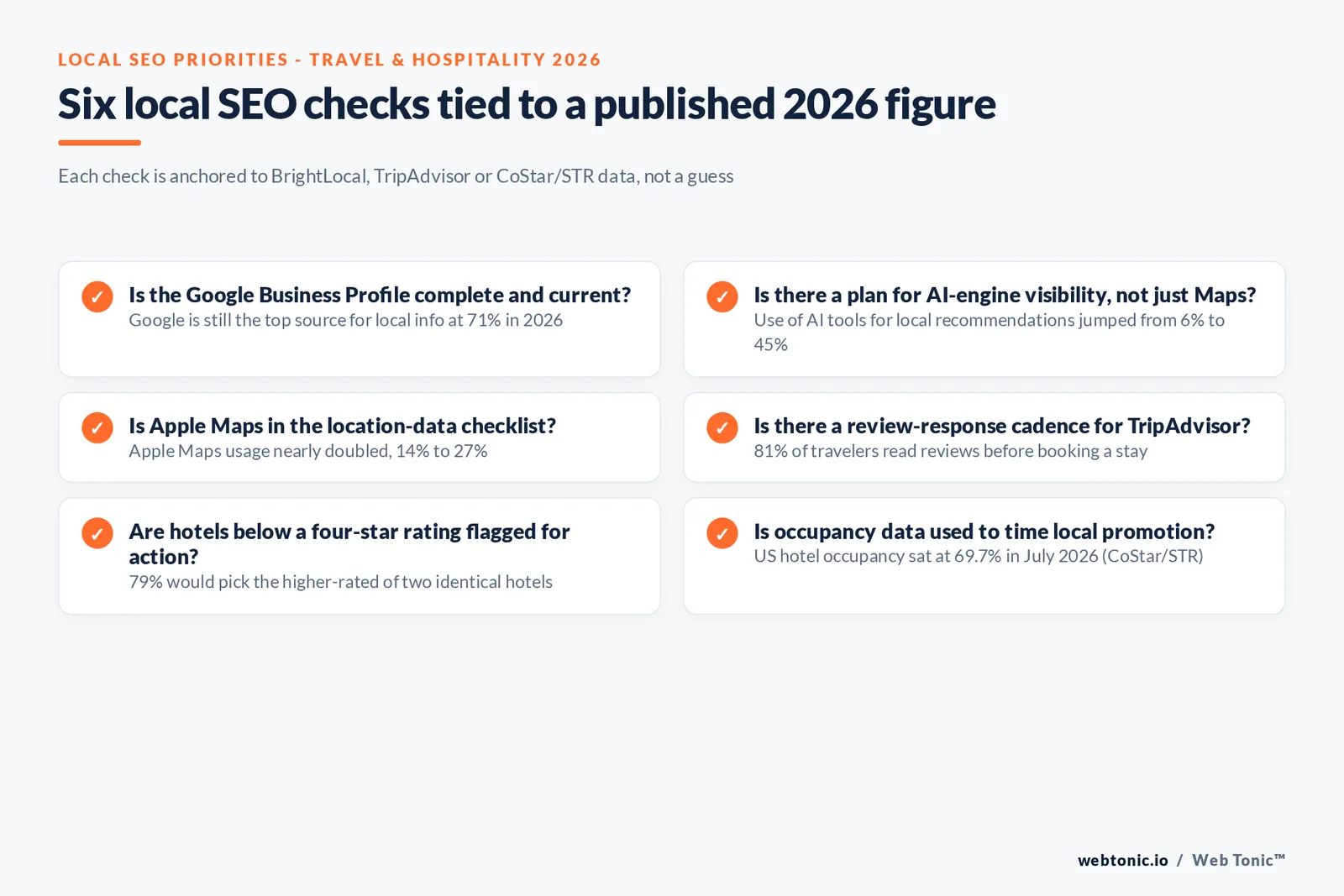
Given the shift toward Apple Maps and AI-tool discovery, a property's structured data — hours, attributes, address consistency, and photo freshness — now needs to be correct on more than one platform, not just Google. Review response cadence matters doubly, since 78% of travelers weight recent reviews most heavily: a six-month-old unanswered complaint is more visible today than it was when Google was the only channel that mattered.
| Priority | Why it matters now | Data point |
|---|---|---|
| Claim and complete listings beyond Google | 27% now use Apple Maps, up from 14% | BrightLocal LCRS 2026 |
| Build a review-response cadence | 78% weight recent reviews most | TripAdvisor / Ipsos MORI |
| Push for a minimum review threshold per property | 52% won't book with zero reviews | TripAdvisor / Ipsos MORI |
| Prepare structured data for AI-tool citation | AI-tool use for local recs is up to 45% | BrightLocal LCRS 2026 |
| Time review pushes to peak-occupancy weeks | Occupancy at 69.7% and rising | CoStar / STR, July 2026 |
What to do next
Treat Google Business Profile management as necessary but no longer sufficient: fold in Apple Maps completeness and a plan for how AI recommendation tools read your listing and reviews. Pair that with a review-response cadence built around TripAdvisor's own finding that recency, not just volume, moves the booking decision. If you want a property-by-property audit of where the local SEO gaps sit, our data intelligence practice can run one, or read our take on building a search strategy around real demand data before the next budget cycle. To talk it through, reach out to our team.
Frequently Asked Questions
Is Google still the most important local SEO channel for a hotel?
Still the biggest single channel, but its share is shrinking. BrightLocal's 2026 Local Consumer Review Survey, a representative panel of 1,002 US adults, found Google's share as a review source fell from 83% in 2025 to 71% in 2026, while the use of generative AI tools for local recommendations jumped from 6% to 45% and Apple Maps usage nearly doubled, from 14% to 27%. A hotel that only optimizes its Google Business Profile is now missing a meaningful and fast-growing share of the discovery moment.
How much do TripAdvisor reviews actually move a booking decision?
TripAdvisor's own research, conducted with Ipsos MORI across more than 23,000 users, found that 81% of travelers always or frequently read reviews before booking a place to stay, versus 72% for travel decisions generally. 79% said they are more likely to book the higher-rated of two otherwise identical hotels, and 52% said they would never book a hotel with no reviews at all. The average user reads about nine reviews before deciding. That data is from 2019, TripAdvisor's last full public study on the topic, and is still the figure it cites.
Does 2026 hotel occupancy data affect local SEO priorities?
Indirectly. CoStar's STR benchmarking data put July 2026 US hotel occupancy at 69.7%, up 2.3% year over year, with average daily rate at USD 171.74 (+5.7%) and revenue per available room at USD 119.77 (+8.2%). Rising occupancy and rate mean more properties are running closer to capacity, which raises the value of showing up correctly in the local pack and Maps results during the specific weeks demand peaks, rather than spreading review and listing management evenly across the year.
Should a hotel actively manage its presence in AI answers now?
The BrightLocal trend line argues yes, sooner than most local businesses assume. Use of generative AI tools for local recommendations rose from 6% of consumers in 2025 to 45% in 2026, a sevenfold jump in a single year according to BrightLocal's panel. That does not replace Google Business Profile or TripAdvisor management, both of which remain larger by absolute share, but it does mean a hotel's structured listing data, review volume and review content are now being read by more surfaces than a Maps pin.
What does 'local SEO' even mean for a destination that isn't a single physical address?
For a hotel or attraction with one location, standard Google Business Profile and review management applies directly. For a destination marketing organization or multi-property brand, the same review-behavior data still applies at the individual-property level: TripAdvisor's finding that 79% of travelers prefer the higher-rated of two identical properties operates hotel by hotel, so the practical local SEO unit of work is still the individual listing, not the destination brand.
Sources
BrightLocal - Local Consumer Review Survey 2026
BrightLocal - Half of consumers are asking AI for business recommendations (LCRS 2026)
TripAdvisor - Online reviews remain a trusted source of information when booking trips (Ipsos MORI study)
Google Hotel Center - Preview, validate and view property performance
Nicolas Sitter - How Google AI Mode recommends hotels (independent research)
CoStar / STR - U.S. hotel performance for July 2026
U.S. Travel Association - U.S. Travel Forecast, Spring 2026
American Hotel & Lodging Association - 2026 State of the Industry
Web Tonic - How to create a Google Ads strategy