Table of contents
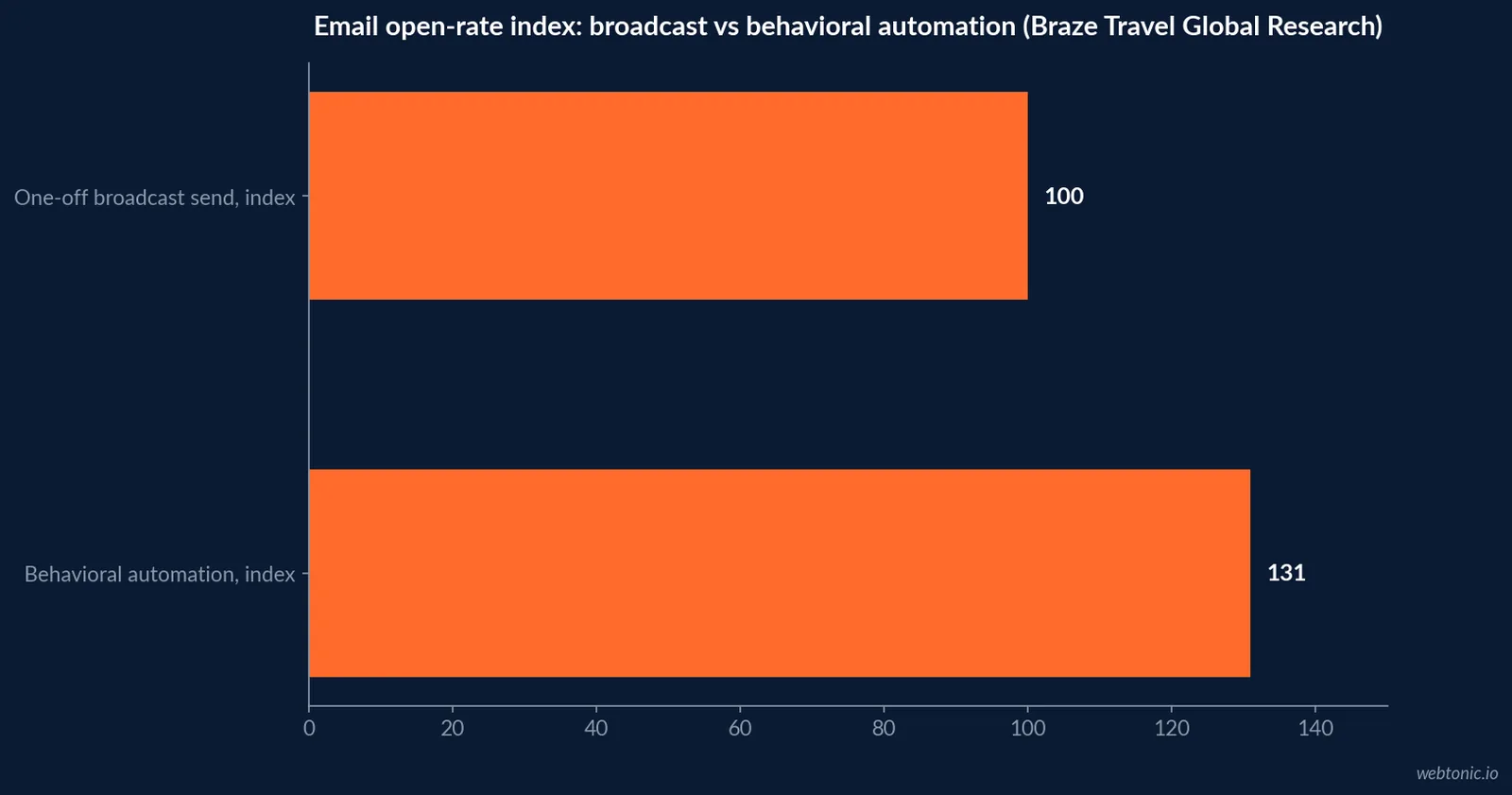
Travel and transportation email posts the lowest open rate of any tracked industry in 2026, at 30.10%, yet Braze's own travel-specific research finds automated, behavior-triggered sends open 31% more often than one-off broadcasts. The gap between those two facts is where a 2026 travel email strategy should focus.
Key Takeaways
- Travel and transportation's 2026 open rate is 30.10%, the lowest of any tracked industry.
- E-commerce follows at 32.67% and publishing at 34.24%, both above travel.
- The all-users cross-industry average open rate is 35.63%, per Mailchimp.
- Constant Contact's 2026 all-industry average open rate is 30.8%.
- Constant Contact's top-performing senders average a 48% open rate.
- Those top performers send roughly three times a week, not less often.
- Braze reports a 31% open-rate increase from automation versus broadcast in its travel research.
- GetYourGuide's action-based automated emails hit a 45% open rate with Braze.
- Skyscanner reports 3 to 4 times higher open and click rates using triggered messaging.
- GetYourGuide also saw email click-through rates grow more than 100% after the shift.
- Mailchimp's all-users click rate benchmark sits at 2.62%.
- Mailchimp's all-users unsubscribe rate benchmark is 0.22%.
The industry starting point: travel opens the least, not the most
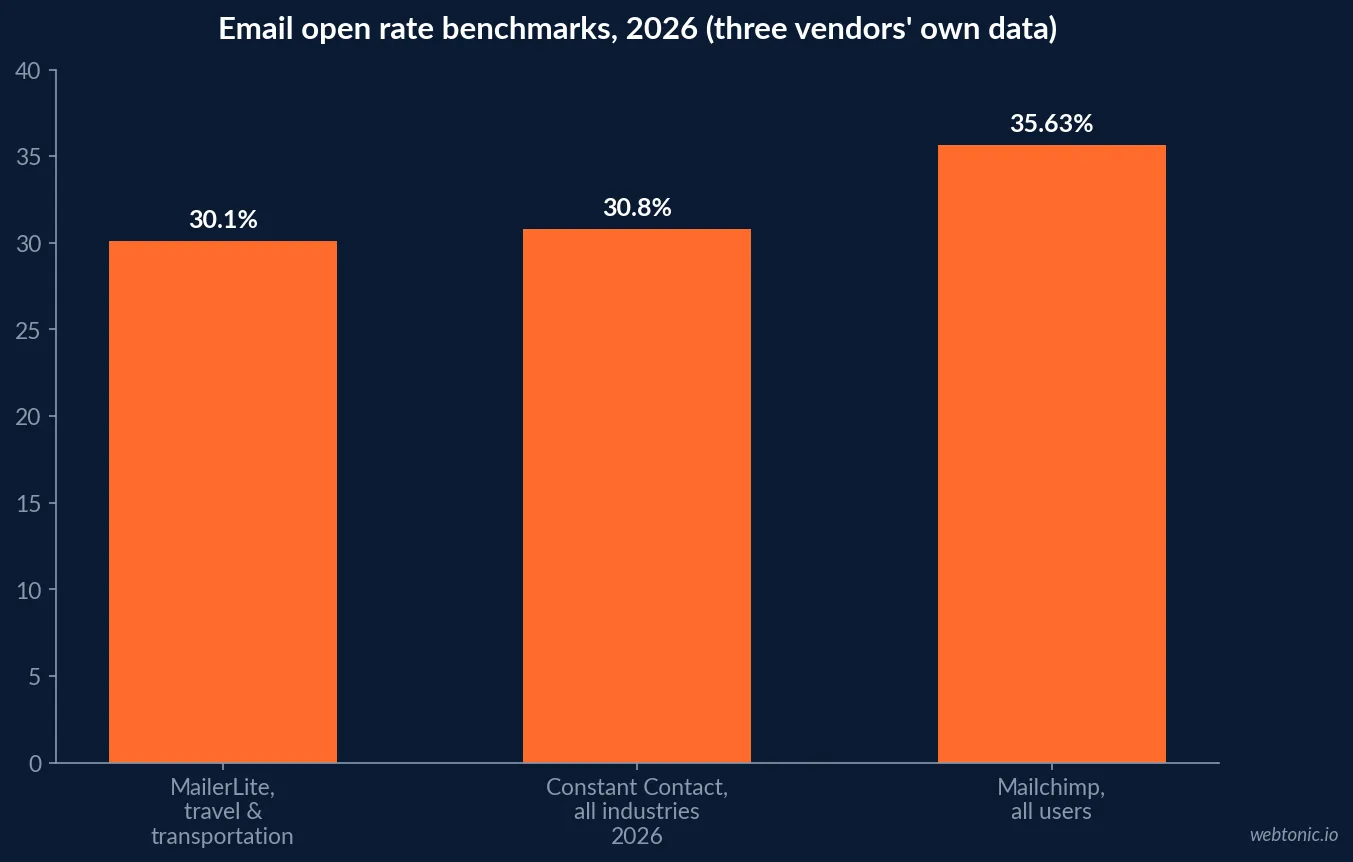
MailerLite's 2026 industry benchmark data lists travel and transportation at a 30.10% open rate, its lowest-performing tracked industry, behind e-commerce at 32.67% and publishing at 34.24%. For comparison, Mailchimp's own benchmark page puts its all-users cross-industry average open rate at 35.63%, with a 2.62% click rate and a 0.22% unsubscribe rate. Travel sits roughly five points below that all-industry floor on the open-rate metric specifically.
That gap is the honest baseline. A travel email program measured only against the cross-industry average will look like it is underperforming even when it is in line with what the rest of the category achieves.
| Email open-rate benchmark (2026) | Figure | Source |
|---|---|---|
| Travel and transportation | 30.10% | MailerLite |
| E-commerce | 32.67% | MailerLite |
| Publishing | 34.24% | MailerLite |
| All users, cross-industry | 35.63% | Mailchimp |
| All industries, cross-industry | 30.8% | Constant Contact |
Frequency changes the number more than industry does
Constant Contact's own 2026 data reports its top-performing customers — those emailing their lists roughly three times a week — averaging a 48% open rate, well above its 30.8% all-industry average. That single data point argues that within travel, the lever most in a marketer's control is not the industry benchmark but the sending cadence and relevance of what gets sent, which is exactly where automation changes the picture.
The implication for a travel sender specifically: raising broadcast frequency alone, without adding relevance, risks trading a low open rate for a higher unsubscribe rate instead. The evidence in this page points toward automation, not raw volume, as the more defensible way to close the gap with the cross-industry average.
What Braze's travel-specific research adds: automation beats broadcast directly
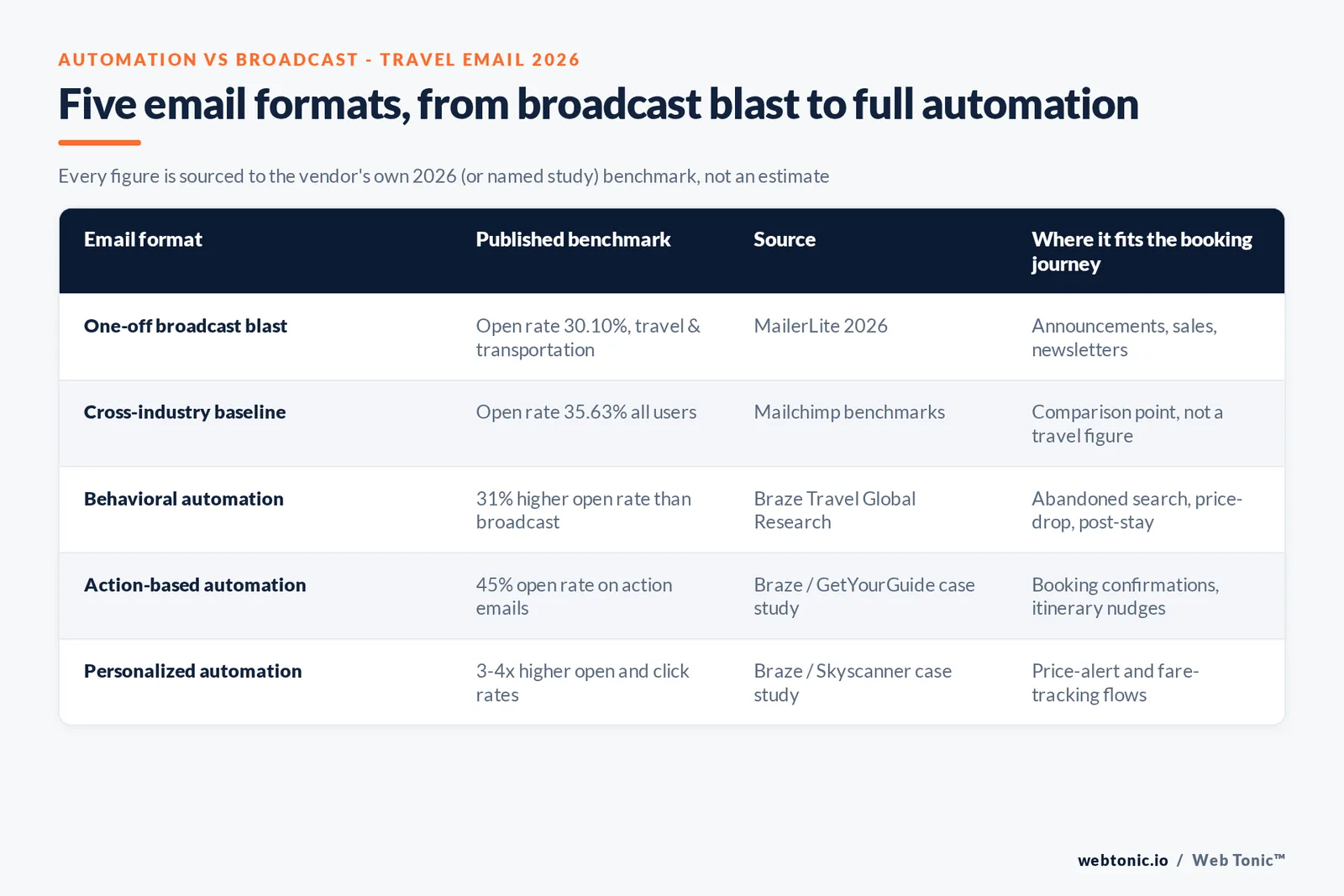
The most useful travel-specific evidence does not come from an open-rate table at all. In its Travel Global Research, Braze reports that its travel customers see a 31% increase in email open rates when they use behavior-triggered automation instead of one-off broadcast sends. Two of its published case studies quantify what that looks like in practice: GetYourGuide reports a 45% open rate on action-based automated messages and more than a 100% increase in email click-through rate, while Skyscanner reports 3 to 4 times higher open and click-through rates after moving to personalized, triggered messaging.
Stacked against the 30.10% broadcast benchmark, a 31% relative lift moves travel email performance from the worst-performing tracked industry to roughly in line with, or above, the cross-industry average — not by writing a better broadcast, but by not sending one.
| Email approach | Reported result | Company | Source |
|---|---|---|---|
| One-off broadcast (baseline) | 30.10% open rate, travel industry average | Industry-wide | MailerLite 2026 |
| Behavioral automation vs broadcast | 31% higher open rate | Braze travel customer base | Braze Travel Global Research |
| Action-based automated email | 45% open rate | GetYourGuide | Braze case study |
| Action-based automated email | 100%+ increase in click-through rate | GetYourGuide | Braze case study |
| Personalized, triggered messaging | 3-4x higher open and click rates | Skyscanner | Braze case study |
A second, cross-industry confirmation: automation beats broadcast almost everywhere
Braze's finding is travel-specific, but it is not an outlier pattern. Klaviyo's own 2026 benchmark report, built from data across more than 183,000 brands, is a cross-industry figure, not a travel-specific one, but it points the same direction: automated flows deliver roughly 3 times higher click rates and 13 times higher placed-order rates than one-off campaigns, and generate nearly 41% of total email revenue from just 5.3% of sends. Klaviyo also reports a cross-industry average campaign open rate of 31%, with its top 10% of senders reaching 45.1%.
Two independent vendors, one travel-specific and one cross-industry, arrive at the same structural conclusion: the send type matters more than almost any other single lever in the open-rate and revenue-per-send equation.
| Metric (Klaviyo 2026, cross-industry) | Campaigns (broadcast) | Automated flows | Multiple |
|---|---|---|---|
| Click rate | Baseline | ~3x higher | 3x |
| Placed-order rate | Baseline | ~13x higher | 13x |
| Share of email revenue | ~59% of revenue from 94.7% of sends | ~41% of revenue from 5.3% of sends | n/a |
| Average open rate, all industries | 31% | Not broken out separately | n/a |
| Top 10% of senders, open rate | 45.1% | Not broken out separately | n/a |
Where automation fits the travel booking journey specifically
Travel bookings have more discrete, high-relevance moments than most retail categories: a search that does not convert, a saved fare or property, a confirmed booking, a pre-arrival window, and a post-stay window for reviews and repeat business. Each of those moments is a natural automation trigger, and each one carries built-in relevance that a scheduled newsletter cannot replicate, which is consistent with why Braze's own travel customers see the reported lift specifically from automation rather than from sending more broadcasts.
| Booking-journey moment | Automation trigger | Why it outperforms broadcast |
|---|---|---|
| Search abandoned, no booking | Price or availability alert | Timed to active intent, not a calendar date |
| Booking confirmed | Confirmation and itinerary email | Guaranteed relevance to the recipient |
| Days before arrival | Pre-arrival reminder and upsell | High open intent driven by the trip itself |
| After the stay | Review request and loyalty offer | Recency drives response, per TripAdvisor's own review-recency findings |
| No activity for 60+ days | Re-engagement or win-back send | Segmented, not sent to the full broadcast list |
None of those five moments requires a large marketing team to implement. Most booking engines and property management systems already fire the underlying event — a confirmed reservation, a stay-completion date — the work is wiring that event to a triggered send instead of leaving it to a monthly newsletter calendar to eventually cover.
Why the growing list is worth automating in the first place
The case for investing in automation rather than treating email as a maintenance channel gets stronger as the addressable list grows. The U.S. Travel Association's Spring 2026 forecast puts domestic leisure travel spending at USD 909 billion for the year, and AHLA's 2026 State of the Industry report expects hotel guest spending to reach roughly USD 805 billion. A growing base of bookers is also a growing base of triggerable email moments — abandoned searches, confirmations, pre-arrival windows — which is exactly where Braze's and Klaviyo's data both say the return sits.
| 2026 demand signal | Figure | Source |
|---|---|---|
| Domestic leisure travel spending | USD 909 billion | U.S. Travel Association |
| Hotel guest spending (AHLA estimate) | ~USD 805 billion | AHLA 2026 State of the Industry |
| Travel email open rate (the channel this demand feeds) | 30.10% | MailerLite 2026 |
A minimum viable automation build for a small hospitality team
A property or operator without a dedicated CRM team does not need all five trigger types from the table above on day one. The evidence above argues for a strict build order: confirmation and pre-arrival first, since those carry guaranteed relevance and require the least behavioral data; review and loyalty requests second, since TripAdvisor's own review-recency findings tie directly to booking influence; and broadcast newsletters last, once the higher-relevance automation is live and measurable.
| Build order | Trigger | Data dependency | Why this order |
|---|---|---|---|
| 1 | Booking confirmation | Booking system only | Zero behavioral data needed, guaranteed open |
| 2 | Pre-arrival reminder | Booking date only | High relevance, simple to automate |
| 3 | Post-stay review request | Stay-completion date | Recency drives review influence on future bookers |
| 4 | Price or availability alert | Search or wishlist behavior | Requires tracking on-site behavior |
| 5 | Broadcast newsletter | Full list | Lowest relevance per send, build last |
What this means for a 2026 email plan
Do not benchmark a travel email program against the 35.63% cross-industry Mailchimp average; benchmark it against the 30.10% travel-specific MailerLite figure, and treat any gap above that as a signal automation is working. Prioritize building out the five trigger moments above before investing further in broadcast newsletter volume, since the travel-specific evidence — not a general email best practice — points to automation as the lever that closes travel's open-rate gap with the rest of the market. Our growth marketing team builds these trigger flows against booking and CRM data directly, and our guide to choosing an email marketing partner covers what to look for if you are evaluating one. To scope an automation build, get in touch.
Frequently Asked Questions
Why does travel have the lowest email open rate of any industry?
MailerLite's 2026 industry benchmark data lists travel and transportation at a 30.10% open rate, the single lowest of the industries it tracks, behind e-commerce (32.67%) and publishing (34.24%). The report does not state a cause, but the pattern is consistent with a category that sends frequent promotional broadcasts to a large, loosely engaged subscriber base built from one-time bookers rather than repeat shoppers, which is exactly where broadcast-style sending underperforms most.
Does automation actually outperform broadcast sending in travel specifically?
Yes, on Braze's own travel-specific research. Its Travel Global Research report found that Braze customers see a 31% increase in email open rates when using behavioral automation instead of one-off broadcast sends. Braze's published case studies go further: GetYourGuide reports a 45% open rate on action-based automated messages, and Skyscanner reports 3 to 4 times higher open and click-through rates using personalized, triggered messaging versus its prior broadcast approach.
What counts as 'automation' versus 'broadcast' in this context?
Broadcast is a scheduled, one-off send to a full list or segment — a newsletter, a sale announcement, a seasonal campaign. Automation is a behavior-triggered message sent to one person based on an action they took: an abandoned search, a price drop on a saved route, a post-booking confirmation, or a pre-arrival reminder. The travel-specific data above compares those two approaches directly, not automation-in-general versus no email at all.
What is a realistic 2026 open-rate benchmark to plan against?
For a broadcast send, plan against MailerLite's travel and transportation figure of 30.10%, not the cross-industry Mailchimp average of 35.63% for all users, since travel specifically underperforms that average. Constant Contact's own 2026 data separately reports an all-industry average open rate of 30.8%, with its top-performing customers — who send roughly three times a week — averaging 48%. Frequency and targeting quality move the number more than industry alone.
Should a small hospitality business invest in automation before it has a large list?
The travel-specific evidence argues for prioritizing a handful of automated triggers over broadcast volume even at small scale. Braze's 31% open-rate lift and the GetYourGuide and Skyscanner case studies were all built on triggered, not mass, sends. A property with even a modest booking volume can automate a confirmation, a pre-arrival, and a post-stay review request before investing further in broadcast newsletter cadence, since those three moments carry the highest built-in relevance.
Sources
MailerLite - Email marketing benchmarks by industry and region, 2026
Mailchimp - Email Marketing Benchmarks & Industry Statistics
Klaviyo - 2026 Email Marketing Benchmarks (open, click and conversion rates)
U.S. Travel Association - U.S. Travel Forecast, Spring 2026
American Hotel & Lodging Association - 2026 State of the Industry
Constant Contact - Your Top 10 Email Marketing Questions Answered, June 2026
Braze - Travel Global Research
Braze / GetYourGuide case study
Braze / Skyscanner case study
Web Tonic - Best email marketing agencies