Table of contents
Home renovation retail sells a research-heavy, high-consideration purchase, and the published funnel data says most of that purchase still closes offline - in a store, on a call, or with a Pro rep - while most tracking stacks were built to measure the web. This page lays out what is actually measurable today, what still is not, and where the gap costs the most.
Key Takeaways
- 69% of consumers research home improvement products online.
- Only 25% of consumers complete that purchase online.
- 64% of professionals research online; just 20% buy online.
- Just 15% of advertisers call their cross-channel measurement very effective.
- 54% of marketers report no year-over-year gain in measurement confidence.
- 14% say their measurement confidence actively declined.
- Over a quarter have 11-20% of budget put at risk by measurement doubt.
- Incrementality is the top-cited measurement gap, at 75%.
- Cross-channel measurement is the second gap, at 59%.
- Home Depot reports its highest online conversion rates in company history.
- Lowe's online sales grew 8.8% in fiscal 2025.
- Online now equals 13% of Lowe's retail sales.
- A 3.5+ star rating is required before Google will show a store rating on text ads.
- Store ratings lift Search-network text-ad click-through by about 2%.
- Only 38% of answered home-services calls are flagged as leads.
- 55% of home services businesses never ask the caller to book.
- The U.S. home improvement products market is forecast at USD 540.1 billion in 2026.
- Under 25% of brands used tools like Google Store Visits to bridge digital to in-store impact.
Why this category breaks last-click measurement
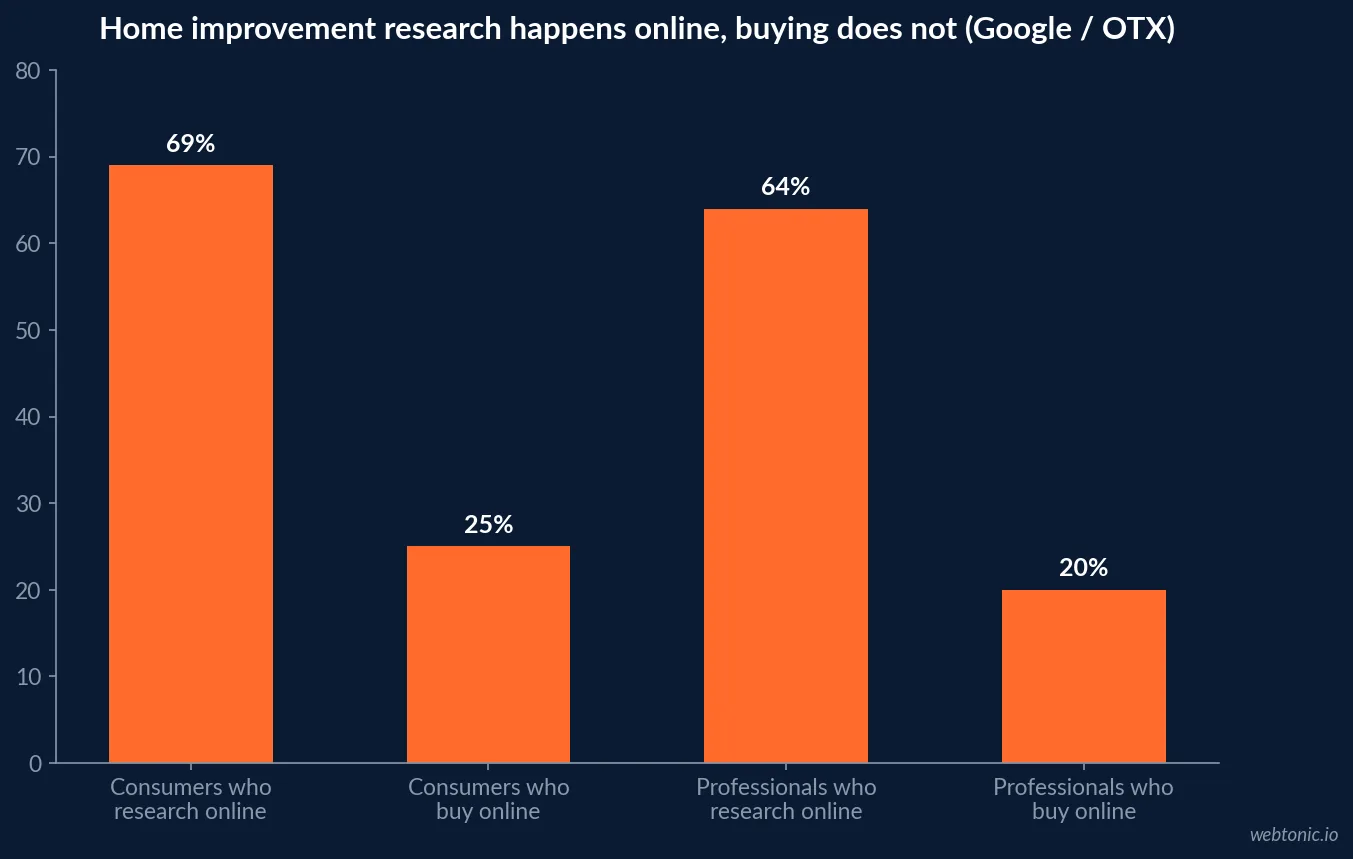
A 2009 Google/OTX study - still the most-cited public data on the shape of this specific funnel - found 69% of consumers and 64% of professionals research home improvement products online before buying, but only 25% of consumers and 20% of professionals complete the purchase online. The rest close in a store, over the phone with a Pro desk, or with a contractor. The pattern is old, but nothing in Home Depot's or Lowe's own 2025/2026 reporting contradicts it at scale: both chains describe accelerating online growth alongside store-first fulfillment, not a shift away from in-store closing.
A tracking stack that only counts a web form or an online checkout as a "conversion" is, by definition, measuring a minority of this category's purchase path.
| Funnel stage (Google/OTX study) | Consumers | Professionals | What it means for tracking |
|---|---|---|---|
| Research home improvement products online | 69% | 64% | Search and content tracking works fine here |
| Complete the purchase online | 25% | 20% | Last-click web conversion only reaches this slice |
| Close offline (store, phone, Pro rep) | ~75% of buyers | ~80% of buyers | Needs store-visit, call or CRM tracking |
| Rely on search as the first online step | Majority | Majority | Paid and organic search still deserve first-touch credit |
How little of that gap gets measured, even in 2026
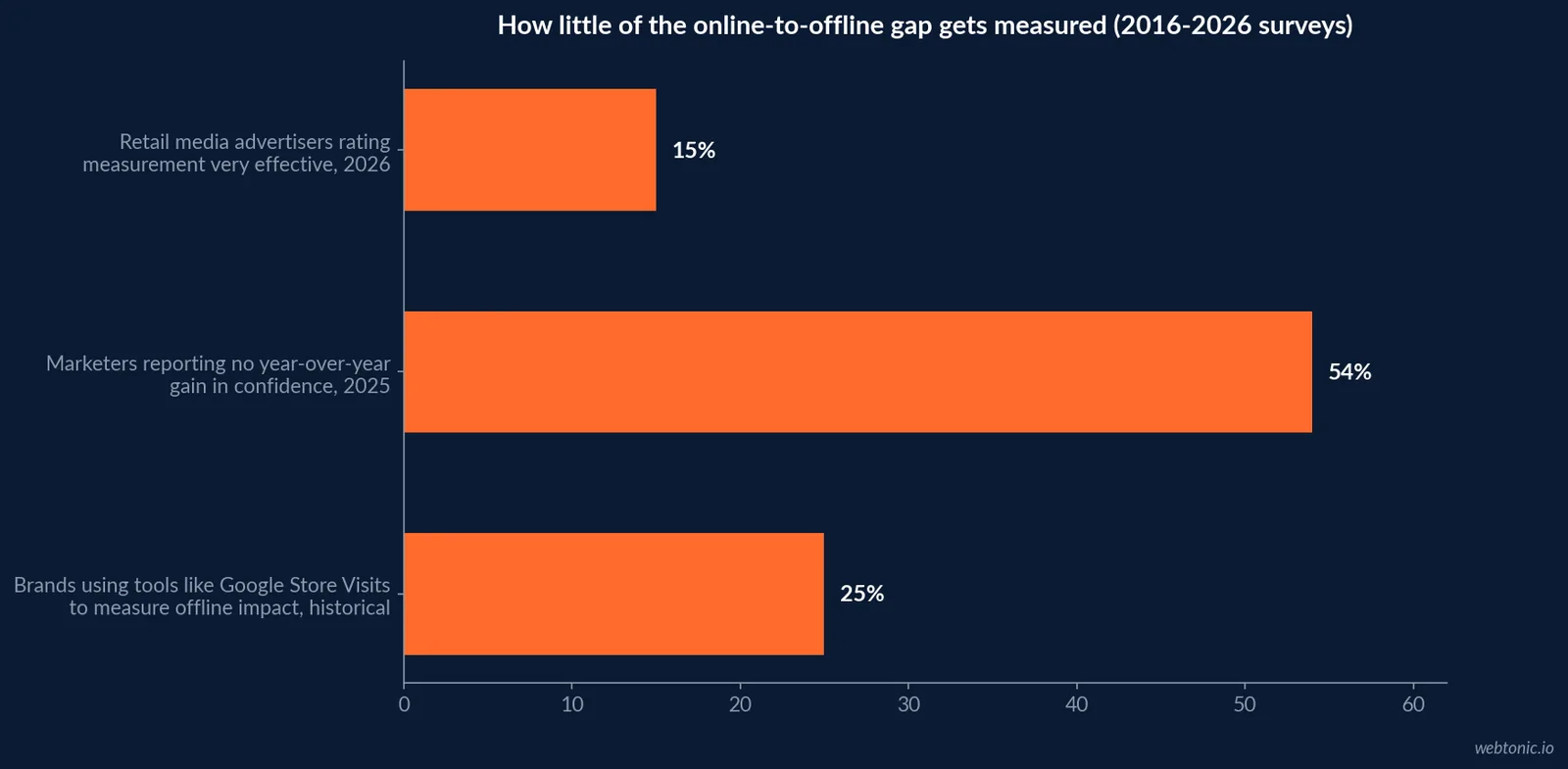
TransUnion and EMARKETER's 2025 survey of 196 U.S. marketers found confidence in measurement has stalled: 54% reported no year-over-year change and 14% said it declined, while more than a quarter have had 11% to 20% of budget reallocated or put at risk purely on measurement doubt. That is the general marketing population - home renovation retail, with its heavier offline close rate, has less reason to be more confident, not less.
Retail media specifically is worse. Skai's 2026 State of Retail Media report, built with Stratably on 166 retail media advertisers, found only 15% call their measurement very or extremely effective, with incrementality the top-cited gap at 75% and cross-channel measurement second at 59%.
| Measurement confidence signal (2025-2026) | Figure | Source |
|---|---|---|
| Marketers with no YoY gain in measurement confidence | 54% | TransUnion / EMARKETER |
| Marketers reporting declining confidence | 14% | TransUnion / EMARKETER |
| Budget at risk from measurement doubt (11-20% band) | 27%+ | TransUnion / EMARKETER |
| Retail media advertisers rating measurement very effective | 15% | Skai / Stratably 2026 |
| Advertisers naming incrementality their top measurement gap | 75% | Skai / Stratably 2026 |
| Advertisers naming cross-channel visibility a top gap | 59% | Skai / Stratably 2026 |
The legacy finding that started this conversation
The oldest data point in this space is also the bluntest: a 2016 Netsertive/CMO Council survey of 189 senior marketing leaders selling through physical retail found fewer than 25% of brands were using tools such as Google Store Visits to measure the impact of digital spend on offline sales, even though 94% called omnichannel coordination important or critical. That gap between stated priority and actual instrumentation is the single most consistent finding across every measurement survey cited on this page, a decade apart.
Treat that figure as a directional baseline, not a current benchmark - the newer TransUnion and Skai data above shows the same shape of problem persisting into 2025-2026, just measured differently.
What Google Ads and Meta actually offer today
Google's own Store Visits documentation confirms the mechanism: eligible accounts can add store visits to the All Conversions column, but the figure is modeled and aggregated from anonymized location data, not a receipt match, and eligibility depends on account scale and location count - which rules out many single-market or regional home renovation retailers from the start.
On the paid-search side, Google Ads' own Store ratings documentation states a rating of 3.5 stars or above is required before a store rating can display on text ads, and that store ratings drive an average 2% click-through rate improvement on the Search network. That is a small, verifiable lever tied directly to review volume and rating - the same data this page's sibling review pages measure from the reputation side.
| Tracking layer | What it actually measures | Known limitation |
|---|---|---|
| Google Ads Store Visits | Modeled store visit after an ad interaction | Eligibility gated by scale; not receipt-level |
| Google Ads Store ratings | Star rating shown next to text ads (3.5+ required) | Only lifts CTR ~2%; not a sales close signal |
| Call tracking / Invoca-style platforms | Answered calls, lead flag, on-call conversion | Only 38% of answered calls get flagged as a lead |
| Meta Conversions API, offline events | Physical-store events sent back to the ad platform | Requires a dataset build and ongoing CRM feed |
| Retail media network self-reporting | In-network attributed sales inside one retailer's own media arm | Closed measurement; hard to compare across networks |
The call-tracking blind spot inside the store-visit blind spot
Even where a retailer builds a call-tracking layer, the process gap shows up immediately. Invoca's 2026 Home Services Lead Conversion Benchmarks report - built on anonymized call data across nine adjacent trades including plumbing, HVAC and construction - found only 52% of calls are answered by a person, 38% of answered calls are flagged as a lead, and 55% of home services businesses never ask the caller to buy or book. Home renovation retail's Pro desks and installation-consultation lines run on the same phone-first pattern, so the same fix applies: instrument the call before trying to attribute it to a channel.
Invoca also reports ChatGPT-referred calls now carry the highest phone lead rate of any channel at 45%, about five points ahead of paid search at 40% - an early signal that AI-referred traffic is arriving with unusually high intent, and one more reason a phone-blind tracking stack is increasingly incomplete.
The market this gap sits inside
HIRI's August 2026 Economic Industry Update puts the U.S. home improvement products market at USD 540.1 billion in 2026, up from a revised USD 526.5 billion in 2025, with growth accelerating toward an average 3.8% a year from 2027 to 2029. Against a market that size, a measurement stack that only sees the online-close quarter of the funnel is leaving three-quarters of the buying pattern to guesswork, brand-level media-mix modeling, or nothing at all.
The two chains anchoring the category are both leaning further into digital without moving away from the store: Lowe's 2025 Annual Report states online sales grew 8.8% and now represent 13% of retail sales, driven by "an increase in both traffic and conversion." Home Depot's own fiscal 2025 earnings release confirms full-year sales of USD 164.7 billion, and its 2025 annual report describes "the highest conversion rates in company history" for its online business - alongside continued heavy store fulfillment.
| Retailer metric (FY2025) | Figure | Source |
|---|---|---|
| Home Depot fiscal 2025 total sales | USD 164.7 billion | Home Depot Q4 FY2025 earnings release |
| Lowe's fiscal 2025 total sales | USD 86.3 billion | Lowe's 2025 Annual Report |
| Lowe's online sales growth, FY2025 | 8.8% | Lowe's 2025 Annual Report |
| Lowe's online share of retail sales | 13% | Lowe's 2025 Annual Report |
| U.S. home improvement products market, 2026 | USD 540.1 billion | HIRI, August 2026 |
Where to instrument first if the budget is limited
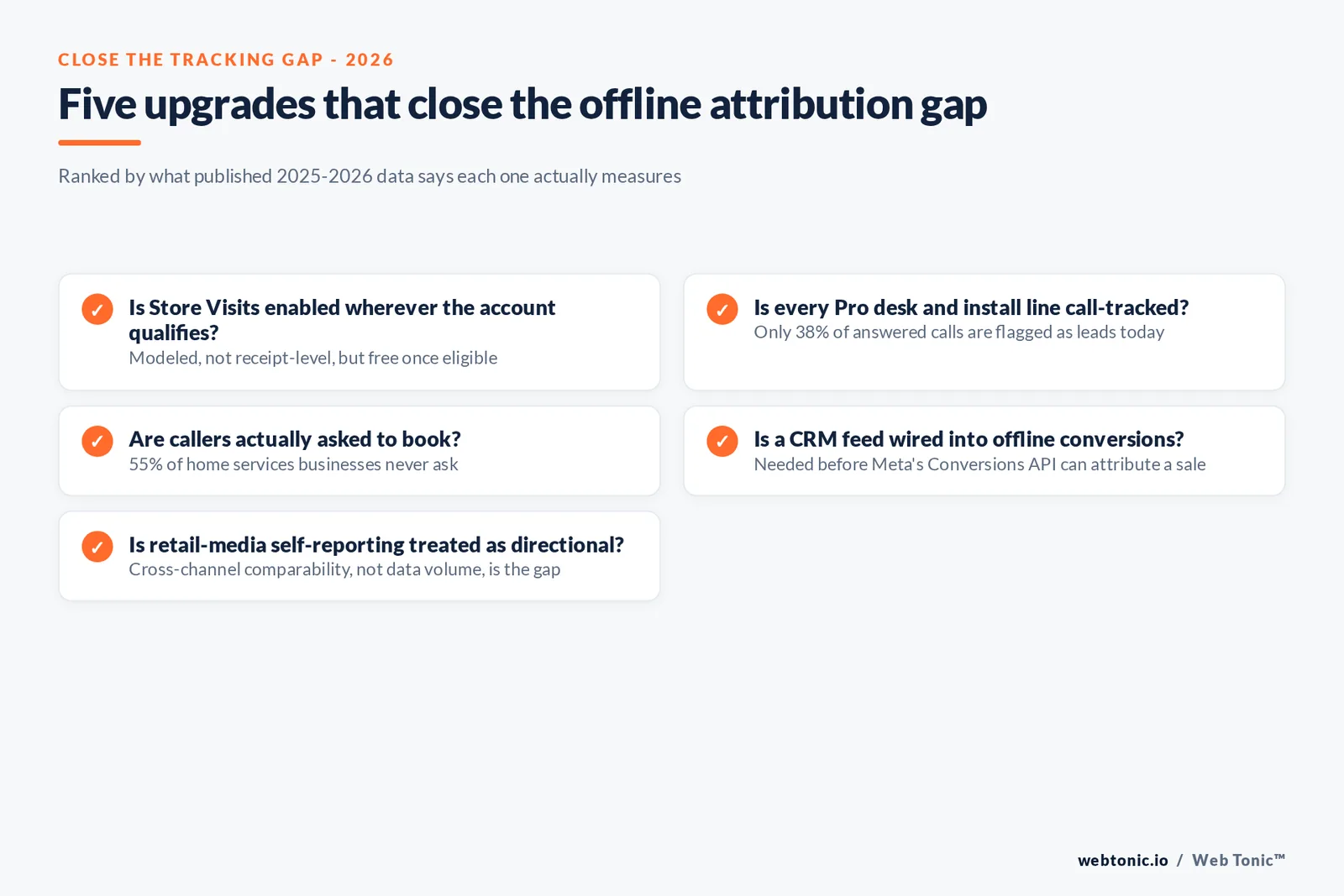
Prioritize in this order: enable Google Ads store-visit reporting wherever the account is eligible, because it is a switch, not a build; add call tracking to every Pro desk and installation-consultation line, because the Invoca data shows the process gap (55% never ask to book) is often bigger than the tracking gap; then layer Meta's Conversions API for offline events once a CRM feed exists to send back. Retail-media self-reported numbers should be treated as directional only, since Skai's 2026 report found cross-channel comparability, not data volume, is the actual constraint on trusting those numbers.
Our data and analytics practice builds this kind of online-to-offline instrumentation before touching channel budget, and our growth marketing practice uses it to reallocate spend once the store-visit and call signal actually exists. If your current stack has none of this in place, talk to us about scoping the first two steps.
Budgeting for the instrumentation, not just the media
None of the tracking layers above are free to build. Call tracking and CRM integration require setup hours, a store-visit goal requires Google Ads account eligibility review, and a Conversions API feed needs an engineering resource to keep the dataset current. Treat that build cost as separate from media spend and stage it against the size of the blind spot: HIRI's USD 540.1 billion 2026 market estimate makes even a partial view of the offline 75-80% of the funnel worth the engineering time, but a single-location retailer should scope call tracking first and defer the CRM-to-Meta feed until volume justifies it.
Read our breakdown of Google Ads cost structures before committing a media budget increase on the strength of a store-visit or call-tracking number that has not yet been cross-checked against a second source.
| Instrumentation step | Approximate build effort | What it unlocks |
|---|---|---|
| Enable Store Visits goal in Google Ads | Low - account setting, if eligible | Modeled in-store visit attribution |
| Add call tracking to Pro/consultation lines | Medium - phone number and CRM tagging | Lead flag and on-call conversion rate |
| Fix the ask-to-book process gap | Low - script and training, not tooling | Converts existing calls, no new tracking needed |
| Build a CRM feed into Meta's Conversions API | High - engineering resource and ongoing maintenance | Offline event matching for ad optimization |
| Cross-check retail-media self-reporting externally | Medium - a second measurement source | Corrects for closed, in-network attribution bias |
What this does not yet solve
None of the tracking layers above produce a receipt-level match between an ad impression and an in-store purchase for most home renovation retailers - that capability is still largely confined to a handful of the largest advertisers with dedicated retail-media measurement teams. For most of the category, the honest state of the art is modeled store visits, tracked calls, and a CRM feed into offline conversions - directional signal, stacked from three sources, rather than one clean number.
Frequently Asked Questions
Why is offline attribution harder for home renovation retail than for general retail?
Because the category's own numbers say the purchase rarely finishes where the research started. Google and OTX's home improvement funnel study found 69% of consumers and 64% of professionals research home improvement products online, but only 25% and 20% respectively complete the purchase online - the rest close in a store, on a call, or with a Pro rep. A tracking stack built only on last-click web conversions is blind to most of that funnel by design, not by accident.
What share of marketers actually trust their cross-channel measurement in 2026?
Not many. TransUnion and EMARKETER's 2025 survey of 196 U.S. marketers found just 15% describe their cross-retailer or cross-channel measurement as very or extremely effective (Skai/Stratably's 2026 State of Retail Media report, n=166 advertisers), and 54% of TransUnion's respondents reported no year-over-year improvement in measurement confidence at all, with 14% saying it got worse.
Does Google Ads have a built-in way to measure store visits from search or video ads?
Yes - store visit conversions, reported inside the All Conversions column once an account is eligible and a store visits goal is set, per Google's own Ads Help documentation. It is a modeled, aggregated estimate, not a receipt-level match, and eligibility depends on account size and location count, so smaller regional home renovation retailers are the ones most likely to have no store-visit signal at all.
What does the research-online, buy-in-store pattern mean for budget allocation?
It means a channel that shows a weak last-click return can still be driving the store visit that closes the sale, and a channel that shows a strong last-click return can be capturing demand another channel generated. HIRI puts the 2026 U.S. home improvement products market at USD 540.1 billion; a market that size cannot be safely optimized on web-conversion data alone when the majority of its purchase research pattern says the close happens elsewhere.
What is the cheapest fix for a retailer with no offline tracking at all?
Call tracking is usually the fastest win, because home renovation retail already runs Pro desks and project consultations by phone. Invoca's 2026 Home Services Lead Conversion Benchmarks report (industries adjacent to home renovation) found only 38% of answered calls are flagged as leads and 55% of businesses never ask the caller to book, which is a measurement and a process gap that a call-tracking layer exposes in the first reporting cycle, before any store-visit or CRM integration is built.
Sources
Google / OTX - The Home Improvement Purchase Funnel
TransUnion / EMARKETER - The True Cost of Trust in Marketing Measurement
Skai / Stratably - The 2026 State of Retail Media Measurement and Incrementality
MarTech - Report: 93% of brands and retailers misaligned, harming omnichannel efforts
Google Ads Help - Show store visit conversions
Google Ads Help - About store ratings
Invoca - Home Services Lead Conversion Benchmarks Report 2026
HIRI - Economic Industry Update, August 2026
Lowe's - 2025 Annual Report
Home Depot - Fourth Quarter and Fiscal 2025 Earnings Release