Table of contents

No email vendor publishes a home-improvement-retail-specific open rate, so the honest starting point is Mailchimp's own Ecommerce category at 29.81% - below its 35.63% all-users average - read against real 2026 renovation-spend timing data from Houzz and Angi. This page builds the benchmark instead of inventing one.
Key Takeaways
- No vendor publishes a home-improvement email benchmark - Ecommerce is the closest labeled Mailchimp category.
- Mailchimp's Ecommerce open rate is 29.81%, click rate 1.74%, unsubscribe rate 0.19%.
- That trails the 35.63% all-users open rate average.
- Non-Profits lead at 40.04% open rate; Education + Training at 35.64%.
- 50% of homeowners plan a 2026 renovation project, down from 52% in 2025 (Houzz).
- Planned median spend fell to USD 15,000 for 2026, from USD 20,000 in 2025.
- 84% of homeowners fund renovations from savings; 34% now use credit cards, up 5 points.
- Millennials spend USD 14,199 a year on home projects on average, the most of any generation (Angi).
- Their maintenance spend of USD 2,601 and emergency spend of USD 1,519 both lead all generations.
- Silent Generation emergency spend is just USD 140, the lowest of any generation.
- The US home improvement products market is projected at USD 540.1 billion in 2026 (HIRI), up from USD 526.5 billion in 2025.
Why "home improvement" is not a Mailchimp category
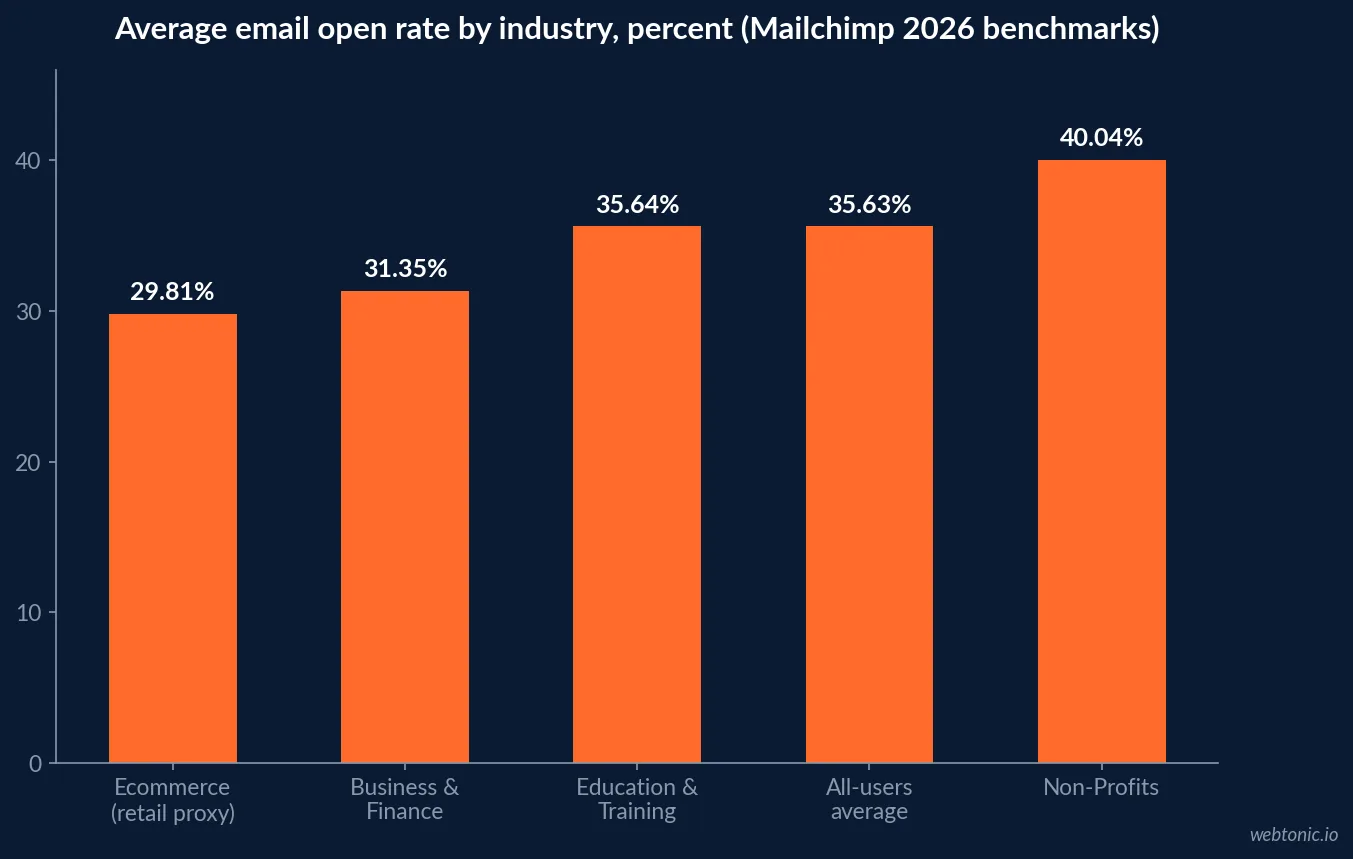
Mailchimp's own 2026 email marketing benchmarks page breaks industries into groups like Business + Finance, Non-Profits, Education + Training and Ecommerce - it does not publish a home improvement or home renovation retail line. Ecommerce is the closest labeled proxy for a retailer selling physical product online and in-store, and it is a below-average category in Mailchimp's own data: 29.81% open rate and 1.74% click rate, against a 35.63% open rate and 2.62% click rate across all Mailchimp users.
| Mailchimp category (2026) | Avg. open rate | Avg. click rate | Unsubscribe rate |
|---|---|---|---|
| Non-Profits | 40.04% | 3.27% | 0.18% |
| Education + Training | 35.64% | 3.02% | 0.18% |
| All Users (average) | 35.63% | 2.62% | 0.22% |
| Business + Finance | 31.35% | 2.78% | 0.15% |
| Ecommerce (retail proxy) | 29.81% | 1.74% | 0.19% |
What is actually happening to renovation demand right now
The 2026 U.S. Houzz and Home Renovation Trends Study (a survey of 20,358 users, 10,176 of them renovating homeowners) reports that 50% of homeowners plan a project in 2026, down slightly from 52% in 2025, with decorating (41%, down from 44%) and repairing (35%, down from 37%) both softening. The median planned renovation spend for 2026 is USD 15,000, down from USD 20,000 in 2025 - a real pullback that should shift email creative toward entry-price and maintenance offers rather than the full-remodel financing pitch.
Financing is also shifting: 84% of homeowners still fund renovations from savings, but 34% now use credit cards, up 5 percentage points year over year, and homeowners with budgets over USD 50,000 turn more often to home equity loans (23%) and proceeds from a home sale (20%).
| Houzz 2026 study metric | 2025 actual | 2026 planned | Change |
|---|---|---|---|
| Share undertaking a renovation | 54% | 50% (planned) | -4pp planned vs 2025 actual |
| Share decorating | 52% | 41% (planned) | -3pp vs 2025 planned |
| Share repairing | 47% | 35% (planned) | -2pp vs 2025 planned |
| Median renovation spend | USD 20,000 | USD 15,000 (planned) | -25% |
| 90th-percentile spend | USD 150,000 | n/d for 2026 plans | up 7% in 2025 vs 2024 |
Who spends what, and when to email them
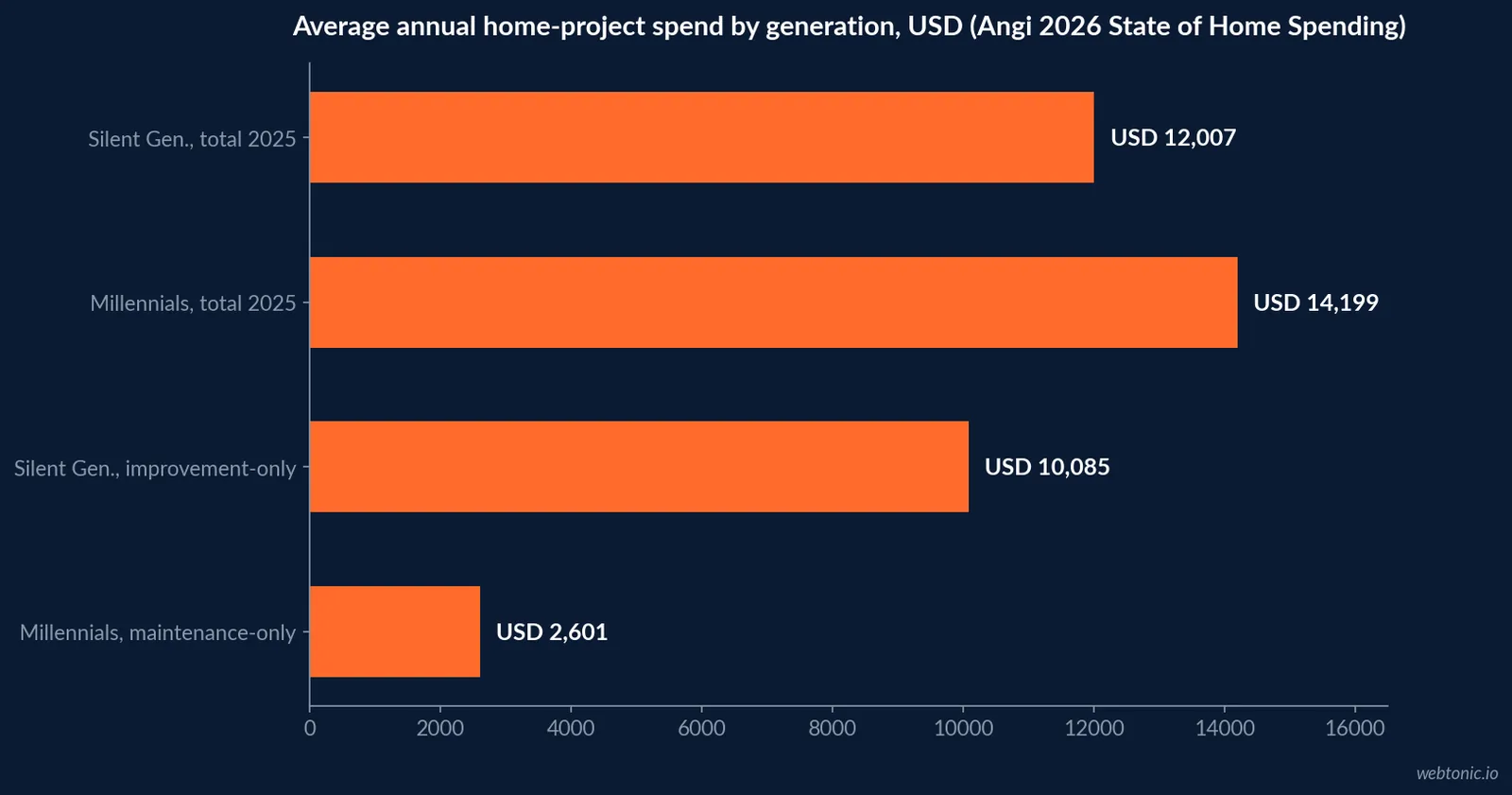
Angi's 2026 State of Home Spending report (via its company announcement) puts Millennials as the highest-spending generation at an average USD 14,199 a year on home projects, including the highest maintenance spend at USD 2,601 and highest emergency spend at USD 1,519. The Silent Generation spends USD 12,007 overall - less in total but a larger share on improvement projects specifically (USD 10,085) and almost nothing on emergencies (USD 140, the lowest of any generation). That is a workable segmentation cue: emergency-readiness and maintenance-plan emails toward a younger list, planned-improvement offers toward an older one.
| Generation (Angi 2026) | Avg. annual total spend | Notable component |
|---|---|---|
| Millennials | USD 14,199 | Highest maintenance (USD 2,601) and emergency (USD 1,519) spend |
| Silent Generation | USD 12,007 | Second-highest improvement spend (USD 10,085), lowest emergency spend |
The market this list is being emailed against
HIRI's August 2026 Economic Industry Update projects the US home improvement products market at USD 540.1 billion in 2026, up from a revised USD 526.5 billion in 2025, with growth continuing past USD 600 billion by 2029. That is a growing addressable market even as individual project budgets soften - which argues for a list strategy built on purchase frequency and category depth (paint, fixtures, seasonal items) rather than betting the whole program on big-ticket remodel conversions.
| HIRI market size projection | Figure | YoY change |
|---|---|---|
| 2025 (revised) | USD 526.5 billion | baseline |
| 2026 (projected) | USD 540.1 billion | +2.6% |
| 2029 (projected) | over USD 600 billion | multi-year growth |
What a below-average Ecommerce open rate is actually competing against
The gap between Ecommerce's 29.81% open rate and Non-Profits' 40.04% is not primarily a copywriting problem - donor and cause-driven email typically enjoys higher intent-to-open than a promotional retail send, which is why Mailchimp's own benchmark table separates the two rather than averaging them together. A retailer should track its own open rate trend against the 29.81% Ecommerce line specifically, not the 35.63% all-users figure that includes higher-intent categories it cannot fairly be compared to.
Segmentation quality moves the number more than subject-line tactics do. A list mixing one-time promotional signups with repeat Pro or contractor buyers is diluting both segments' relevance - splitting the two, and messaging each against its own spend pattern from the Angi data above, is the more durable lever.
| Lever | What it targets | Data point behind it |
|---|---|---|
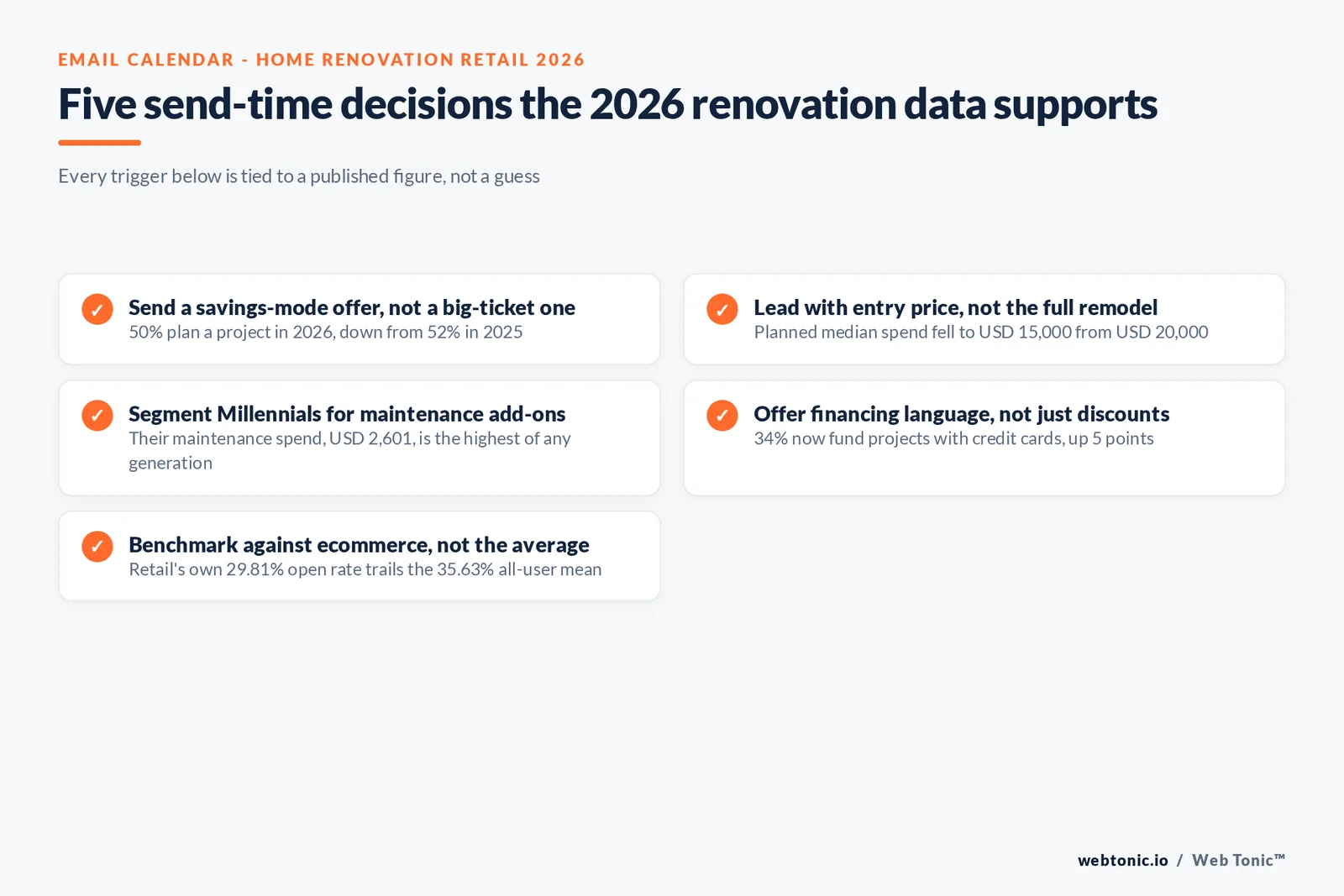
| Segment by generation | Relevance of maintenance vs. improvement framing | Angi 2026 spend components |
| Lead with entry-price SKUs | Match message to softening 2026 budgets | Houzz planned spend, USD 15,000 |
| Add financing language | Match rising credit-card usage | Houzz: 34% now use credit cards, +5pp |
| Benchmark against Ecommerce, not all-users | Realistic open-rate target | Mailchimp 2026, 29.81% vs 35.63% |
Where this fits the wider retail marketing mix
Email is one channel inside a broader digital budget that, per the market sizing above, is growing even as individual project size softens - which argues for treating email as a retention and cross-sell tool for the high-frequency purchases (paint, fixtures) rather than the primary channel for winning a full-remodel customer, a job better suited to paid search and local SEO. Our Google Ads pricing guide covers how that acquisition-side spend is typically sized against a retention channel like email.
The compliance layer under every send
CAN-SPAM requires a working unsubscribe link, accurate sender and subject information and a physical postal address in every commercial email, including automated post-purchase and review-request sequences a retailer might treat as "transactional." The FTC's 2024 rule against fake or deceptive reviews and testimonials also reaches email review requests directly: offering an incentive for a review without disclosing it, or filtering out negative responses before they reach a public review site, is now an explicit enforcement target rather than a gray area worth risking on a high-volume retail list.
Neither rule is unique to renovation retail, but the category's high purchase frequency for low-consideration products (paint, fixtures) means retailers send review requests more often than most, which raises the practical exposure even where the legal standard is the same as any other ecommerce sender.
Building the program from here
Set the open-rate goal at 29.81% (Ecommerce), not 35.63% (all-users), lead fall/winter 2026 sends with entry-price and maintenance offers given the pullback in planned spend, and segment by generation using Angi's spend components rather than a single seasonal blast. Our data and analytics practice builds that segmentation from a retailer's own purchase history; if you want the program built end to end, talk to us.
None of the figures above are a promise of what a specific list will do - Mailchimp's own benchmark table already spans a 10-point range across categories it does track directly, and a retailer's actual performance depends on list hygiene, send cadence and creative quality as much as category. The value of naming the Ecommerce line explicitly is simply avoiding the more common mistake: comparing a retail list's real numbers against the flattering all-users average and concluding the program is underperforming when it is, in fact, in line with its category.
Frequently Asked Questions
Is there an email benchmark specifically for home renovation retail?
No. Mailchimp, the vendor whose benchmark data is used across this page, does not publish a home improvement or home renovation retail category. The closest labeled proxy in its own 2026 table is Ecommerce, at a 29.81% open rate and 1.74% click rate - below its 35.63% all-users average. Any page that states a home-improvement-specific open rate without naming a source is presenting a guess as a fact; this page uses Ecommerce and says so.
What is a realistic open rate for a home renovation retailer's email list?
Benchmark against Mailchimp's Ecommerce figure of 29.81%, not the 35.63% all-users average, since retail transactional and promotional email typically underperforms services and B2B verticals in Mailchimp's own data (Business + Finance 31.35%, Education + Training 35.64%, Non-Profits 40.04%). A retailer sitting meaningfully below 29.81% has a list-quality or subject-line problem worth isolating before assuming the category ceiling is the cause.
When should a retailer send its highest-value renovation offers?
Houzz's 2026 study shows planned 2026 renovation activity already softening - 50% of homeowners plan a project versus 52% in 2025, with the median planned spend falling to USD 15,000 from USD 20,000. That argues for leading fall/winter 2026 campaigns with entry-price and maintenance offers rather than the full-remodel financing pitch that worked when the median planned spend was higher, and saving the larger asks for homeowners who show engagement signals consistent with a bigger project.
Which segment should get a maintenance-focused email versus a big-project one?
Angi's 2026 State of Home Spending report gives generational spend a clear shape: Millennials lead all generations in average annual home-project spending at USD 14,199, including the highest maintenance spend at USD 2,601 and highest emergency spend at USD 1,519. The Silent Generation spends less overall (USD 12,007) but a larger share on improvement (USD 10,085) and almost nothing on emergencies (USD 140). That argues for maintenance and emergency-readiness messaging to a younger list and improvement-focused messaging to an older one, rather than one generic seasonal blast.
Does CAN-SPAM or the FTC's review rules affect a retailer's email program?
Both apply. CAN-SPAM requires a working unsubscribe mechanism, accurate header/subject information and a physical postal address in every commercial email, including automated post-purchase and review-request sends. The FTC's 2024 rule banning fake and deceptive reviews and testimonials also reaches email: asking a customer for a review in exchange for an incentive without disclosing that incentive, or suppressing negative reviews solicited by email, is now explicitly an enforcement target, not a gray area.
Sources
Mailchimp - Email Marketing Benchmarks & Industry Statistics
Houzz - 2026 U.S. Houzz and Home Renovation Trends Study
Angi - 2026 State of Home Spending report (company announcement)
HIRI - Economic Industry Update, August 2026
Federal Trade Commission - CAN-SPAM Act compliance guide