



Table of contents
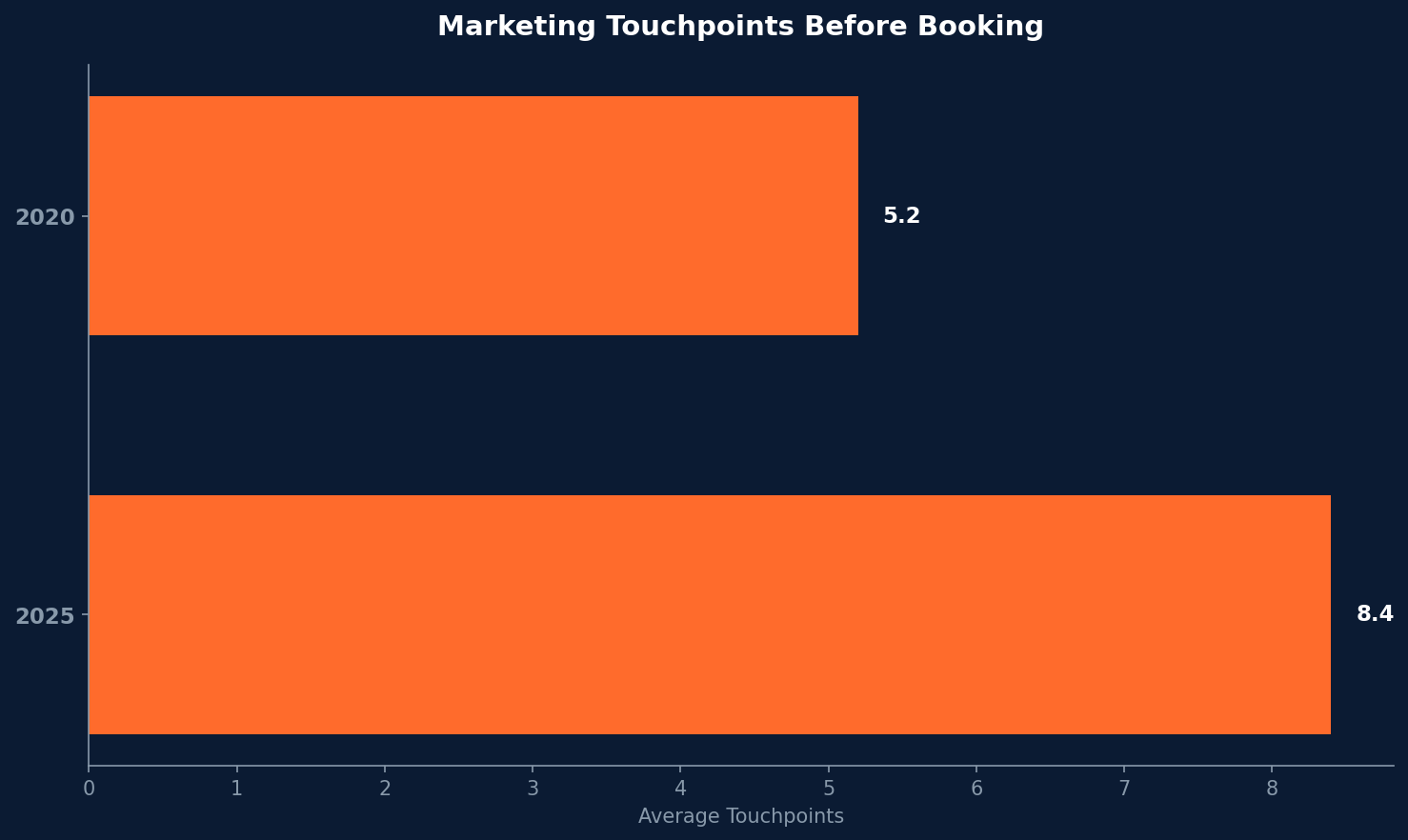
HVAC contractors touch 8.4 marketing channels before a homeowner books a job, yet 63% of businesses cannot prove marketing ROI because last-click attribution misallocates up to 40% of conversion credit, according to Numen Technology. Without proper analytics, every ad dollar is a guess.
Key Takeaways
- HVAC websites convert visitors to leads at 7.8% on average, but phone leads convert at 46% — making call tracking the single most important analytics investment (BaaDigi/SearchLight, 816 contractors).
- Multi-touch attribution lifts profit per job by 15% versus last-click models for contractors using it correctly (Funnel Fabric, 2025).
- Blended HVAC cost per lead is $104 on Google Ads, with non-branded search at $149 and Performance Max at $72 (SearchLight by Hatch, $14.9M in spend).
- Customer lifetime value averages $15,340 per HVAC customer, producing a 147× return on the $104 lead cost over the relationship.
- Customers hit 8.4 marketing touchpoints before booking, up from 5.2 in 2020, making single-touch attribution dangerously unreliable.
HVAC Website Conversion Analytics
BaaDigi's 2026 HVAC benchmark data, sourced from SearchLight by Hatch covering $14.9 million in HVAC ad spend across 816 contractors, reveals that analytics gaps cost contractors more than ad spend inefficiency.
HVAC websites convert visitors to leads at about 7.8% on average, but this headline number masks a critical split: phone leads convert at roughly 46% — nearly six times the web form rate. This data point alone explains why speed-to-lead and call handling matter more than squeezing CPL for HVAC companies.
| Metric | Benchmark | Notes |
|---|---|---|
| Avg. CPL (Google Ads) | $104 | Blended across search types |
| Non-Branded Search CPL | $149 | Higher competition, colder intent |
| Performance Max CPL | $72 | Lowest CPL; mixed lead quality |
| Web Conversion Rate | 7.8% | Visitor to lead |
| Phone Lead Conversion | 46% | Call to booked job |
| Customer Lifetime Value | $15,340 | Repeat maintenance + replacements |
| Net Profit Margin | 8% | Industry avg for established shops |
The $15,340 customer lifetime value against a $104 blended lead cost produces a 147× return over the customer relationship. Net margins run about 8% for established shops, meaning the real revenue leak is conversion, not ad spend. Companies investing in data intelligence platforms that track lifetime value alongside acquisition cost gain a structural advantage over competitors focused only on CPL.
Attribution and Multi-Touch Tracking
Single-touch attribution is dangerously outdated for HVAC marketing. PipelineOn's contractor attribution analysis documented how the customer journey has become dramatically more complex.
The average contractor customer hits 8.4 marketing touchpoints before booking a job, up from 5.2 in 2020 (Numen Technology, 2025). Despite this complexity, 63% of businesses cannot prove marketing ROI because last-click attribution misallocates up to 40% of conversion credit to bottom-funnel channels.
Multi-touch attribution lifts profit per job by 15% for contractors using it correctly (Funnel Fabric, 2025). The mechanism is straightforward: last-click systematically overpays branded search and retargeting while underpaying the channels that started the customer journey. A homeowner sees a Facebook ad on Tuesday, Googles the company name on Friday, clicks a branded search ad, and calls Monday. Last-click credits branded search for the entire $14,000 furnace install — Facebook gets zero credit, and eventually gets its budget cut.
Offline conversion tracking via GCLID and CRM integration is the only way to credit Google Ads for jobs that close 2–6 weeks after the initial click. For HVAC, where the decision cycle for replacements spans 30–90 days, attribution windows shorter than 60 days miss the majority of high-value conversions.
Call Tracking Analytics
Phone calls dominate HVAC lead volume. The Snow Media reports that phone calls represent 70%–80% of all HVAC leads, and missed calls waste an estimated $1,500 per month for the average contractor.
Call tracking assigns unique phone numbers to each marketing channel. CallRail's dynamic number insertion operates at the keyword level, meaning contractors see calls credited to specific search terms like "emergency furnace repair near me" vs "best HVAC company [city]." Most contractor setups start around $45 per month for the entry plan.
According to Marketing LTB's compilation of 97+ HVAC statistics, 80% of HVAC searches happen outside normal business hours, making after-hours call handling and tracking critical. Companies with 24/7 support convert 38% more leads than those limited to business hours, and 52% of HVAC customers choose the first company they contact.
The analytics implication is clear: speed-to-lead tracking matters more than CPL tracking for HVAC companies. A $150 lead answered in 30 seconds converts at 46%, while a $50 lead that goes to voicemail converts at near zero. Contractors who work with specialized Google Ads agencies benefit from call tracking integrations that measure time-to-answer alongside cost-per-lead.
Website Performance Analytics
Site speed directly impacts HVAC conversion analytics. BaaDigi's client case study demonstrates the ROI: after rebuilding a Southern Maryland HVAC company's site and cutting load time from 4.2 seconds to 1.4 seconds, phone leads grew 45% within 5 months and organic traffic rose 38%.
Yet PipelineOn's Q2 2026 data shows the industry is far from that benchmark. The median mobile landing page load time across home service advertisers is 7.3 seconds (average 9.7 seconds), with 78% loading slower than 4 seconds and 47% loading slower than 8 seconds.
Fast-loading HVAC websites convert 50% better than slow ones, according to Marketing LTB. Combined with the finding that 65% of HVAC leads come from mobile devices, mobile speed analytics should be a top dashboard metric for every HVAC marketing program.
| Speed Metric | Industry Median | Target | Impact |
|---|---|---|---|
| Mobile LCP | 7.3 seconds | < 2.5 seconds | 78% currently fail |
| Average Load Time | 9.7 seconds | < 3 seconds | 47% in Poor zone |
| Phone Lead Lift (fast site) | — | — | +45% in 5 months |
| Organic Traffic Lift | — | — | +38% post-rebuild |
HVAC Marketing ROI Measurement
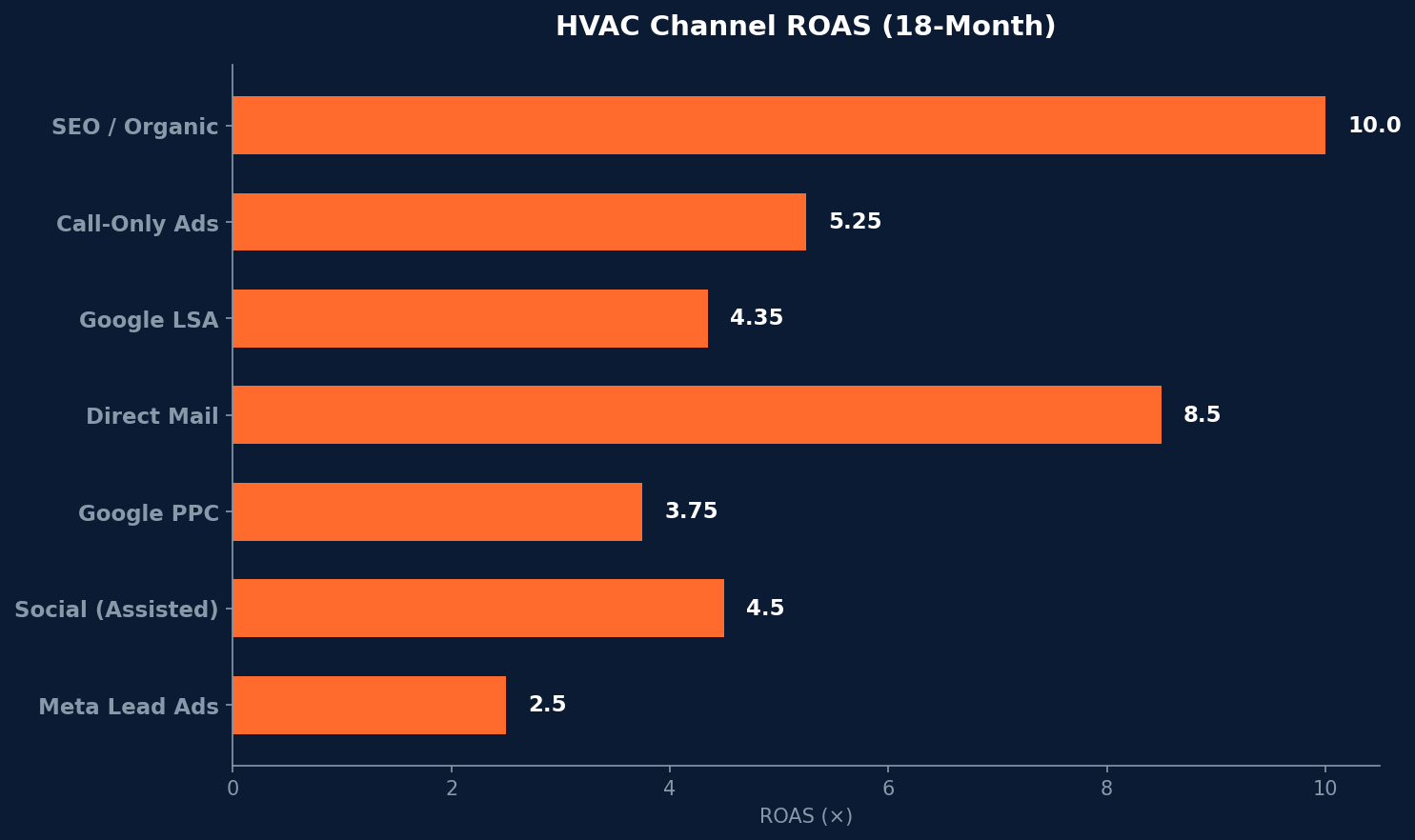
Measuring true ROI requires tracking beyond the lead stage. SureShot Systems aggregated 18 months of data from 127 HVAC contractors (43,200 leads, 12,800 closed jobs, $18.4M in tracked revenue) to build channel-level ROI analytics.
SEO delivers the highest long-term ROAS at 10:1 or higher over 18 months, with organic CPL dropping from $180 at month 3 to under $70 by month 12, and close rates of 30%–40%. Google Search PPC achieves 2.5×–5.0× ROAS with 30%–50% close rates on emergency leads. Direct mail produces 4:1 to 13:1 ROAS when targeting older systems in serviceable ZIP codes.
Social paid advertising shows the lowest standalone ROI at 3:1–6:1 assisted ROAS, but its value is in top-of-funnel awareness that feeds branded search volume. This is exactly the attribution gap that single-touch models miss: cutting social spend reduces search lead volume 6–12 months later because fewer homeowners remember the brand.
CRM and Lead Scoring Analytics
HVAC companies using CRM systems close 29% more deals than those without, according to Marketing LTB. The analytics advantage comes from tracking the full funnel: which lead sources produce booked jobs (not just form fills), which technicians have the highest close rates, and which service types generate repeat business.
AI-powered platforms like Mack now automate lead validation by transcribing and scoring every call based on intent signals, ensuring sales teams focus on qualified homeowners rather than spam or wrong numbers. This level of analytics sophistication was previously only available to enterprise operations.
HVAC email marketing campaigns average a 22% open rate, and follow-up sequences increase conversion rates by 18%. Companies using marketing automation increase booking rates by 32% (Marketing LTB). When integrated with CRM analytics, these automated touchpoints become trackable revenue drivers rather than cost centers. Contractors who implement growth marketing frameworks see measurably faster feedback loops between marketing spend and revenue.
Pixel and Measurement Infrastructure Gaps
The analytics foundation for most HVAC companies is broken. PipelineOn's data reveals that 79% of HVAC Facebook advertisers ran no Meta Pixel, 96% lacked Conversions API, and 100% had no lead recovery tooling. Without this infrastructure, analytics platforms cannot attribute conversions to specific campaigns, ad sets, or creatives.
The operational cost of these gaps is substantial. Yusr Prime's HVAC conversion optimization guide recommends tracking bounce rate by page and device, cost per lead by channel, phone calls by day/time/source, and form submissions by page — all of which require properly configured analytics.
HVAC companies with Google Business Profiles get 2× more calls on average, and those with photos on listings get 42% more requests — but these lifts are only visible in analytics when GBP data is integrated with website and CRM tracking. Siloed analytics produce siloed decisions, and the cost compounds monthly. Investing in understanding the true cost structure of HVAC advertising requires connected analytics across every channel.
Behavioral and Engagement Analytics
Understanding how homeowners interact with HVAC marketing content reveals optimization opportunities invisible in standard conversion metrics. 85% of HVAC searches are intent-driven, targeting specific service needs like repair, installation, or emergency response rather than general browsing (Marketing LTB).
HVAC companies posting weekly content get 2.5× more traffic than those publishing less frequently. The analytics insight is that consistent content production creates compounding organic visibility that reduces paid CPL over time. Companies with blogs generate 67% more monthly leads — a measurable lift that only appears when content analytics are tracked alongside paid performance.
69% of HVAC customers check social media before contacting a company, and 88% trust online reviews as much as personal recommendations. These behavioral signals mean HVAC analytics must extend beyond website and ad platforms to include review monitoring, social engagement tracking, and reputation management metrics. Companies that partner with full-service agencies gain access to unified analytics dashboards that connect these disparate data streams.
Related reading
- Heating & Ventilation Email Marketing Benchmarks: What the Data Says (2026)
- Dashboards & Reporting in the Heating & Ventilation Industry: 2026 Statistics Roundup
- The Definitive Guide to Heating & Ventilation Attribution & BI Statistics (2026)
- Marketing Analytics services at Web Tonic
FAQ
What conversion rate should HVAC websites target?
The average HVAC website converts visitors to leads at 7.8%, based on SearchLight data from 816 contractors. However, phone leads convert at 46% to booked jobs, so optimizing for call conversions delivers higher ROI than optimizing web form rates.
How much is an HVAC customer worth over their lifetime?
Customer lifetime value averages $15,340 per HVAC customer, including repeat maintenance, replacements, and referrals. Against a $104 blended cost per lead, this produces a 147× return on acquisition cost over the relationship.
Why is multi-touch attribution important for HVAC?
Customers hit 8.4 marketing touchpoints before booking an HVAC job, up from 5.2 in 2020. Last-click attribution misallocates up to 40% of conversion credit, systematically underfunding top-of-funnel channels that actually drive demand. Multi-touch attribution adds 15% more profit per job.
What is a good cost per lead for HVAC Google Ads?
The blended average is $104, with non-branded search at $149 and Performance Max at $72. Emergency residential leads via Google Search PPC range from $40–$85, while non-emergency leads cost $55–$95, based on SureShot Systems' data from 127 contractors.
How does site speed impact HVAC analytics?
The median HVAC landing page loads in 7.3 seconds on mobile, yet cutting load time to under 2 seconds can lift phone leads by 45%. Fast-loading HVAC websites convert 50% better than slow ones, making Core Web Vitals a critical analytics metric.
Sources
BaaDigi / SearchLight
PipelineOn Attribution
PipelineOn Q2 2026
The Snow Media
Marketing LTB
SureShot Systems
Yusr Prime
Mack Data


