Table of contents
X is the cheapest major paid-social auction in 2026 and the hardest one for a health brand to use legally. Average CPC is $0.74 against $1.41 on Meta, average CPM $5.65, and median cost per lead $41 — but X's healthcare policy prohibits health and pharmaceutical promotion outside a short exception list. Here is what the data says about when that trade is worth taking.
Key Takeaways
- X reaches 611 million monthly active users and 251-259 million daily actives, with ad reach of 544-600 million people.
- Average CPC $0.74 vs Meta's $1.41; average CPM $5.65-$6.46 vs Facebook's $7.19.
- Median CPL is $41 — half LinkedIn's $82 — but marketers report 34% lower lead quality than LinkedIn.
- X's health policy is an exception list: promotion of health and pharmaceutical products is prohibited unless listed.
- Only 4% of marketers consider X ads brand safe; 52% of pre-acquisition advertisers cut or stopped spend.
- Ad revenue fell from a $4.51B peak in 2021 to roughly $2.3B in 2025, with Q1 2026 revenue up 17% to $752M.
- Video ads earn 2.6x the engagement of static images, and vertical video 7x the engagement of home-timeline placements.
X Ads Benchmarks at a Glance
The table below consolidates the 2026 benchmark sets published by Searchlab, The Global Statistics and Marketing LTB. Where sources diverge we show the range rather than picking a flattering midpoint — X's auction is thin enough that medians and averages separate widely.
| Metric | 2026 benchmark | Cross-platform comparison | Planning note |
|---|---|---|---|
| Average CPC | $0.74 | Meta $1.41 | Working range $0.27-$1.95 |
| CPC during peak events | $3.00 - $5.00 | — | Cultural-moment bidding is punitive |
| Median CPC (Hootsuite dataset) | $0.18 | — | Engagement-optimised buys, not link clicks |
| Average CPM | $5.65 - $6.46 | Facebook $7.19 | Hootsuite records $2.09 on engagement buys |
| Average CTR | 0.86% | Facebook 0.90%, LinkedIn 0.52% | Promoted posts reach 1%-3% |
| Average CPA | $21.55 median | — | Rises sharply on regulated offers |
| Median cost per lead | $41 | LinkedIn $82, Facebook $24, TikTok $20 | Lead quality reported 34% lower than LinkedIn |
| Conversion rate, lead gen | 0.77% | Facebook 1.11% | Website campaigns run 1%-3% |
| Cost per follow | $2.00 - $4.00 | — | Audience-building is still cheap here |
| Promoted Trends | $100,000 - $250,000/day | — | Reserved inventory, not auctioned |
Read those rows together and X's position is clear: cheap impressions, cheap clicks, expensive qualification. The platform wins on media cost and loses on downstream conversion, which is exactly the wrong shape for a wellness offer with a long compliance-heavy funnel — unless the creative does the qualifying work upfront.
1. The Policy Wall Every Wellness Advertiser Hits First
Before benchmarks matter, eligibility does. According to Accelerated Digital Media's 2026 review of social health ad policies, X operates the most restrictive framework of the major platforms in structure if not in enforcement: its healthcare policy is written as a blanket prohibition with a short exception list, stating that unless listed, the promotion of health and pharmaceutical products and services is prohibited.
| Category | Status on X | Practical requirement |
|---|---|---|
| Telemedicine | Allowed by exception | Prior authorisation from X; advertise only in states where licensed |
| Brick-and-mortar pharmacy | Allowed by exception | No promotion of online pharmaceutical sales |
| FDA-approved medical devices | Allowed by exception | Approval documentation on file |
| Online pharmacy | Allowed by exception | NABP accreditation required |
| Supplements and nutraceuticals | Restricted | Named on X's restricted-category list; case-by-case review |
| Health-based custom audiences | Prohibited | No audiences or conversion events built on health data |
That last row is the one that breaks measurement plans. X prohibits creating custom audiences or conversion events based on sensitive information including health data — the same direction of travel as Meta's restricted health categorisation and LinkedIn's 2025 decision to disable its Insight Tag on healthcare domains. The pattern across every platform in 2026 is identical: you may still buy the impression, but you may no longer build the audience. Wellness advertisers who planned around lookalikes need a first-party alternative before they need a bid strategy, which is why measurement infrastructure now precedes media planning in most health accounts.
2. Audience: Who You Actually Reach on X in 2026
SocialNexis and Searchlab put X at 611 million MAU and 251-259 million daily active users, with advertising reach of 544-600 million people, or about 7.1% of the global population. The composition matters more than the scale.
| Audience attribute | Figure | Wellness implication |
|---|---|---|
| Gender split | 60.9% male / 39.1% female | Structural mismatch with female-skewed wellness categories |
| Largest age cohort | 25-34 (29.6%), then 18-24 (23.1%) | Good for performance, longevity and men's health |
| Urban users | 68% — highest of major platforms | Efficient for clinic and studio catchments |
| College-educated | 42% vs 33% of internet population | Supports clinical and technical claims |
| Above-median income | 37% | Viable for cash-pay and premium programmes |
| Knowledge-economy workers | 34% | Strong for B2B health tech and employer wellness |
| Mobile usage | 80-82% of sessions | Vertical creative is mandatory, not optional |
| Daily time on platform (US) | 34 minutes, flat since 2022 | Frequency builds fast in small audiences |
EMARKETER notes that the 34-minute daily average has held steady since 2022 despite advertiser turmoil — engagement per remaining user is durable even as the advertiser base thinned. One more structural fact worth planning around: 20% of X users generate 98% of posts and 47% describe themselves as lurkers. Conversation-led creative reaches a small, loud audience; the majority are reading, not replying.
3. The Revenue Story Behind Your CPMs
Cheap inventory on X is not an efficiency innovation. It is the price signal of a thinner auction. Global ad revenue peaked at $4.51 billion in 2021, collapsed roughly 46% in a single year to $2.2-$2.5 billion in 2023, and has since stabilised near $2.3 billion. WARC Media estimates a $5.9 billion hypothetical revenue gap against the platform's pre-acquisition trajectory.

The recovery signals are real but modest: Digital Applied's analysis of the SpaceX S-1 filing — the first audited X data since 2022 — records subscription revenue above $1 billion annually and Q1 2026 revenue of $752 million, up 17% year over year, while True Interactive notes the platform still posted a $577 million net loss against more than $1 billion in annual interest payments. For a media buyer the read-through is simple: today's low CPMs are a function of absent competition, and they will rise if the advertiser base returns.
4. Cost per Lead in Context
Wellness lead-gen teams comparing channels care about one number more than CPM. Searchlab's cross-platform CPL comparison puts X mid-pack on cost and bottom-tier on quality.
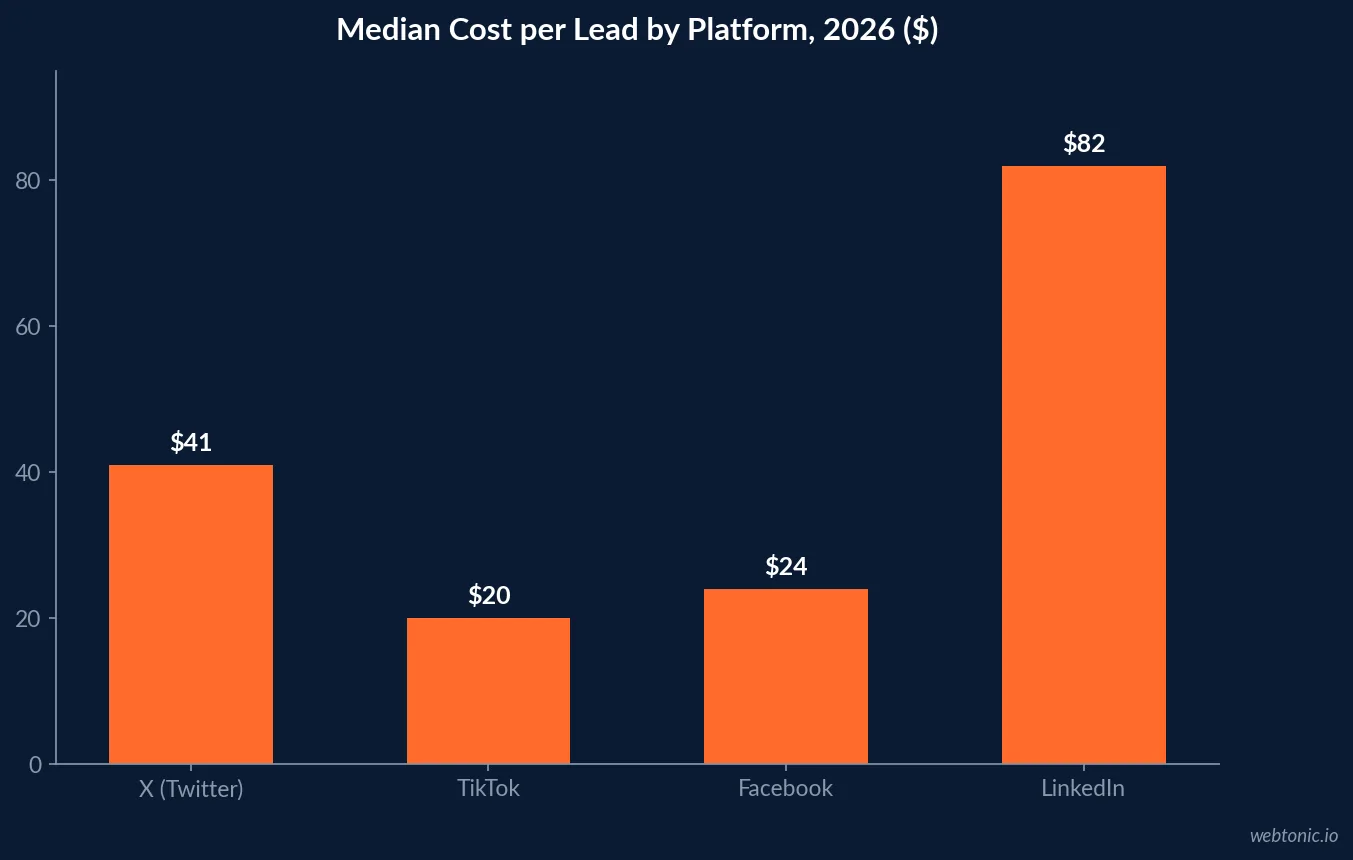
X undercuts LinkedIn by half but carries a documented 34% lower lead quality, and its visitor-to-lead conversion rate of 0.69% trails LinkedIn's 2.74%. The honest conclusion for a wellness advertiser: X is cost-effective for volume at the top of the funnel and unreliable as a standalone lead engine. Teams that make it work treat it as a feeder into retargeting pools running on Meta and search, not as a closing channel.
5. Format and Creative Data That Moves the Numbers
The format effects on X are larger than the targeting effects, which is unusual among the big platforms.
- Video earns 2.6x the engagement of static image ads, and vertical video generates 7x the engagement of standard home-timeline placements.
- Early adopters of vertical video report CPMs 14% below other formats.
- Carousel ads drive 35% more clicks than single-image ads.
- Native video receives 2.5x more reach than posts linking out to YouTube.
- Threads generate 4.3x more impressions than single posts, with 4-7 posts the optimal length.
- Posts with 1-2 hashtags earn 21% more engagement; more than three cuts engagement 17%.
- AI-optimised campaigns delivered +10% CTR and +16% conversions in platform testing.
For a compliance-constrained wellness advertiser this is genuinely useful: format upgrades are policy-neutral. You cannot claim a cure, but you can move from static to vertical video and pick up engagement without touching a single word of regulated copy. Getting that production volume right is a performance creative problem before it is a media one.
6. Where X Actually Pays Back
CO Consulting's 2026 practitioner analysis describes X as a middle-tier channel where returns concentrate in tight networked communities. HeyOz's vertical breakdown reaches the same split.
| Segment | Fit on X | Why |
|---|---|---|
| B2B health tech and SaaS | Strong | Decision-makers actively discuss category trends |
| Employer wellness and benefits | Strong | 34% of users work in the knowledge economy |
| Men's health, performance, longevity | Good | 60.9% male base with above-median income |
| Clinician-facing education | Good | Keyword targeting captures real-time professional intent |
| Visual DTC wellness and beauty | Weak | Shopping behaviour is native to Instagram and TikTok |
| Local clinics and studios | Weak | Geo-targeting less precise than Google or Meta |
GOSH Digital documented a DTC apparel brand hitting 3.1x ROAS on X against a 1.8-2.4x Meta cold-prospecting average — proof the channel can outperform, in a category with no policy friction and a male-skewed buyer. Wellness advertisers should read that as a demonstration of the audience arbitrage, not as a category benchmark.
7. Keyword Targeting: The One Structural Advantage
X's keyword targeting — reaching users based on the terms they post and search in real time — has no clean equivalent on Meta, and it delivers an average 31% higher CTR than interest targeting in the same accounts. For health and wellness this is the single most defensible use of the platform, because intent expressed in a public post is not sensitive health data inferred from behaviour: the user volunteered the topic.
Practical constraints apply. Keyword pools on X are small, so frequency climbs fast, and the platform's own policy prohibits constructing audiences that imply an individual's health status. The workable pattern is broad category language — training, recovery, sleep, nutrition, benefits — rather than condition terms.
8. Brand Safety, Quantified
No health advertiser should enter X without pricing this risk explicitly. Kantar's survey of 18,000 consumers and 1,000 senior marketers found only 4% of marketers believe X ads are brand safe, against 39% for Google Ads, with trust in X ads at 12%, down from 22% in 2022. Some 26% of marketers planned to cut X spend in 2025 — the largest recorded pullback from any major platform — and Searchlab reports 52% of pre-acquisition advertisers have reduced or stopped entirely. X's own position is a claimed 99% brand-safety rate validated by DoubleVerify and Integral Ad Science.
The regional data shows how unevenly this landed: X's UK revenue fell 58% in one year, from $95.2 million in 2023 to $39.8 million in 2024, per UK Companies House filings. For a regulated health brand the mitigation list is short and non-negotiable — adjacency controls on, keyword exclusion lists loaded, third-party verification enabled, and placement reporting reviewed weekly rather than at flight end.
9. Budget Guidance for a First Wellness Test
WebFX survey data shows 53% of businesses spend $101-$500 per month on X. That is a real budget on this platform because of the low unit costs, but it is not enough to learn anything about conversions.
| Test stage | Daily budget | Objective | Success signal |
|---|---|---|---|
| Audience validation | $20 - $50 | Traffic or engagement | CPC under $0.80 with on-site engagement |
| Creative selection | $50 - $100 | Traffic, 3-5 variants | One vertical video beating the set on CTR |
| Conversion attempt | $50 - $100 per ad set | Conversions | CPA within 1.5x your Meta CPA |
| Premium placement | $25,000+ single day | Timeline Takeover | Reserved buys only, for launches |
X has no minimum daily budget, which is a trap as much as a feature. Underfunded conversion campaigns never leave learning, and the resulting CPAs get blamed on the platform rather than on the budget. Set the floor at $50 per day per conversion ad set or stay on traffic objectives.
10. How X Compares to the Rest of the Wellness Media Mix
| Platform | Avg CPC | Avg CPM | Health policy friction | Primary wellness role |
|---|---|---|---|---|
| X (Twitter) | $0.74 | $5.65 - $6.46 | High — prohibition with exceptions | Cheap reach, keyword intent, retargeting feeder |
| Meta | $1.41 | $7.19 | High — restricted categorisation, audience limits | Core acquisition and retargeting |
| TikTok | $0.70 - $2.00 | $10 - $20 | Moderate — certification-based | Creator-led demand generation |
| $5.00 - $8.00 | $9.10 | High — Insight Tag disabled on health domains | B2B health and employer wellness | |
| Google Search | Varies by term | — | Moderate — certification for some categories | Capturing existing demand |
The composite picture: X buys attention at the lowest price of any comparable platform and asks for the most compliance work per dollar. That equation favours brands with in-house policy expertise and an existing performance engine elsewhere — which is how most growth marketing programmes end up using it. For CPC and CPM context on the platforms doing the closing, our breakdowns of Facebook ad costs and Google Ads pricing set the reference points.
Frequently Asked Questions
What do X (Twitter) Ads cost for a health and wellness brand in 2026?
X remains the cheapest major paid-social auction. The average CPC sits at $0.74 against $1.41 on Meta, with a typical working range of $0.27 to $1.95 and spikes to $3.00-$5.00 during high-competition cultural moments. Average CPM is $5.65-$6.46 versus $7.19 on Facebook, and median cost per lead is $41 compared with $82 on LinkedIn and $24 on Facebook. Promoted Trends are the outlier at $100,000-$250,000 per day.
Can health and wellness brands even advertise on X?
Only inside a narrow exception list. X's healthcare policy states that unless specifically listed, the promotion of health and pharmaceutical products and services is prohibited. The documented exceptions are telemedicine with prior X authorisation and state-level eligibility, brick-and-mortar pharmacies that do not promote online drug sales, FDA-approved medical devices, and NABP-accredited online pharmacies. X also prohibits building custom audiences or conversion events from sensitive health information.
Is X's audience a good match for wellness buyers?
Partially. X reaches 611 million monthly active users and roughly 251-259 million daily actives, but the base skews 60.9% male, 68% urban and heavily toward news, finance and technology interests. It is a strong fit for B2B health tech, clinician-facing products, longevity and performance niches, and a weak fit for visual-discovery DTC wellness where TikTok, Instagram and Pinterest convert better.
What conversion rates should a wellness advertiser expect on X?
Plan for 1%-3% on traffic and website campaigns, with lead-generation conversion rates around 0.77% and app installs near 1.23%. X's visitor-to-lead rate of 0.69% trails LinkedIn's 2.74%, so most wellness teams use X as a cheap top-of-funnel and retargeting-feeder channel rather than a primary acquisition engine.
How serious is the brand-safety risk on X for a health brand?
Serious enough to require documented controls. Only 4% of marketers surveyed by Kantar believe X ads are brand safe and 12% say they trust X ads at all, down from 22% in 2022; 52% of pre-acquisition advertisers have cut or stopped spend. X counters with a claimed 99% brand-safety rate verified by DoubleVerify and Integral Ad Science. For a regulated health advertiser the practical answer is adjacency controls, keyword exclusion lists and third-party verification switched on from day one.
Sources
Searchlab — X (Twitter) Statistics 2026
The Global Statistics — X Advertising Statistics 2026
Marketing LTB — X Ads Statistics
HeyOz — Are X Ads Worth It in 2026
Accelerated Digital Media — 2026 Health Ad Policies
SocialNexis — X (Twitter) Statistics 2026
Digital Applied — X Platform Statistics 2026
EMARKETER — X is outlasting its would-be replacements
GOSH Digital — X Ads DTC results 2026
WebFX — X advertising cost data
CO Consulting — X Ads in 2026
True Interactive — Where X stands with advertisers