Table of contents

Snapchat is the paid-social channel most wellness brands skip and then rediscover when Meta CPMs climb. The 2026 numbers make the case plainly: 483 million daily active users, a median CPC of $0.84, and platform research showing Snapchatters are 1.2x more likely to buy health and wellness products. Here is the full benchmark picture, with the constraints that decide whether a test works.
Key Takeaways
- Snap reported Q1 2026 revenue of $1.53B, up 12%, on 483M daily active users (+5%).
- Median Snapchat CPC is $0.84 versus $1.10–$2.00 typical on Meta; median CTR is 1.04%.
- June 2026 median CPMs: $5.84 awareness, ~$11.20 mid-funnel, $27.10 premium conversion.
- 62% of daily Snapchatters prioritise regular check-ups, per Snap's own health research.
- AR formats deliver 5x the active attention of in-feed and lift purchase intent 53%.
- Wellness brand Comfrt recorded +85% new-visitor lift, +32% revenue and above 3x incremental ROAS.
Snapchat Ads Benchmarks at a Glance
The table below combines AdLiftr's 2,431-campaign benchmark set with Hackceleration's June 2026 pricing lab. All figures are medians with interquartile ranges, not averages — ad spend distributions are too skewed for means to mean anything.
| Metric | Median | 25th–75th percentile | Planning note |
|---|---|---|---|
| CPC, all objectives | $0.84 | $0.51 – $1.34 | Materially below Meta for matched audiences |
| CPC, traffic objective | $0.71 | $0.43 – $1.12 | Cheapest reliable clicks on the platform |
| CPC, conversions objective | $1.18 | $0.72 – $1.94 | Rises with auction competitiveness |
| CTR, all objectives | 1.04% | 0.61% – 1.69% | Roughly 22% above Meta in the same dataset |
| CTR, Spotlight placement | 1.36% | 0.83% – 2.18% | Most engaged inventory available |
| CTR, Story Ads placement | 0.94% | 0.55% – 1.51% | Largest single placement bucket |
| CPM, awareness | $5.84 | — | 30–40% cheaper than equivalent Meta inventory |
| CPM, premium conversion | $27.10 | — | Roughly comparable to Meta at the bottom of the funnel |
The structural insight underneath those rows: Snapchat is 30–40% cheaper than Meta at the top of the funnel and roughly at parity on conversions. The arbitrage lives in reach and consideration, which is exactly where most wellness brands are under-invested.
1. Where Snapchat Sits Against Other Vertical-Video Buys
Wellness media plans rarely choose Snapchat in isolation — the real question is how it prices against the other vertical-video inventory competing for an 18–34 buyer. AdCreate's 2026 Snapchat guide puts Snapchat at the bottom of the CPM ladder.
| Placement | CPM range | CPC range | Best wellness use |
|---|---|---|---|
| Snapchat | $6 – $14 | $0.50 – $1.50 | Cheap incremental reach and AR try-on |
| YouTube Shorts | $8 – $18 | $0.60 – $1.80 | Explainers and longer education |
| TikTok In-Feed | $10 – $20 | $0.70 – $2.00 | Creator-led demand generation |
| Instagram Stories | $12 – $25 | $0.80 – $2.50 | Established retargeting workhorse |

Two caveats keep this honest. Snapchat's post-click conversion rate is lower than Meta's in most verticals, so the effective cost per buyer converges more than the CPC gap suggests. And the audience skews young: for a supplement brand selling to 45-plus consumers, cheap impressions against a 22-year-old are not cheap at all.
2. The Audience Case for Health & Wellness Specifically
Snap's own research programme has published the most category-specific numbers available. According to Snapchat for Business, 62% of daily Snapchatters say they prioritise regular check-ups, and Snapchatters are 1.2x more likely than non-Snapchatters to purchase health and wellness products. That is a modest multiple, but it applies across a very large base.
On scale, Sprout Social reports the platform reaches roughly 90% of 13–24 year olds in more than 25 countries and about 75% of 13–34 year olds. Snap's Q1 2026 results put daily active users at 483 million, up 5% year over year, with total revenue up 12% to $1.53 billion.
The revenue mix matters for advertisers because it signals where Snap's attention is going. Digital Applied notes advertising revenue grew only 3% to roughly $1.24 billion in the quarter while other revenue — Snapchat+, Memories and Lens+ subscriptions — grew 87% to $285 million. Axis Intelligence corroborates the $1.243 billion ad line from Snap's 8-K filing. A platform monetising users directly has less pressure to inflate ad load, which is part of why CPMs remain soft.
3. Creative Length Is the Biggest Cost Variable
AdLiftr segmented the same campaign set by creative format and length. The pattern is unusually clean, and it explains most of the variance between advertisers paying median rates and those paying triple.
| Creative format | Median CPM | Median CTR | Median cost per purchase |
|---|---|---|---|
| Vertical video, under 7 seconds | $9.40 | 1.42% | $19.80 |
| Vertical video, 7–15 seconds | $10.20 | 1.04% | $22.10 |
| Vertical video, 15–30 seconds | $12.80 | 0.78% | $28.40 |
| Vertical video, over 30 seconds | $16.40 | 0.52% | $39.20 |
| Single image, native vertical | $11.20 | 0.62% | $31.40 |
| Single image, landscape repurpose | $15.10 | 0.41% | $43.80 |
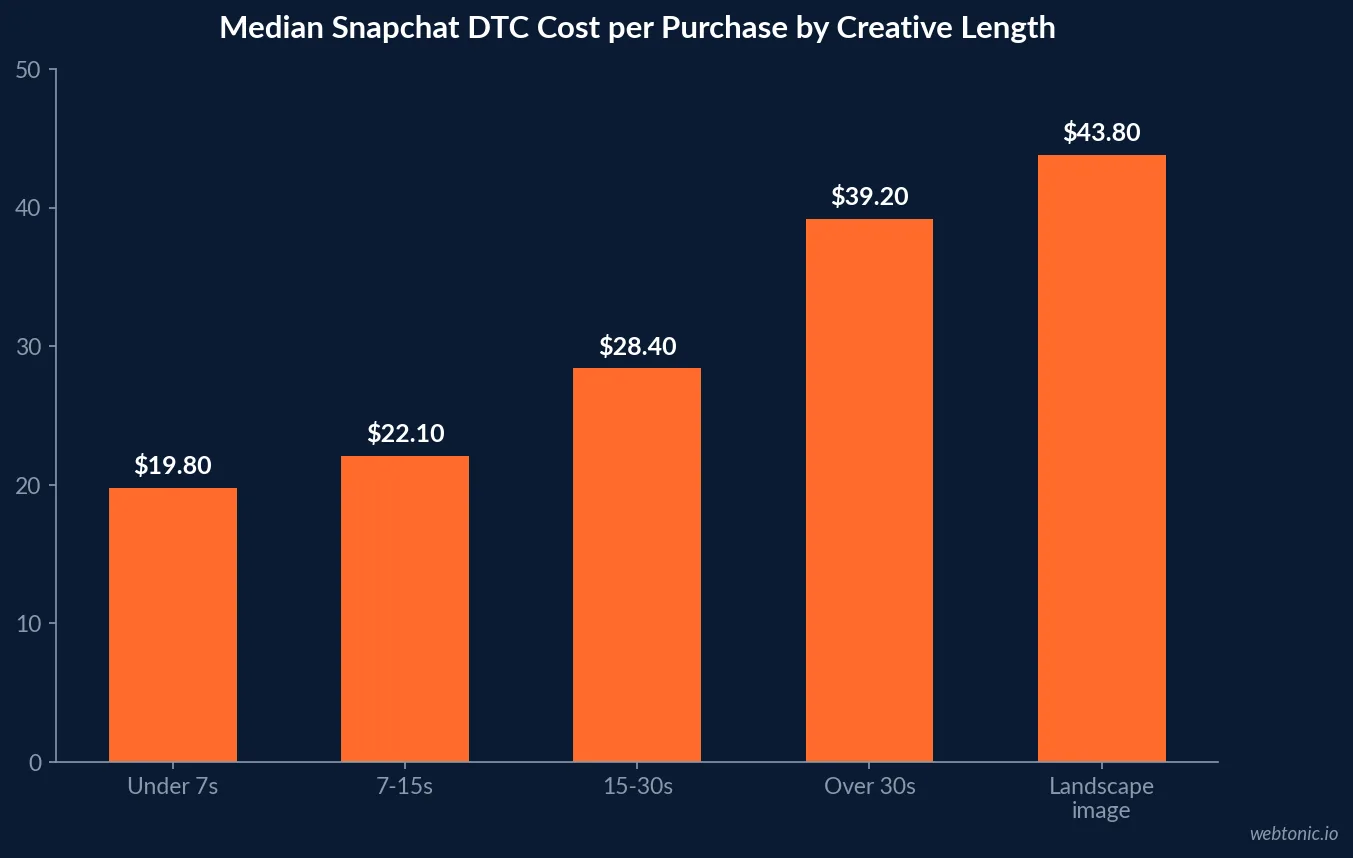
Read the top and bottom rows together: a sub-seven-second vertical video acquires a customer for $19.80 while a repurposed landscape image costs $43.80 — a 2.2x penalty for using the wrong asset. For wellness brands with long ingredient stories to tell, the discipline is to earn attention in five seconds and move the education to the landing page, which is how our performance creative team structures Snap builds.
4. Vertical Benchmarks and Where Wellness Lands
AdLiftr's vertical table does not break out supplements separately, but the two closest analogues bracket the category well: DTC beauty and cosmetics at a $23.40 median CPA (range $14.20–$34.80) and DTC food and beverage at $28.90 (range $17.60–$44.20). Apparel and accessories lead the whole dataset at $19.80.
| Vertical | Median CPA | 25th–75th percentile | Read-across for wellness |
|---|---|---|---|
| DTC apparel & accessories | $19.80 | $12.40 – $32.10 | Ceiling case: strongest Snap-native fit |
| DTC beauty & cosmetics | $23.40 | $14.20 – $34.80 | Closest analogue for supplements and skincare |
| DTC food & beverage | $28.90 | $17.60 – $44.20 | Functional food and beverage benchmark |
| Local services (US) | $42.80 | $22.10 – $71.30 | Clinics and studios: harder, but workable locally |
| B2B SaaS lead generation | $58.40 | $31.20 – $98.40 | Corporate wellness platforms sit here |
The practical planning rule: a consumer wellness product should target the $20–$30 first-purchase CPA band, and a clinic or studio should expect $40-plus per booked lead before optimisation. If your numbers are two to three times those figures, AdLiftr attributes the gap, in frequency order, to creative that ignores the vertical-video idiom, audiences too narrow for the auction to find liquidity, a misconfigured Snap Pixel conversion event, and budgets too low for the objective.
5. Budget Floors That Actually Work
Snapchat advertises a $5 per day minimum, and that number has misled a lot of small wellness brands into launching tests that cannot resolve. Practitioner guidance converges on $50–$100 per day per ad set for conversion objectives — enough daily events for the algorithm to exit the learning phase inside a fortnight rather than a quarter.
Hackceleration's pricing lab is blunt about the mechanism: the platform's conversion optimisation depends on Snap Pixel purchase events firing at volume, and thin budgets starve it. The same review notes a community satisfaction rating around 3.3 to 3.5 out of 5, with learning-phase budget strain cited as the top complaint — a good proxy for the fact that most disappointment on Snapchat is a funding problem wearing a targeting costume.
6. Augmented Reality: The Attention Numbers
AR is Snapchat's genuine format differentiator, and there is now attention research behind it rather than only case studies. Eye-tracking work commissioned by Snap with OMG and Lumen found AR formats deliver roughly 5x the active attention of standard in-feed placements, lift short-term purchase likelihood by 53%, raise brand mental availability 31% after a single exposure and produce 1.3x higher brand recall. In one published retail application, a Sephora AR activation drove a 12-point brand awareness lift and a 5.6% increase in add-to-cart rate.
For wellness, the honest translation is narrower than the headline. AR try-on maps cleanly onto topical skincare, cosmetics-adjacent wellness and device products where the visual outcome is the proposition. It maps poorly onto ingestible supplements, where the benefit is invisible. Budget AR as a consideration-stage asset measured on lift and recall, and keep direct response on short vertical video.
7. What Wellness Advertisers Have Actually Recorded
Four documented campaigns give a sense of the achievable range.
| Brand | Reported outcome | What drove it |
|---|---|---|
| Comfrt (wellness apparel) | +85% lift in new-site visits, +32% revenue, above 3x incremental ROAS | Incrementality-tested spend, with a further 12% iROAS improvement at 2x budget |
| Dr Nutrition (supplements) | −80% cost per purchase, −15% CPC, +22% click rate | Server-side event quality and audience rebuild |
| V Shred (fitness programmes) | +33% new customers | Creative volume and Snap-native editing |
| Gymshark (fitness apparel) | 100% more purchases at 2.5x lower cost of sale | Story Ads placement with vertical-first assets |
Note the common thread. None of these results came from porting Meta assets. Comfrt's case is the most methodologically interesting because it was measured incrementally rather than in-platform, and it also showed a halo effect on the brand's other channels — the pattern our data intelligence practice looks for when validating a new channel.
8. Brand Safety and Claim Risk in a Young-Skewing Feed
Advertising health products to a platform whose core audience skews 13–34 raises the stakes on messaging. Survey work summarised by independent trackers found that among users encountering health content on Snapchat, 54% reported seeing helpful mental-health material, while 35% reported seeing self-harm content and 32% eating-disorder content. For a wellness advertiser, that context is not incidental: weight, appearance and restriction messaging that would pass review on another platform can land badly here.
The operational guardrails are the same ones that govern all health media:
- No diagnosis, treatment or cure claims. Structure and function language only, with substantiation on file.
- Never build audiences that infer an individual's health condition. Contextual targeting is fine; condition inference is where risk begins.
- Use server-side conversion tracking wherever protected health information could be in scope.
- Avoid before-and-after body framing for a young audience, regardless of technical policy compliance.
- Budget a 3–5 day review buffer and keep a compliant creative variant ready to swap.
9. A Snapchat Test Plan That Produces a Decision
- Fund it properly. $50–$100 per day per conversion ad set for at least 30 days, not the $5 platform floor.
- Start on awareness or traffic inventory. That is where the 30–40% CPM discount to Meta lives; conversions inventory prices at parity.
- Build for sub-seven seconds. The $19.80 versus $43.80 cost-per-purchase spread between short vertical video and repurposed landscape assets is the largest single lever.
- Verify Snap Pixel purchase events before launch, ideally server-side. Misconfigured events are a top-four cause of double-median CPAs.
- Target broad enough for liquidity. Narrow audiences starve the auction faster on Snap than on Meta.
- Judge on incremental lift. Comfrt's above-3x figure was an incremental ROAS; in-platform numbers will read differently.
- Benchmark against your current mix. Our guides to Facebook Ads costs and Meta Ads management supply the comparison points, and our growth marketing team runs the holdout design.
The summary judgement for 2026: Snapchat is not a Meta replacement for wellness brands, and the platforms that market it that way are overselling. It is a genuinely cheap incremental reach channel with a young, health-attentive audience, a real AR differentiator for visual products, and a low tolerance for lazy creative. Fund one properly-built test, measure it incrementally, and the numbers above will tell you quickly whether the audience matches your buyer.
Frequently Asked Questions
What do Snapchat Ads cost for a health and wellness brand in 2026?
Median CPC across objectives sits at $0.84 with an interquartile range of $0.51 to $1.34, against $1.10–$2.00 typical on Meta for matched audiences. Median CPMs in June 2026 ran roughly $5.84 for awareness inventory, about $11.20 mid-funnel and $27.10 for premium conversion placements. For vertical-video buyers aged 18–34, Snapchat CPMs of $6–$14 undercut Instagram Stories at $12–$25.
Does Snapchat reach a health and wellness audience worth buying?
Yes, if your product suits a younger buyer. Snapchat reports 483 million daily active users, reaches about 90% of 13–24 year olds in more than 25 countries and 75% of 13–34 year olds. Its own research finds 62% of daily Snapchatters prioritise regular check-ups and that Snapchatters are 1.2x more likely than non-users to buy health and wellness products.
How much budget does a Snapchat wellness test need?
The platform floor is $5 per day, but conversion campaigns realistically need $50–$100 per day per ad set to get through the learning phase. Underfunded ad sets are the single most common reason wellness advertisers report CPAs two to three times the vertical median.
Is augmented reality worth the production cost for a wellness brand?
The attention data says it can be. Independent eye-tracking research commissioned by Snap found AR formats deliver roughly 5x the active attention of standard in-feed placements, lift short-term purchase likelihood 53% and raise brand mental availability 31% after a single exposure, with brand recall 1.3x higher. Treat AR try-on as a mid-funnel consideration asset, not a direct-response replacement.
What compliance limits apply to health advertising on Snapchat?
The same substance rules as everywhere else: no diagnosis, treatment or cure claims, no audience construction that infers an individual health condition, and server-side conversion tracking wherever protected health information is in scope. Snapchat's younger user base makes claim review stricter in practice, so build a 3–5 day approval buffer and keep compliant creative variants ready to swap.
Sources
AdLiftr — Snapchat Ads Cost Benchmarks 2026
Hackceleration — Snapchat Ads Pricing Lab, June 2026
Snapchat for Business — Health on Social
Digital Applied — Snapchat Statistics 2026
PPC Land — Snap Q1 2026 revenue
Axis Intelligence — Snapchat Statistics 2026
Sprout Social — Snapchat Statistics
WorkMagic — Comfrt incrementality case study
Journify — Dr Nutrition Snapchat case study
AdCreate — Snapchat Ads Advertising Guide 2026