Table of contents

Growth hacking has taken startups from zero users to millions — Dropbox grew 3,900% in 15 months using a single referral incentive. Here is a complete guide to what growth hacking is, how it works, and the strategies companies use to achieve rapid, scalable growth.
Key Takeaways
- Growth hacking is a data-driven, experiment-first approach to business growth that prioritizes rapid iteration and measurable outcomes over large marketing budgets. It was coined by Sean Ellis in 2010 to describe the mindset of optimizing every lever — product, content, engineering, and data — for user acquisition and retention.
- Dropbox grew from 100,000 to 4 million users in 15 months by offering 500 MB of free storage for every successful referral — a product-led growth hack that cost the company virtually nothing in traditional marketing spend (Forbes, 2024).
- The AARRR pirate metrics framework (Acquisition, Activation, Retention, Revenue, Referral) provides the measurement backbone for growth hacking, giving teams a structured way to identify their biggest growth bottleneck and focus experiments on the lever that moves the needle fastest.
- Growth hacking prioritizes speed over perfection, typically delivering measurable results within weeks rather than the quarters required by traditional marketing campaigns. Teams run 15–30 experiments per month across the full funnel.
- AI-powered growth hacking tools are accelerating the cycle — startups now use AI for automated A/B test analysis, predictive audience modeling, content generation, and real-time personalization at scales previously reserved for enterprise budgets.
- Successful growth hacking requires cross-functional teams that combine marketing, product, engineering, and data analytics — not siloed departments executing separate strategies.
What Is Growth Hacking?
Growth hacking is a systematic approach to achieving rapid business growth through data-driven experimentation across marketing, product, and engineering. According to Stripe's growth hacking strategy guide, the term was coined by Sean Ellis in 2010 when he needed a job title that described marketers whose singular focus was growth — not brand building, not PR, not communications, but measurable, scalable user acquisition and retention.
The core principle separating growth hacking from traditional marketing is the scope of the toolkit. Traditional marketers work with campaigns, ad budgets, and media placements. Growth hackers treat the entire business — the product itself, the onboarding flow, the pricing model, the referral mechanics, the data infrastructure — as levers available for experimentation. A growth hacker might improve revenue by changing a button color, restructuring the pricing page, adding a referral incentive directly into the product, or automating personalized outreach based on user behavior data.
According to G2's growth hacking guide, the growth hacking process follows a continuous loop: analyze data → generate hypotheses → prioritize experiments → run tests → measure results → learn and iterate. Each cycle is designed to be fast — days or weeks, not months. The velocity of experimentation is itself a competitive advantage because it compounds learning over time.
Growth Hacking vs Traditional Marketing
Understanding the differences between growth hacking and traditional marketing clarifies when each approach is appropriate. According to Growth Hakka's comparison analysis, the distinction isn't about quality — it's about speed, scope, and resource allocation.
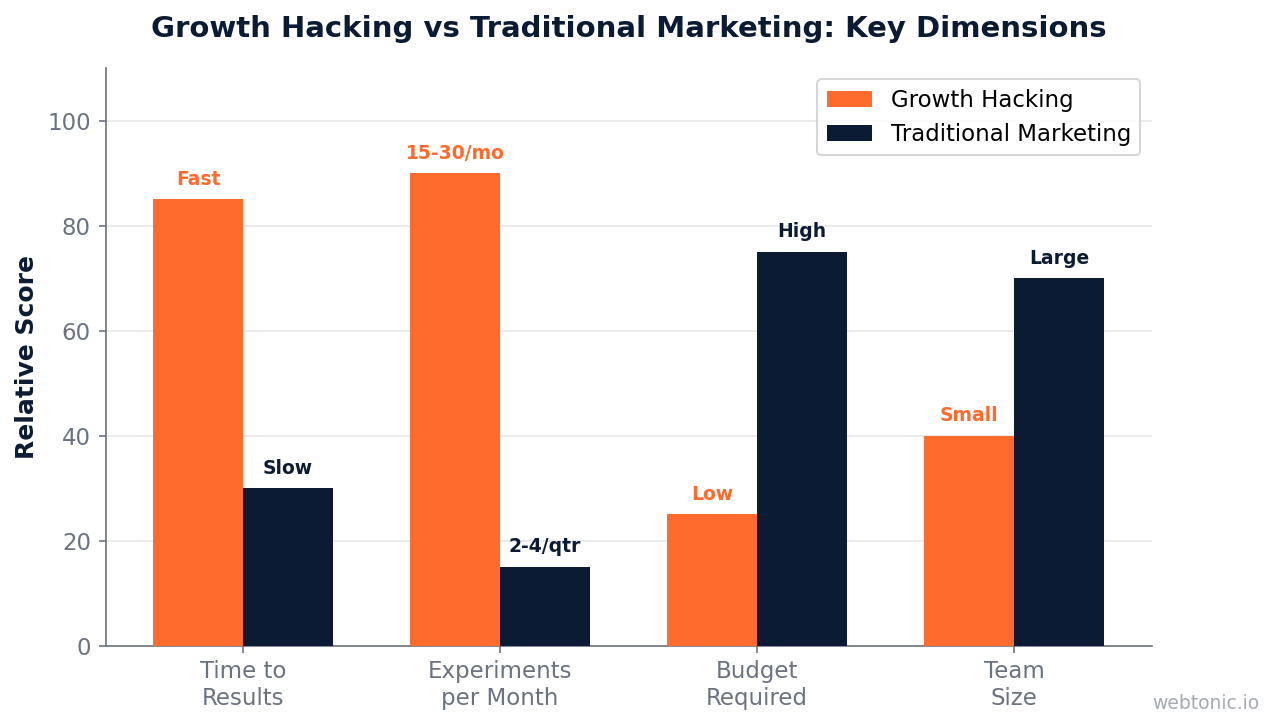
| Dimension | Growth Hacking | Traditional Marketing |
|---|---|---|
| Primary Goal | Rapid, scalable growth | Brand building and market positioning |
| Timeline | Results in weeks | Results in quarters |
| Budget Model | Low-cost, high-creativity experiments | Significant upfront media and production budgets |
| Team Structure | Cross-functional (marketing + product + engineering) | Siloed departments (marketing, creative, media) |
| Decision Making | Data-driven, 15–30 experiments/month | Research-driven, 2–4 campaigns/quarter |
| Scope | Full funnel — product, pricing, onboarding, referral | Top-of-funnel awareness and demand generation |
The important nuance: growth hacking and traditional marketing are complementary, not mutually exclusive. Established companies use growth hacking techniques within their existing marketing operations to accelerate results and find efficiency gains. Startups with no budget use growth hacking as their primary strategy because it requires creativity and engineering effort rather than media spend. At Web Tonic, we blend both approaches — using data-driven experimentation within a strategic marketing framework to deliver compounding results.
The AARRR Pirate Metrics Framework
The AARRR framework — also called pirate metrics — provides the measurement backbone for every growth hacking strategy. Developed by Dave McClure, it breaks the customer journey into five measurable stages. According to Ahrefs' AARRR framework guide, the framework gives teams a structured way to identify their biggest growth bottleneck and focus experiments on the lever that delivers the fastest improvement.
| Stage | What It Measures | Key Metrics |
|---|---|---|
| Acquisition | How users discover your product | Traffic sources, CAC, signup rate |
| Activation | Whether users experience the core value | Onboarding completion, time-to-value, aha moment rate |
| Retention | Whether users come back and keep using the product | DAU/MAU ratio, churn rate, cohort retention curves |
| Revenue | Whether users pay and how much | ARPU, LTV, conversion rate from free to paid |
| Referral | Whether users bring in new users | Viral coefficient (K-factor), referral rate, NPS |
The critical insight from the AARRR framework is that most businesses should not optimize acquisition first. According to Amplitude's pirate metrics analysis, fixing retention before scaling acquisition prevents the "leaky bucket" problem — pouring more users into a product they don't stick with. Start by identifying which stage has the largest drop-off, then concentrate your experiment velocity on that bottleneck before moving to the next.

5 Growth Hacking Strategies With Proven Results
1. Product-Led Referral Programs
Dropbox's referral program remains the canonical example of a product-led growth hack. According to Forbes' growth hacking case study analysis, Dropbox grew from 100,000 to 4 million users in 15 months — a 3,900% increase — by offering 500 MB of free storage for every successful referral. The key insight was that the incentive (more storage) directly enhanced the product experience rather than offering a disconnected reward like a gift card. This alignment between incentive and product value created a self-reinforcing loop: users who referred friends got a better product, which made them more likely to refer more friends.
2. Viral Content Loops
Hotmail pioneered the viral content loop by appending "Get your free email at Hotmail" to every outgoing email. According to Monolit's 2026 growth hacking case studies, this simple addition turned every Hotmail user into an unpaid ambassador — each email became a micro-advertisement seen by the recipient and anyone the email was forwarded to. Hotmail grew to 12 million users in 18 months using this single mechanic. Modern applications of viral content loops include shareable reports (Spotify Wrapped), embeddable widgets (YouTube embed codes), and collaborative features that require inviting non-users (Google Docs sharing).
3. Marketplace Supply Hacking
Airbnb's early growth was driven by a bold supply-side hack: cross-posting listings to Craigslist. According to Entrepreneur's startup growth strategies analysis, Airbnb built a tool that allowed hosts to automatically publish their Airbnb listings on Craigslist, tapping into an established audience of millions of travelers actively searching for accommodations. This generated a massive wave of traffic and bookings from people who had never heard of Airbnb — leveraging an existing platform's audience to bootstrap their own marketplace. The tactic worked because it solved a real problem for hosts (wider distribution) while acquiring users at near-zero cost for the platform.
4. Freemium With Built-In Virality
Slack's growth strategy combined a freemium product with built-in team virality. According to Semrush's growth hacking examples, Slack grew from 15,000 to 500,000 daily active users in its first year by making the free tier genuinely useful while building virality into the core use case: every team that adopted Slack needed to invite their colleagues, creating organic expansion within organizations. The product's integration ecosystem — connecting with 2,400+ apps — made it increasingly sticky as teams built workflows around it, driving retention that amplified the acquisition flywheel.

5. AI-Powered Personalization at Scale
Modern growth hacking increasingly leverages artificial intelligence for personalization, testing, and optimization. According to Vizotto's AI growth hacking strategies analysis, AI tools now enable startups to run automated A/B test analysis, predictive audience modeling, dynamic content personalization, and real-time pricing optimization at scales previously reserved for enterprise budgets. The practical application: use AI to analyze experiment results faster, generate creative variations for testing, and personalize user experiences based on behavioral data. This doesn't replace the growth hacking mindset — it accelerates the experiment-measure-learn cycle.
Building a Growth Hacking Team
Effective growth hacking requires a cross-functional team structure that breaks traditional departmental silos. According to Neal Schaffer's growth hacking guide, the ideal team combines four disciplines:
- Growth lead: Sets experiment priorities, manages the testing backlog, and ensures the team focuses on the highest-impact bottleneck identified through the AARRR framework. This person owns the growth metric and reports directly to leadership.
- Product/engineering: Implements experiments that require product changes — onboarding flow modifications, referral mechanics, pricing page variations, and integration features. 50–60% of high-impact experiments require engineering resources.
- Data analyst: Designs experiments with statistical rigor, builds tracking infrastructure, analyzes results, and identifies patterns in user behavior that generate new hypotheses. Without this role, growth hacking degrades into random testing.
- Content/marketing: Executes acquisition and retention experiments that involve content creation, paid media, email sequences, and community engagement. Brings creative skills and channel expertise to the experiment pipeline.
Startups with fewer than 10 employees typically combine these roles into 1–2 people. The critical requirement isn't headcount — it's having someone who can move between marketing thinking and product thinking, using data to connect the two. For businesses looking to build this capability, explore our data intelligence services.

Growth Hacking Tools for 2026
The right tools accelerate every stage of the growth hacking process. According to Growth Expertz's 2026 tools guide, the essential toolkit spans six categories:
- Analytics and tracking: Mixpanel, Amplitude, PostHog for product analytics and funnel analysis. Google Analytics 4 for acquisition channel attribution. These tools provide the data foundation for identifying bottlenecks and measuring experiment impact.
- Experimentation: LaunchDarkly, Optimizely, or VWO for A/B testing and feature flagging. Teams running 15–30 experiments monthly need robust testing infrastructure that supports rapid deployment and statistical analysis.
- User feedback: Hotjar, FullStory for session recordings and heatmaps. Typeform, Canny for structured feedback collection. Understanding why users behave certain ways is as important as knowing what they do.
- Automation: Zapier, Make (formerly Integromat), n8n for connecting tools and automating workflows. Customer.io, Braze for behavioral email and push notification sequences.
- AI-native tools: AI-powered content generators for test variation creation, predictive analytics platforms for audience modeling, and automated optimization tools that adjust campaigns in real time based on performance data.
For more strategies on combining growth tools with performance marketing, visit our marketing insights blog.
Related reading
- Growth Advisory / Growth Consulting: how to choose a provider
- Investor-Ready Growth Plan Statistics: Benchmarks and KPIs
- Investor-Ready Growth Plan Statistics: Cost and Pricing
- Marketing Strategy Consulting services at Web Tonic
Frequently Asked Questions
What is growth hacking in simple terms?
Growth hacking is a systematic, experiment-driven approach to achieving rapid business growth using creativity, data analysis, and cross-functional collaboration rather than large traditional marketing budgets. Instead of planning campaigns months in advance, growth hackers run 15–30 small, fast experiments per month across every lever available — product features, pricing, onboarding flows, referral mechanics, content, and paid channels. Each experiment is measured against specific growth metrics (using frameworks like AARRR pirate metrics), and the results feed the next round of hypotheses. The goal is to find scalable, repeatable tactics that drive user acquisition, activation, retention, and revenue as efficiently as possible.
Is growth hacking only for startups?
No — growth hacking principles apply to businesses of all sizes. While the term originated in the startup world where teams needed to achieve rapid growth with limited resources, established companies including Facebook, LinkedIn, and Uber maintain dedicated growth teams that apply the same experiment-first methodology. The difference is scope: startups apply growth hacking to their entire business strategy, while enterprises typically use growth hacking techniques within specific business units, product lines, or customer segments. Any organization that values data-driven experimentation and rapid iteration can benefit from the growth hacking mindset.
What is the AARRR framework?
AARRR stands for Acquisition, Activation, Retention, Revenue, and Referral — five stages of the customer journey that provide a structured measurement framework for growth hacking. Created by Dave McClure, it helps teams identify their biggest growth bottleneck by analyzing conversion rates between each stage. For example, if 80% of signups never complete onboarding (the activation stage), focusing experiments on acquisition channels would waste resources — the priority should be improving the onboarding experience. The framework works best when teams calculate drop-off rates between each stage and concentrate their experiment velocity on the single stage with the largest gap.
What are the best growth hacking examples?
The most cited growth hacking examples include: Dropbox's referral program (grew 3,900% in 15 months by offering free storage for referrals), Hotmail's email signature (reached 12 million users in 18 months by adding "Get your free email at Hotmail" to every outgoing message), Airbnb's Craigslist integration (cross-posted listings to tap into Craigslist's existing audience), Slack's freemium virality (grew from 15,000 to 500,000 DAUs by building team invitation into the core product), and LinkedIn's address book import (let users import contacts and send invitations at scale, accelerating network effects). Each example demonstrates the growth hacking principle of leveraging existing behaviors and platforms to achieve rapid user adoption.
How do I start growth hacking my business?
Start by choosing a single growth metric to focus on — often called the North Star metric — that best represents the value your business delivers to customers (e.g., weekly active users, revenue per user, tasks completed). Map your current funnel using the AARRR framework and identify the stage with the largest drop-off. Generate 10–20 experiment ideas targeting that bottleneck, then prioritize them using an ICE score (Impact × Confidence × Ease). Run your top 3–5 experiments simultaneously, measure results within 1–2 weeks, and iterate. The most important first step is building the data infrastructure to measure accurately — without reliable analytics, experiments produce unreliable conclusions. Consider working with a growth marketing partner to accelerate the process.
Sources
stripe.com — What is Growth Hacking? Strategies to Know
g2.com — Growth Hacking Marketing: Guide and Strategies
growthhakka.co.uk — Growth Hacking vs Traditional Marketing: Key Differences
ahrefs.com — AARRR Pirate Metrics Framework: What It Is & How It Works
amplitude.com — The Pirate Metrics Framework Explained
forbes.com — 5 Famous Startup Growth Hacking Examples
monolit.sh — Growth Hacking Case Studies From Successful Startups (2026)
semrush.com — Growth Hacking Examples
growthexpertz.com — The 25 Best Growth Hacking Tools for Startups in 2026