Table of contents
Companies still put 59.5% of their capability-building emphasis on hiring and training, while a third of digital marketing work already runs through outside partners. Those two numbers, both from 2026 surveys, explain why the hire-versus-outsource argument never resolves - most companies are doing both, badly measured.
Key Takeaways
- 59.5% of capability-building emphasis goes to building in-house, 38.5% to partnering.
- Only 15.5% of that emphasis goes to marketing agencies and 12.7% to consultancies.
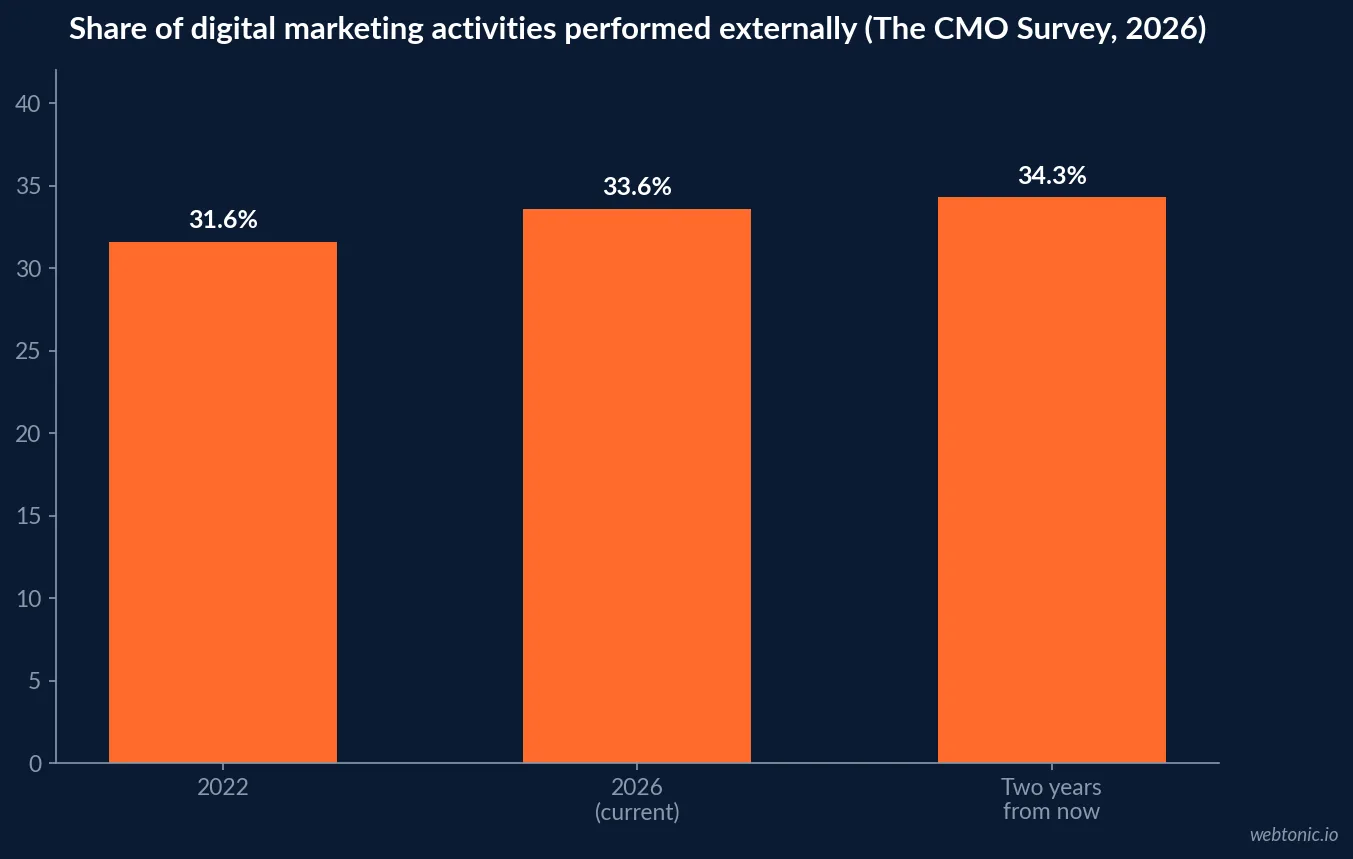
- 33.6% of digital marketing activities are performed externally, up from 31.6% in 2022.
- Leaders project 34.3% external delivery two years out - drift, not a swing.
- Retail and wholesale outsource 57% of digital activity; education outsources 3%.
- Professional services firms are among the most likely to build, at 70.0%.
- 66% of client firms keep at least 26% of marketing work in-house, down from 92% in 2024.
- Average US CMO total compensation is USD 293,575 against a USD 225,908 base.
- Fractional CMO rates average USD 180 per hour at about nine hours a week.
- An executive mis-hire costs at least 30% of first-year earnings.
- Average CMO tenure is 4.1 years and 31% of the S&P 500 has no CMO.
- Marketing headcount growth slowed by more than 50% year over year.
The build-versus-partner split, measured
The cleanest data on this decision comes from The CMO Survey's 2026 report, which asked marketing leaders to allocate 100 points across approaches to developing new capability. The result: 59.5% build, 38.5% partner, 1.9% buy. Partnering splits into 15.5% with marketing agencies, 12.7% with other consultancies and 10.4% with other companies.
The finding that matters is the comparison. The same question was last asked in February 2020 and returned 57.9% build and a near-identical partner mix. Six years of martech, AI and channel upheaval moved the build-versus-partner instinct by less than two points.
| Approach to new capability | 2026 emphasis | 2020 emphasis |
|---|---|---|
| Build by training or hiring | 59.5% | 57.9% |
| Partner with marketing agencies | 15.5% | 15.1% |
| Partner with other consultancies | 12.7% | 11.9% |
| Partner with other companies | 10.4% | 12.2% |
| Buy other companies | 1.9% | 1.9% |
A third of the work is already outside
Stated emphasis and actual delivery diverge. The same survey asks what percent of digital marketing activities are performed by external agencies, partners and services, and the answer is 33.6% today, up from 31.6% in 2022, with 34.3% projected two years out. Companies say they build, then quietly route a third of execution outside.
Sector variation is the real story. Retail and wholesale externalise 57% of digital activity, consumer packaged goods 55% and mining and construction 52%, while education sits at 3%, communications and media at 10% and technology and software at 28%. B2B services companies are among the lowest at 25%, against 48% for B2C product businesses.
| Segment | Digital activity performed externally | Direction |
|---|---|---|
| All companies | 33.6% | Up from 31.6% in 2022 |
| B2B product | 28% | Rising to 31% expected |
| B2B services | 25% | Broadly flat at 26% |
| B2C product | 48% | Easing to 44% expected |
| B2C services | 44% | Holding near 45% |
| Retail / wholesale | 57% | Highest external use |
| Education | 3% | Lowest external use |
Who builds and who partners
Size and model predict the answer. The survey's breakouts show companies under USD 10 million in revenue putting 64.1% of emphasis on building, and B2B services companies at 64.4% build against 34.8% partner, while B2C services sit at 53.8% build and 45.9% partner. By industry, education (83.0%), consumer services (73.3%) and professional services (70.0%) are most likely to build; mining and construction (75.0%) and retail and wholesale (65.9%) are most likely to partner.
Small companies leaning hardest on building is the uncomfortable finding, because they have the least capacity to absorb a wrong hire. It is also why advisory work sells well into that segment: the diagnosis can be bought without buying the headcount, which is the same logic behind our growth marketing engagements.
In-housing is not the one-way trend it was sold as
The 2026 RSW/US New Year Outlook Report found 66% of client firms saying at least 26% of their marketing work is managed by an in-house team, a sharp fall from 92% in 2024. At the same time, 60% of agencies and professional services firms report that their clients now have some form of in-house capability, up from 40% a year earlier.
Read together: more companies have some internal capability, but the volume of work each keeps inside is falling. The report attributes part of that to an AI resource gap, citing studies where roughly 61% of external agencies used generative AI in 2025 against 17% of in-house agencies, plus a preference for variable over fixed cost under economic pressure.
| Signal | 2026 reading | Prior reading |
|---|---|---|
| Client firms with 26%+ of work in-house | 66% | 92% in 2024 |
| Clients with some in-house capability | 60% | 40% a year earlier |
| External agencies using generative AI | About 61% | 17% for in-house agencies |
| External share of digital activity | 33.6% | 31.6% in 2022 |
| Emphasis on partnering | 38.5% | 42.1% combined in 2020 |
Why companies outsource, in their own words
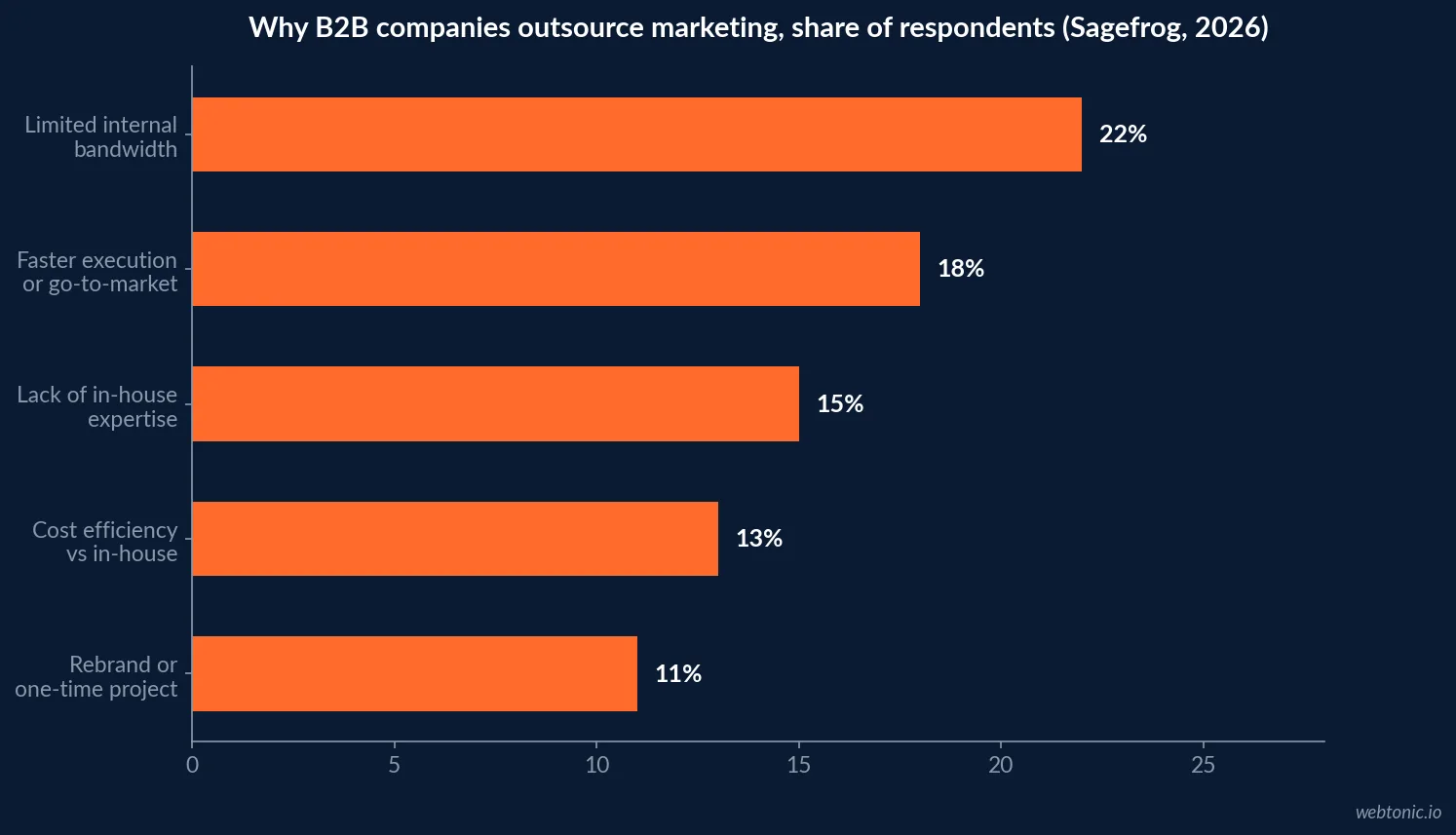
Sagefrog's 2026 B2B Marketing Mix Report asked directly. The leading motivators were limited internal bandwidth or time constraints at 22% and faster execution or go-to-market at 18%, ahead of lack of in-house expertise at 15% and cost efficiency compared with in-house teams at 13%. Rebrands and one-time projects and access to outside perspective each drew 11%.
That ordering is a change worth noting. In earlier editions, missing expertise dominated; in 2026 the top two answers are about capacity and speed. Companies are not admitting they cannot do the work - they are admitting they cannot get to it.
| Reason for outsourcing | Share of respondents | What it implies about scope |
|---|---|---|
| Limited internal bandwidth or time | 22% | Buy capacity, keep the strategy |
| Faster execution or go-to-market | 18% | Buy a start date, not a headcount |
| Lack of in-house expertise | 15% | Buy a specialist channel or diagnosis |
| Cost efficiency versus in-house | 13% | Compare loaded cost, not rate |
| Rebrand or one-time project | 11% | Project structure, fixed deliverable |
| Fresh ideas and outside perspective | 11% | Advisory scope, short engagement |
The structures companies actually use
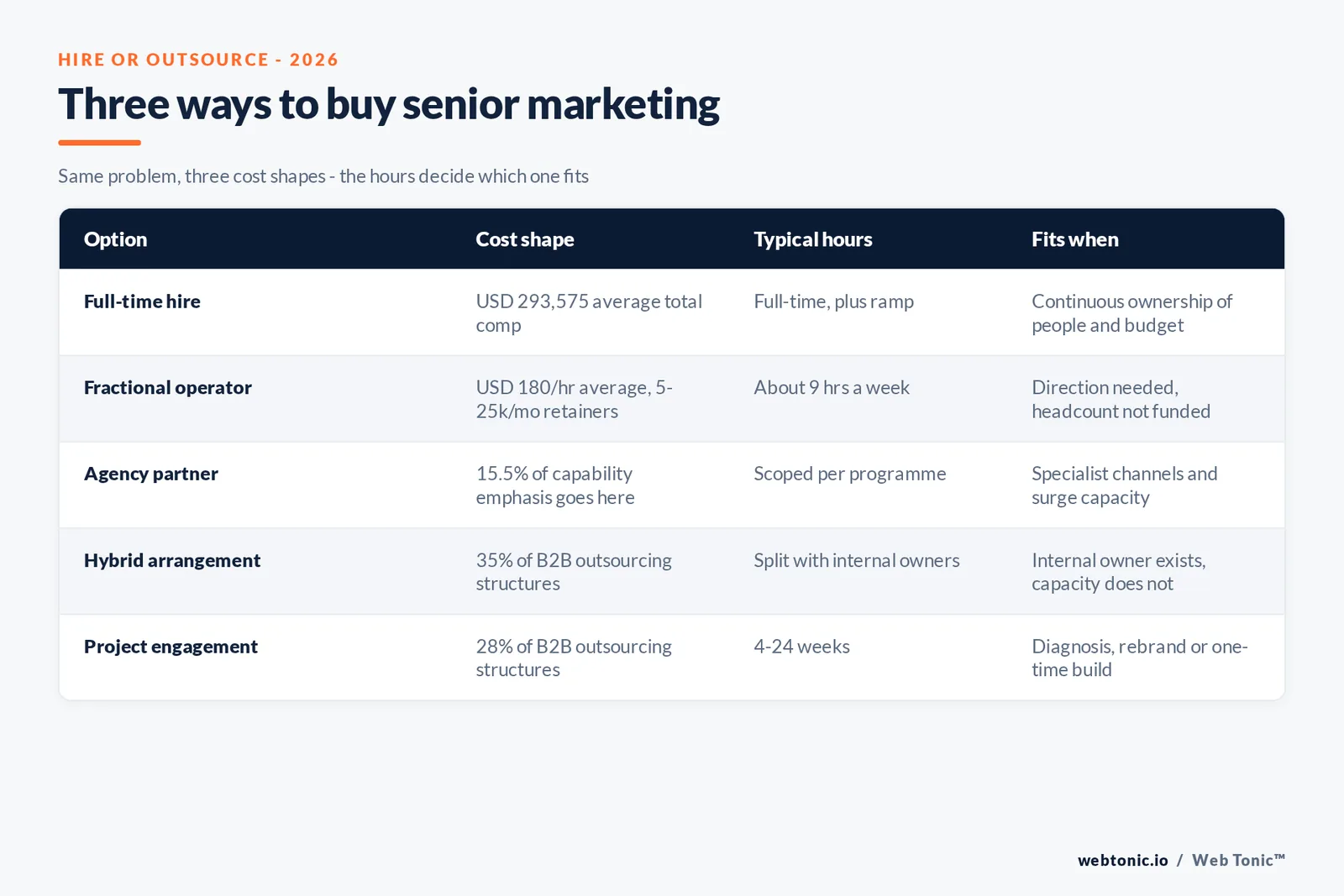
The same report maps how those relationships are shaped: 35% hybrid, 28% project-based, 24% ongoing retainer and 12% freelancers or contractors. Hybrid leading is consistent with the motivators - firms want a partner sitting close to the internal team with flexibility at the edges, not a wholesale handover.
Structure choice has a bigger effect on cost than rate does. Fractional Pulse's engagement comparison shows retainer-shaped billing applied to project-shaped work costing four to five times more, with a worked example of USD 180,000 against USD 40,000 for the same output. Naming the deliverable in a paragraph before choosing the structure is the cheapest hour anyone spends in this process.
| Engagement structure | Share of B2B outsourcing | Best fit |
|---|---|---|
| Hybrid with internal team | 35% | Ongoing programmes with internal owners |
| Project-based | 28% | Defined scope with an end date |
| Ongoing retainer | 24% | Continuous work needing availability |
| Freelancers or contractors | 12% | Single-skill execution capacity |
What the full-time hire actually costs
The honest comparison prices the hire fully. Built In puts average US CMO base pay at USD 225,908 and average total compensation at USD 293,575. Add employer costs, recruitment and ramp. Talentfoot puts the floor cost of any bad hire at at least 30% of the person's first-year earnings, citing US Department of Labor data, and notes senior leadership mis-hires reaching up to 213% of salary with retained search fees alone at 25% to 35% of first-year compensation.
The market adds risk on top. Spencer Stuart's CMO Tenure 2026 snapshot reports average CMO tenure of 4.1 years against 5.0 years for the C-suite overall, with 31% of S&P 500 companies operating without a CMO and 77% of departing CMOs landing a new role within six months. Meanwhile The CMO Survey records marketing headcount growth slowing by more than 50% from the prior year, so the internal option is getting harder to fund regardless of preference.
| Cost or risk line | 2026 figure | Source |
|---|---|---|
| CMO average base salary | USD 225,908 | Built In |
| CMO average total compensation | USD 293,575 | Built In |
| Bad-hire floor cost | 30% of first-year earnings | Talentfoot / US Dept of Labor |
| Average CMO tenure | 4.1 years | Spencer Stuart 2026 |
| S&P 500 companies with no CMO | 31% | Spencer Stuart 2026 |
| Marketing headcount growth | Down over 50% YoY | The CMO Survey 2026 |
What the outsourced option costs by comparison
GoFractional's rate data puts the average fractional CMO rate at USD 180 per hour with a median of USD 175 and a middle band of USD 130 to 220, on engagements averaging about nine hours a week, or roughly 468 hours a year. Fractional Pulse reports retainers of USD 5,000 to 25,000 a month with initial terms of six to twelve months converting to month-to-month, on 30-day notice, and loaded hourly equivalents of USD 200 to 500 on retainers against USD 300 to 700 on project work.
Supply is not the constraint it once was. The Fractional Work Report records 149% year-over-year growth in demand and roughly 150,000 US practitioners, with marketing accounting for 20% of demand, 87% of practitioners holding 11 or more years of experience and 90% saying they will not return to full-time work. Vendux notes Gartner's expectation that more than 30% of midsize companies will use fractional executives by 2027.
Turning the numbers into a decision
Three tests separate the two options without ideology. First, hours: if the work needs more than about fifteen hours a week for longer than a year, you are describing a job, not an engagement. Second, authority: if the person must own internal decisions, budgets and people, a permanent hire is usually unavoidable, because advisory scopes are written around hour ranges, not line management. Third, risk: with a mis-hire floor of 30% of first-year earnings and 4.1-year average tenure, buying a diagnosis before buying the seat is the cheaper sequence.
That sequence is what we run for lean teams: a paid diagnosis of offer, pricing, ICP and measurement first, then a written decision on what to hire, what to keep outside and what to stop doing. If you want a second read on which side of the line your next role sits, our measurement team and creative and paid media team both start from the same diagnosis, and you can get in touch to talk it through.
Related reading
- Marketing KPI Scorecard Statistics: Hiring vs Outsourcing
- AI Marketing Advisory Statistics: Hiring vs Outsourcing
- Growth Advisory / Growth Consulting: vs hiring in-house
- Marketing Strategy Consulting services at Web Tonic
Frequently Asked Questions
Do most companies build marketing capability in-house or buy it?
Both, in a stable ratio. The CMO Survey's 2026 edition asked leaders to allocate 100 points across approaches and got 59.5% on building new capabilities by training or hiring, 38.5% on partnering and 1.9% on buying companies. Inside the partner share, 15.5% goes to marketing agencies, 12.7% to other consultancies and 10.4% to other companies. The striking part is that the same question asked in February 2020 produced almost identical numbers, so six years of technology change did not shift the build-versus-partner instinct at all.
How much marketing work is actually outsourced?
About a third. The CMO Survey puts the share of digital marketing activities performed by external agencies, partners and services at 33.6%, up from 31.6% in 2022, with leaders projecting 34.3% two years out. It varies enormously by sector: retail and wholesale externalise 57% of digital activity and consumer packaged goods 55%, while education outsources 3% and communications and media 10%.
Is a fractional or advisory hire cheaper than a full-time executive?
On cash cost, usually - but the comparison is only honest if you match the hours. Built In puts average US CMO base pay at USD 225,908 and total compensation at USD 293,575. GoFractional's rate data has fractional CMOs averaging USD 180 per hour on roughly nine hours a week, which annualises to about 468 hours and a mid-five-figure to low-six-figure engagement. Fractional Pulse reports retainers between USD 5,000 and 25,000 a month depending on role and stage. Cheaper per year, far fewer hours, and no line management of an internal team unless the scope says so explicitly.
What is the risk of getting the senior hire wrong?
It is the largest hidden number in the decision. Talentfoot puts the floor cost of an executive mis-hire at 30% of the person's first-year earnings, before counting lost momentum. Add the market context: Spencer Stuart's CMO Tenure 2026 study found average CMO tenure at 4.1 years against 5.0 for the full C-suite, and 31% of S&P 500 companies with no CMO at all. A senior marketing hire is a shorter-lived, harder-to-replace bet than most hiring plans assume.
When does outsourcing stop making sense?
When the work is continuous, proprietary and needs internal authority rather than expertise. RSW/US found 66% of client firms keep at least 26% of marketing work in-house, and the share of clients with some in-house capability rose from 40% to 60% in a year. Companies keep brand ownership, customer data and decision rights inside; they buy diagnosis, specialist channels and surge capacity. Sagefrog's 2026 data shows the same instinct, with hybrid arrangements at 35% the most common structure.
Sources
The CMO Survey - Highlights and Insights Report 2026
RSW/US - 2026 New Year Outlook Report
Sagefrog - 2026 B2B Marketing Mix Report
Built In - CMO salary data
Talentfoot - The real cost of a senior leadership mis-hire (2026)
Spencer Stuart - CMO Tenure 2026 Snapshot
GoFractional - Fractional CMO rates
Fractional Pulse - Fractional CMO retainer benchmarks
Fractional Jobs - Fractional Work Report
Vendux - Numbers reshaping fractional executive thinking in 2026