



Table of contents

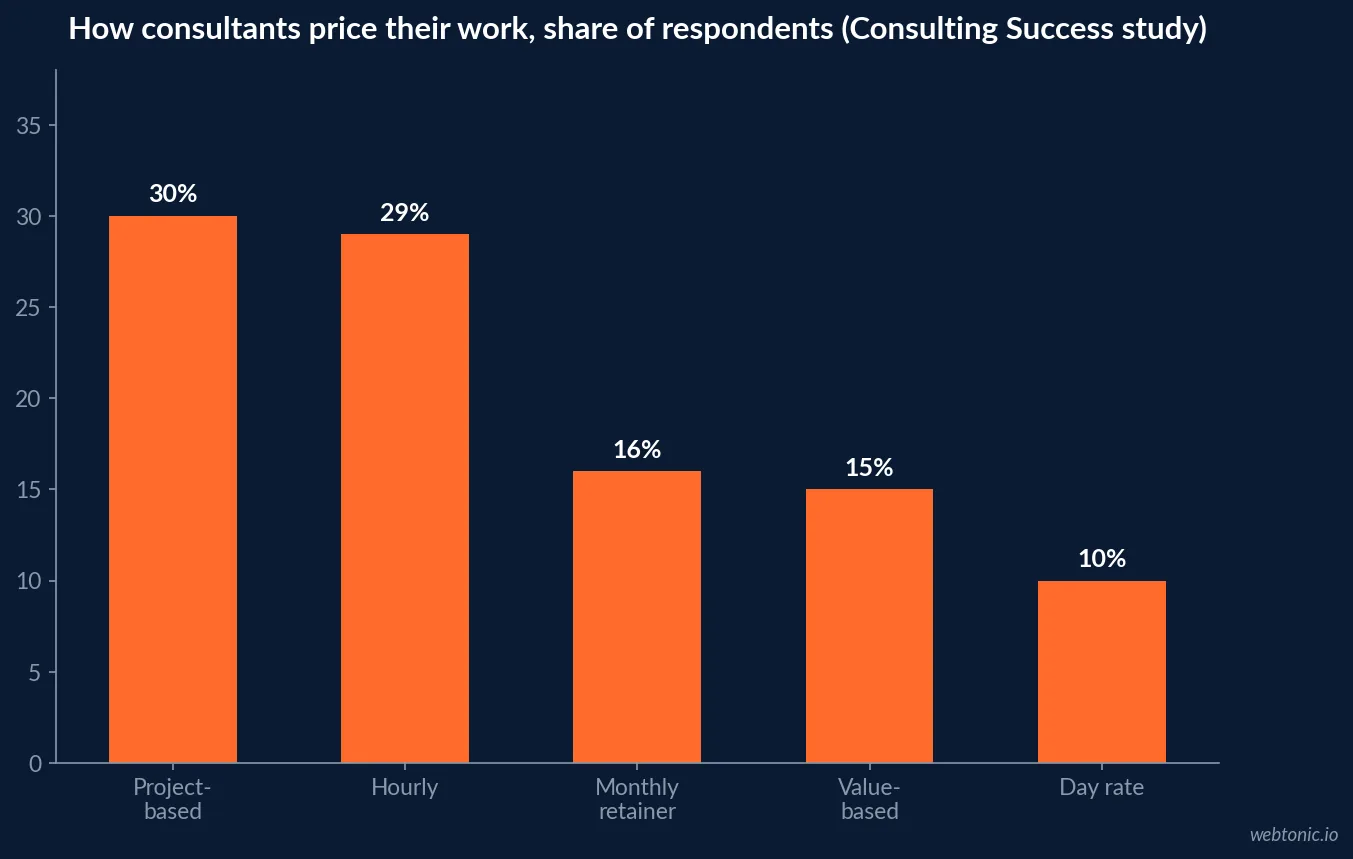
Only 15% of consultants price on value, while 29% still bill by the hour. That single distribution explains more about what a growth advisory engagement costs than seniority, brand or city does. Here is the 2026 pricing data, drawn from fee studies and engagement research rather than from vendor price lists.
Key Takeaways
- 30% of consultants charge project-based fees, the single most common model.
- 29% still bill hourly, 16% use monthly retainers, 15% price on value and 10% charge daily.
- 79% of consultants are actively trying to raise their fees.
- 39% have never tried value-based pricing because they do not know how.
- 51% of value-based consultants report average project values above USD 10,000, against 39% of hourly billers.
- 38% of consultants earn USD 10,000 or more a month.
- Advisory retainers run USD 5,000 to USD 25,000 a month depending on role and stage.
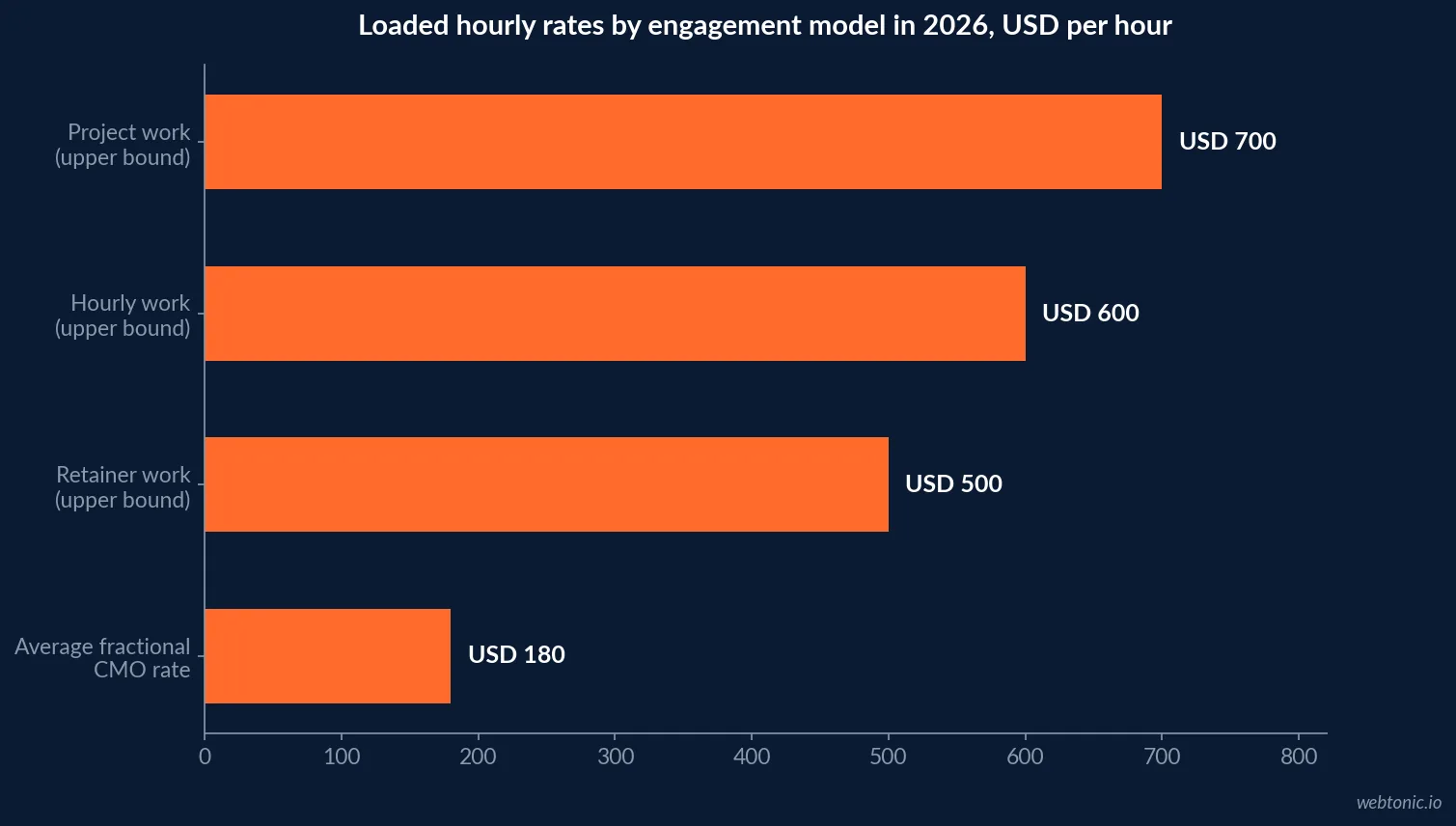
- Loaded hourly equivalents span USD 200 to USD 700 across retainer, project and hourly work.
- The average fractional CMO rate is USD 180 an hour, median USD 175.
- A 12-month retainer at USD 15,000 costs USD 180,000 for scope a project might cover for USD 40,000.
- High-growth firms spend 12.0% of revenue on marketing, no-growth firms 5.0%.
- A 1% gain in consultant utilisation lifts operating profit by about 20%, which is why rates resist discounting.
The pricing distribution, measured
The figures below come from named studies with stated samples. No agency rate cards, including our own, appear anywhere on this page - what a single firm charges is not a benchmark.
| Pricing input | 2026 figure | Source and sample |
|---|---|---|
| Project-based pricing | 30% of consultants | Consulting Success fee study, ~1,000 consultants |
| Hourly pricing | 29% of consultants | Consulting Success fee study |
| Monthly retainer | 16% of consultants | Consulting Success fee study |
| Value-based pricing | 15% of consultants | Consulting Success fee study |
| Daily rate | 10% of consultants | Consulting Success fee study |
| Advisory retainer range | USD 5,000-25,000/month | Fractional Pulse, 2026 |
| Average fractional CMO rate | USD 180/hour | Go Fractional rate data, 2026 |
| Consultants seeking a fee increase | 79% | Consulting Success fee study |
The model sets the price more than the person does
Consulting Success's fee study, based on close to 1,000 consultants, found the market split across five models: 30% project-based, 29% hourly, 16% monthly retainer, 15% value-based and 10% daily. The same study reports that 51% of consultants using value-based fees have an average project value above USD 10,000, compared with 39% of hourly billers, and that 38% of consultants earn USD 10,000 or more a month.
Two findings matter to the buyer more than to the seller. 79% of consultants say they are actively looking to increase their fees, so quoted prices are not stable across a year. And 39% have never tried value-based pricing because they do not know how - meaning an hourly quote often reflects the seller's pricing confidence rather than the complexity of your problem.
| Model | Share of consultants | Buyer gets | Buyer risk |
|---|---|---|---|
| Project-based | 30% | A fixed price for a defined artefact | Change orders when scope shifts |
| Hourly | 29% | Flexibility on unpredictable scope | Clock-watching; questions cost money |
| Monthly retainer | 16% | Ongoing access and continuity | Paying retainer rates for project work |
| Value-based | 15% | Fee tied to a measurable outcome | Outcome definition drifts after signature |
| Day rate | 10% | Simple comparison across suppliers | Days are counted, results are not |
What the numbers look like in cash
Fractional Pulse's engagement comparison puts advisory and fractional retainers at USD 5,000 to USD 25,000 a month, with loaded hourly equivalents of USD 200 to USD 500 for retainer work, USD 300 to USD 700 for project work and USD 200 to USD 600 for hourly engagements. Go Fractional rate data for the marketing seat specifically shows an average of USD 180 an hour and a median of USD 175.
The gap between the two datasets is not a contradiction. Marketplace averages reflect ongoing part-time leadership; the higher project bands reflect short, intense, deliverable-shaped work. Buying the wrong one is the expensive part.
| Engagement shape | Typical structure | Indicative annual cost | Best fit |
|---|---|---|---|
| Advisory, 4-8 hrs/month | Hourly or small retainer | USD 15,000-40,000 | A second opinion on an existing plan |
| Diagnostic project | Fixed fee, 8-10 weeks | One-off, USD 25,000-60,000 | The problem is not yet defined |
| Ongoing retainer | USD 5,000-15,000/month | USD 60,000-180,000 | Continuous leadership and oversight |
| Senior retainer | USD 15,000-25,000/month | USD 180,000-300,000 | Line management plus category complexity |
The most expensive mistake is structural, not numerical
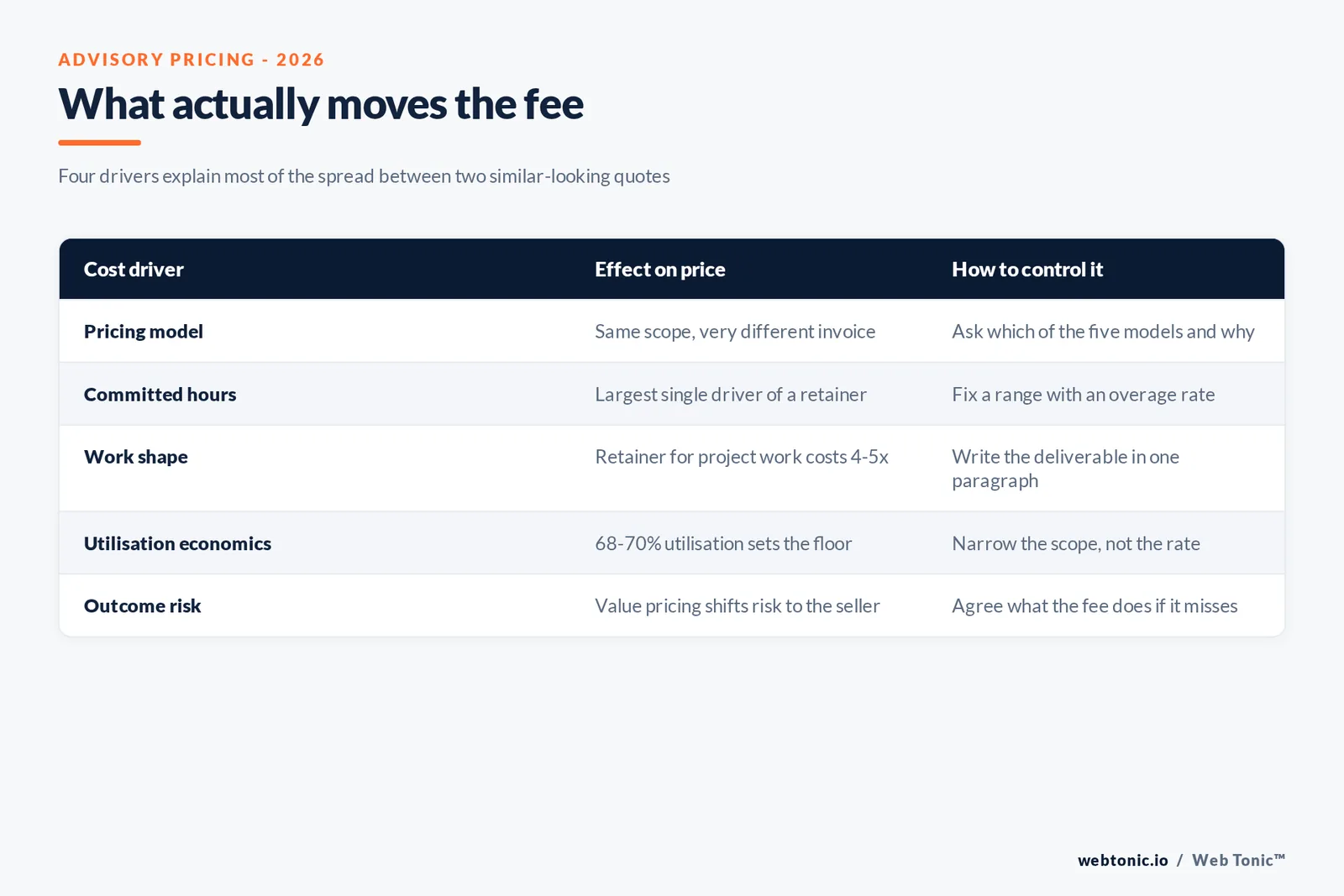
Fractional Pulse names it directly: paying retainer rates for project-shaped work. Their worked example is a 12-month retainer at USD 15,000 a month - USD 180,000 - for scope that as a clean project might cost USD 40,000 over eight to ten weeks, four to five times the price for the same output. The reverse error is cheaper but real: buying a project when the need is continuous judgement, then paying again three months later.
The test is a paragraph. If you can write the deliverable, the start and the end date in one paragraph, it is a project. If you cannot, you are buying availability, and availability is what a retainer prices.
Why rates resist discounting
Consultancy economics explain more of the price floor than positioning does. The BenchPress benchmarking study of UK consulting businesses reports average utilisation of non-partner roles between 68% and 70%, and calculates that a 1% improvement in utilisation delivers roughly a 20% improvement in operating profit. A firm running at 68% utilisation has to price for the 32% of time nobody pays for.
That is why a discount request usually returns a smaller scope rather than a lower rate, and why day rates in that study were described as essentially flat while overheads rose. Ask for a narrower scope at full rate rather than the same scope at a discount; the first request is one the supplier can actually accept.
Sizing the budget from the top down
Anchor the fee to the marketing envelope rather than to the consultant's hourly rate. Hinge's High Growth Study 2026 shows high-growth professional services firms spending 12.0% of revenue on marketing against 5.0% for no-growth firms, and Gartner's 2026 CMO Spend Survey puts overall marketing budgets at 7.8% of revenue across 401 organisations.
Run the arithmetic before the first call. On USD 3 million of revenue at a 7.8% envelope, the whole marketing budget is USD 234,000 - so a USD 15,000-a-month retainer would consume more than three quarters of it and leave almost nothing for the execution it is meant to direct. Advisory fees compete with media and creative for the same money, and that trade-off should be explicit in the brief.
| Revenue | Marketing envelope at 7.8% | Advisory at 15% of envelope | What that buys |
|---|---|---|---|
| USD 1M | USD 78,000 | USD 11,700/year | Advisory hours or one diagnostic project |
| USD 3M | USD 234,000 | USD 35,100/year | A small retainer or a substantial project |
| USD 10M | USD 780,000 | USD 117,000/year | A USD 8-10k monthly retainer |
| USD 25M | USD 1,950,000 | USD 292,500/year | Senior retainer with line management |
Questions that change the quote
Pricing conversations move when the buyer defines the shape. Ask which of the five models the quote uses and why that one. Ask what the fee does if the outcome is missed. Ask what hours are committed and what happens on overage. Ask what artefacts remain with the company at the end - a documented plan, a working measurement layer, a research cadence - because those are the parts that outlive the invoice, and they are usually the reason a measurement engagement pays back after the advisory one closes.
| Question | Weak answer | Strong answer |
|---|---|---|
| Which pricing model and why? | Whatever you prefer | Named model tied to the shape of the work |
| What if the outcome is missed? | Fees are for effort | A stated review, resize or exit point |
| What hours are committed? | As much as it takes | A range in writing with an overage rate |
| What do we keep? | The results | Plan, baseline, dashboards, documented process |
| Who reviews the numbers? | We will report monthly | A named internal owner on a set cadence |
Reading pricing data without being misled
Fee studies measure sellers, not transactions - they report what consultants say they charge, which skews toward the confident end. Retainer ranges bundle very different scopes under one number. And utilisation economics are firm-level, so a solo operator and a 30-person consultancy reach similar rates by different routes. Use the distribution to judge whether a quote is structured sensibly, not to argue a specific number down.
If you want a second read on a proposal before you sign it, our growth marketing team looks at scope shape and review clauses first, and you can get in touch with the document in hand.
Frequently Asked Questions
How do growth consultants charge in 2026?
Consulting Success surveyed close to 1,000 consultants and found 30% charge project-based fees, 29% bill hourly, 16% use a monthly retainer, 15% price on value and 10% charge a day rate. The distribution matters because the same scope produces very different invoices under each model, and because 79% of consultants in that study said they were actively looking to raise their fees.
What is a typical growth advisory retainer?
Fractional Pulse reports fractional and advisory retainers running between USD 5,000 and USD 25,000 a month depending on role and stage, on six to 12 month initial terms with 30-day notice. Loaded hourly equivalents sit around USD 200 to USD 500 for retainer work, USD 300 to USD 700 for project work and USD 200 to USD 600 for pure hourly engagements. Go Fractional's 2026 rate data puts the average fractional CMO rate at USD 180 an hour with a median of USD 175.
Is value-based pricing better for the buyer?
It is better for the seller on the published evidence: 51% of consultants using value-based fees report an average project value above USD 10,000, against 39% of hourly billers. For the buyer, value pricing is worth paying for when the outcome is measurable and the consultant carries some of the risk, and worth avoiding when the deliverable is a defined artefact that a fixed project fee prices more cheaply. The question to ask is what happens to the fee if the outcome does not land.
What is the most expensive pricing mistake buyers make?
Paying retainer rates for project-shaped work. Fractional Pulse puts a concrete number on it: a 12-month retainer at USD 15,000 a month is USD 180,000, while the same scope as a defined project might cost USD 40,000 over eight to ten weeks - four to five times the cost for the same output. If you can write the deliverable in one paragraph with a start and an end date, it is a project.
How much should a company budget for growth advisory work overall?
Anchor it to the marketing envelope rather than to the consultant's rate. Hinge's High Growth Study 2026 shows high-growth professional services firms spending 12.0% of revenue on marketing against 5.0% for no-growth firms, and Gartner's 2026 survey puts overall marketing budgets at 7.8% of revenue. Advisory fees come out of that envelope, so an engagement that consumes a large share of a 5% budget has to displace execution spending to be worth it.
Sources
Consulting Success - Consulting Fees Study
Fractional Pulse - Engagement Model Comparison 2026
Go Fractional - Fractional CMO Rate Data 2026
BenchPress - Benchmarks for Consulting Businesses
Hinge Research Institute - High Growth Study 2026
Gartner 2026 CMO Spend Survey (Business Wire release)
The Business Research Company - Management Consulting Services Market Report


