Table of contents
Grassroots marketing is a strategy that targets a small, highly specific group of people and relies on them to spread the word outward, rather than buying reach across a broad audience. It trades media budget for community effort, which is why small businesses and challenger brands keep returning to it.
Key Takeaways
- Grassroots marketing starts with a group small enough to reach in person — typically 1 neighbourhood, 1 campus or 1 niche community — and grows through sharing, not spend.
- It is not the same as guerrilla marketing: guerrilla is about surprise tactics, grassroots is about audience depth. Campaigns often use both.
- The economics are the point. With average US search CPCs at $5.42 across 23 industries in LocaliQ's 2026 benchmarks, paid reach is expensive for businesses serving one metro area.
- Community advocacy has a measurable internal counterpart: Gallup found only 23% of employees say their organisation delivers on its promises to customers.
- Social platforms amplify grassroots work rather than replace it — 5.66 billion people use social media for about 2 hours 40 minutes a day.
- Measure with 4 numbers: cost per conversation, share or UGC rate, branded search lift, and local conversion rate.
- Paid or gifted advocacy needs disclosure. The FTC's endorsement rules apply to every incentivised post, including a free sandwich.
What grassroots marketing means, precisely
The term comes from politics, where a grassroots campaign is organised by ordinary members rather than run down from party headquarters. Applied to business, grassroots marketing focuses effort on a target audience so tightly defined that you can meet a meaningful share of it face to face, then equips those people to spread the word for you.
Three properties separate it from traditional marketing. First, reach is earned, not bought — the media spend is often under $500. Second, the message is participatory: people do something, they do not just see something. Third, the unit of growth is a person, not an impression, so the campaign compounds slowly and then quickly.
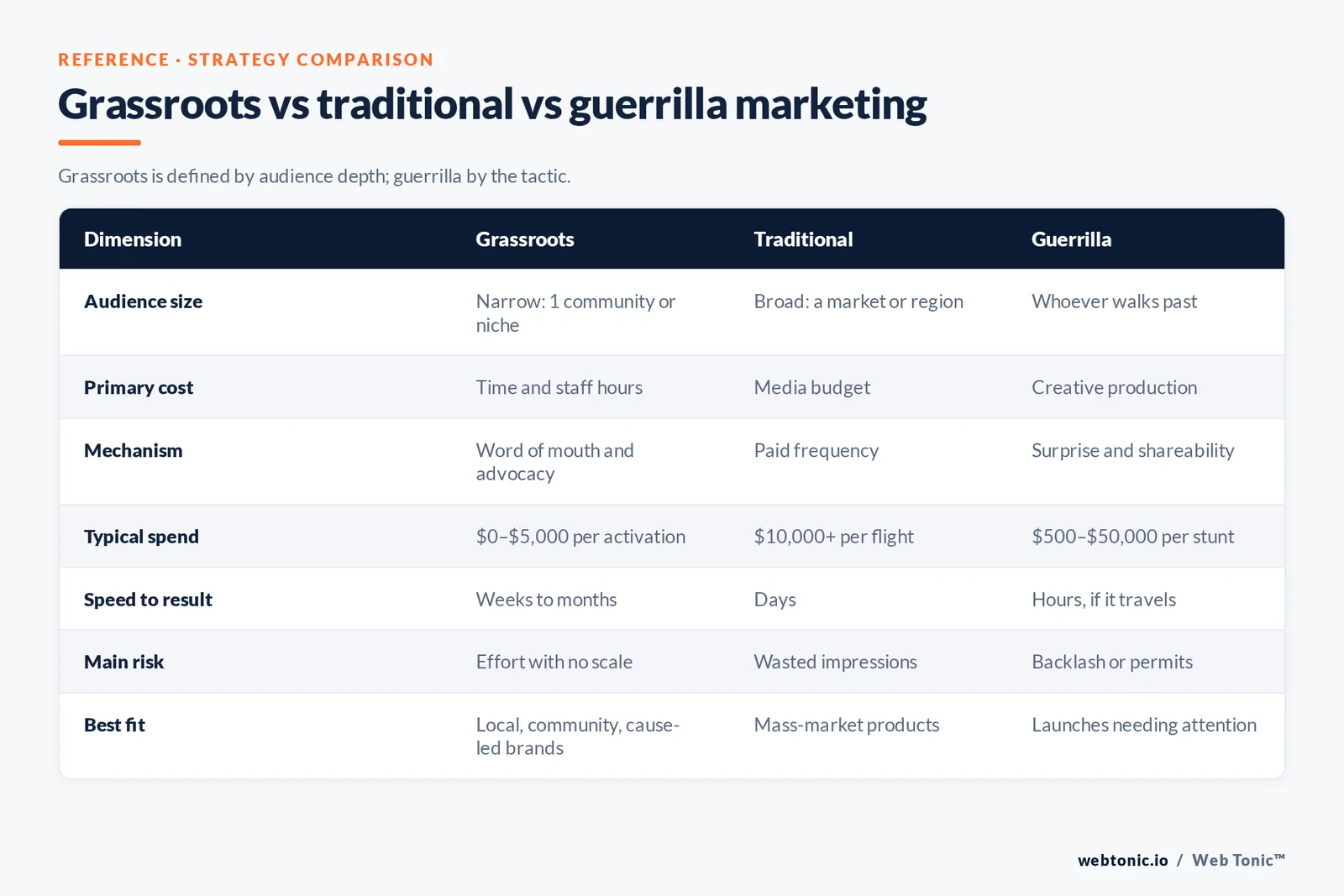
| Dimension | Grassroots marketing | Traditional marketing | Guerrilla marketing |
|---|---|---|---|
| Audience size | Narrow: 1 community or niche | Broad: a market or region | Whoever walks past |
| Primary cost | Time and staff hours | Media budget | Creative production |
| Mechanism | Word of mouth and advocacy | Paid frequency | Surprise and shareability |
| Typical spend | $0 to $5,000 per activation | $10,000+ per flight | $500 to $50,000 per stunt |
| Speed to result | Weeks to months | Days | Hours, if it travels |
| Main risk | Effort with no scale | Wasted impressions | Backlash or permits |
| Best fit | Local, community, cause-led brands | Mass-market products | Launches needing attention |
Rule 1: if your grassroots plan does not name the specific community — a running club, a school district, a subreddit, a farmers market — it is not a grassroots plan, it is small-budget advertising. The US Small Business Administration's marketing guide starts from the same place: define the audience before the tactic.
Why grassroots marketing works for small businesses
Paid channels price reach at auction. A local business bidding against national advertisers pays national prices for a fraction of the relevant audience — LocaliQ's 2026 cross-industry search benchmarks put the all-industry average CPC at $5.42 and average cost per lead at $66.69, with legal at $9.87 and home improvement at $8.33 per click. Against those numbers, 50 real conversations at a community event can be the cheaper acquisition route.
The second reason is trust transfer. A recommendation arrives with the credibility of the person giving it, which no ad unit can buy. The Better Business Bureau's consumer trust resources and the Word of Mouth Marketing Association both treat that transfer as the core asset rather than a bonus.
The third is durability. A community relationship keeps producing referrals after the campaign stops, whereas paid demand ends with the budget. That is the trade: slower start, longer tail.
20 grassroots marketing ideas, and why each one works
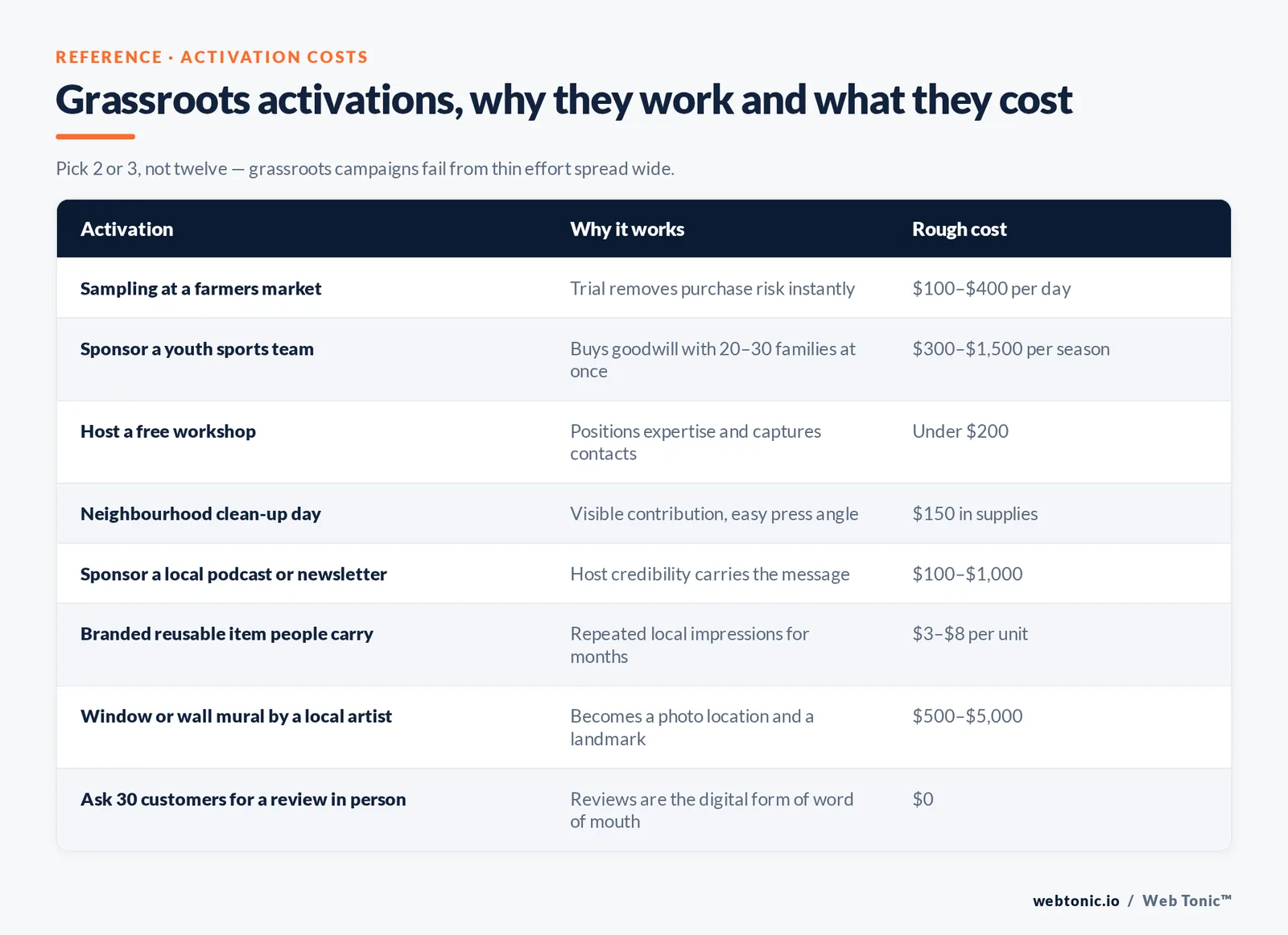
These are the activations that reliably produce conversations. Pick 2 or 3, not twelve — grassroots campaigns fail from thin effort spread wide.
| Idea | Where it happens | Why it works | Rough cost |
|---|---|---|---|
| 1. Sampling at a farmers market | Weekly local market | Trial removes purchase risk instantly | $100 to $400 per day |
| 2. Sponsor a youth sports team | Local league | Buys goodwill with 20 to 30 families at once | $300 to $1,500 per season |
| 3. Host a free workshop | Your premises or a library | Positions expertise and captures contacts | Under $200 |
| 4. Chalk-art street messages | High-footfall sidewalk | Cheap surprise that people photograph | Under $50, check local rules |
| 5. Neighbourhood clean-up day | Your own street | Visible contribution, easy press angle | $150 in supplies |
| 6. Cross-promotion with 5 nearby shops | Adjacent businesses | Borrows an existing customer base | Print cost only |
| 7. Loyalty referral card | Point of sale | Turns a satisfied customer into a channel | $0.10 per card |
| 8. Community Facebook group participation | Local groups | Answers questions where buying intent appears | Staff time |
| 9. User-generated content contest | Instagram or TikTok | Customers produce the creative and the reach | Prize value |
| 10. Micro-influencer gifting (local only) | Creators under 10,000 followers | High engagement, genuinely local audience | Product cost |
| 11. Pop-up inside a partner store | Complementary retailer | Zero-rent access to qualified footfall | Revenue share |
| 12. Sponsor a local podcast or newsletter | Niche media | Host credibility carries the message | $100 to $1,000 |
| 13. Free service for one visible cause | School, shelter, clinic | Demonstrates the work instead of claiming it | Labour only |
| 14. Branded reusable item people carry | Bags, bottles, totes | Repeated local impressions for months | $3 to $8 per unit |
| 15. Ambassador programme with 10 regulars | Existing customers | Formalises advocacy that already exists | Perks only |
| 16. Local awards or "best of" nomination push | Community media | Mobilises supporters and earns coverage | $0 |
| 17. Charity round-up at checkout | POS | Shared purpose gives people a reason to talk | Admin time |
| 18. Run a recurring community event | Monthly meetup | Compounding attendance beats one-off stunts | $200 per event |
| 19. Window or wall mural by a local artist | Your storefront | Becomes a photo location and a landmark | $500 to $5,000 |
| 20. Ask 30 customers for a review in person | In store, after service | Reviews are the digital form of word of mouth | $0 |
Eventbrite's organiser blog is a practical resource for the event-based half of that list, and the US Chamber of Commerce small-business strategy hub covers the partnership side.
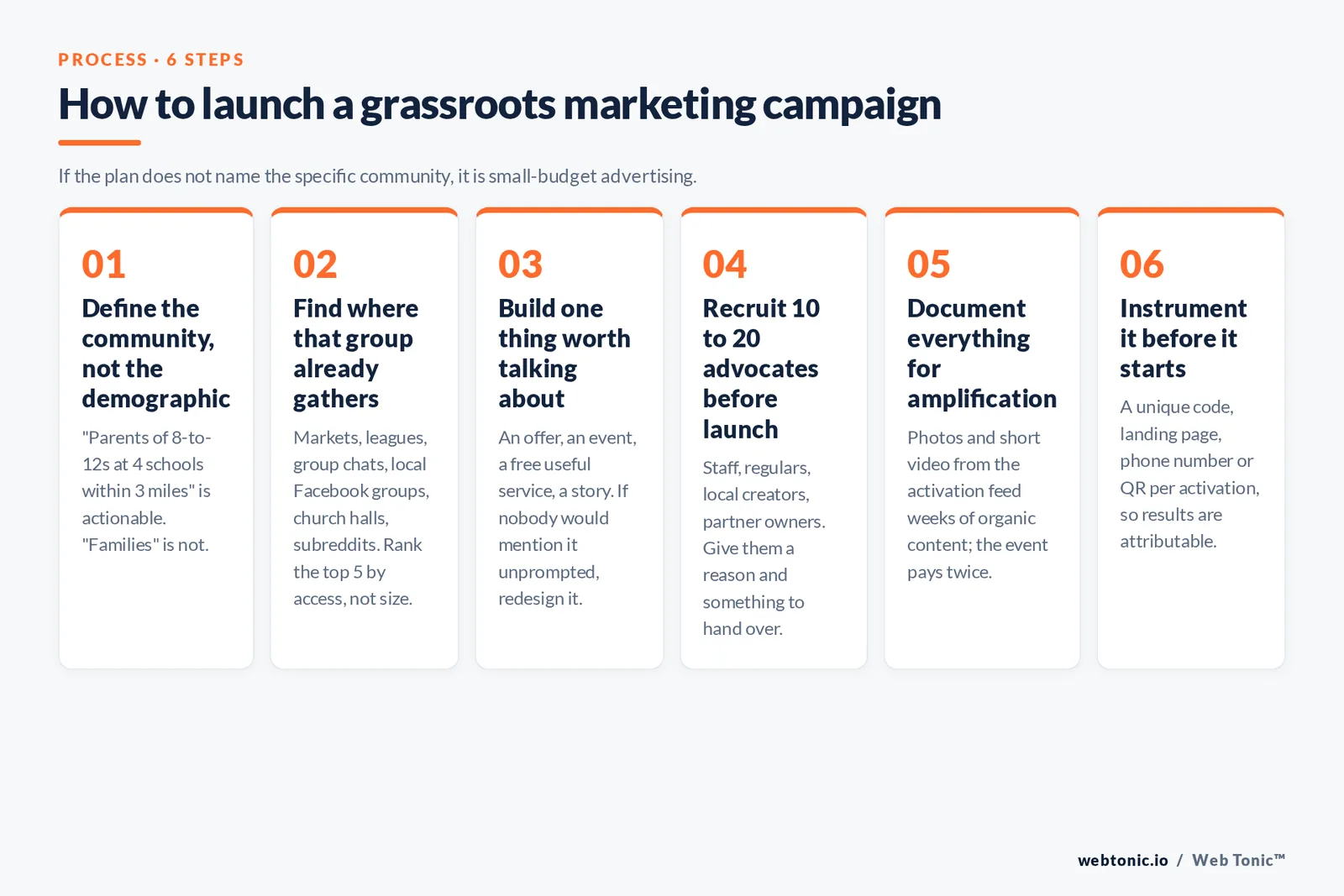
How to launch a grassroots marketing campaign in 6 steps
- Step 1 — Define the community, not the demographic. "Parents of 8-to-12s at 4 schools within 3 miles" is actionable. "Families" is not.
- Step 2 — Find where that group already gathers. Markets, leagues, group chats, local Facebook groups, church halls, subreddits, WhatsApp lists. Rank the top 5 by access, not size.
- Step 3 — Build one thing worth talking about. An offer, an event, a free useful service, a story. If nobody would mention it unprompted, redesign it.
- Step 4 — Recruit 10 to 20 advocates before launch. Staff, regulars, local creators, partner owners. Give them a reason and something to hand over.
- Step 5 — Document everything for social amplification. Photos and short video from the activation feed weeks of organic content; the event pays twice.
- Step 6 — Instrument it before it starts. A unique code, landing page, phone number or QR per activation, so results are attributable rather than anecdotal.
Amplification matters because the community conversation continues online: current DataReportal and Sprout Social figures put social usage at 5.66 billion people averaging 2 hours 40 minutes daily, and Sprout Social's index research documents how fast audiences expect brands to respond in those spaces.
Grassroots campaign examples worth studying
Three patterns recur in campaigns that scaled beyond their starting community.
Pattern 1 — surprise the individual, film the reaction. WestJet's Christmas Miracle activation asked departing passengers what they wanted for Christmas and delivered the gifts at baggage claim; the airline still publishes campaign updates through its news centre. The mechanic is grassroots — a few hundred real people — but the documentation gave it national reach.
Pattern 2 — hand the message to the audience. Dove's Real Beauty work grew because participants and viewers argued about it publicly, adding reach the brand did not buy. Any campaign that invites people to submit, vote, nominate or share their own version borrows the same engine, and Content Marketing Institute's case coverage tracks how the pattern is used today.
Pattern 3 — anchor to a place. Murals, sponsored courts, named community rooms and repeat local events convert marketing spend into a physical landmark that keeps working. Track the effect in branded search: rising local branded queries in Google Trends and in your own search data is the earliest measurable signal.
One legal note: when advocates receive product, discounts or payment, the relationship must be disclosed. The FTC's endorsement guides apply to gifted meals and ambassador perks exactly as they apply to paid influencer contracts.
Grassroots marketing by business type
| Business type | Best starting activation | Community to target | Primary metric | Realistic first-90-day outcome |
|---|---|---|---|---|
| Restaurant or cafe | Sampling plus a recurring weekly event | Office workers and residents within 1 mile | Covers per week | 10% to 20% repeat-visit lift |
| Home services | Free demo at a neighbourhood event | 2 to 3 target subdivisions | Cost per booked quote | 20 to 60 qualified enquiries |
| Retail store | Partner pop-up plus a mural | Nearby complementary retailers | Footfall and UGC posts | Steady tagged-post volume |
| Fitness studio | Free outdoor class series | Local running and cycling clubs | Trial-to-member rate | 30 to 80 trials |
| B2B service firm | Practitioner meetup or workshop | One industry association chapter | Meetings booked | 5 to 15 sales conversations |
| Ecommerce / DTC | Micro-creator gifting plus a UGC contest | One niche interest community | Content pieces per 100 units gifted | 50+ usable assets |
| Nonprofit | Volunteer day plus a nomination push | Existing donors and their networks | Second-gift rate | New volunteer cohort |
| Professional practice | Free clinic or Q&A evening | Schools, employers, community centres | New patient or client registrations | 15 to 40 registrations |
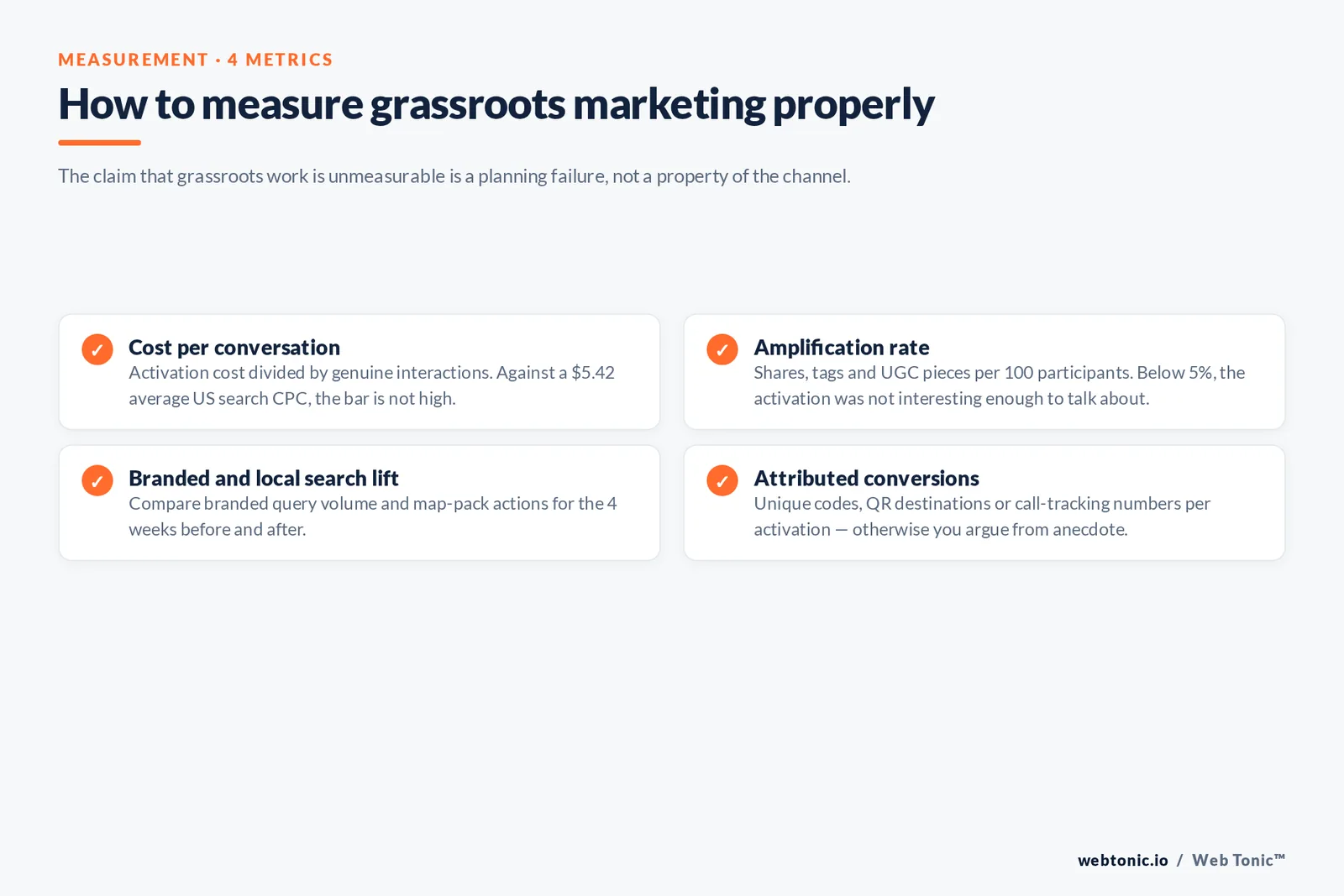
How to measure grassroots marketing
The complaint that grassroots work is unmeasurable is a planning failure, not a property of the channel. Four metrics cover it.
Metric 1 — cost per conversation. Total activation cost divided by genuine interactions. It is the honest comparison against a paid CPC, and at a $5.42 average click cost the bar is not high.
Metric 2 — amplification rate. Shares, tags and UGC pieces per 100 participants. Below 5%, the activation was not interesting enough to talk about.
Metric 3 — branded and local search lift. Compare branded query volume and map-pack actions for the 4 weeks before and after. This is where community work shows up in analytics, and it is the read our data intelligence team sets up first.
Metric 4 — attributed conversions. Unique codes, QR destinations or call-tracking numbers per activation. Without them you will be arguing from anecdote at the next budget meeting.
For benchmarking sentiment and awareness at a market level, Nielsen's insights library and Ipsos US research both publish current consumer studies you can use as a comparison point instead of guessing.
FAQ
What is grassroots marketing in simple terms?
It is marketing that targets a small, specific group of people directly and relies on them to spread the message to a wider audience. Instead of paying for reach, you invest time in one community — a neighbourhood, a club, a campus, an online niche — and make the experience worth talking about.
How is grassroots marketing different from guerrilla marketing?
Grassroots is defined by audience depth: a narrow group cultivated over time. Guerrilla is defined by tactic: an unconventional, high-surprise execution designed to grab attention quickly. A chalk-art stunt at a local market is guerrilla execution inside a grassroots strategy, and most strong campaigns combine the two.
How much does a grassroots marketing campaign cost?
Most single activations land between $0 and $5,000, with cost concentrated in staff hours rather than media. A sampling day runs $100 to $400, a youth team sponsorship $300 to $1,500 per season, and a storefront mural $500 to $5,000. The realistic constraint is people-hours, not cash.
Does grassroots marketing work for online-only businesses?
Yes, if you treat an online niche as the community. A subreddit, Discord server, professional forum or creator audience under 10,000 followers functions the same way a neighbourhood does: small enough to participate in genuinely, tight enough that word travels. Gifting, contests and consistent useful participation replace the market stall.
How long before grassroots marketing shows results?
Expect weeks rather than days. Attributable conversions from a single activation appear immediately, but the compounding effects — referrals, branded search, review volume — typically take 60 to 90 days of consistent presence in the same community to become visible in reporting.
If you want community activity connected to measurable demand rather than treated as a separate project, our growth marketing and performance creative teams build that link, and you can talk to us about your market.
Sources: US Small Business Administration — Marketing and sales guide · US Chamber of Commerce — Small business strategy · Better Business Bureau — Consumer trust · Word of Mouth Marketing Association · Eventbrite — Organiser blog · Sprout Social — Social media index research · DataReportal / Sprout Social 2026 social usage figures · LocaliQ — 2026 search advertising benchmarks (23 industries) · Gallup — Customer engagement topic hub, February 2026 · WestJet — News centre · Content Marketing Institute — Articles · Google Trends · FTC — Endorsement guides: what people are asking · Nielsen — Insights · Ipsos US.