



Table of contents
The Google Display Network reaches over 90% of internet users worldwide across more than 35 million websites, apps, and Google-owned properties. It is the largest display advertising network on the planet — and it is either a powerful brand-building machine or an easy way to waste your budget, depending entirely on how you set it up.
Key Takeaways
- The Google Display Network (GDN) reaches 90%+ of internet users globally across 35 million websites, apps, YouTube, Gmail, and Google-owned properties — making it the broadest reach platform in digital advertising.
- The average GDN CPM is $2.80 in 2025, with responsive display ads averaging $2.60 CPM and a 0.58% CTR — significantly higher than static banner ads at 0.45% CTR.
- Responsive display ads generate 28% higher click-through rates than static banners, and they adapt automatically to every placement size, reducing creative production costs.
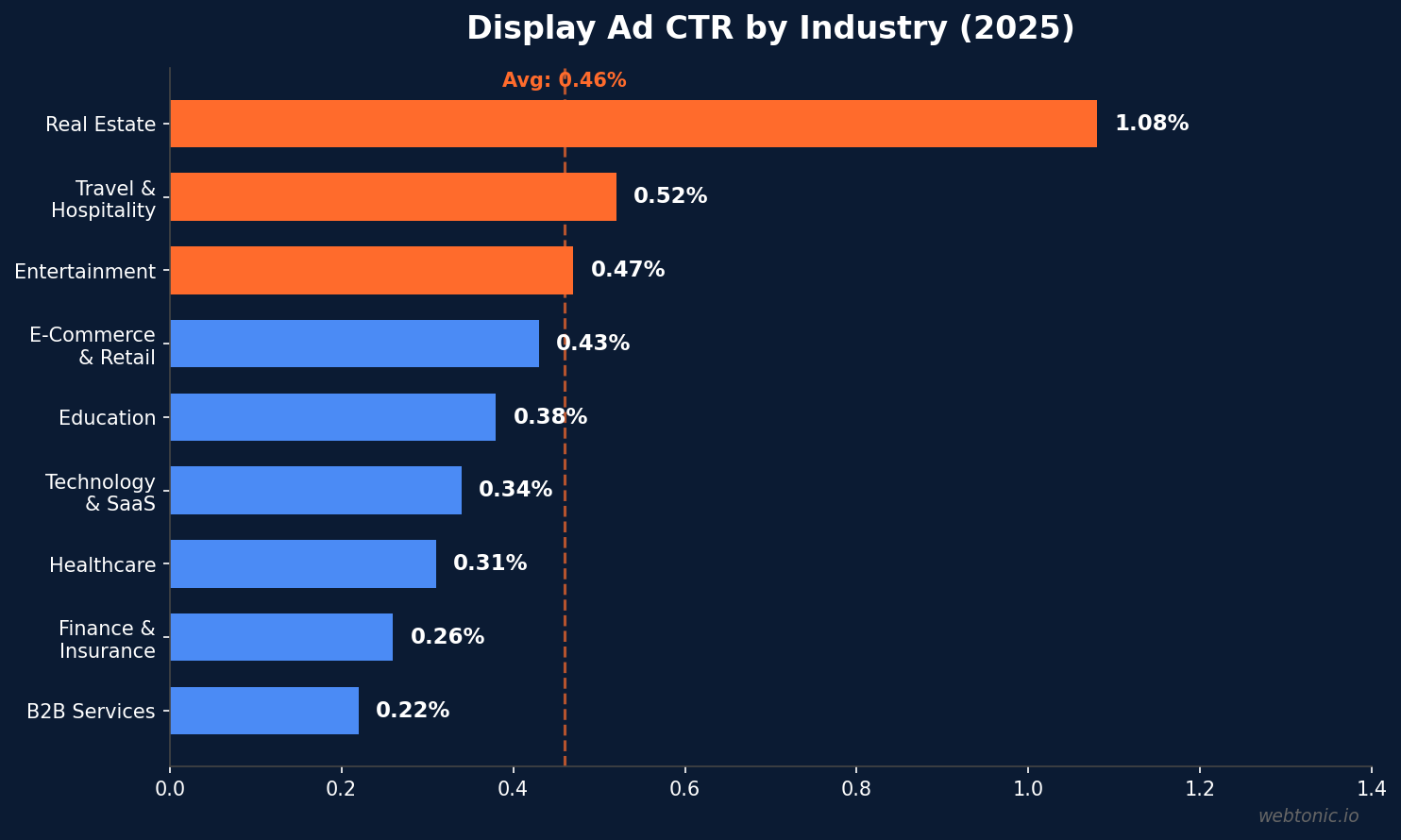
- GDN click-through rates average 0.46% across all industries, with real estate leading at 1.08% CTR and B2B trailing at 0.22% — proper targeting is what separates profitable GDN campaigns from budget waste.
- Google is phasing out standard Display campaigns in 2027, migrating advertisers toward Demand Gen and Performance Max — understanding the GDN now prepares you for the transition.
Whether you are running display advertising campaigns for brand awareness or direct-response conversions, this guide covers how the Google Display Network works, the targeting options that actually drive results, and the best practices that separate profitable GDN campaigns from budget drains.
What Is the Google Display Network
The Google Display Network (GDN) is a collection of over 35 million websites, mobile apps, and video content where your ads can appear. It includes Google-owned properties like YouTube, Gmail, and Blogger, as well as millions of third-party websites that participate in the Google AdSense program.
When you create a Display campaign in Google Ads, your ads can show as banner images, responsive display ads, or native ads across this network. Unlike Google Search ads — which appear when someone actively searches for a keyword — display ads reach people while they browse content, watch videos, check email, or use apps. This makes the GDN fundamentally a push channel rather than a pull channel.
The distinction between the Display Network and the Search Network is critical for setting expectations. Search ads target active intent (someone searching for "best running shoes"). Display ads target passive browsing (someone reading a running blog). This difference explains why GDN click-through rates average 0.46% compared to Search's 3–5% — and why judging GDN campaigns by search campaign metrics leads to premature optimization kills.
| Feature | Google Display Network | Google Search Network |
|---|---|---|
| Reach | 35M+ websites and apps | Google Search and partner sites |
| User Intent | Passive — browsing content | Active — searching for solutions |
| Average CTR | 0.46% | 3.17% |
| Average CPM | $2.80 | N/A (CPC model) |
| Primary Goal | Brand awareness, remarketing | Lead generation, direct sales |
| Ad Format | Banners, responsive, native, video | Text-based RSAs |
| Targeting | Audience, context, placement | Keyword-based |

GDN Targeting Options That Actually Work
The GDN offers three categories of targeting: audience targeting (who you want to reach), content targeting (where you want ads to appear), and demographic targeting (age, gender, household income). The most common mistake advertisers make is using broad audience targeting without content or placement refinements — which leads to ads appearing on irrelevant websites and wasting budget.
Audience targeting is the most powerful lever on the GDN. According to Google's official targeting documentation, audience segments fall into several categories:
In-market audiences — people Google has identified as actively researching or comparing products in a specific category. These audiences are built from search behavior, website visits, and YouTube engagement. In-market audiences consistently deliver the highest conversion rates on the GDN because they target users with demonstrated purchase intent.
Custom audiences — audiences you build using keywords, URLs, and apps related to your ideal customer. Enter the URLs of competitor websites and Google will find users who have visited similar content. This is effectively competitor conquest targeting without directly bidding on competitor brand names.
Remarketing audiences — users who have previously visited your website, used your app, or interacted with your YouTube channel. Remarketing on the GDN typically generates 2–3x higher conversion rates than prospecting because you are targeting people who already know your brand.
Content targeting lets you specify where your ads appear rather than who sees them. Topic targeting places ads on pages about specific subjects (e.g., "fitness" or "personal finance"). Placement targeting lets you choose specific websites, YouTube channels, or apps where your ads will show. Keyword targeting shows ads on pages containing specific terms. Combined with audience targeting, content targeting creates a precision intersection: the right person on the right page.
GDN Ad Formats and Creative Best Practices
The GDN supports four primary ad formats: responsive display ads, uploaded image ads, HTML5 animated ads, and native ads. Of these, responsive display ads dominate — and for good reason.
Responsive display ads (RDAs) automatically adjust their size, appearance, and format to fit any available ad space. You provide up to 15 images, 5 logos, 5 headlines, 5 descriptions, and your business name, and Google's machine learning assembles the optimal combination for each impression. According to the 2025 GDN benchmark data from RockingWeb, responsive display ads generate a 28% higher CTR (0.58%) compared to standard image banners (0.45%).
The creative requirements for effective GDN ads differ from search ads. Display ads are competing for attention against the content the user is actually reading — your ad is the interruption, not the answer. The three elements that drive GDN creative performance are:
Visual contrast. Your ad must stand out from the surrounding page content. High-contrast color combinations (dark backgrounds with bright CTAs, bold text against clean backgrounds) outperform ads that blend into the page. Use your brand colors consistently across all assets so users begin to recognize your ads even before reading them.

Clear value proposition in the headline. You have roughly 2–3 seconds of attention on a display ad. The headline must communicate the benefit immediately: "Save 30% on Cloud Hosting" outperforms "Discover Our Cloud Solutions." Lead with the number, the discount, or the outcome.
A single, unambiguous CTA. "Get Started Free," "Download Now," or "Shop the Sale" — one action, one button. Multiple CTAs on a display ad split attention and reduce click-through rates by up to 25%.
| Ad Format | Average CPM | Average CTR | Best Use Case |
|---|---|---|---|
| Responsive Display Ads | $2.60 | 0.58% | All-purpose — automated format optimization |
| Standard Image Banners | $2.90 | 0.45% | Brand-specific creative control |
| HTML5 Animated Banners | $3.40 | 0.51% | Product showcases and interactive ads |
| Native Ads | $3.80 | 0.62% | Content-heavy sites and editorial placements |
| Gmail Ads | $7.20 | 0.84% | B2B outreach and email-native promotions |
GDN Performance Benchmarks by Industry
Understanding what "good" looks like on the GDN requires industry context. Display advertising performance varies dramatically by vertical, and applying a one-size-fits-all CTR or CPA benchmark leads to misguided optimization decisions.
According to Focus Digital's 2025 display advertising benchmark study, the overall industry average CTR for display ads is 0.46%. However, the range spans from 0.22% (B2B Services) to 1.08% (Real Estate) — a nearly 5x difference between the lowest and highest performing verticals.
Real estate leads with a 1.08% CTR because property ads are highly visual and target users with strong intent signals (actively browsing real estate websites). Travel and hospitality follows at 0.52%, benefiting from aspirational imagery that captures attention. At the other end, B2B services and finance struggle because their products are complex, their buying cycles are long, and their audiences are harder to identify through browsing behavior alone.
For CPM benchmarks, the global average GDN CPM sits at $2.80 in 2025. Financial services has the highest CPM at $18.50, reflecting intense competition for high-value customers. General interest content has the lowest at $0.30–$0.80, making it extremely cost-effective for awareness campaigns — though the traffic quality from general content placements is typically lower.
When to Use GDN vs. Other Campaign Types
The GDN does not exist in isolation. Google Ads offers several campaign types that include display placements, and choosing the wrong one wastes money. Here is when each makes sense.
Standard Display campaigns give you the most control over targeting, placements, and bidding on the GDN. Use them when you want to build brand awareness, run remarketing, or test specific audience segments with granular reporting. Note: Google has announced that standard Display campaigns will be phased out in 2027, migrated toward Demand Gen.
Performance Max (PMax) campaigns include GDN placements alongside Search, YouTube, Gmail, Discover, Shopping, and Maps. PMax uses full automation for targeting and bidding, making it ideal for conversion-focused advertisers who want Google's AI to find the best placements across all networks. The trade-off is limited visibility into which network is driving results.

Demand Gen campaigns target YouTube, Discover, and Gmail — overlapping with some GDN placements but using more engaging, visual-first ad formats. Demand Gen is Google's successor to Discovery campaigns and is designed for mid-funnel engagement — reaching users who are interested but not yet actively searching.
The strategic framework: use Search for bottom-funnel capture (users searching for your solution), GDN for mid-funnel awareness and remarketing (users browsing related content), Demand Gen for discovery and engagement (users on YouTube and Discover), and PMax for fully automated multi-channel performance. Most mature Google Ads strategies use all four in combination.
Brand Safety and Placement Exclusions
One of the biggest criticisms of the GDN is that ads can appear on low-quality websites, inappropriate content, or fraudulent placements. Placement exclusions are not optional — they are essential for protecting your brand and your budget.
Start with Google's built-in content suitability settings: under Campaign Settings → Content Exclusions, exclude sensitive categories (tragedy, conflict, sexually suggestive content) and ad group-level topic exclusions for irrelevant content categories.
Then review your placement reports weekly for the first month and monthly thereafter. Look for:
Mobile app placements — apps like "flashlight" or children's games often generate accidental clicks from users who did not intend to interact with your ad. Exclude adsenseformobileapps.com and specific low-quality app categories to eliminate this waste.
Made-for-advertising (MFA) sites — websites designed purely to display ads, with thin content and high ad density. These sites generate impressions and clicks but almost never produce conversions. Review placements with high click counts and zero conversions — these are likely MFA sites.
Parked domains and error pages — occasionally ads appear on domains that are for sale or pages that return errors. Exclude these immediately when they appear in your placement report.
For large-scale brand safety, consider using a placement allow-list strategy: instead of excluding bad sites (reactive), define a list of approved websites where your ads can appear (proactive). This reduces reach significantly but dramatically improves traffic quality and conversion rates.
Frequently Asked Questions
What is the difference between the Google Display Network and Google Search?
The Google Search Network shows text ads to users actively searching for keywords. The Google Display Network shows visual ads (banners, responsive, native) to users while they browse websites, apps, YouTube, and Gmail. Search targets active intent with an average 3.17% CTR; Display targets passive browsing with an average 0.46% CTR. Search is best for direct response; Display is best for brand awareness and remarketing.
How much does it cost to advertise on the Google Display Network?
The average GDN CPM is $2.80 in 2025, but costs vary dramatically by industry. Financial services pays up to $18.50 CPM, while general interest content costs as low as $0.30–$0.80 CPM. Most advertisers use CPC bidding (cost per click) rather than CPM, with average CPCs ranging from $0.50 to $3.00 depending on the targeting and industry.
Are Google Display Network ads effective?
GDN ads are effective for brand awareness, remarketing, and audience building — but they are not designed to compete with Search ads for direct-response conversion rates. GDN remarketing campaigns typically convert at 2–3x the rate of prospecting campaigns. The key is setting appropriate KPIs: measure GDN by assisted conversions, view-through conversions, and brand search lift — not last-click CPA alone.
How do I stop my Google Display ads from showing on bad websites?
Use three layers of exclusion: content suitability settings (exclude sensitive categories), placement exclusions (remove specific websites from your reports), and topic exclusions (block entire content categories). Review your placement report weekly during the first month and exclude any site with high clicks and zero conversions. For maximum brand safety, use a placement allow-list to restrict ads to pre-approved websites only.
Will Google Display campaigns go away?
Google has announced that standard Display campaigns will be phased out in 2027, with advertisers migrating toward Demand Gen campaigns and Performance Max. The Google Display Network itself will continue to exist as an ad placement network, but the campaign types that target it will change. Advertisers should start testing Demand Gen campaigns now to prepare for the transition.
Sources
WordStream — Complete Guide to the Google Display Network (2026)
Google — Targeting for Display Campaigns
RockingWeb — GDN CPM Benchmarks 2025
Focus Digital — Average Display Ad CTR 2025
Tinuiti — Digital Ads Benchmark Report Q3 2025


