Table of contents
Google publishes the definitions of its own Business Profile Performance metrics, which makes GBP one of the few local-marketing channels where the benchmark data comes straight from the platform rather than a third-party estimate. This page works from those definitions plus named local-search research to lay out what a profile is actually measured on, what ranks it, and what gets it suspended - cross-industry figures, labeled as such throughout.
Key Takeaways
- Google defines five core Performance metrics: views, searches, directions, calls, and website clicks.
- The Views metric counts a unique visitor once per day, capped across devices.
- Search queries update monthly and can take up to 5 days to appear.
- Direction requests are adjusted for multiple taps, cancellations and spam before counting.
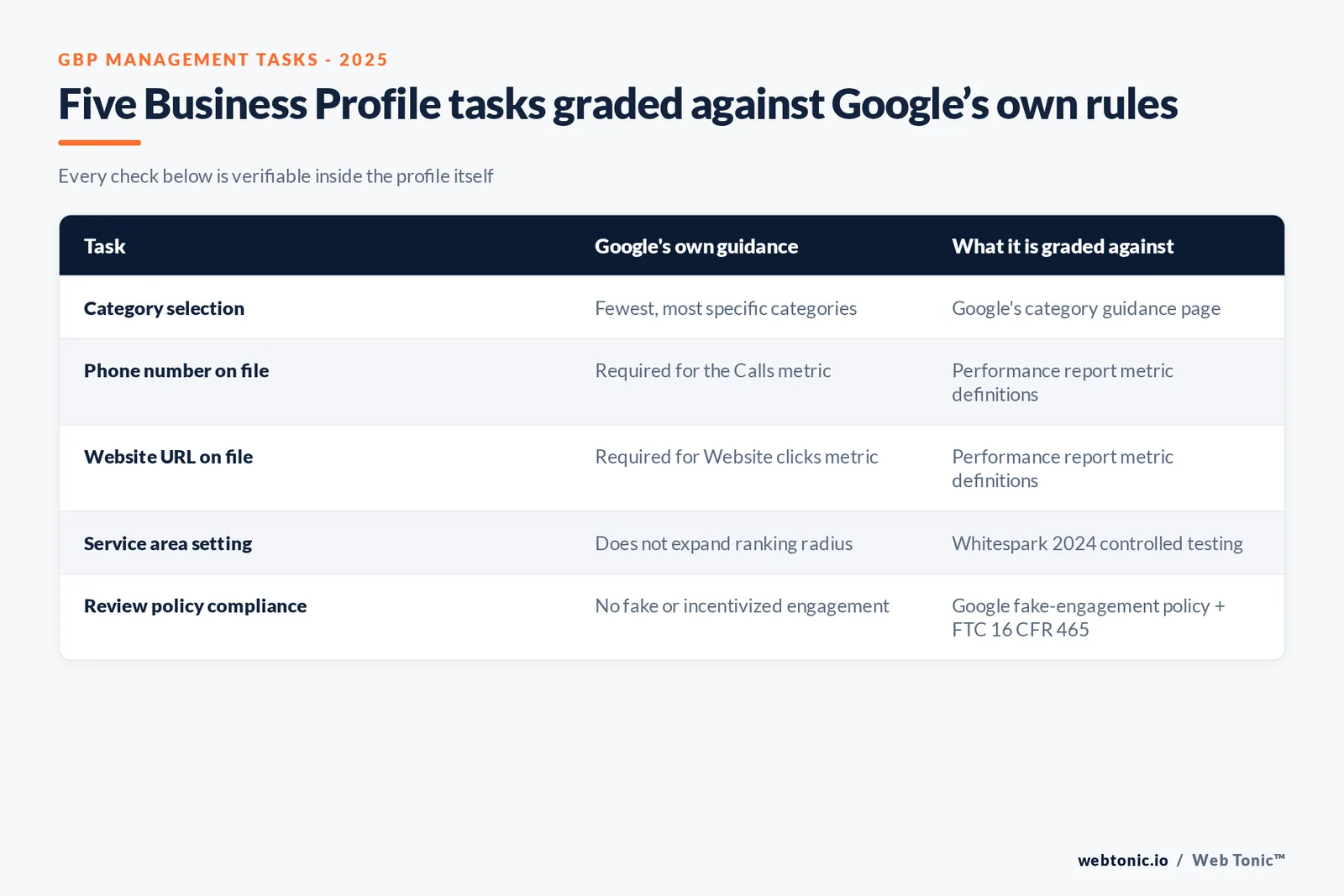
- Calls only register if a phone number is added to the profile.
- Setting a wider service area does not expand ranking radius (Whitespark, 2024 controlled testing).
- Google's category guidance says to use the fewest, most specific categories possible.
- Suspension appeals require documented evidence: business registration, license, tax certificate, or utility bills.
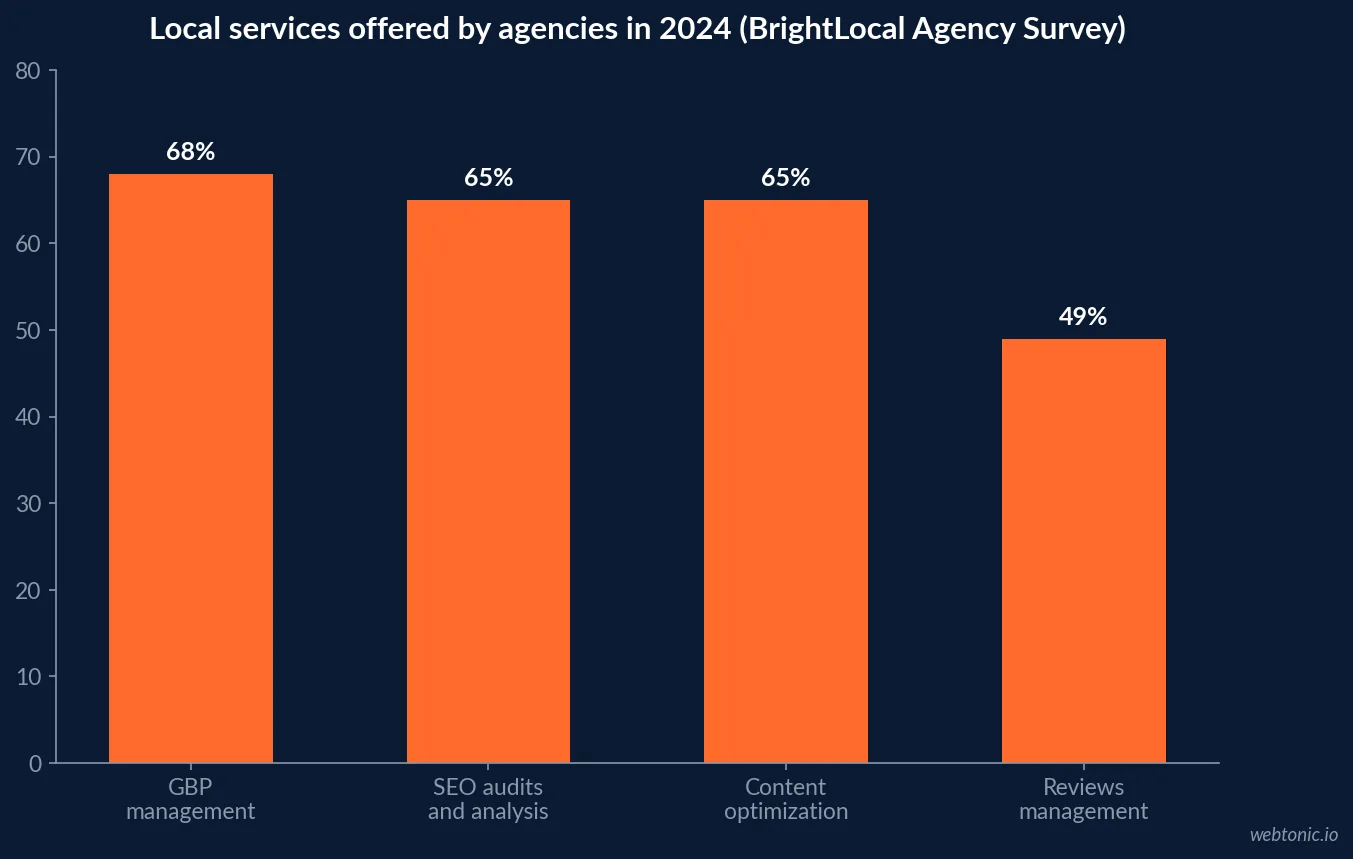
- 68% of local agencies already offer GBP management, more than any other single local service (BrightLocal 2024).
- 49% of agencies offer review management specifically, a separate but adjacent service.
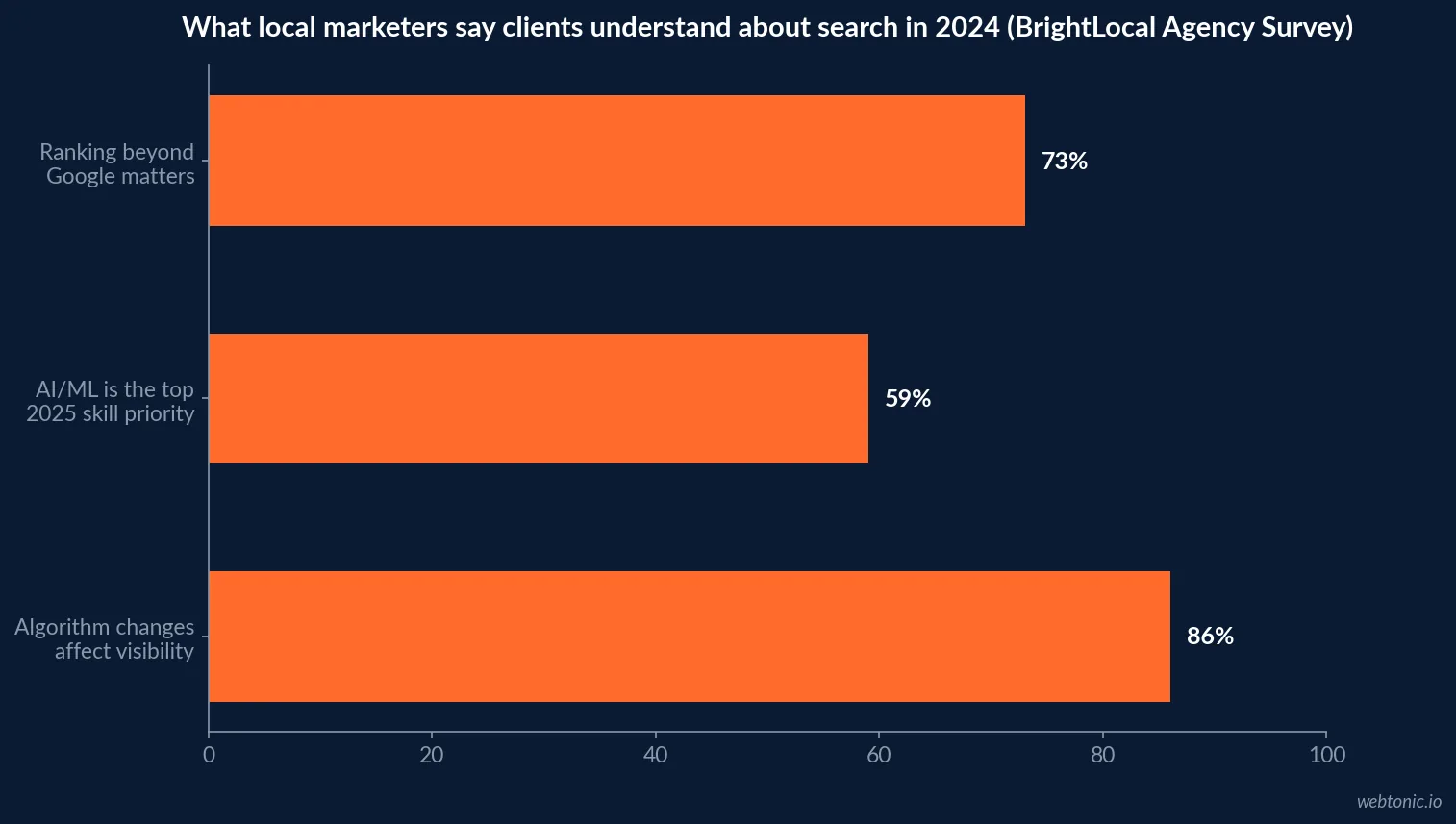
- 86% of local marketers say clients are aware algorithm changes affect their visibility (BrightLocal 2024).
- 59% of agency marketers name AI/machine learning as their top 2025 skills priority.
- The FTC's fake-review rule (16 CFR Part 465) reinforces Google's own fake-engagement policy with federal enforcement.
What the Performance report actually counts (Google's own definitions)
Unlike most local-marketing benchmarks, the source for GBP performance data is the platform itself. Google's own Business Profile help documentation defines each metric precisely, and the definitions carry real limits worth knowing before treating a number as a simple headcount. Views counts unique visitors, capped at once per day regardless of how many times or devices someone returns on. Searches updates only at the start of each month and can take up to five days to populate. Directions requests are adjusted downward for multiple taps, cancellations, and detected spam before they are reported. Calls only tracks clicks on the call button, and only if a phone number has been added to the profile in the first place - a profile without a listed number simply cannot generate this metric.
| Performance metric | Google's official definition | Counting limitation to know |
|---|---|---|
| Views | Unique visitors who saw the profile on Search or Maps | Counted once per day per user, across devices |
| Searches | Search terms that surfaced the profile | Updates monthly; up to 5-day reporting lag |
| Directions | Requests for directions to the business | Adjusted for multiple taps, cancellations, spam |
| Calls | Clicks on the profile's call button | Requires a phone number on the profile to register at all |
| Website clicks | Clicks through to the business's linked website | Requires a website URL on the profile |
Category and photo hygiene: Google's own rules, not a best-practice guess
Google's category guidance instructs owners to use as few categories as possible to describe the core business, choose the most specific option available rather than a broad one, and avoid using a category purely as a keyword or attribute descriptor. Google's own system also nests broader categories automatically under a specific one - the documentation's example is that selecting "Golf Resort" implicitly includes "Resort Hotel," "Hotel," and "Golf Course," which means stacking every plausible category does not add discoverability, it just clutters the listing against Google's own guidance.
Photos and posts sit in the same "platform-defined" bucket: Google's Performance metric set separately tracks merchant-uploaded versus customer-uploaded photo views and counts, which means a business's own photo activity and its customers' organic photo activity are measured, and reported, as two different signals - not one combined "photo count."
| Profile element | Google's guidance | Common mistake it corrects |
|---|---|---|
| Categories | Fewest, most specific categories describing the core business | Stacking every plausible category as a keyword tactic |
| Photos | Merchant and customer uploads tracked as separate metrics | Treating photo count as one undifferentiated total |
| Service area | Does not expand ranking radius (Whitespark 2024 testing) | Widening service area to try to rank further from the address |
| Phone number | Required for the Calls metric to register at all | Expecting call tracking on a profile with no number listed |
| Website URL | Required for the Website clicks metric to register | Expecting click data on a profile with no linked site |
Ranking is address-anchored, not service-area-anchored
Whitespark's 2024 controlled testing, backed by its long-running annual Local Search Ranking Factors survey of local-search practitioners, found that changing or widening a profile's listed service area produced no measurable change in where that profile ranked, even when the tested service area was moved progressively closer to the business's actual physical address. Ranking radius is instead governed by proximity to the searcher relative to the profile's verified address, and that radius varies with how competitive the local market is - a business cannot widen its own ranking footprint by editing the service-area field alone.
That single finding resolves a common budgeting mistake: paying for service-area expansion inside a GBP tool as if it were a ranking lever. It is a discovery/relevance field for customers reading the profile, not a ranking input Google's algorithm rewards.
What suspends a profile, and what it takes to get it back
Google's suspension and appeals documentation is explicit that profiles violating its guidelines - most visibly its fake-engagement policy on reviews and ratings, and misrepresentation of business information - can be suspended or disabled, and that reinstatement runs through a formal appeals tool rather than a quick resubmission. Google recommends submitting supporting evidence with the appeal: official business registration, a business license, tax certificates, or utility bills tied to the business address. The same fake-engagement enforcement guidance notes that violating profiles can also be blocked from receiving new reviews for a set period, or have existing reviews unpublished, independent of a full suspension.
The FTC's 2024 fake-review rule (16 CFR Part 465) runs on a parallel track to Google's own policy enforcement - a business can face both a platform-level suspension and separate federal exposure for the same underlying fake-review conduct.
| Suspension trigger (Google's own policy) | Platform-level consequence | Separate federal exposure |
|---|---|---|
| Fake or incentivized reviews/ratings | Reviews unpublished; new reviews blocked for a period | FTC 16 CFR 465 civil penalty risk if knowing |
| Misrepresented business information | Profile suspended pending appeal | None directly, but consumer-protection risk |
| Ineligible business type verified anyway | Profile disabled on discovery | None directly |
| Repeated policy violations | Account-level restriction, blocking new profile claims | None directly |
Who is already managing this, and what it costs to run
BrightLocal's 2024 Local Marketing Industry Survey: Agency Edition (almost 400 local agency marketers surveyed) found Google Business Profile optimization/management is the single most commonly offered local service at 68% of agencies, ahead of SEO audits (65%), content optimization (65%), and online reviews management specifically (49%). The same survey found 86% of local marketers say their clients are aware algorithm changes can affect visibility, and 59% name AI and machine learning as the top skill area they want to develop for 2025 - a sign that GBP management is increasingly bundled with broader AI-search readiness rather than sold as a narrow, stand-alone task.
There is no single published market rate for GBP management software or services - most reputation and local-SEO platforms price on a quote or tiered-plan basis rather than one public list price, which is consistent with BrightLocal's finding that most agencies fold it into a broader retainer instead of billing it as an isolated line item. The honest cost question for a buyer is less "what does GBP management cost" and more "is the number I'm seeing quoted a software license, the labor to keep the profile current, or both."
| Local service (BrightLocal Agency Survey 2024) | Share of agencies offering it |
|---|---|
| Google Business Profile optimization/management | 68% |
| SEO audits and analysis | 65% |
| Content creation/optimization | 65% |
| Technical SEO | 63% |
| Online reviews management | 49% |
How Google's own metric definitions compare to the developer API
The consumer-facing help pages and the machine-readable side of the platform describe the same metrics with slightly different vocabulary, which matters for anyone piping Performance data into a dashboard rather than reading it inside the Business Profile UI. Google's Business Profile APIs metric reference exposes photo counts and views split by uploader - PHOTOS_VIEWS_MERCHANT versus PHOTOS_VIEWS_CUSTOMERS, and PHOTOS_COUNT_MERCHANT versus the customer-uploaded equivalent - a split the ordinary Performance report dashboard does not always surface as clearly. A profile manager reconciling in-house reporting against the API should expect these four fields, not one blended "photo engagement" figure.
Google's own Business Profile product page frames the whole surface as free - there is no listing fee to create or verify a profile, which is worth stating plainly since some of the market confuses profile creation cost with the separate, ongoing cost of software or the labor behind the 68% of agencies already selling this as a service.
| Photo metric (Business Profile API) | What it tracks | Why the split matters |
|---|---|---|
| PHOTOS_VIEWS_MERCHANT | Views on photos the business itself uploaded | Measures the business's own content investment |
| PHOTOS_VIEWS_CUSTOMERS | Views on photos customers uploaded | Measures organic, unpaid customer content |
| PHOTOS_COUNT_MERCHANT | Live photo count uploaded by the business | A managed input a business fully controls |
| PHOTOS_COUNT_CUSTOMERS | Live photo count uploaded by customers | An organic signal a business can only encourage, not set |
Platform enforcement runs in parallel with Google's own fake-engagement policy
Google's fake-engagement rules do not operate in isolation - other review platforms enforce nearly identical policies at real scale, which is useful context for judging how seriously Google's own version should be taken. Yelp's 2024 Trust & Safety Report states the platform removed over 185,100 reported reviews in 2024, with 26% found not to reflect a firsthand experience, and warned consumers about nearly 550 businesses for review manipulation, while Trustpilot's 2025 Trust Report states it removed 4.5 million detected fake reviews in 2024, 90% of them caught automatically. The FTC's 2024 final rule now backs all of this with federal civil-penalty authority, meaning a profile's fake-engagement exposure is judged against at least three independent enforcement layers: Google's own policy, competing platforms' proven detection scale, and federal law.
| Enforcement layer | 2024-2025 evidence | Applies to a Business Profile? |
|---|---|---|
| Google's own fake-engagement policy | Suspension, review unpublishing, appeal process | Directly |
| Yelp Trust & Safety Report | 185,100+ reviews removed, 26% non-firsthand | By analogy - proves detection works at scale |
| Trustpilot Trust Report 2025 | 4.5M fake reviews removed, 90% automated | By analogy - same detection logic Google applies |
| FTC 16 CFR Part 465 | Federal civil penalties for knowing violations | Directly, on top of platform-level suspension |
What a GBP management scorecard should track
Given Google's own metric definitions and guidance, a working scorecard tracks: category accuracy against the "fewest, most specific" rule, phone number and website URL presence (both gate entire metrics if missing), monthly view/search trend rather than a single snapshot, direction and call volume against category-comparable profiles, the merchant-versus- customer photo split the API exposes, and a running compliance check against the fake-engagement policy that Google, competing platforms, and the FTC now all enforce. None of this requires a third-party estimate - every figure is available directly inside the profile's own Performance report or its developer API.
Our growth marketing practice builds this kind of platform-native scorecard, our data and analytics team wires the API-level metrics into a single dashboard, and our team can review what a specific profile's Performance report is actually showing today.
Frequently Asked Questions
What does Google's Business Profile Performance report actually measure?
Google's own help documentation defines five core interaction types: Views (unique visitors who saw the profile on Search or Maps, counted once per day per user), Searches (the queries that surfaced the profile, updated monthly), Directions (requests, adjusted for multiple taps, cancellations and spam), Calls (clicks on the call button, requiring a phone number on file), and Website clicks. None of these are estimates from a third party - they come directly from Google's Business Profile Performance API and dashboard.
Does setting a wider service area help a profile rank in more places?
No, according to Whitespark's controlled 2024 testing and its long-running annual Local Search Ranking Factors survey of local-search practitioners: setting or widening a service area on a profile does not expand where that profile ranks. Ranking radius is instead governed by the profile's physical address and how competitive that specific area is - a business cannot buy extra ranking radius by listing a wider service area.
What actually gets a Google Business Profile suspended?
Google's own suspension guidance points to violations of its Business Profile policies - most commonly around fake engagement (reviews or ratings that don't reflect a genuine experience) and misrepresenting business information such as address, category or eligibility. Google provides a formal appeals process with a defined evidence list (business registration, license, tax certificate, utility bills) rather than a simple resubmission, which is why an accurate, guideline-compliant profile from day one is cheaper than fighting a suspension later.
How many categories should a profile use?
Google's own category guidance says to use as few categories as possible to describe the core business, choosing the most specific option available rather than a broad one, and never using a category purely as a keyword. Google's system also implicitly nests broader categories under a specific one - selecting "Golf Resort", for example, automatically implies "Resort Hotel" and "Hotel" - so adding every plausible category is redundant, not additive.
What does managing a Business Profile actually cost?
There is no single published market rate - reputation and local-SEO software is typically sold on a quote or tiered-plan basis rather than one public list price, and BrightLocal's own 2024 Agency Survey shows 68% of local agencies already fold GBP management into a broader SEO retainer rather than selling it as a standalone line item. The honest budget question is whether a business is buying the software license, the labor to keep it current, or both.
Sources
Google Business Profile Help - Understand your Business Profile performance & insights
Google Business Profile Help - Choose your business category
Google Business Profile Help - Fix suspended or disabled profiles
Google Business Profile Help - Business Profile restrictions for policy violations
Whitespark - Do Service Areas Impact GBP Rankings in 2024?
Google for Developers - Business Profile APIs Metric reference
Google - Google Business Profile product page
Yelp Inc. - 2024 Trust & Safety Report
Trustpilot - Trust Report 2025
Federal Trade Commission - Final rule banning fake reviews and testimonials, 2024
BrightLocal - Local Marketing Industry Survey: Agency Edition 2024
eCFR - 16 CFR Part 465, Trade Regulation Rule on the Use of Consumer Reviews and Testimonials