Table of contents

Garage door and window SEO budgets are being pulled in two directions: resale-value search demand staying strong while overall remodeling spending is forecast to cool through 2026. This page reads both signals plus the two compliance rules - FTC R-value and the terminated 25C tax credit - that change what a page is allowed to claim.
Key Takeaways
- Garage door replacement recoups 267.7% of its cost at resale, the highest of 28 tracked projects (Zonda 2025).
- Steel entry door replacement recoups 216.4% and manufactured stone veneer 207.9%, the next two highest.
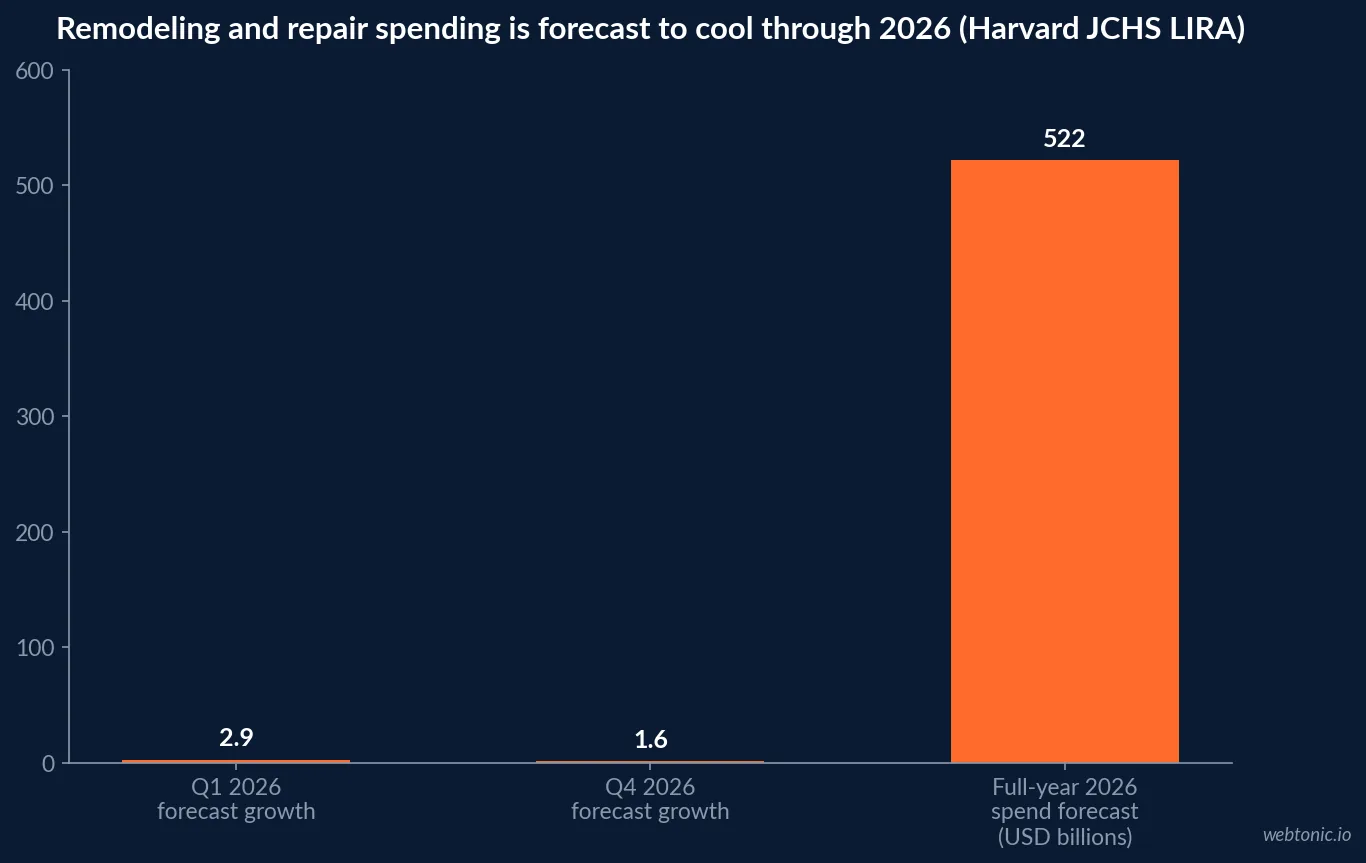
- National remodeling and repair spend is forecast near USD 522 billion for 2026 (Harvard JCHS LIRA).
- Growth is forecast to cool from 2.9% in Q1 2026 to about 1.6% by Q4 2026.
- The 25C energy-efficient home improvement credit does not apply after December 31, 2025, per IRS guidance.
- 83% of consumers read reviews on Google specifically before choosing a local service.
- Only 42% now trust reviews as much as a personal recommendation, down from 79% in 2020.
- Home & Home Improvement paid search CPC runs USD 8.33, the second-highest tracked category.
- That category's Google Ads conversion rate is 8.05%, above the 8.18% all-industry average by only a fraction.
- A single window replacement averages USD 850 and a garage door averages USD 1,500 (HomeAdvisor).
- The FTC's R-value rule, 16 CFR Part 460, still governs any insulation claim on an insulated garage door.
The two signals pulling budget in different directions
Overall remodeling demand is softening. The Harvard Joint Center for Housing Studies' Leading Indicator of Remodeling Activity forecasts full-year 2026 remodeling and repair spending near USD 522 billion, with year-over-year growth cooling from about 2.9% in Q1 2026 to roughly 1.6% by Q4 2026. That is the macro backdrop every home-improvement SEO budget sits inside right now - a slowing, not a shrinking, market.
Against that backdrop, garage door replacement specifically keeps outperforming. Zonda's 2025 Cost vs. Value Report (its 38th annual edition) ranks it the single highest-ROI project of the 28 it tracks nationally, recouping 267.7% of its $4,672 average cost at resale. That combination - a cooling category overall, with one line item still the strongest resale argument in the whole remodeling report - is exactly the kind of split a content plan should reflect, rather than spreading budget evenly.
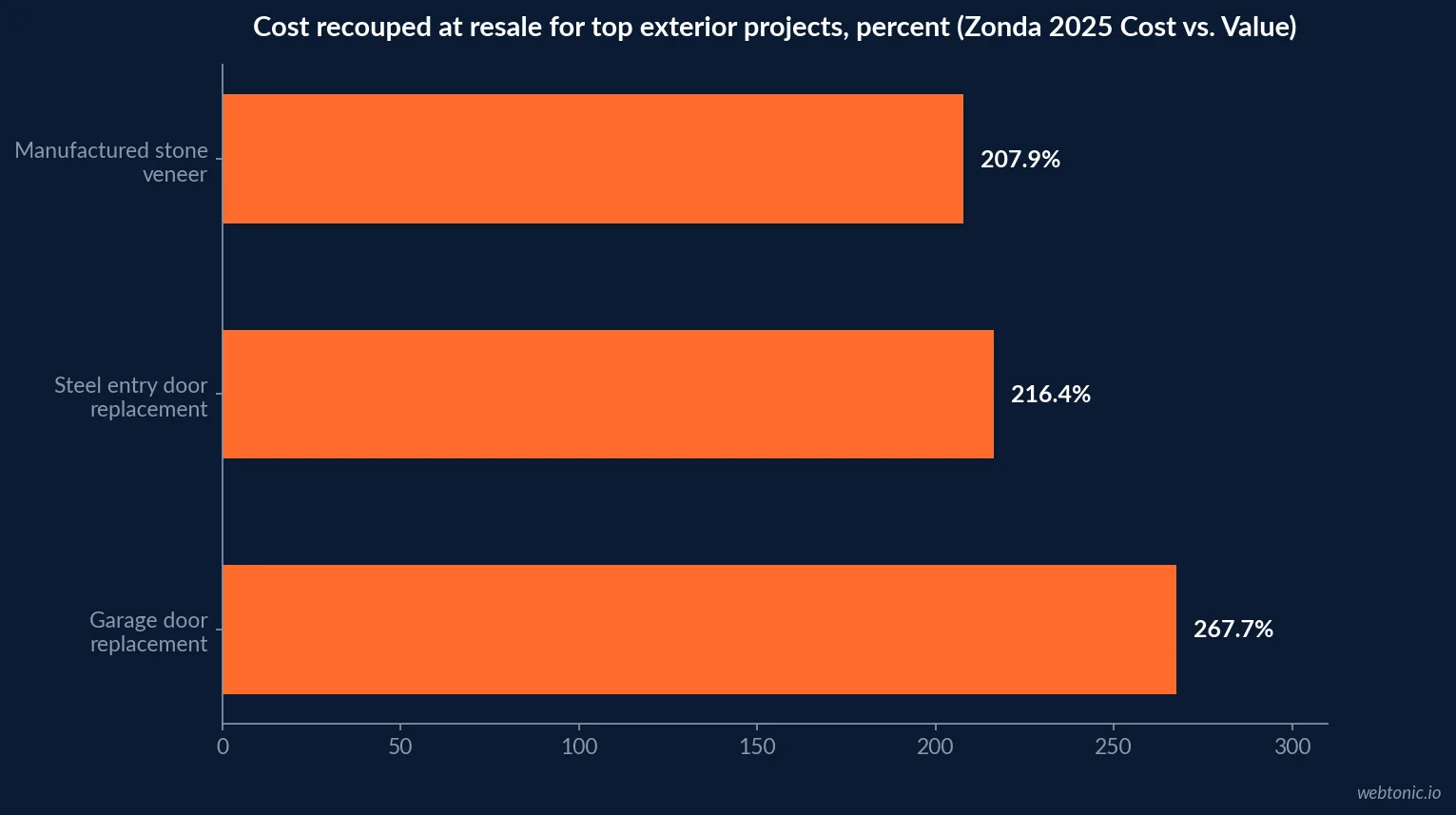
| Exterior project (Zonda 2025 Cost vs. Value) | Avg. job cost | Cost recouped at resale |
|---|---|---|
| Garage door replacement | USD 4,672 | 267.7% |
| Steel entry door replacement | USD 2,435 | 216.4% |
| Manufactured stone veneer | USD 11,702 | 207.9% |
The compliance content that changes what a page can claim
Two rules directly affect garage door and window content in 2026. First, under IRS guidance issued August 2025, the Energy Efficient Home Improvement Credit under 26 U.S.C. §25C "shall not apply with respect to any property placed in service after December 31, 2025." Any existing page telling homeowners they can claim 30% back on new ENERGY STAR windows installed in 2026 is now publishing an outdated tax claim, a direct SEO and trust liability, not just a stale fact. Second, insulation and thermal-performance claims on insulated garage doors are still governed by the FTC's R-value rule, 16 CFR Part 460, which requires a tested R-value figure rather than a marketing phrase like "energy efficient."
| Compliance item | 2026 status | SEO content action |
|---|---|---|
| 25C Energy Efficient Home Improvement Credit | Terminated for property placed in service after Dec. 31, 2025 (IRS, Aug. 2025) | Remove or clearly date-stamp any '30% tax credit' claim on window pages |
| FTC R-value rule, 16 CFR Part 460 | Still in force | State a tested R-value on any insulated garage door claim, not a vague label |
| ENERGY STAR labeling | Still in force, program-specific criteria apply | Cite the specific ENERGY STAR category the product meets |
| FTC fake-review/testimonial rule | Enforceable since October 21, 2024 | Only use real, disclosed reviews in on-page trust content |
Organic versus paid: where the budget argument actually sits
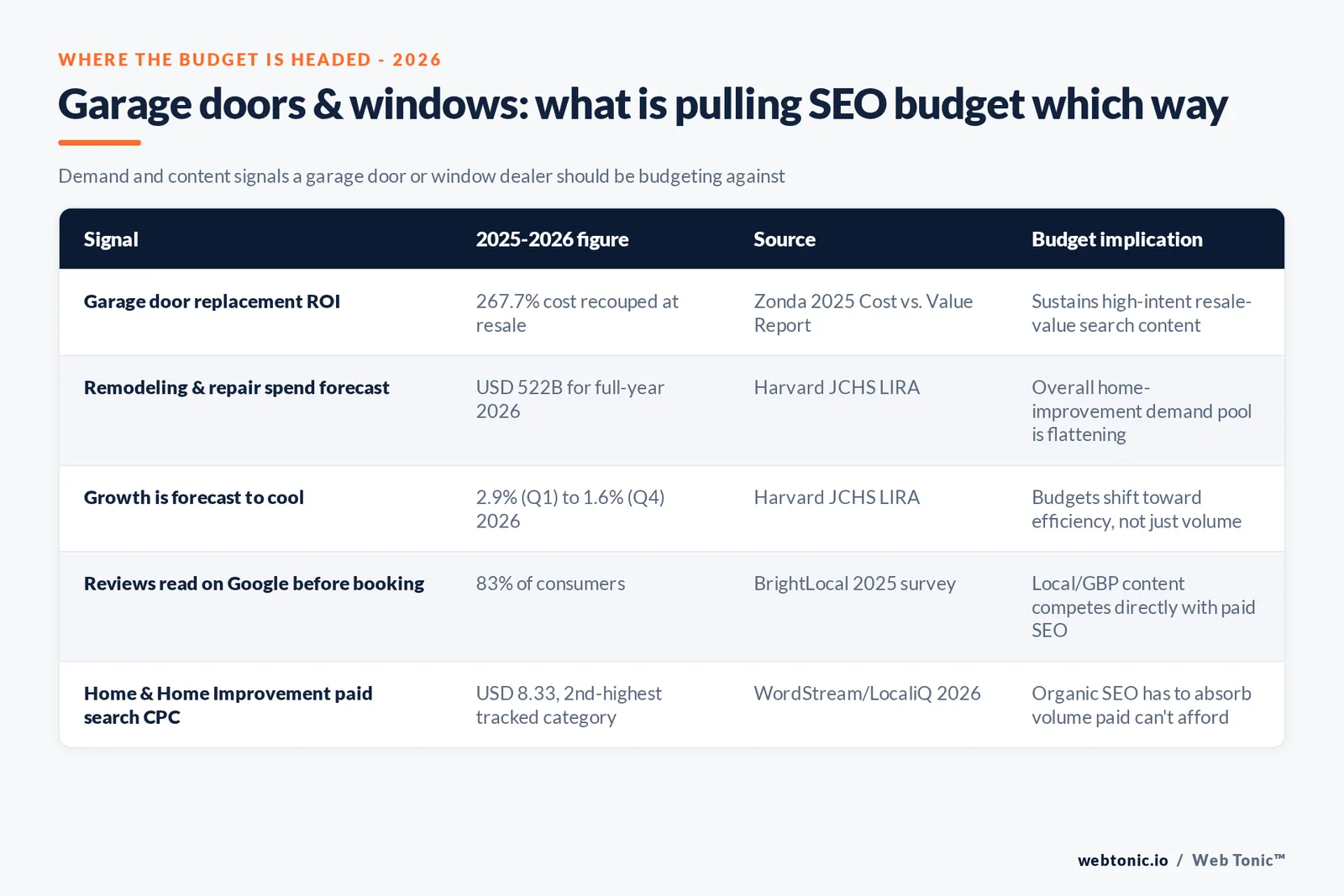
Paid search in this category is not cheap ground to concede. WordStream/LocaliQ's 2026 benchmarks place Home and Home Improvement at $8.33 per click, the second-highest of the 20-plus industries it tracks (behind only Attorneys and Legal Services), with an 8.05% conversion rate that is close to but slightly below the 8.18% all-industry average. Meanwhile BrightLocal's 2025 survey found 83% of consumers read reviews on Google specifically before booking a local service - a step that happens whether or not a dealer is running ads. A garage door or window company skipping organic and review content is not avoiding cost; it is paying full retail on every click while leaving the review-reading 83% to a competitor's page.
| Channel signal (2026) | Figure | Source |
|---|---|---|
| Google Ads CPC, Home & Home Improvement | USD 8.33 | WordStream/LocaliQ 2026 Google Ads Benchmarks |
| Google Ads conversion rate, same category | 8.05% | WordStream/LocaliQ 2026 Google Ads Benchmarks |
| Consumers reading Google reviews before booking | 83% | BrightLocal 2025 Local Consumer Review Survey |
| Consumers trusting reviews like a personal recommendation | 42%, down from 79% in 2020 | BrightLocal 2025 Local Consumer Review Survey |
What the real job costs look like against that search demand
HomeAdvisor's cost data puts a typical garage door replacement at $1,500 (ranging $400 to $10,000), and its window replacement page puts that job at $850 per window on average. Pages built around these real ranges, tied to the resale-value case above, answer the search intent a homeowner actually has - "is this worth it" - more directly than a generic services page.
| Project | Typical cost (HomeAdvisor) | Cost range |
|---|---|---|
| Garage door replacement | USD 1,500 | USD 400-10,000 |
| Garage door repair (vs. replace) | USD 265 | n/a |
| Window replacement, per window | USD 850 | USD 300-2,100 |
A defensible SEO budget allocation for this category
- Weight resale-value and ROI content toward garage doors first, given the 267.7% recouped figure, then steel entry doors and window efficiency second.
- Retire or re-date any 25C tax-credit page immediately - the credit is gone for anything installed after December 31, 2025.
- Add tested R-value figures to any insulated garage door claim rather than a vague efficiency phrase.
- Do not defund organic and review content to fund paid search - the category's $8.33 CPC makes paid-only strategies expensive, and 83% of buyers still check reviews regardless.
- Plan for a slower overall category: the 1.6% Q4 2026 growth forecast argues for efficiency-focused content (answering objections, pricing pages) over volume-focused content (blanket blog expansion).
What the census data says about the trades behind this content
Census Bureau Expenditures for Residential Improvements and Repairs data provides the historical backdrop the LIRA forecast builds on: national spend on residential improvements and repairs has been on a multi-decade climb, with garage doors and windows sitting inside the broader "exterior replacement" spend category rather than being tracked as a stand-alone line - one more reason a dealer cannot rely on a single published number for its specific sub-category and instead has to triangulate from the resale-value and remodeling-activity data above.
Where this fits inside a broader SEO and content plan
Garage door and window content should not compete for budget against every other home-improvement trade on equal footing; the data above argues for weighting it by the resale case specifically. Web Tonic's own growth marketing planning applies that same demand-weighted logic across service lines, and Web Tonic's Google Ads pricing guide is a useful cross-check for teams deciding how much of the budget above should shift from paid clicks toward the organic content this page recommends. For any dealer questioning whether SEO or ads should lead the plan, a scoping conversation is the faster way to get a category-specific answer than a generic benchmark page can give.
Content gaps most garage door and window sites still carry
Beyond the compliance fixes above, the most common structural gap on a garage door or window site is treating every service page as interchangeable, when the underlying demand data says they are not. A site that gives its garage-door-replacement page the same word count and the same generic "energy efficient options" language as its window-repair page is under-investing in the highest-ROI project in its own catalog and over-investing in a lower-intent repair page. The fix is not more pages; it is re-weighting the pages that already exist toward the resale and compliance data above.
| Common gap | What the data argues instead |
|---|---|
| Every service page treated as equal priority | Garage door replacement content should carry the resale-ROI case first |
| Generic 'energy efficient' language on insulated doors | A tested R-value figure, per the FTC's 16 CFR Part 460 |
| A live 2025-written '30% tax credit' claim | Removed or re-dated; the 25C credit ended Dec. 31, 2025 |
| No review or trust content on the page itself | 83% of buyers check Google reviews before booking regardless of the ad |
| Content volume spread evenly across a slowing category | Weighted toward the projects the LIRA and Zonda data still support |
Frequently Asked Questions
Is overall demand for garage door and window SEO content growing or shrinking?
Mixed, and the direction depends on which project. The Harvard Joint Center for Housing Studies' Leading Indicator of Remodeling Activity (LIRA) forecasts total 2026 remodeling and repair spending near $522 billion, with year-over-year growth cooling from roughly 2.9% in Q1 2026 to about 1.6% by Q4 2026. That is a market-wide slowdown, not a garage-door-specific one - Zonda's 2025 Cost vs. Value Report still ranks garage door replacement the single highest-ROI project tracked, at 267.7% of cost recouped at resale, which keeps resale-focused search demand for that project resilient even while the broader remodeling budget softens.
Does the end of the 25C tax credit change window SEO content?
Yes, materially. Under the One, Big, Beautiful Bill (Public Law 119-21), the Energy Efficient Home Improvement Credit (26 U.S.C. §25C) does not apply to property placed in service after December 31, 2025, per IRS guidance issued August 2025. Content built around "get 30% back on new windows" is now out of date for any window installed in 2026 or later; pages built on that hook need the credit-status note updated or the claim removed entirely, or they risk publishing wrong tax information.
Is local SEO or paid search the bigger competitor for this budget?
Local SEO, by consumer behavior at least. BrightLocal's 2025 Local Consumer Review Survey finds 83% of consumers use Google specifically to read reviews before choosing a local service, ahead of paid search exposure at the moment of decision. But paid search is not cheap ground to concede either: WordStream/LocaliQ's 2026 benchmarks put Home & Home Improvement among the more expensive Google Ads categories at $8.33 per click, the second-highest of the 20-plus industries it tracks. A garage door or window dealer skipping organic content is paying full retail for every click instead.
What compliance content belongs on a garage door or window SEO page?
Two federal rules matter directly. The FTC's R-value rule (16 CFR Part 460) requires insulation performance claims - including on insulated garage doors - to state a tested R-value rather than a vague "energy efficient" claim. Separately, the ENERGY STAR labeling program sets the qualification bar manufacturers use for window and garage-door product claims. A page making an efficiency claim without citing either standard is making an unsupported claim, which is also a weak page by Google's own quality standards.
Where should new SEO content go if remodeling spend is cooling?
Toward the projects the data still supports. Zonda's 2025 report ranks garage door replacement, steel entry door replacement (216.4% recouped) and manufactured stone veneer (207.9% recouped) as the three highest-ROI exterior projects, all directly adjacent to a garage door and window dealer's actual scope. That is a more defensible content allocation than spreading budget evenly across every service line while overall remodeling growth is forecast to slow to 1.6% by the end of 2026.
Sources
Harvard Joint Center for Housing Studies, Leading Indicator of Remodeling Activity
U.S. Census Bureau, Expenditures for Residential Improvements and Repairs
Harvard JCHS, Remodeling Growth Set to Downshift in Late 2026
Zonda, 2025 Cost vs. Value Report
Internal Revenue Service, FAQs on OBBB modifications to sections 25C and related credits
26 U.S.C. §25C, Energy efficient home improvement credit
BrightLocal, 2025 Local Consumer Review Survey
WordStream/LocaliQ, 2026 Google Ads Benchmarks
HomeAdvisor, garage door cost data
HomeAdvisor, window replacement cost data