Table of contents
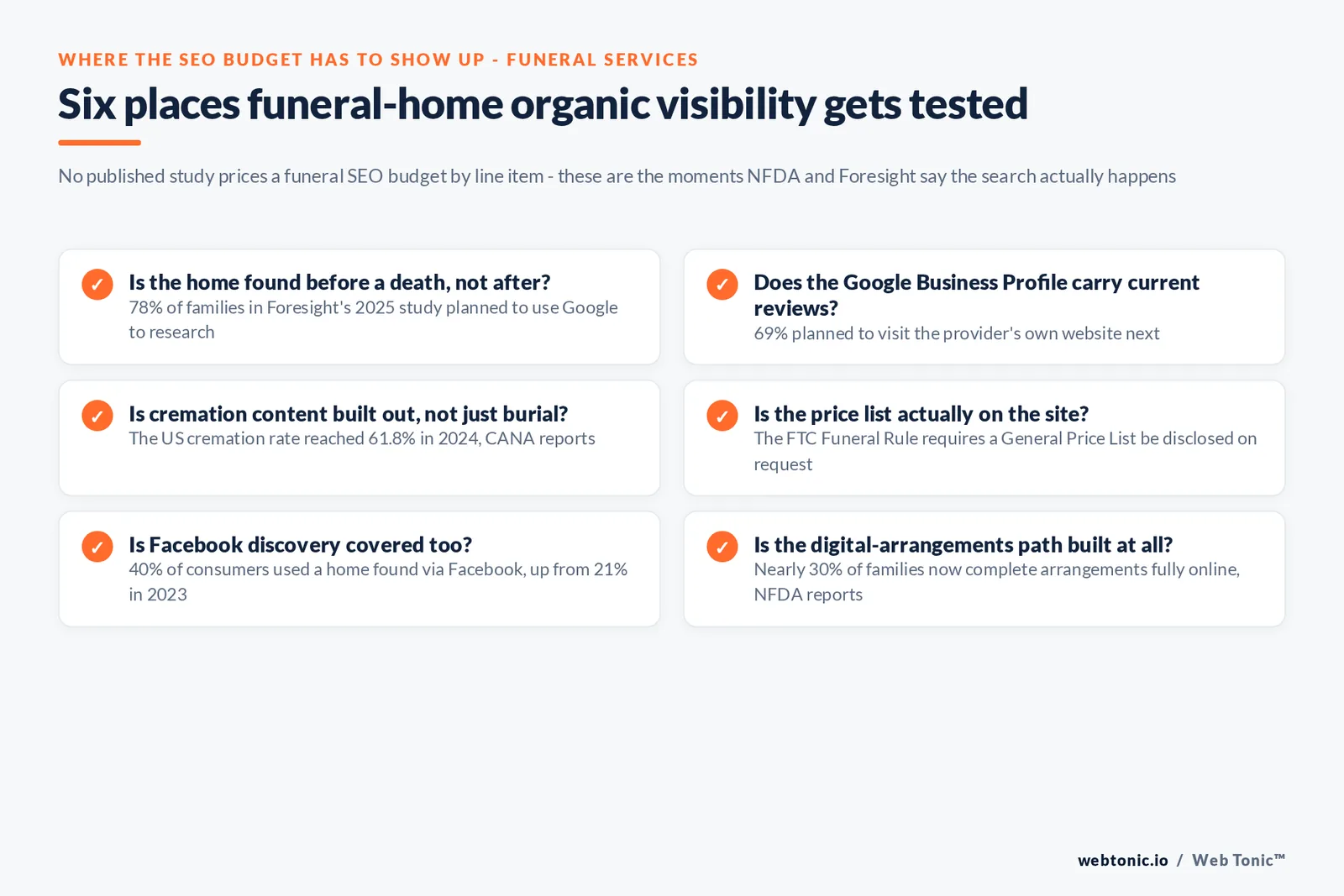
No published study prices a funeral home's SEO budget by line item, so this page does not invent one. What it does instead is trace where consumer research from NFDA, Foresight and CANA says families actually go looking - Google first, the provider's own website second, Facebook a rising third - and map that to what an organic strategy has to cover.
Key Takeaways
- No public study reports a funeral-home SEO budget breakdown - stated plainly, not filled in.
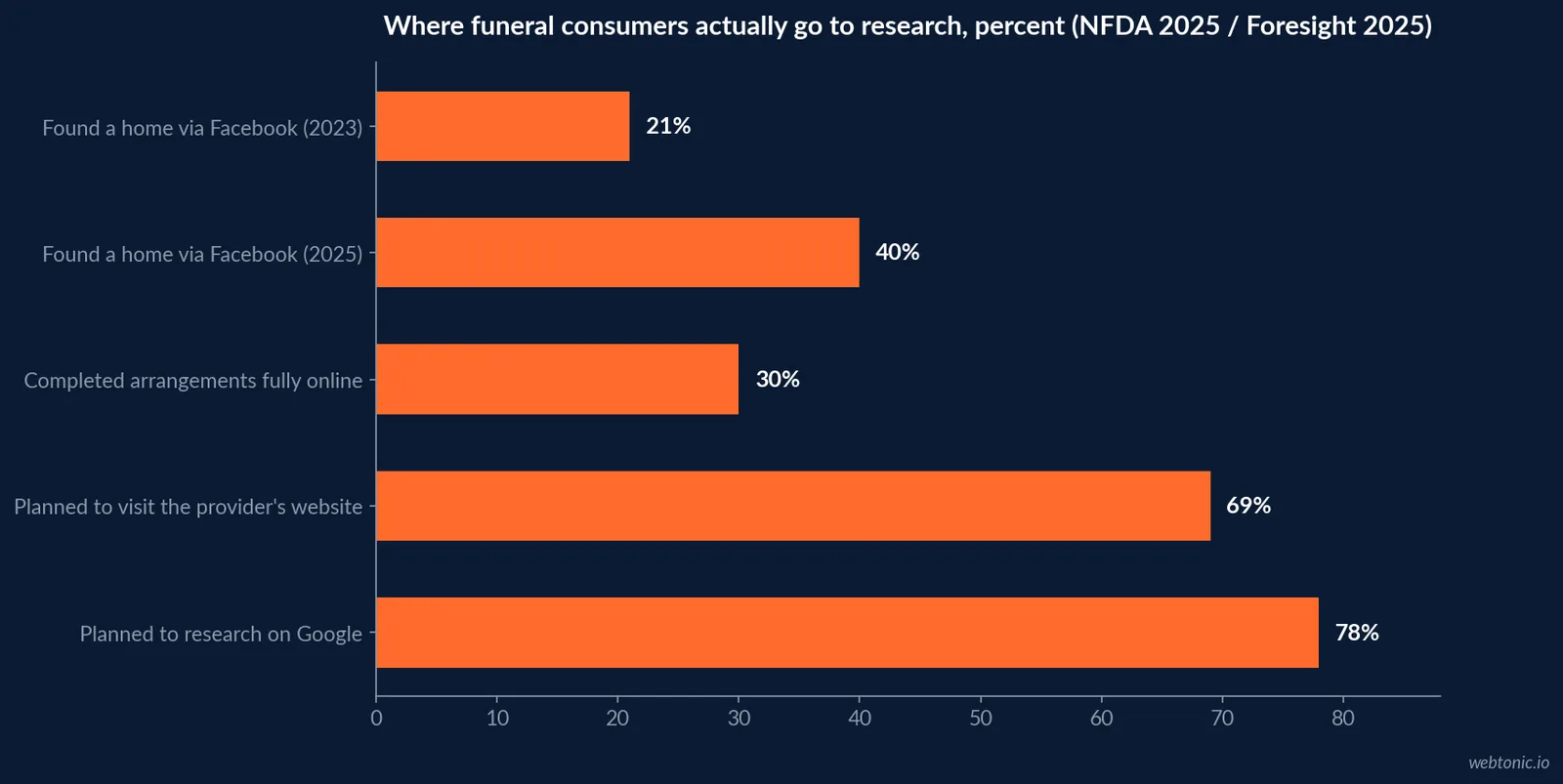
- 78% of consumers planned to research on Google, Foresight's 2025 study found.
- 69% planned to visit the provider's own website next.
- 40% have used a home found on Facebook, nearly double 2023's 21%.
- Nearly 30% of families now complete arrangements fully online.
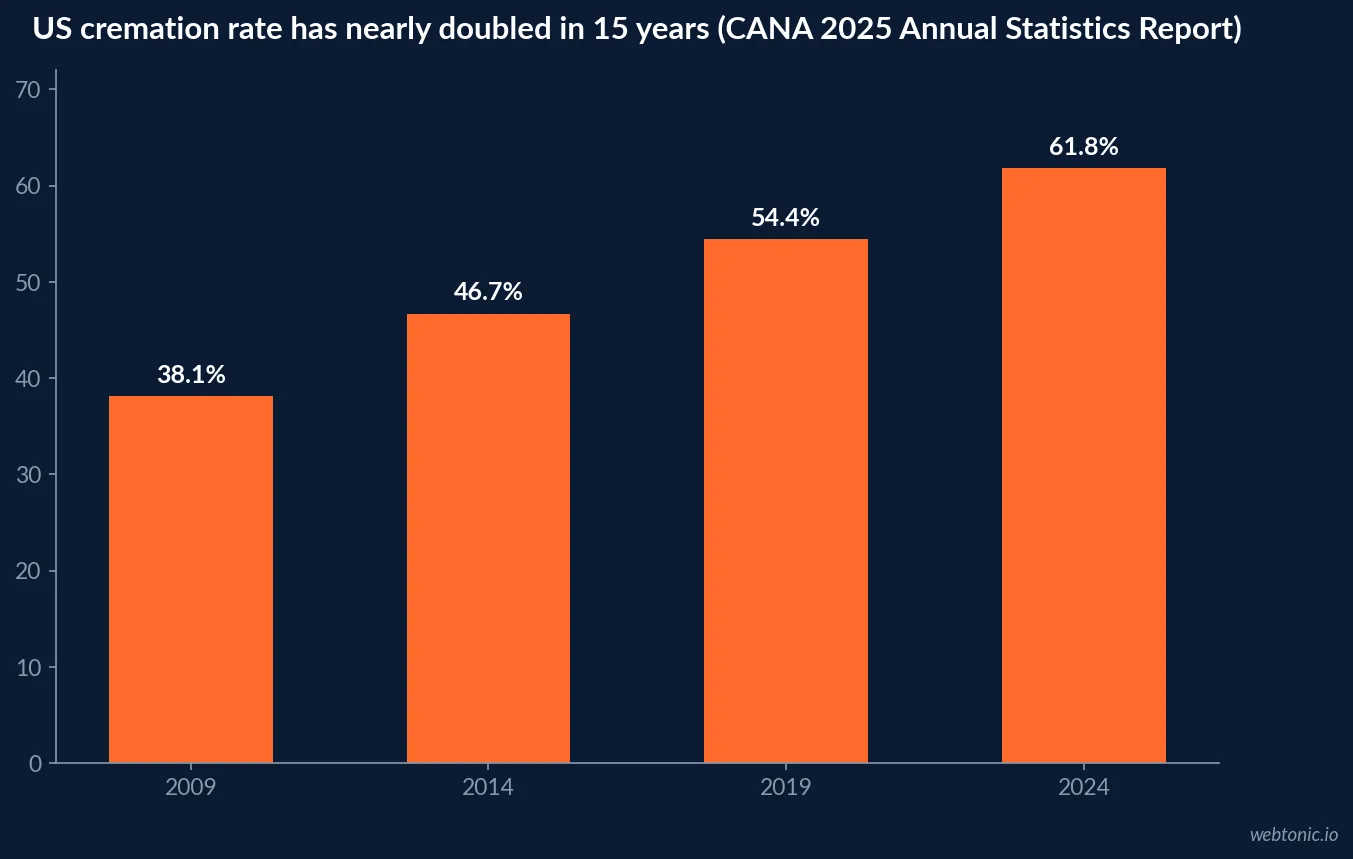
- The US cremation rate reached 61.8% in 2024, up from 38.1% in 2009.
- CANA projects the rate toward roughly 80% before it plateaus.
- The median burial funeral costs USD 8,300, per NFDA's General Price List Study.
- The median cremation funeral costs USD 6,280.
- Burial cost rose 5.8% and cremation cost 8.1% over the study's two-year window.
- Funeral directors earn a median USD 49,800 a year, BLS reports.
- The Funeral Rule requires a General Price List on request, per 16 CFR Part 453.
- The FTC has run an ANPR on requiring that list to be posted online.
- Job growth for funeral service workers is projected at 4% through 2034, BLS reports.
What the data does not show
Be direct about the limits here: unlike a paid-media benchmark report, no association or vendor publishes a funeral-home SEO budget as a percentage of revenue, a typical monthly retainer, or a channel-mix breakdown. Searches for that figure return general small-business marketing surveys, not a funeral-industry-specific number, and none of them meet this page's bar for a primary, named study. What the industry does publish - consistently, and from primary sources - is exactly where and how families research a funeral home before they call one. That is the honest proxy for where an SEO program's priorities should sit, even without a spend figure to benchmark against.
| Consumer research finding (2025) | Figure | Source | SEO implication |
|---|---|---|---|
| Planned to research on Google | 78% | Foresight Companies 2025 | Local SEO and Google Business Profile are the primary battleground |
| Planned to visit the provider's website | 69% | Foresight Companies 2025 | The site has to hold up once Google sends the click |
| Found a home via Facebook | 40% (up from 21% in 2023) | NFDA 2025 | Off-site social signals now matter more than before |
| Completed arrangements fully online | Nearly 30% | NFDA 2025 | Digital-arrangement content is serving real, growing demand |
The category shift content has to follow
The Cremation Association of North America's 2025 Annual Statistics Report puts the US cremation rate at 61.8% for 2024, against 38.1% in 2009 - a near-doubling in fifteen years - and projects continued, if slowing, growth toward a plateau around 80%. A site whose page architecture, headings and internal linking still treat burial as the default option is structured against the category's actual search volume. That does not mean removing burial content - burial still represents roughly a third of cases - but it does mean cremation content needs parity, not an afterthought section.
| Funeral type | Median cost (NFDA General Price List Study) | 2-year cost change | Cremation rate trend |
|---|---|---|---|
| Burial with viewing and vault | USD 8,300 | +5.8% | Declining share, still roughly a third of cases |
| Cremation with services | USD 6,280 | +8.1% | Majority and rising share of cases |
Pricing content is a compliance page, not just an SEO page
The FTC's Funeral Rule (16 CFR Part 453) already requires funeral providers to supply an itemized General Price List on request, and the Commission's own Advance Notice of Proposed Rulemaking has explored requiring that price information be posted online, noting that "many funeral providers are not making their price lists available electronically or on their websites, even when requested by consumers." The rulemaking record shows the review is ongoing, not finalized as an online-posting mandate - so publish current pricing now, both because Foresight's data ranks it as a top research priority and because it pre-empts a compliance requirement that may firm up.
| Page type | Why it should exist | Compliance/SEO note |
|---|---|---|
| General Price List / cost transparency page | Foresight: consumer research narrows to Google + your site | Required on request under 16 CFR Part 453; publish it proactively |
| Cremation services and packages | 61.8% of cases are cremation, and rising | Match content depth to actual case volume, not tradition |
| Burial services and packages | Roughly a third of cases, still substantial | Keep parity; don't delete, de-prioritize the emphasis |
| Online/digital arrangement path | Nearly 30% complete arrangements fully online | A newer intent that needs its own dedicated page |
| Local Google Business Profile presence | 78% plan to research on Google first | Reviews and accurate NAP data feed this directly |
What the establishment and labor data adds
The Bureau of Labor Statistics' Occupational Outlook Handbook puts the median annual wage for morticians, undertakers and funeral arrangers at USD 49,800 as of May 2024, with funeral service worker job growth projected at a modest 4% through 2034 - "as fast as average," not a boom. That is a market growing in line with the wider economy, competing mostly for a fixed number of local searches rather than an expanding one, which raises rather than lowers the value of ranking well for the searches that do exist.
What the labor and establishment picture adds
Funeral service work is not a growth industry in the way a software category is, which changes what "winning" organic visibility actually means. The BLS Occupational Employment and Wage Statistics counted roughly 24,200 morticians, undertakers and funeral arrangers nationally in the most recent published estimate, a workforce size that tracks with a large number of small, independently-run operations rather than a few dominant national chains. That structure means most funeral homes are competing hyper-locally for a fixed, slow-growing number of searches - so outranking two or three nearby competitors on the terms families actually type matters more than ranking for high-volume national keywords a single-location business will never convert on anyway.
| Structural fact | Figure | Source | SEO consequence |
|---|---|---|---|
| National funeral service worker count | ~24,200 (prior estimate) | BLS OEWS | Market is fragmented, hyper-local competition |
| Funeral service worker job growth, 2024-2034 | 4% ("as fast as average") | BLS Occupational Outlook | Demand is stable, not surging - win share, don't just wait for growth |
| US cremation rate, 2024 | 61.8% | CANA 2025 | Cremation content should carry equal or greater weight than burial |
| Projected cremation rate plateau | ~80% | CANA 2025 infographic | The shift still has years to run; content built now compounds |
What "digital funeral planning" content actually has to answer
NFDA's 2025 study frames the online-arrangement trend as consumers wanting convenience without losing access to a real person: families increasingly start the process online but still want a funeral director available for guidance. A page built purely as a self-service checkout funnel, with no path to a live conversation, is optimizing against how the same study says people actually want to use it. The pages that convert are the ones combining a clear digital-arrangement path with an obvious, immediate way to reach a person - which is also consistent with Foresight's finding that the provider's own website (69% planned to visit) still has to hold up once the click lands.
What a competitive local-pack presence requires beyond content
Content answers the query; the Google Business Profile decides whether the click happens at all. With 78% of families planning to research on Google first, the local map pack is effectively the funeral home's shop window before a single page loads. That means review volume and recency, accurate categories (funeral home versus cemetery versus cremation provider are distinct Google categories that shouldn't be conflated), and consistent name-address-phone data across directories matter as much as any on-page copy - and none of them are one-time fixes, since NFDA's own data shows the underlying consumer behavior shifting year over year rather than settling. Our data and analytics practice tracks that shift quarterly rather than treating a local SEO setup as a one-time project.
| Local visibility factor | Why it matters given the research | Cadence |
|---|---|---|
| Review volume and recency | 78% research on Google before calling | Ongoing, not a one-time push |
| Correct Google category (funeral home vs. cemetery vs. cremation provider) | Prevents mismatched intent in the local pack | Set once, audit quarterly |
| Consistent NAP across directories | Feeds both local ranking and consumer trust | Audit twice a year |
| Cremation-specific landing pages | 61.8% of cases are cremation and rising | Build now, expand as share grows |
| Digital-arrangement page with a live-person path | NFDA: convenience without losing human guidance | Build once, keep current |
How to prioritize without a budget benchmark
Absent a published SEO-spend figure, prioritize by where the consumer-research data says the decision actually gets made: the Google Business Profile and local pack first, since 78% of families start there; the provider's own website second, since 69% plan to land on it; pricing and cremation content next, since those map to the buyer's top research question and the category's actual case mix. Our growth marketing practice builds that prioritization before touching a keyword list - see how we frame the broader question in building a search strategy and talk to us about a funeral-services-specific plan.
Frequently Asked Questions
Does any study actually show where funeral home SEO budgets are going?
No. No public benchmark study breaks funeral-home marketing spend into an SEO line item, let alone a channel-by-channel allocation. What exists is consumer-research data on where families actually search - from the National Funeral Directors Association (NFDA) and the Foresight Companies' 2025 Funeral and Cemetery Consumer Behavior Study - which shows where an SEO budget has to show results even without a published spend figure to compare against.
Where do families actually go to research a funeral home?
Foresight's 2025 study found 78% of respondents planned to use Google and 69% planned to visit the provider's own website, with the researchers noting that consumer research effectively narrows to "just 2 locations: Google and your website." NFDA's 2025 Consumer Awareness and Preferences Study adds that 40% of consumers have used a funeral home they found on Facebook, nearly double the 21% reported in 2023.
Is cremation content more important than burial content now?
By volume of searches it likely is. The Cremation Association of North America's (CANA) 2025 Annual Statistics Report puts the US cremation rate at 61.8% in 2024, up from 38.1% in 2009, and projects the rate toward roughly 80% before it plateaus. A site still built primarily around burial and casket content is optimizing for a shrinking share of the category's actual search demand.
Does the FTC Funeral Rule affect what has to be on the page?
Yes. The Funeral Rule (16 CFR Part 453) requires funeral providers to give an itemized General Price List on request, and the FTC has run an Advance Notice of Proposed Rulemaking exploring whether that disclosure should be required online. Publishing accurate, current pricing content is both a compliance matter and a page that directly answers the buyer's first-ranked research priority, per Foresight's data.
Should a funeral home invest in digital-arrangement content?
The trend line says yes. NFDA's 2025 Consumer Awareness and Preferences Study reports that nearly 30% of families now complete all funeral arrangements online - a channel that barely existed as a search category a few years earlier - which means the content answering "how do I arrange a funeral online" is now serving a real and growing share of search intent, not a hypothetical one.
Sources
The Foresight Companies - 2025 Funeral and Cemetery Consumer Behavior Study
NFDA - 2025 Consumer Awareness and Preferences Study
NFDA - 2023 General Price List Study
CANA - 2025 Annual Statistics Report
CANA - 2025 Cremation Rate Infographic
FTC - Funeral Rule Advance Notice of Proposed Rulemaking
Reginfo.gov - Funeral Rule rulemaking status (RIN 3084-AB55)
US Bureau of Labor Statistics - Funeral Service Workers Occupational Outlook
US Bureau of Labor Statistics - Morticians, Undertakers, and Funeral Arrangers OEWS data