Table of contents
No named vendor publishes a Google Ads CPL, CTR or conversion-rate table for funeral services specifically. The closest sourced proxy - WordStream/LocaliQ's "Personal Services" category - shows conversion rate up 26.69% year over year in 2026, and Google's own sensitive-category ad policy explains part of why a dedicated funeral benchmark doesn't exist to compare it against.
Key Takeaways
- No vendor publishes a funeral-specific Google Ads benchmark table for 2026.
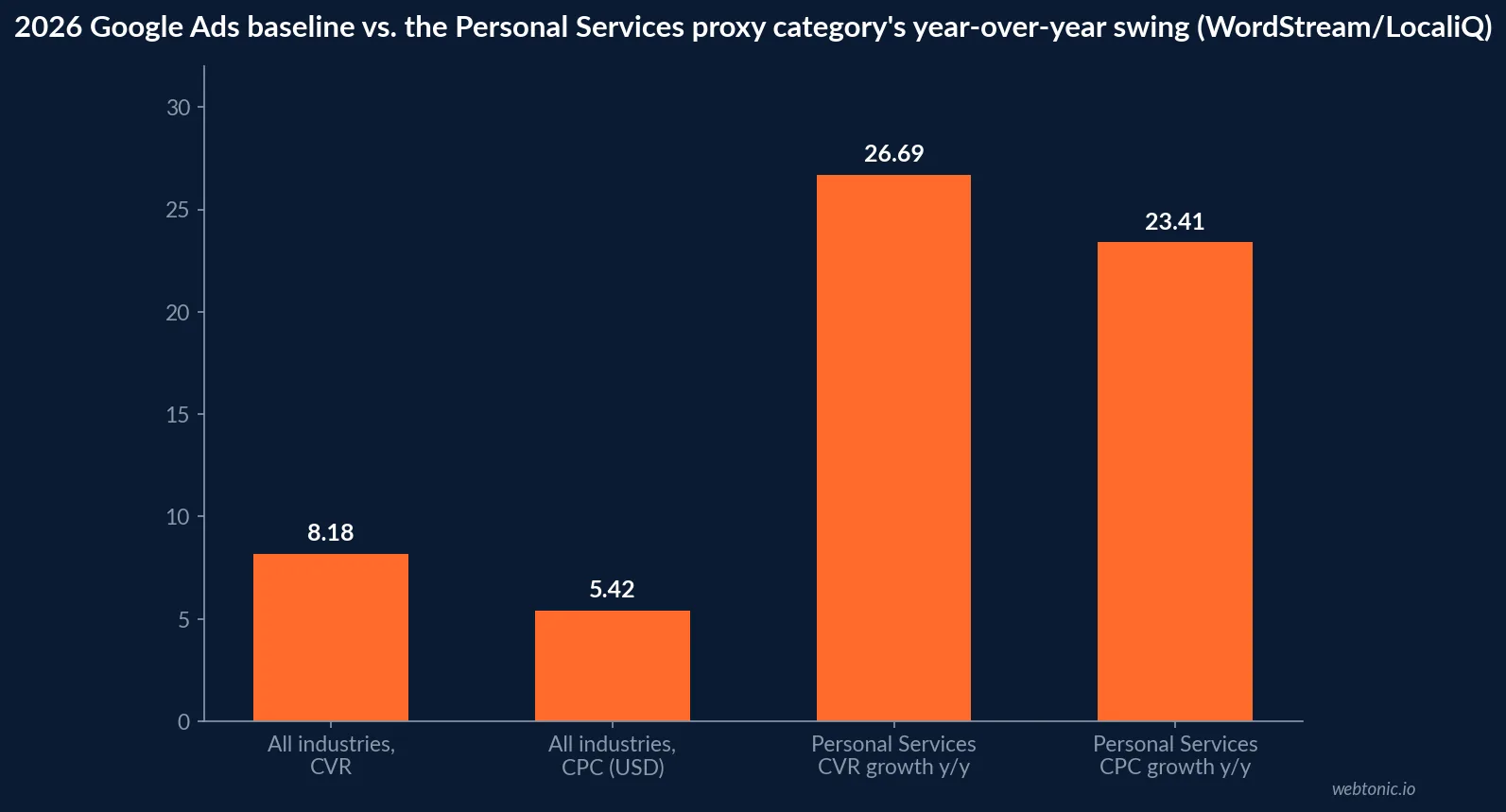
- The Personal Services proxy category's CVR rose 26.69% year over year.
- Its CPC rose 23.41% over the same period.
- The 2026 all-industry average CPC is USD 5.42.
- The 2026 all-industry average conversion rate is 8.18%.
- The 2026 all-industry average CPL is USD 66.69.
- Attorneys and Legal Services carry the highest CPC, at USD 9.87 - the nearest high-trust proxy.
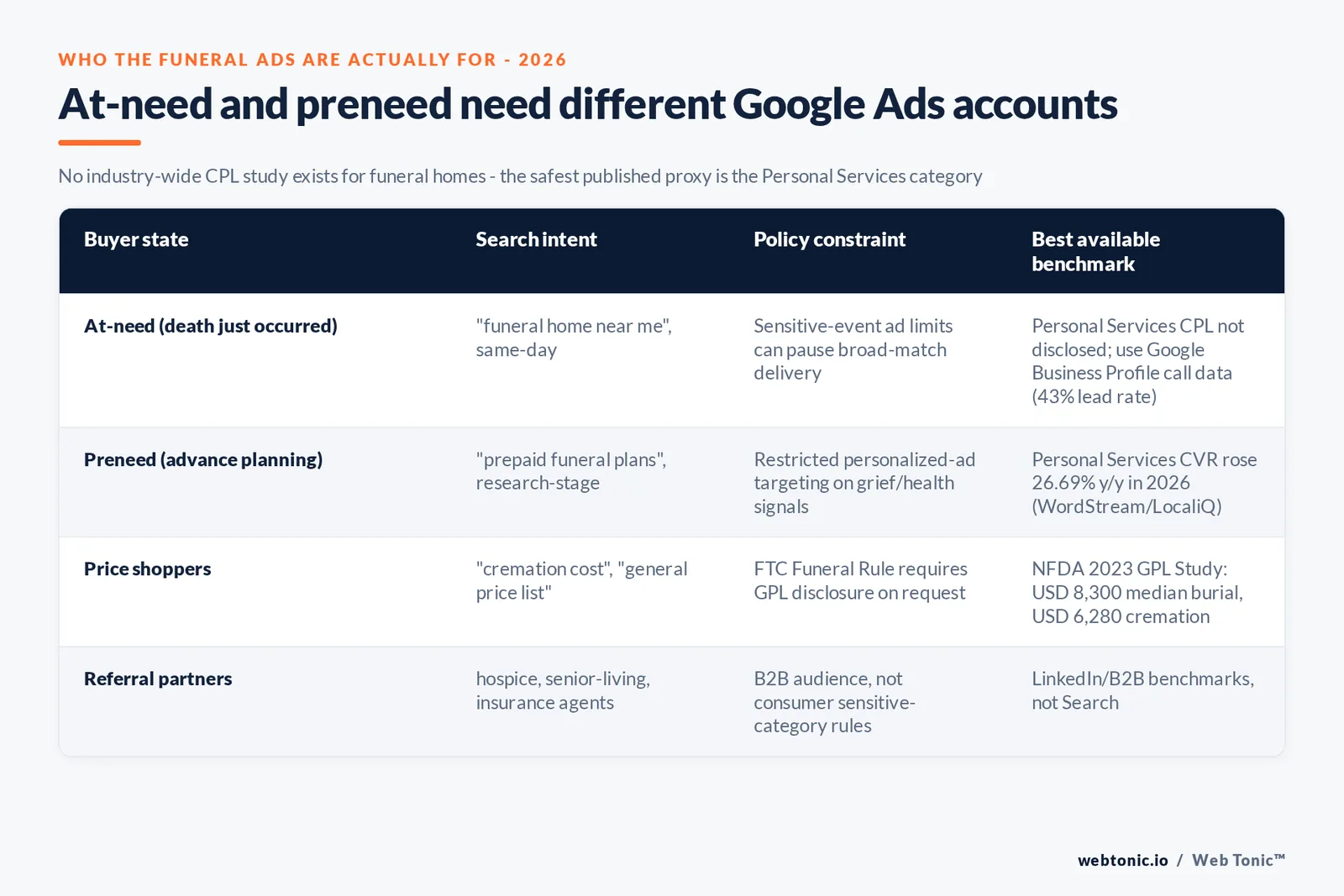
- Home services calls convert to leads at 38%, per Invoca's 2026 data.
- Senior care calls convert at just 29%, the lowest of the adjacent categories.
- 78% of families plan to research on Google first, Foresight's 2025 study found.
- 40% have used a funeral home found on Facebook, up from 21% in 2023.
- The median burial funeral costs USD 8,300, per NFDA's General Price List Study.
- Nearly 30% of families now arrange a funeral fully online.
- The US cremation rate reached 61.8% in 2024, reshaping what keywords convert.
Why there is no funeral row in the benchmark tables
WordStream/LocaliQ's 2026 Google Ads Benchmarks report, covering 13,474 US search campaigns, publishes named categories including Legal Services, Health and Fitness, Physicians and Surgeons, and Personal Services - but no funeral, death care, or cemetery category appears anywhere in the report. That is almost certainly a sample-size and categorization limitation, not evidence that funeral accounts don't run on Google Ads; it does mean any "funeral services CPL is USD X" claim circulating online is not traceable to a named study and should be treated as unsourced until proven otherwise.
| 2026 Google Ads metric (all industries) | Figure | Source |
|---|---|---|
| Average click-through rate | 6.64% | WordStream/LocaliQ 2026 |
| Average cost per click | USD 5.42 | WordStream/LocaliQ 2026 |
| Average conversion rate | 8.18% | WordStream/LocaliQ 2026 |
| Average cost per lead | USD 66.69 | WordStream/LocaliQ 2026 |
| Highest-CPC named category (Legal Services) | USD 9.87 | WordStream/LocaliQ 2026 |
The closest proxy that does exist
Personal Services is the WordStream/LocaliQ category most likely to include funeral, memorial and related consumer-services businesses, though the report does not confirm the exact business types folded into it. What is verifiable: Personal Services carried a 23.41% cost-per-click increase and a 26.69% conversion-rate increase year over year in the 2026 report, both notably larger swings than the all-industry averages of a flat-to-modest change. Whether that reflects rising competition, better-optimized landing pages, or a genuine demand shift in the category it represents isn't disclosed - the honest read is "something is moving in this bucket," not a specific funeral-industry story.
For a trust-sensitive purchase comparison, Attorneys and Legal Services at a USD 9.87 average CPC is the more useful reference point than a low-consideration retail category: both categories sell a service bought rarely, under pressure, where the buyer is unusually likely to click multiple competing ads before deciding.
| Google Ads category (2026) | CPC direction y/y | CVR direction y/y | Read for funeral accounts |
|---|---|---|---|
| Personal Services (closest proxy) | +23.41% | +26.69% | Budget for rising cost per click; conversion is improving faster |
| Attorneys & Legal Services | Highest named CPC, USD 9.87 | Not the focus of the y/y note | Nearest high-trust, high-CPC comparable |
| Health & Fitness | +23.41% (tied with Personal Services) | CTR fell 19.08% | Sensitive-category ad restrictions likely a factor |
| All industries (baseline) | Flat to modest | Flat to modest | The floor to beat, not the target |
What Google's sensitive-category policy actually restricts
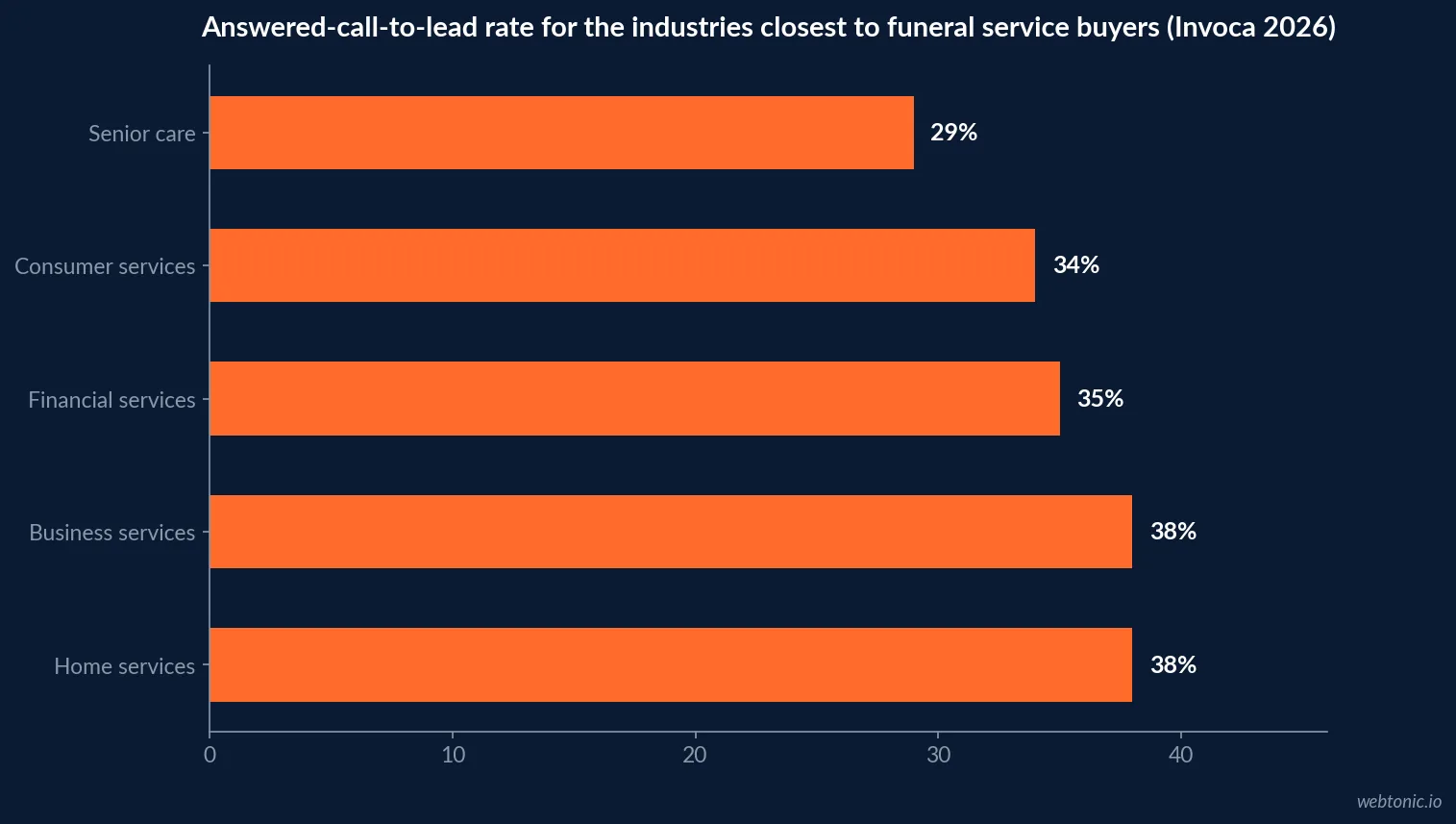
Google's restricted targeting policy lists Health and Relationship hardships among the sensitive interest categories excluded from certain personalized-advertising audience signals, and Google separately runs Sensitive Event protocols that can limit ad delivery around tragedies. Neither policy bans funeral-industry advertising outright, but both narrow the audience-targeting toolkit available - which means search-intent keyword targeting (the actual query, not an inferred grief or loss audience signal) has to carry more of the account's performance than it would for a less-restricted vertical.
| Buyer state | Search intent example | Policy constraint | Practical account move |
|---|---|---|---|
| At-need (death just occurred) | "funeral home near me" | Sensitive-event delivery limits possible | Prioritize exact-match, location-specific keywords over broad match |
| Preneed (advance planning) | "prepaid funeral plans" | Restricted personalized-ad audience signals | Build on search intent and remarketing to site visitors, not inferred interest lists |
| Price shoppers | "cremation cost near me" | FTC GPL disclosure applies on request | Land the click on a page with real, current pricing |
| Referral partners (B2B) | hospice, senior-living, insurance | Standard B2B targeting rules apply | LinkedIn/B2B channels, not consumer Search restrictions |
Why the phone still decides the account's real ROI
Invoca's 2026 call-tracking benchmarks - not funeral-specific, but the closest published read on adjacent categories - show home services and business services both converting answered calls to leads at 38%, financial services at 35%, consumer services at 34%, and senior care, arguably the closest emotional-purchase analog, at 29%. A funeral Google Ads account measuring only form-fill conversions is very likely missing a large share of real leads, given how consistently phone-based every adjacent trust-sensitive category converts. Pairing search campaigns with call tracking and Google's own call-conversion actions closes that gap without needing a funeral-specific study to prove the point.
What the pricing rule means for Quality Score, not just compliance
Landing page experience is one of three published components of Google's Quality Score, and a funeral account has an unusually direct way to strengthen it: publish the General Price List content the Funeral Rule already requires be available on request. A landing page that states cremation and burial pricing plainly, rather than gating it behind a "call for pricing" form, answers the exact question Foresight's 2025 consumer research ranks as the top thing families look for once they land on a provider's site - which is also, not coincidentally, the kind of page relevance signal Quality Score is built to reward.
| Funeral pricing benchmark (NFDA 2023 GPL Study) | Median cost | 2-year change |
|---|---|---|
| Burial with viewing and vault | USD 8,300 | +5.8% |
| Cremation with services and urn | USD 6,280 | +8.1% |
What the cremation shift means for keyword targeting
CANA's 2025 Annual Statistics Report puts the US cremation rate at 61.8% for 2024, nearly double the 38.1% recorded in 2009, with growth projected to continue toward a plateau near 80%. A Google Ads account still built primarily around burial-service keywords is bidding against the minority of actual search volume in most markets. Splitting ad groups by service type - cremation, burial, and combination packages - rather than running a single generic "funeral home" campaign lets Quality Score and bid strategy respond to genuinely different buyer economics instead of averaging them into one blended number.
What the establishment structure means for account strategy
Funeral service is overwhelmingly a hyper-local, single-location business category rather than one dominated by a handful of national advertisers bidding up shared keywords nationally. That structure changes what "competitive" means in a Google Ads account: the auction a funeral home is actually in is against two or three nearby providers, not a national category average, which is one more reason a generic Personal Services benchmark should inform planning rather than dictate a specific target CPL. A campaign built around a tight geographic radius and city- or neighborhood-level ad copy will typically out-convert one built on broad-match, wide-radius targeting, even before creative or offer differences are considered. Our data and analytics practice builds that geographic and conversion-tracking structure before the first campaign goes live.
| Campaign structure choice | Why it matters for this category | Recommended default |
|---|---|---|
| Match type | Sensitive-category audience signals are restricted | Favor exact and phrase match over broad |
| Geographic radius | Funeral service is hyper-local by nature | Tight radius around the physical location(s) |
| Ad group split | Cremation and burial buyers have different price points | Separate ad groups, not one blended group |
| Landing page | FTC pricing disclosure applies on request | Dedicated pricing page per service type |
| Conversion action | Phone conversion patterns run high in adjacent categories | Track calls as a conversion action, not just form fills |
Where the budget should actually go first
Absent a named funeral benchmark, prioritize by what is sourced: exact-match at-need keywords with call tracking attached, a compliant pricing landing page per the FTC's Funeral Rule, and a preneed track built on search intent rather than audience inference given the sensitive-category restrictions. Our growth marketing practice builds funeral accounts this way - read our broader take in what Google Ads actually costs and talk to us about structuring the campaign split.
Frequently Asked Questions
What is a realistic Google Ads CPL for a funeral home in 2026?
No named vendor publishes one. WordStream/LocaliQ's 2026 general benchmark report (13,474 US search campaigns) does not break out a funeral or death-care category; its closest proxy, Personal Services, carries an overall Google Ads average cost per click of USD 5.42 and conversion rate of 8.18% across all tracked industries, with Personal Services itself showing a 23.41% CPC increase and a 26.69% conversion rate increase year over year in 2026. Treat any single funeral-specific CPL number you see elsewhere as unsourced until it names its own dataset.
Why doesn't a major benchmark report break out funeral services specifically?
Funeral services sit inside a health- and grief-adjacent sensitive category that most benchmark vendors fold into a broader "Personal Services" bucket rather than tracking separately, likely because sample sizes for a single, regionally fragmented trade are too small to report reliably at scale. That's a gap in published data, not evidence the category performs at the Personal Services average.
Does Google restrict funeral-related ad targeting?
Google's advertising policies treat health and relationship-hardship content as sensitive interest categories with restricted personalized-ad targeting, and Google runs Sensitive Event protocols around tragedies that can pause or limit ad delivery. A funeral provider's preneed campaigns should assume narrower audience-targeting options than a typical local service business, and build search-intent keyword targeting as the primary lever instead of audience layering.
How much of a funeral home's ad traffic should be expected to call instead of fill a form?
Invoca's 2026 call-tracking data, while not funeral-specific, shows the industries closest to a funeral buyer's profile converting well on the phone: home services and business services both convert answered calls to leads at 38%, consumer services at 34%, senior care at 29%. A grieving or planning caller is a high-intent phone user by every adjacent category's pattern, which argues for call tracking and call-only ad formats over a form-first landing page.
What does the FTC Funeral Rule mean for the ad copy itself?
The Funeral Rule (16 CFR Part 453) requires an itemized General Price List be provided on request; it does not currently mandate price disclosure inside the ad itself, though the FTC's ongoing rulemaking has explored requiring online price posting. The safer practice already used by compliant providers is linking ad copy directly to a landing page carrying accurate, current pricing rather than making a price claim in the ad headline that the GPL then has to match exactly.
Sources
WordStream/LocaliQ - 2026 Google Ads Benchmarks by Industry
Invoca - 2026 Lead Conversion Rate Benchmarks
Google Ads Help - Restricted targeting in personalized advertising
Google Ads Help - Sensitive Event content policy update
FTC - Funeral Rule Advance Notice of Proposed Rulemaking
The Foresight Companies - 2025 Funeral and Cemetery Consumer Behavior Study
NFDA - 2023 General Price List Study
CANA - 2025 Annual Statistics Report