Table of contents

Free shipping is not a single tactic with one universal statistic behind it - it is a threshold decision that trades a documented slice of cart abandonment against a margin cost that varies by category. This page separates what the 2026 research actually measured from the "shoppers love free shipping" framing most roundups repeat.
Key Takeaways
- Average cart abandonment sits at 70.22% across 50+ compiled studies.
- Extra costs like shipping are cited by 39% to 48% of abandoners, the top named cause.
- 94% of consumers say free shipping affects where they shop, per AlixPartners.
- More than 25% now expect free shipping with no minimum at all.
- Two in three shoppers abandon when fees exceed about USD 10.
- 51% of shoppers add items specifically to hit a shipping minimum, per NRF.
- 81% of surveyed Gen Z shoppers admit to the same basket-padding behavior.
- Average US free-shipping threshold estimates range from about USD 59 to USD 103.
- The reliable rule is a threshold set 15% to 25% above current AOV.
- A well-set threshold is reported to lift AOV by roughly 12% to 24%.
- Only about 14% of sampled top US stores offer unconditional free shipping.
- Free shipping's influence on purchase decisions fell 14% year over year per Ryder.
- 39% of shoppers now expect delivery within one to two days, a four-year high.
- 76% would accept slower delivery in exchange for free shipping, per Narvar.
Shipping cost is the single largest named cause of cart abandonment
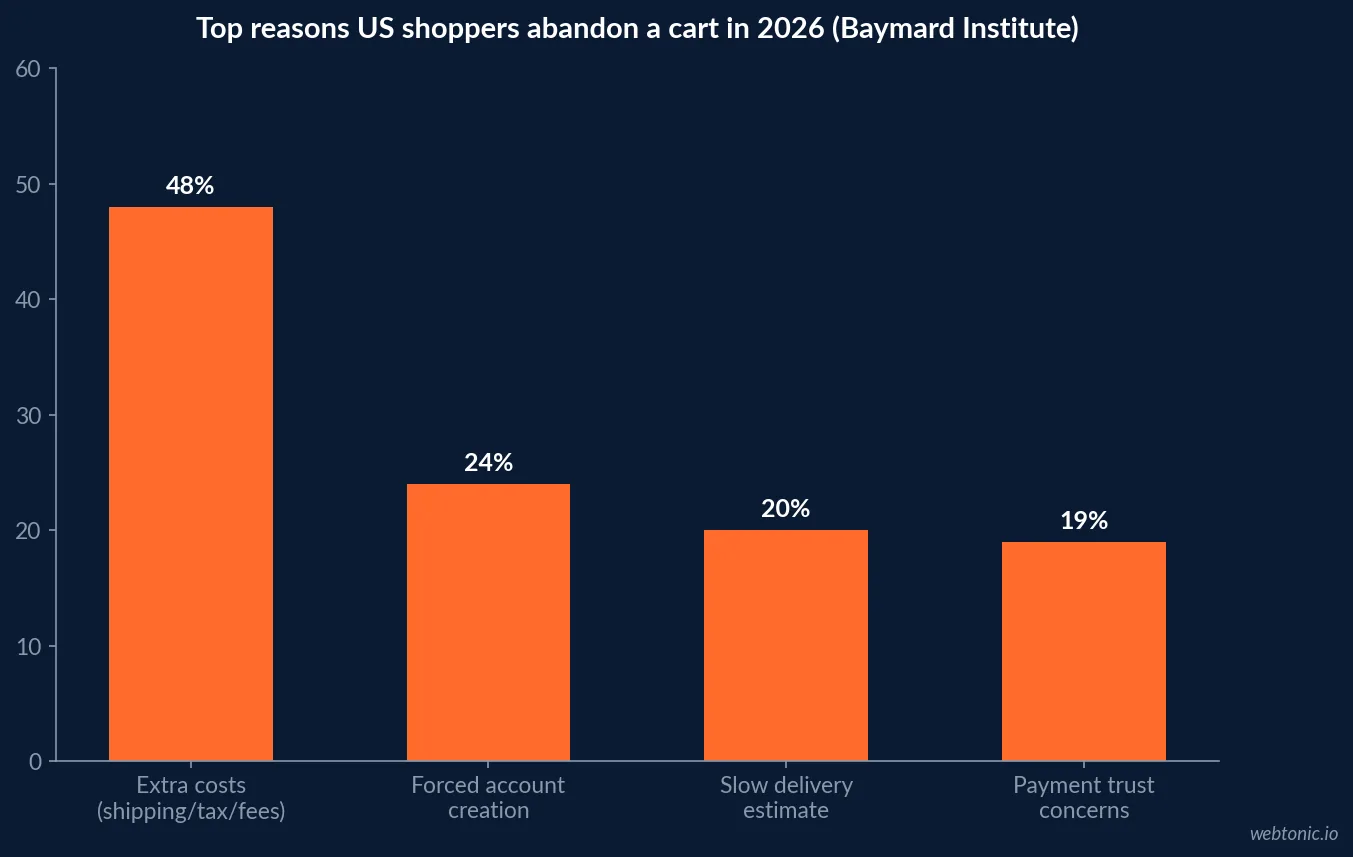
The Baymard Institute's compiled research across 50-plus studies puts the average online cart abandonment rate at 70.22%. When Baymard and others break that figure down by stated reason, extra costs revealed at checkout - shipping, tax and fees - are cited by roughly 39% to 48% of abandoners depending on the survey wave, consistently the largest single named cause, ahead of forced account creation, a lengthy checkout process, and distrust of the site with payment information.
That is a specific, fixable friction point, not a vague "cart abandonment problem." A checkout that reveals shipping cost only at the final step is asking to lose the roughly four in ten shoppers who cite that exact surprise as their reason for leaving.
| 2026 checkout friction | Share of abandoners citing it | Source |
|---|---|---|
| Extra costs (shipping, tax, fees) | 39%-48% | Baymard Institute |
| Delivery estimated too slow | ~20% | Baymard Institute |
| Forced account creation | ~24% | Baymard Institute |
| Distrust of site with payment info | ~19% | Baymard Institute |
| Shoppers who abandon once fees exceed ~USD 10 | 2 in 3 | AlixPartners 2026 |
What shoppers say they expect from delivery pricing in 2026
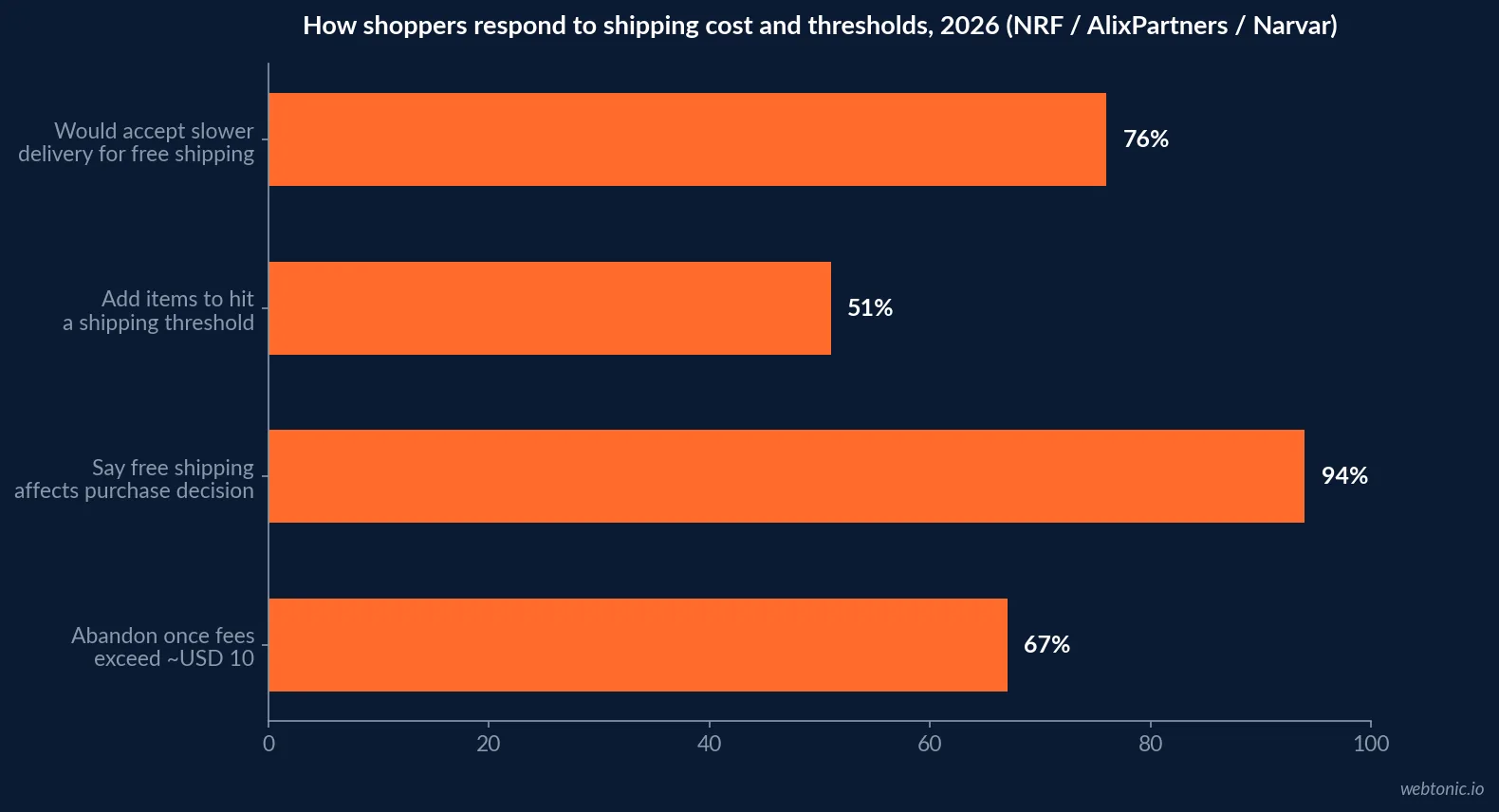
AlixPartners' 2026 Home Delivery Survey found that 94% of consumers say free shipping impacts their purchase decisions, with nearly 70% saying it has a "great impact," and more than 25% now expect free shipping with no minimum order at all. The same survey found two in three shoppers abandon a cart entirely once shipping fees exceed roughly USD 10.
The Ryder 2026 E-commerce Consumer Study adds a counter-trend worth noting for planning: free shipping's influence on where people buy fell 14% year over year even as it remains the single leading factor at 62%, while fast delivery expectations are climbing - 39% of shoppers now expect delivery within one to two days, a four-year high. Shipping cost and shipping speed are converging into one expectation, not two.
| 2026 consumer expectation | Figure | Source |
|---|---|---|
| Say free shipping affects purchase decisions | 94% | AlixPartners 2026 |
| Say it has a "great impact" | ~70% | AlixPartners 2026 |
| Expect free shipping with zero minimum | 25%+ | AlixPartners 2026 |
| Free shipping's influence, year-over-year change | -14% | Ryder 2026 |
| Expect delivery within 1-2 days | 39% | Ryder 2026 |
Shoppers pad the cart to hit the line, and they say so themselves
The National Retail Federation reports that half of online shoppers will either back out of a purchase entirely if they miss a free-shipping threshold (47%) or add items to their cart to reach it (51%). A 2026 consumer survey covered via PR Newswire found the same behavior even more pronounced among Gen Z: 94% call free shipping a deciding factor in where they shop, and 81% admit to adding items just to cross a threshold.
That basket-padding is the actual mechanism behind most reported average-order-value gains from a threshold strategy - it is not that shoppers spend more because they feel generous, it is that a near-miss basket gets one more item added deliberately to avoid paying for shipping.
Where the threshold number itself actually comes from
Published estimates of the "average" US free-shipping threshold vary by source and year - figures circulating in 2026 industry write-ups range from roughly USD 59 to USD 103, reflecting different sample sets, categories and measurement dates rather than one settled number. What the vendor research agrees on more consistently is the rule for setting your own: price the threshold 15% to 25% above your current average order value rather than copying a published industry average that was never built from your product mix or margin.
A threshold set above that band risks becoming unreachable for the bulk of your actual order distribution; a threshold set below it gives away margin on orders that would have converted at your current AOV anyway.
| Threshold-setting input | What to use | Why the published average is a poor substitute |
|---|---|---|
| Your current AOV | Actual trailing 90-day median | Published averages mix every category and margin |
| Target threshold | 15%-25% above current AOV | Keeps the bar reachable for most baskets |
| Category ceiling check | Electronics vs. homeware vary widely | A single flat number ignores category |
| Fully loaded shipping cost | Weight-banded carrier rate, not list price | List rates understate true cost |
| Target contribution margin | Set before, not after, launch | Retrofitting margin after launch is costly |
Free shipping is never actually free - it is absorbed or priced in
Only a minority of stores offer it unconditionally: research on delivery promises found that about 14% of sampled top US online shops offered free standard shipping with no threshold at all, meaning the remaining majority price it as a threshold-gated incentive precisely because absorbing it on every order is not financially sustainable for most margin structures. Categories with thin unit margins - low-price commodity goods, heavy or bulky items - are the ones least able to absorb shipping cost without a threshold or a price increase baked in elsewhere.
The honest framing for a merchandising or growth team is that "free shipping" is a subsidy funded by either the basket size lift from the threshold, a slightly higher baseline product price, or margin given away outright. Deciding which of the three is funding it should happen before the banner goes live, not after finance asks why margin compressed.
Gen Z shoppers show the basket-padding behavior even more sharply
A 2026 consumer survey covered by PR Newswire, based on 2,000 Americans surveyed via the Prolific research platform in July 2026, found 94% of respondents call free shipping a deciding factor in where they shop, and 81% admit to adding items to their cart specifically to hit a free-shipping threshold. That is a noticeably higher basket-padding rate than the NRF's broader 51% figure, suggesting the youngest cohort of online shoppers is more threshold-aware and more willing to act on it than the general shopper population.
For a merchandising team, that gap matters when segmenting threshold messaging: a younger audience may respond better to an explicit "USD X away from free shipping" prompt than an older audience that is less likely to actively cart-build toward a number.
Shipping ranks behind price and delivery date, not ahead of them
Narvar's 2026 holiday shopping research found that when ranked against every other purchase factor, shipping cost lands third for shoppers, behind product price at 54% and a reliable delivery date at 50%, with shipping cost cited by 48%. The same research found 76% of shoppers would accept slower delivery in exchange for a free shipping option, suggesting the cost of shipping matters more to most shoppers than the speed of it.
That ranking is a useful corrective to treating free shipping as the single lever that decides a purchase: it is a top-three factor, not the only one, and a retailer under margin pressure may get more leverage from a firmer delivery-date promise than from lowering the shipping threshold further.
| Purchase factor ranking (2026 holiday research) | Share citing it | Source |
|---|---|---|
| Product price | 54% | Narvar 2026 |
| Reliable delivery date | 50% | Narvar 2026 |
| Shipping cost | 48% | Narvar 2026 |
| Would accept slower delivery for free shipping | 76% | Narvar 2026 |
| Gen Z basket-padding to hit a threshold | 81% | PR Newswire / Prolific survey 2026 |
What Shopify's own guidance adds on top of the survey data
Shopify's merchant guidance echoes the same abandonment driver - roughly 39% of online shoppers cite extra costs including shipping as their reason for abandoning a cart - and adds a practical point often missed in threshold planning: the moment a shopper reaches checkout and sees an unexpected shipping charge is the highest-leverage point to lose them, which is why surfacing the threshold earlier in the browsing session, not just at checkout, tends to outperform a checkout-only reveal in merchant testing.
If cart abandonment is showing up as a recurring flag in your own funnel data, our data and analytics practice can help isolate whether shipping cost, delivery speed or checkout friction is the actual driver before you commit to a threshold change.
The takeaway for 2026 planning
Free shipping statistics are frequently quoted as proof that "shoppers want free shipping," which is true but not actionable on its own. The actionable version is narrower: shipping cost surprises drive roughly four in ten cart abandonments, a threshold set 15% to 25% above your own AOV recovers a meaningful share of that loss through documented basket-padding behavior, and the subsidy has to be funded from somewhere specific rather than left to erode margin quietly.
Want help modeling the threshold against your own margin and AOV data rather than an industry average? Talk to us, see how our growth marketing practice approaches checkout diagnostics, or read our acquisition cost breakdown before you decide how much margin a shipping incentive can absorb.
Quick reference: what to check before changing a threshold
Before adjusting a free-shipping threshold, pull the actual numbers rather than relying on a published industry average - the gap between what a competitor advertises and what your own margin supports is where most threshold changes go wrong.
| Decision point | Data to pull | 2026 benchmark to compare against |
|---|---|---|
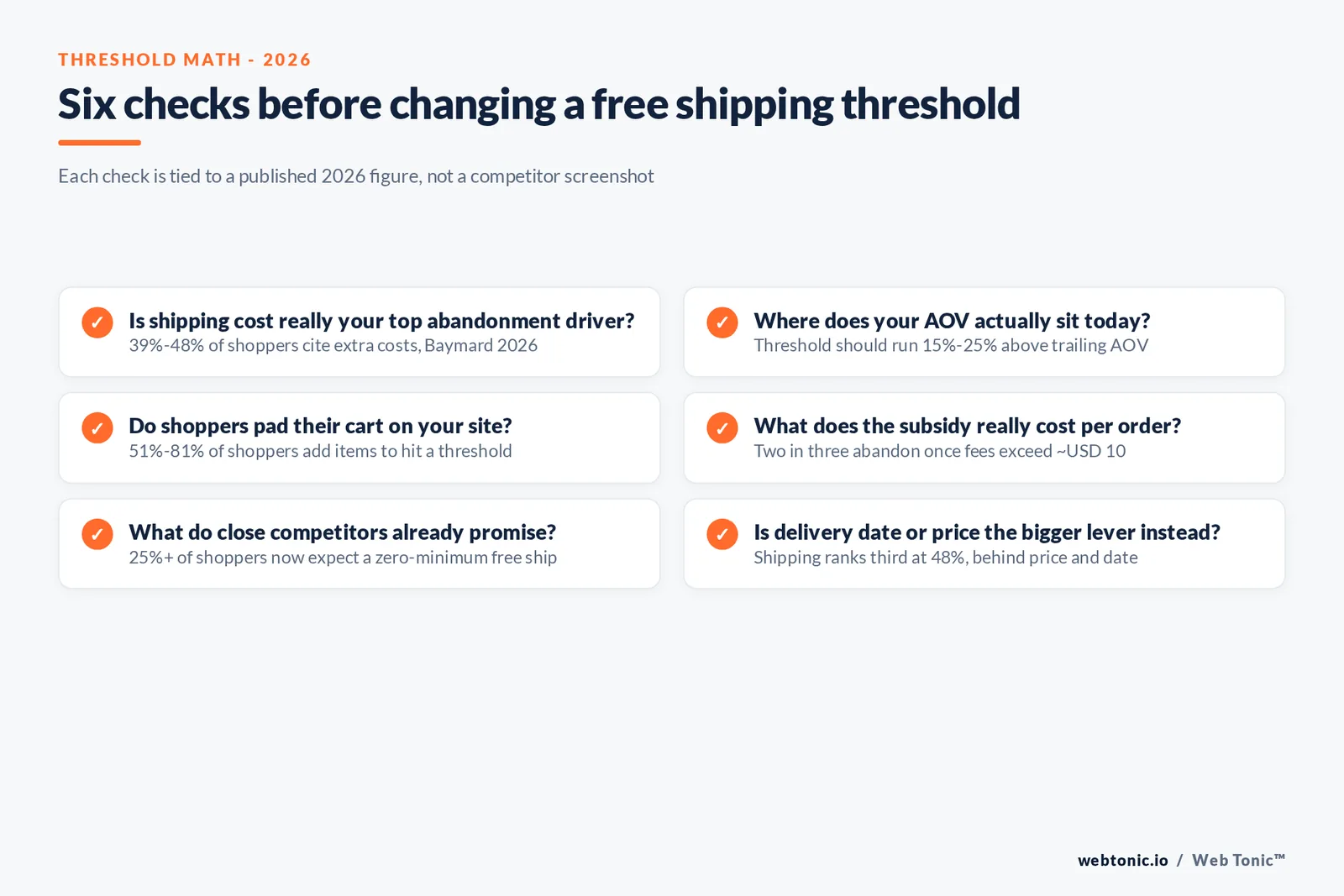
| Current abandonment linked to shipping cost | Checkout funnel drop-off by step | 39%-48% cite extra costs, Baymard |
| Where your AOV sits vs. threshold | Trailing 90-day median order value | Threshold at 15%-25% above AOV |
| Basket-padding behavior on your site | Cart edits in the 10 minutes before checkout | 51%-81% add items to hit a threshold |
| True cost of the subsidy | Fully loaded shipping cost by weight band | USD 7-10+ absorbed per qualifying order |
| Competitive expectation ceiling | What close competitors advertise | 25%+ of shoppers expect zero-minimum free shipping |
Frequently Asked Questions
Does free shipping really reduce cart abandonment?
It reduces one specific cause of abandonment, not the overall rate. The Baymard Institute's ongoing checkout research, compiled from more than 50 studies, puts the average cart abandonment rate at 70.22%, with extra costs such as shipping, tax and fees cited by roughly 39% to 48% of abandoners depending on the survey wave, making it the single largest named cause. Removing the shipping surprise addresses that share; it does not touch the other reasons people abandon, such as forced account creation or a slow checkout.
What is a realistic free shipping threshold in 2026?
There is no single number, because the right threshold is a function of your own average order value, not a market constant. Published benchmarks put the average US free-shipping threshold somewhere between roughly USD 59 and USD 103 depending on the data source and year, but the reliable rule cited across vendor research is to set the threshold 15% to 25% above your current AOV rather than copying a competitor's number.
Do shoppers actually add items to hit a free shipping threshold?
Yes, and it is documented behavior, not a marketing claim. The National Retail Federation reports that 51% of online shoppers say they add items to their cart specifically to meet a shipping minimum, and a 2026 Bank of America-linked consumer survey found 81% of Gen Z shoppers admitting to the same behavior. That basket-padding is the mechanism behind most reported average-order-value lifts from a threshold.
How much does free shipping actually cost a retailer?
It is never literally free; the cost is absorbed into margin or built into the price. Retailers offering free shipping over a threshold are effectively subsidizing delivery on every qualifying order, and how much that costs depends heavily on parcel weight, carrier contract and category margin, which is why fewer than one in five sampled top US online stores offer free standard shipping unconditionally rather than above a threshold.
Should a threshold be based on cost or on psychology?
Both, in that order. Start from your fully loaded shipping cost per order and your target contribution margin to find the floor threshold you can afford, then adjust it against what AlixPartners' 2026 Home Delivery Survey found shoppers actually expect: more than 25% now expect free shipping with no minimum at all, which sets a psychological ceiling on how high a threshold can climb before it stops converting.
Sources
Baymard Institute - Cart abandonment rate statistics
Baymard Institute - How to reduce cart abandonment
National Retail Federation - Fulfillment and delivery research
AlixPartners - 2026 Home Delivery Survey
Ryder - 2026 E-commerce Consumer Study
Shopify - Free shipping and conversion guidance
PR Newswire - 2026 Gen Z free shipping consumer survey
Narvar - 2026 holiday shopping trends research