Table of contents

Franchise growth still runs substantially through brokers and consultants selling exclusive territories, not through a conventional content-affiliate program. This page prices that referral channel - cost per lead, broker commission and close rate - against the direct lead sources franchisors run in parallel.
Key Takeaways
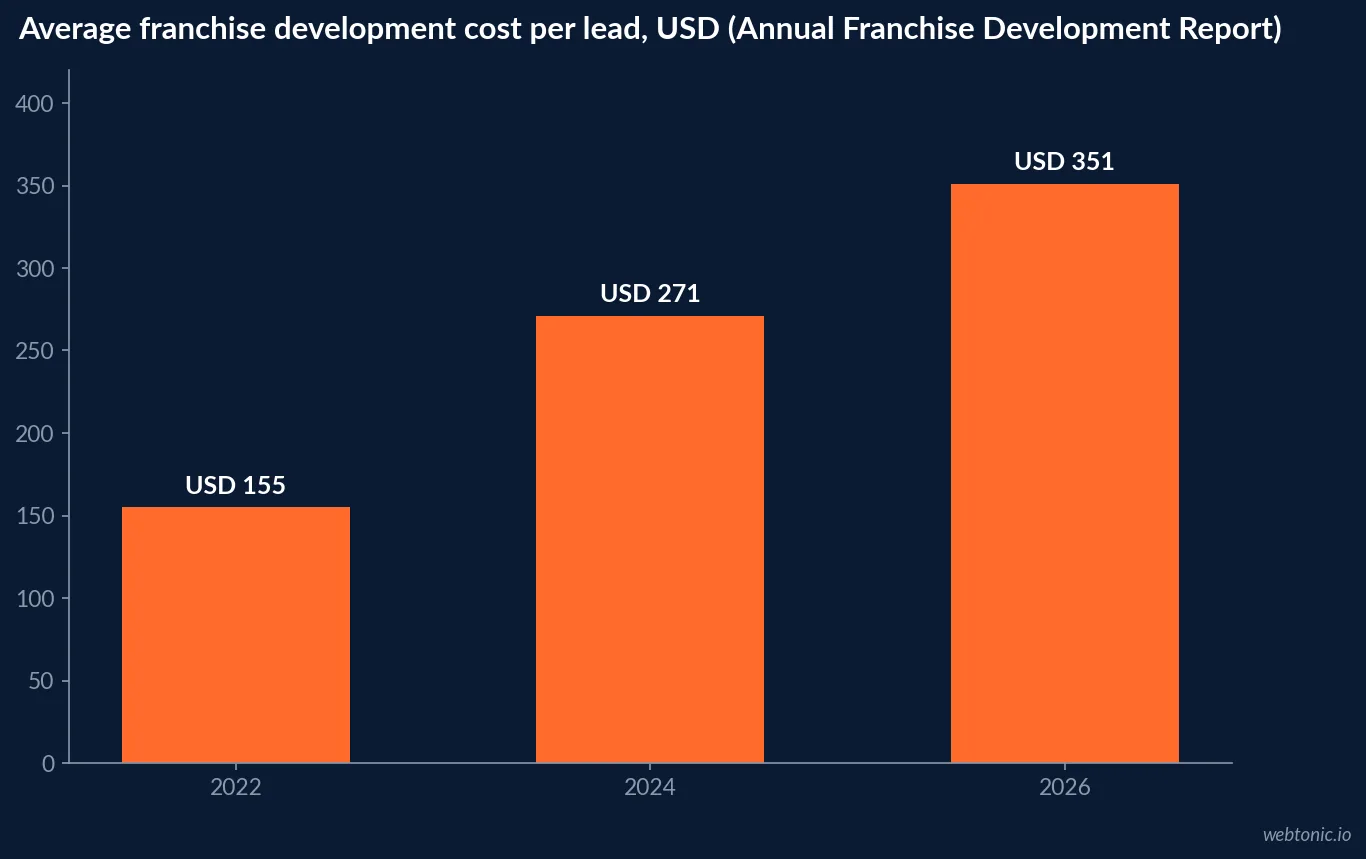
- Average franchise development cost per lead reached USD 351 in the 2026 AFDR, up from USD 271 in 2024.
- Cost per lead was USD 155 as recently as 2022 - more than double in three years.
- Average cost to secure a signed franchisee hit USD 17,550 in 2025, up from USD 13,757 in 2024.
- 56% of respondents tracked cost per lead in the most recent AFDR, down from 63% in 2022.
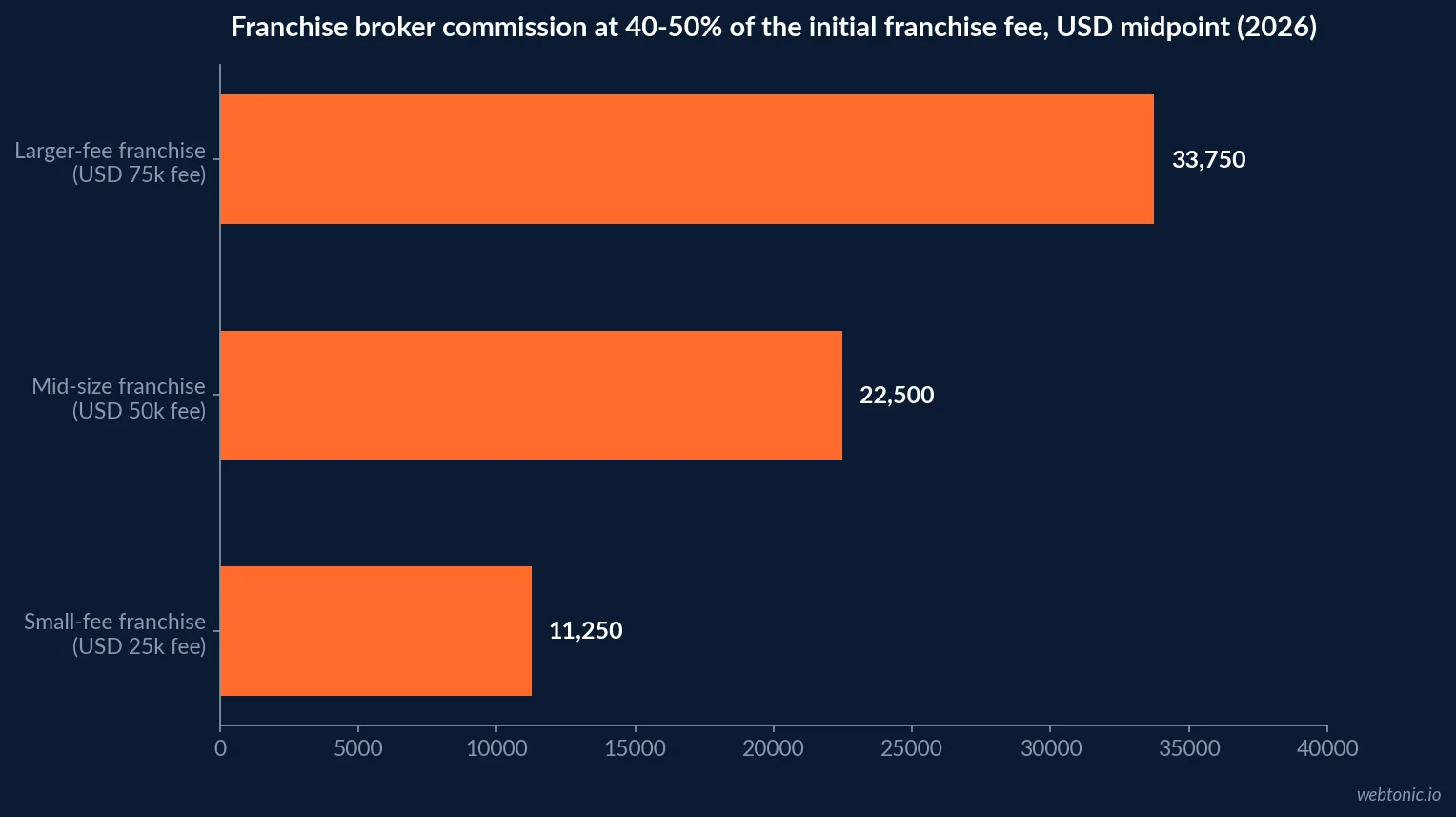
- Franchise brokers typically earn 40% to 50% of the initial franchise fee on a closed placement.
- On a USD 50,000 franchise fee, that is USD 20,000 to 25,000 per deal, paid by the franchisor.
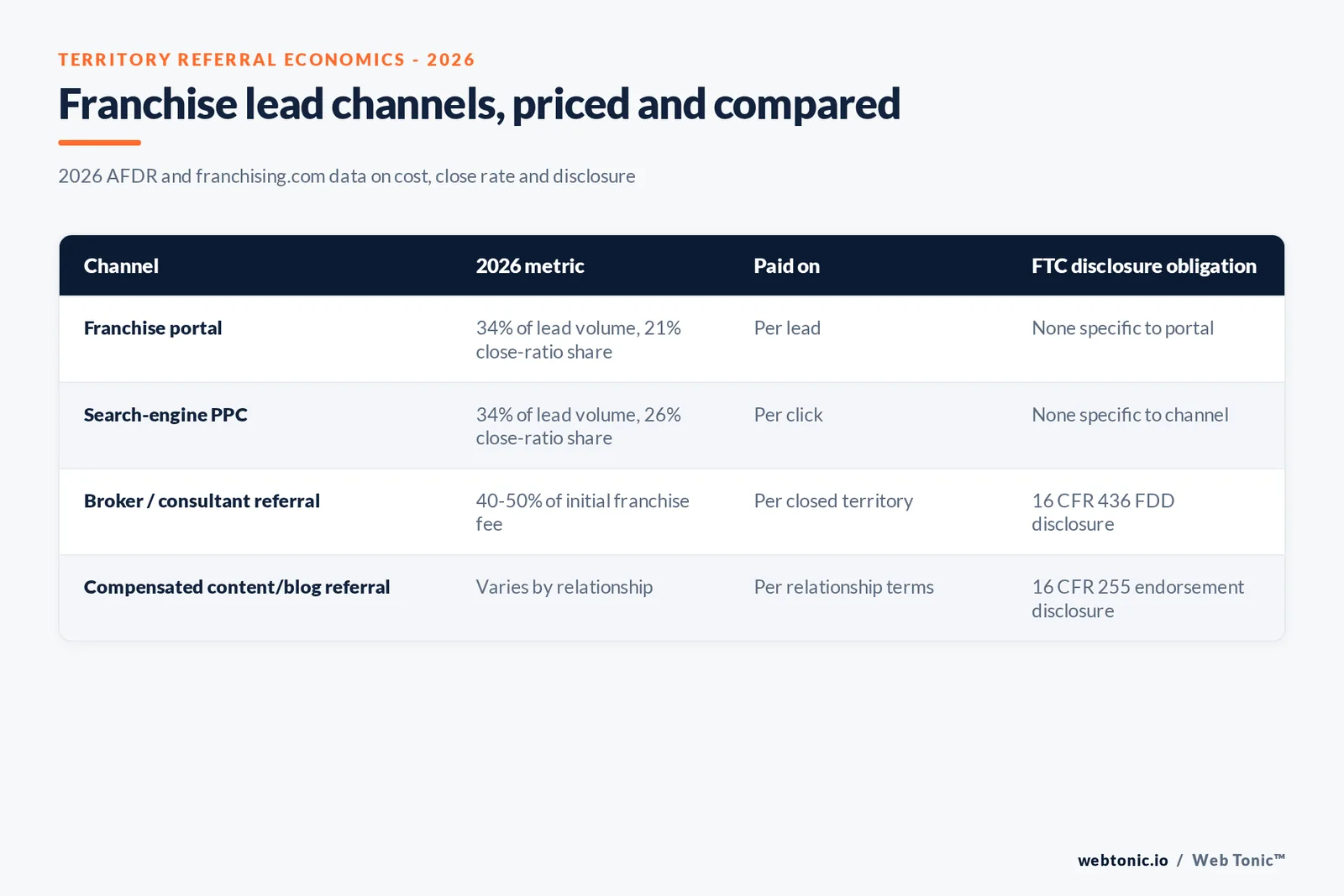
- Franchise portals generated 34% of leads by volume in 2026 survey data.
- Search-engine PPC also generated 34% of leads by volume.
- PPC had the highest lead-to-close ratio at 26%, ahead of portals at 21%.
- Total projected U.S. franchise establishments reach 845,000 units in 2026, up 1.5%.
- Franchise economic output is projected past USD 920 billion in 2026.
- The FTC's Franchise Rule (16 CFR Part 436) requires broker compensation disclosure in the FDD.
- The FTC's 16 CFR 255 separately requires endorsement disclosure for any paid referral content.
Why "affiliate marketing" means broker referral in franchising
Franchising does not run a percentage-of-sale affiliate link the way retail or SaaS does. The closest equivalent is the franchise broker or consultant, who is paid a share of the one-time initial franchise fee for delivering a qualified, closed candidate for a specific territory. Franchising.com's own reporting puts that commission at 40% to 50% of the franchisor's initial fee, and CT Acquisitions' 2026 guide corroborates the range with a worked example: on a USD 50,000 initial fee, a broker typically earns USD 20,000 to 25,000 per closed placement.
That is a materially different economic model from a typical affiliate link: the "commission" is paid once, is large in absolute terms, and is tied to an exclusive territory changing hands rather than a repeat transaction.
What franchise development leads actually cost now
The 2026 Annual Franchise Development Report (AFDR) found average cost per lead rising to USD 351, up from USD 271 in 2024 and USD 155 in 2022 - more than doubling in three years. The same report puts the average cost to secure one signed franchisee at USD 17,550 in 2025, up from USD 13,757 in 2024, which franchising.com attributes to inflation combined with a system-wide push toward more qualified leads over raw volume. A separate 2025 AFDR summary notes that only 56% of respondents tracked cost per lead at all, down from 63% in 2022 - a measurement gap worth flagging before trusting any franchisor's self-reported number at face value.
| Metric (AFDR, Franchise Update) | 2022 | 2024 | 2025/2026 |
|---|---|---|---|
| Average cost per lead | USD 155 | USD 271 | USD 351 |
| Average cost to secure one franchisee | n/a (2023: USD 10,086) | USD 13,757 | USD 17,550 |
| Share of respondents tracking cost per lead | 63% | n/a | 56% (most recent) |
Broker and consultant referral commission
Franchise brokers are paid on close, not on lead delivery, which is the structural difference from a conventional affiliate program. Franchise Fast Track's own description of the model confirms candidates are typically shown to several brands at once through a broker network, with the broker paid wherever the deal closes most easily - the channel is built around the candidate's decision, not around a single franchisor's territory map.
| Referral fee example | Initial franchise fee | Broker commission (40-50%) | Paid by |
|---|---|---|---|
| Small-fee franchise | USD 25,000 | USD 10,000-12,500 | Franchisor, on close |
| Mid-size franchise (worked example) | USD 50,000 | USD 20,000-25,000 | Franchisor, on close |
| Larger-fee franchise | USD 75,000 | USD 30,000-37,500 | Franchisor, on close |
Which lead sources actually convert territory referrals
franchising.com's own 2026 survey of franchise development executives asked which sources generated the most volume and, separately, which converted best. On raw lead volume, franchise portals and search-engine PPC tied at 34% each as the most-cited source. On lead-to-close ratio, PPC led at 26%, ahead of franchise portals at 21% - meaning the channel that generates the most leads is not the channel that closes them most efficiently, and broker/consultant referrals compete against both for the same finite territory candidates.
| Lead source | Share citing it as top volume source | Share citing it as top close-ratio source |
|---|---|---|
| Franchise portals | 34% | 21% |
| Search-engine PPC | 34% | 26% |
| Broker/consultant referral | Not separately broken out | Paid on close by design |
The FTC Franchise Rule sets the disclosure boundary
Broker-arranged deals are not exempt from federal disclosure. The FTC's 16 CFR Part 436 Franchise Rule defines a "franchise broker" as any person other than the franchisor or franchisee who sells, offers for sale, or arranges for the sale of a franchise, and requires the resulting disclosure document to identify who is compensating the broker and on what basis. Separately, the 16 CFR Part 255 Endorsement Guides apply if a broker or consultant publishes content recommending a specific brand while being compensated by it - two separate disclosure obligations that both apply to the same relationship.
| Disclosure requirement | What it covers | Rule |
|---|---|---|
| Franchise Disclosure Document (FDD) | Who compensates the broker, and on what basis | 16 CFR Part 436 |
| Endorsement disclosure | Material connection in any compensated recommendation | 16 CFR Part 255 |
| State franchise registration (where applicable) | Additional state-level filing on top of the federal FDD | Varies by state |
How franchise referral economics compare to the general affiliate benchmark
Franchise development sits well outside the pattern the wider affiliate industry follows. The Performance Marketing Association's 2024 Brand Survey found 77.5% of general U.S. affiliate programs managed by an agency on a recurring percentage-of-sale basis. Franchise development runs the opposite structure almost everywhere: brokers and consultants are independent, paid a single large fee only on close, and rarely operate as an agency-of-record the way a retail affiliate program does - the territory-based, one-time nature of a franchise sale simply does not fit the recurring-commission model most affiliate networks are built around.
| Structural comparison | General affiliate marketing (PMA 2024) | Franchise broker referral |
|---|---|---|
| Typical management model | 77.5% agency-managed | Independent broker or consultant network |
| Payout timing | Per transaction, often recurring | Single payout on signed territory |
| Payout basis | Percentage of sale, often single digits to ~30% | 40-50% of the one-time franchise fee |
| Attribution window | 30-90 days, 60-day median | Entire sales cycle to signature, no fixed window |
Is the growth still there to justify the channel
The macro backdrop supports continued investment in territory-referral channels. The International Franchise Association and FRANdata's 2026 Franchising Economic Outlook projects total U.S. franchise establishments reaching 845,000 units in 2026, up 1.5% from roughly 832,500 - a modest acceleration from 1.3% growth in 2025 - with economic output projected past USD 920 billion. IFA's own release on the report puts that at roughly 12,000 new franchised businesses opening in 2026. That growth is what keeps broker networks recruiting new territory candidates even as cost per lead climbs.
| Franchise sector metric (2026 Outlook) | Figure | Source |
|---|---|---|
| Total US franchise establishments | 845,000 units | IFA/FRANdata 2026 Outlook |
| Growth from ~832,500 units | 1.5% | IFA/FRANdata 2026 Outlook |
| Prior year growth (2025) | 1.3% | IFA/FRANdata 2026 Outlook |
| New franchised businesses opening | ~12,000 | IFA press release, Feb. 2026 |
| Projected economic output | USD 920 billion+ | IFA/FRANdata 2026 Outlook |
Where the raw AFDR data itself lives
Franchise Update's own Annual Franchise Development Report portal collects the underlying data behind every figure cited above directly from franchisors, organized by industry, unit investment, system-wide sales and broker usage - the primary dataset the cost-per-lead and cost-per-franchisee trend numbers in this article are drawn from, rather than a single static PDF that goes stale after one publication cycle.
Pricing the channel against a direct hire
A franchisor weighing broker/consultant referral against building an in-house development team is really comparing a large, one-time, per-deal commission against a fixed salary plus a paid-media budget. At USD 351 per lead and a typical 20:1 to 50:1 lead-to-close ratio implied by the AFDR's own cost-per-lead and cost-per-franchisee figures, direct paid acquisition and broker referral converge on a similar effective cost per signed unit once broker commission is annualized across a territory's lifetime royalty stream - the deciding factor is usually how fast the territory needs to be filled, not which channel is cheaper on paper. Our Google Ads strategy guide covers the direct-acquisition half of that comparison in more depth.
Our growth marketing practice models that direct-vs-broker comparison against a franchisor's own AFDR-reported cost per lead before recommending either channel - talk to us to run the numbers on your territory map.
Setting a realistic development budget
Working backward from the AFDR's own figures, a franchisor targeting 10 signed units in a year at the current USD 17,550 average cost per franchisee should budget roughly USD 175,500 in blended development spend across whichever mix of broker commission, portal listing fees and PPC the territory map calls for - before accounting for the internal development team's own salary if any of that work is kept in-house. Franchisors running leaner unit-economics with a USD 25,000 initial fee have less room to absorb a 40% to 50% broker commission on top of that spend, which is the practical reason broker referral concentrates more heavily among franchise brands with a mid-size or larger initial fee.
Frequently Asked Questions
What does a franchise broker or consultant referral actually cost a franchisor?
Franchise brokers and consultants typically earn 40% to 50% of the franchisor's one-time, nonrecurring initial franchise fee when a referred candidate signs, per franchising.com's own reporting and corroborated by CT Acquisitions' 2026 guide. On a USD 50,000 initial fee, that is roughly USD 20,000 to USD 25,000 paid per closed placement, not per lead.
How much does a franchise development lead cost in 2026?
The 2026 Annual Franchise Development Report found average cost per lead rose to USD 351, up from USD 271 in 2024 and USD 155 in 2022. The average cost to secure one signed franchisee jumped from USD 13,757 in 2024 to USD 17,550 in 2025, which franchising.com attributes to inflation and a system-wide push toward higher-quality, more qualified leads rather than raw volume.
Are franchise brokers required to disclose their referral fee to candidates?
The FTC's 16 CFR Part 436 Franchise Rule defines a franchise broker as anyone other than the franchisor or franchisee who sells, offers, or arranges for the sale of a franchise, and requires the franchise disclosure document a broker distributes to identify who is paying the broker and how. A broker's compensation from the franchisor does not have to be hidden from the prospective franchisee - it has to appear in the FDD.
Which lead sources actually close the most franchise development deals?
Franchising.com's own 2026 survey of franchise development executives found pay-per-click on search engines had the highest reported lead-to-close ratio at 26%, ahead of franchise portals at 21%. On raw lead volume, franchise portals and PPC tied at 34% each as the most commonly cited source.
Is the franchise sector still growing enough to justify referral-channel investment?
The International Franchise Association and FRANdata's 2026 Franchising Economic Outlook projects total U.S. franchise establishments reaching 845,000 units in 2026, up 1.5% from roughly 832,500 - a modest acceleration from 1.3% growth in 2025, alongside output crossing an estimated USD 920 billion.
Sources
Franchising.com - Inside the 2026 Annual Franchise Development Report
Franchising.com - Studying the numbers: the 2025 AFDR
Franchising.com - Going for brokers: third parties in franchise development
CT Acquisitions - Franchise consultants: how to vet one, 2026 guide
Franchise Fast Track - How franchise brokers work
Franchising.com - Primary sources of franchise development leads, 2026
Franchising.com - Highest lead-to-close ratio sources, 2026
eCFR - 16 CFR Part 436 Franchise Rule
Federal Trade Commission - 16 CFR Part 255 Endorsement Guides
International Franchise Association/FRANdata - 2026 Franchising Economic Outlook
IFA - Press release on the 2026 Franchising Economic Outlook
Franchise Update - Annual Franchise Development Report portal