



Table of contents
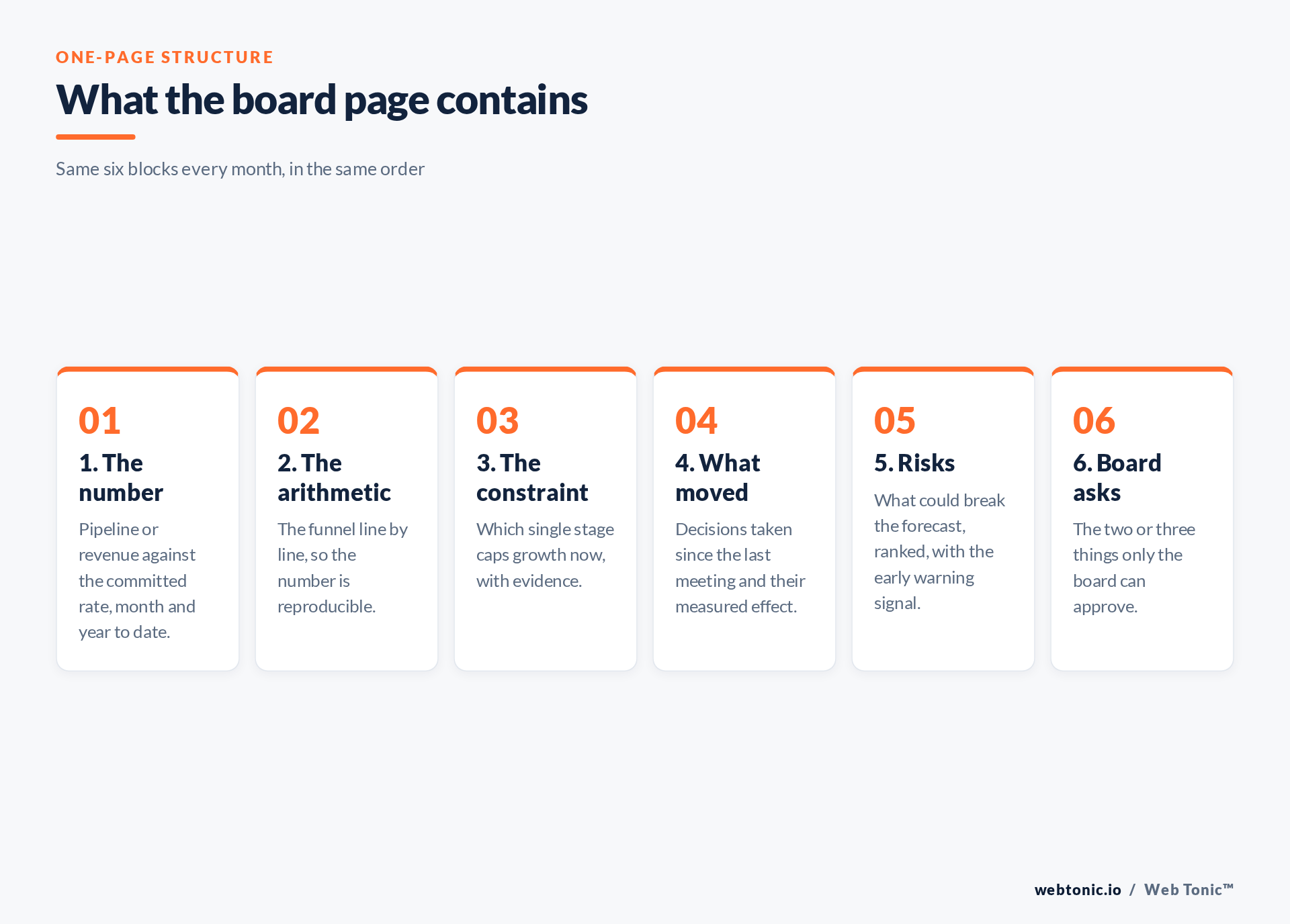
Quick answer: Report a fractional head of growth on one page a month: the committed number against actual, the pipeline arithmetic behind it, the single constraint being worked, what changed since last meeting, ranked risks, and two or three board asks.
Last verified: 2026-09-09
The board is buying forecast confidence, not activity
Directors are accountable for oversight of strategy and risk, not for channel tactics — that is the substance of a board's role. So a growth report that leads with campaigns launched, creatives tested and impressions delivered answers a question nobody in the room asked. The question is always the same: is the number going to land, how do you know, and what do you need from us.
That makes the reporting format almost fixed. One page, six blocks, identical every month so the board reads deltas rather than re-learning a layout. Appendices can be long; the page cannot. A fractional CGO reporting into a board earns credibility by being boringly consistent, not by producing a new dashboard each quarter.
Lead with the number, then show the arithmetic
Open with the commitment and the actual: the monthly rate implied by the annual target, what was delivered, and the cumulative gap. Then reproduce the funnel arithmetic underneath — deal value, win rate, qualified opportunities, leads, sessions, spend — so any director can rebuild the number without asking. This is the same backwards math a good marketing plan rests on, and putting it in the pack removes most of the suspicion that attaches to marketing reporting.
State the attribution basis in a footnote rather than in conversation. Which window, which model, whether the figure is platform-reported or reconciled against billing. Google documents its own conversion windows, and a one-line note that says "30-day click, platform-reported, unreconciled" prevents the argument where two people quote different revenue for the same month. Where the reconciliation itself is broken, say so and point at the fix — the mechanics sit under conversion tracking and analytics.
Report the constraint, not the to-do list
Every month, name the one stage that caps growth and show the evidence. Traffic that converts but is too small. Conversion that fails at volume already available. Qualification discarding most of what marketing sends. Sales capacity that cannot work existing pipeline. Working the funnel one binding limit at a time is the theory of constraints applied to demand, and it gives the board a way to judge whether effort is aimed at the right place.
If the constraint has not changed in three months, that is the story of the report. Either the moves against it were too small, or the diagnosis was wrong. Both are legitimate; concealing them behind a longer activity list is not.
Translate the metrics before the meeting
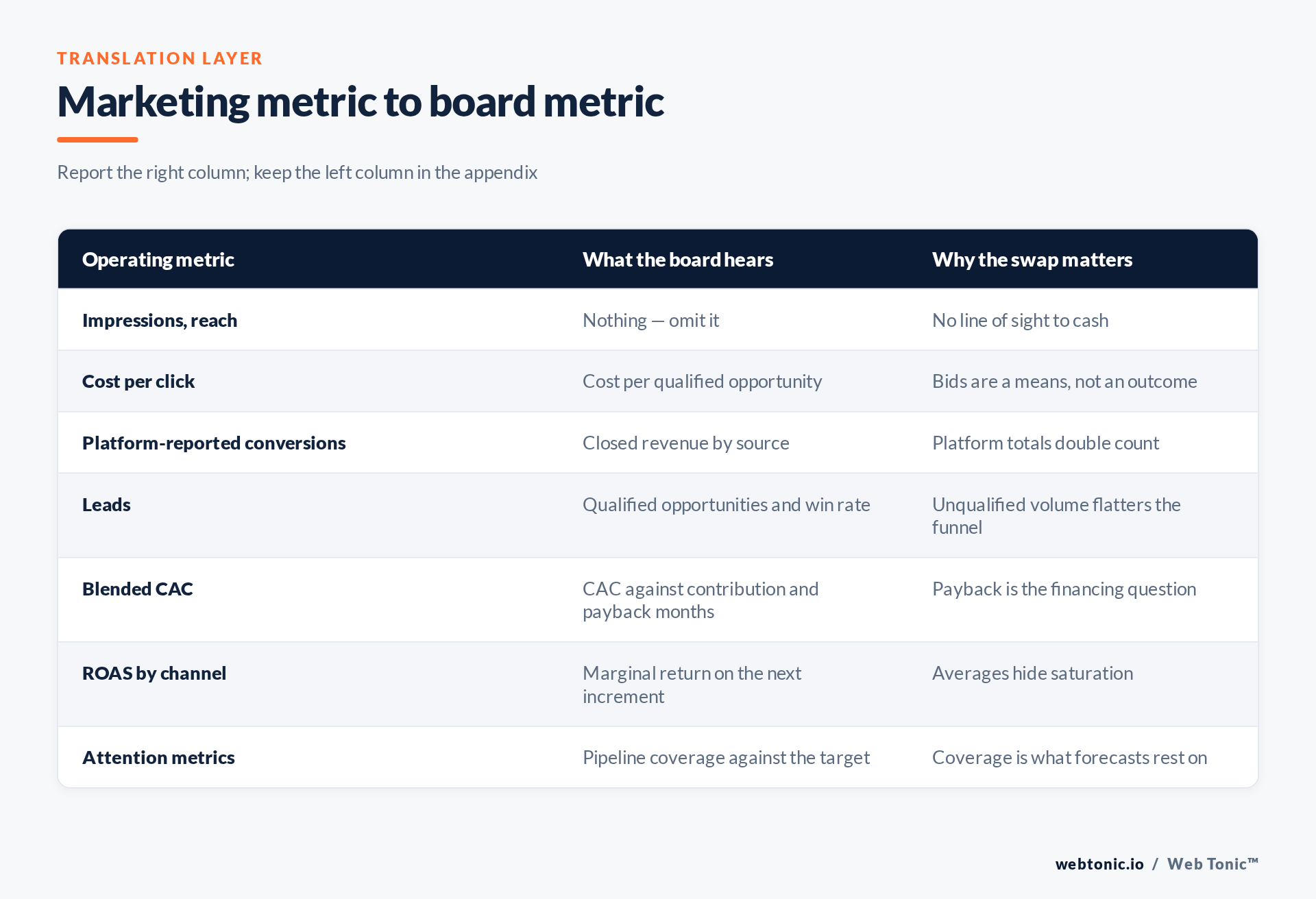
Operating metrics are for the working session; board metrics are about cash and risk. Customer acquisition cost read against lifetime value and payback months tells a director whether growth is fundable. Cost per click does not. Keep a small, stable set — most boards are served by five to seven measures, chosen the way a KPI set should be and left alone for a year.
Two habits protect the numbers. First, marginal thinking: report what the next increment of budget returns, not the blended average, because averages hide saturation. Second, never present a platform total as company revenue; if the pack shows both, label which is which. Modelled views such as marketing mix modelling belong in an appendix with their assumptions visible.
| Block | Length | Fails when |
|---|---|---|
| Number vs commitment | Three lines | Only month shown, no cumulative gap |
| Pipeline arithmetic | One small table | Inputs cannot be traced to a system |
| Constraint | One sentence plus proof | Written as a mood, not a measurement |
| What moved | Three to five bullets | Lists work done instead of effects |
| Risks | Ranked, three max | No early warning signal attached |
| Board asks | Two or three | Asks are informational, not decisions |
Make the asks decisions, not updates
A board can approve budget, accept a risk, unblock a hire, change a commitment or settle a priority conflict between functions. Those are the only asks worth the page. Frame each with the decision, the option set, the cost of each option and the consequence of deferring — a deferred decision is the most expensive item in most growth plans and the pack should price it.
Send the document at least forty-eight hours ahead and do not present it slide by slide. Read-in-advance packs turn the meeting into discussion of the two hard items rather than a recital. Where the ask involves a commercial commitment, attach the scope in the same language as the statement of work so the approval and the contract match.
What goes wrong
The failure mode: the pack grows. Month one is a page, month six is nineteen slides of channel detail, and the constraint has disappeared into the appendix. Directors stop reading, questions get sharper and less informed, and the chief growth officer role starts being judged on presentation quality. Freeze the format on day one and push everything else into an appendix nobody is obliged to read.
Second failure mode: shifting definitions. A metric quietly re-baselined between meetings destroys trust faster than a bad month reported honestly. If a definition must change, show both series side by side for one cycle and say why.
Third: no bad news until it is unfixable. Boards forgive misses they saw coming and punish surprises. Put the risk in the pack while it is still cheap. Related process notes sit in the help library; the delivery side under growth marketing.
Related reading
- Fractional CGO / Head of Growth: how to measure it
- Fractional CGO / Head of Growth: what it costs in 2026
- How to Report a Fractional CMO's Work to the Board
- Marketing Strategy Consulting services at Web Tonic
Frequently Asked Questions
How often should a fractional head of growth report to the board?
Monthly in writing, with attendance at the formal board cycle. The written monthly cadence is what makes the quarterly meeting short.
How long should the board report be?
One page for the report itself, with unlimited appendix. Six fixed blocks: number, arithmetic, constraint, what moved, risks, asks.
Which metrics belong in a board pack?
Five to seven, tied to cash: revenue or pipeline against commitment, qualified opportunities, win rate, CAC with payback months, and pipeline coverage. Leave impressions and clicks out.
Should the fractional lead present or should the CEO?
The fractional lead owns the numbers and answers questions; the CEO owns the asks. Splitting it that way keeps accountability where the board expects it.
Sources: Board of directors, Marketing plan, Theory of constraints, Customer acquisition cost, Customer lifetime value, KPI, Marketing mix modeling, Statement of work (Wikipedia); Google Ads conversion windows; Harvard Law School Forum on Corporate Governance. Verified 2026-09-09.


