



Table of contents

No published study prices a fractional head of growth as a product. What does exist is rate data - USD 130 to 220 an hour, USD 5,000 to 25,000 a month - and the hours behind it. Here is how the 2026 numbers assemble into a defensible budget.
Key Takeaways
- Fractional marketing leadership averages USD 180 an hour, median USD 175.
- The 25th-to-75th percentile band runs USD 130 to 220 an hour.
- Engagements average about 9 hours a week, or 468 hours a year.
- Monthly retainers run USD 5,000 to 25,000, typically over 6 to 12 months.
- Project engagements run 4 to 24 weeks.
- Loaded hourly equivalents: USD 200-500 retainer, 300-700 project, 200-600 hourly.
- Buying a retainer for project work costs 4 to 5 times more.
- A published example puts that gap at USD 180,000 against USD 40,000.
- A full-time CMO costs USD 293,575 in total cash compensation.
- Retained search adds 25% to 35% of first-year earnings.
- A bad hire starts at 30% of first-year earnings; senior mis-hires reach 213%.
- Project pricing leads consulting at 30%, hourly at 29%, retainers at 16%.
- 38% of consultants earn USD 10,000 or more a month.
- Marketing budgets sit at 9.0% of revenue, growing just 1.7%.
The rate base: what is actually published
GoFractional's rate data for fractional marketing leadership reports an average of USD 180 an hour, a median of USD 175 and a 25th-to-75th percentile range of USD 130 to 220, on engagements of about 9 hours a week - roughly 468 hours a year.
Those two facts multiply into the only figure that matters for planning: about USD 84,240 a year at the average rate and the average commitment. Anything quoted far below that is buying fewer hours, and anything far above it is buying more seniority or more hours - not a different market.
| Rate point | USD per hour | Annual cost at 468 hours |
|---|---|---|
| 25th percentile | 130 | About 60,840 |
| Median | 175 | About 81,900 |
| Average | 180 | About 84,240 |
| 75th percentile | 220 | About 102,960 |
The buying shape moves the total more than the rate
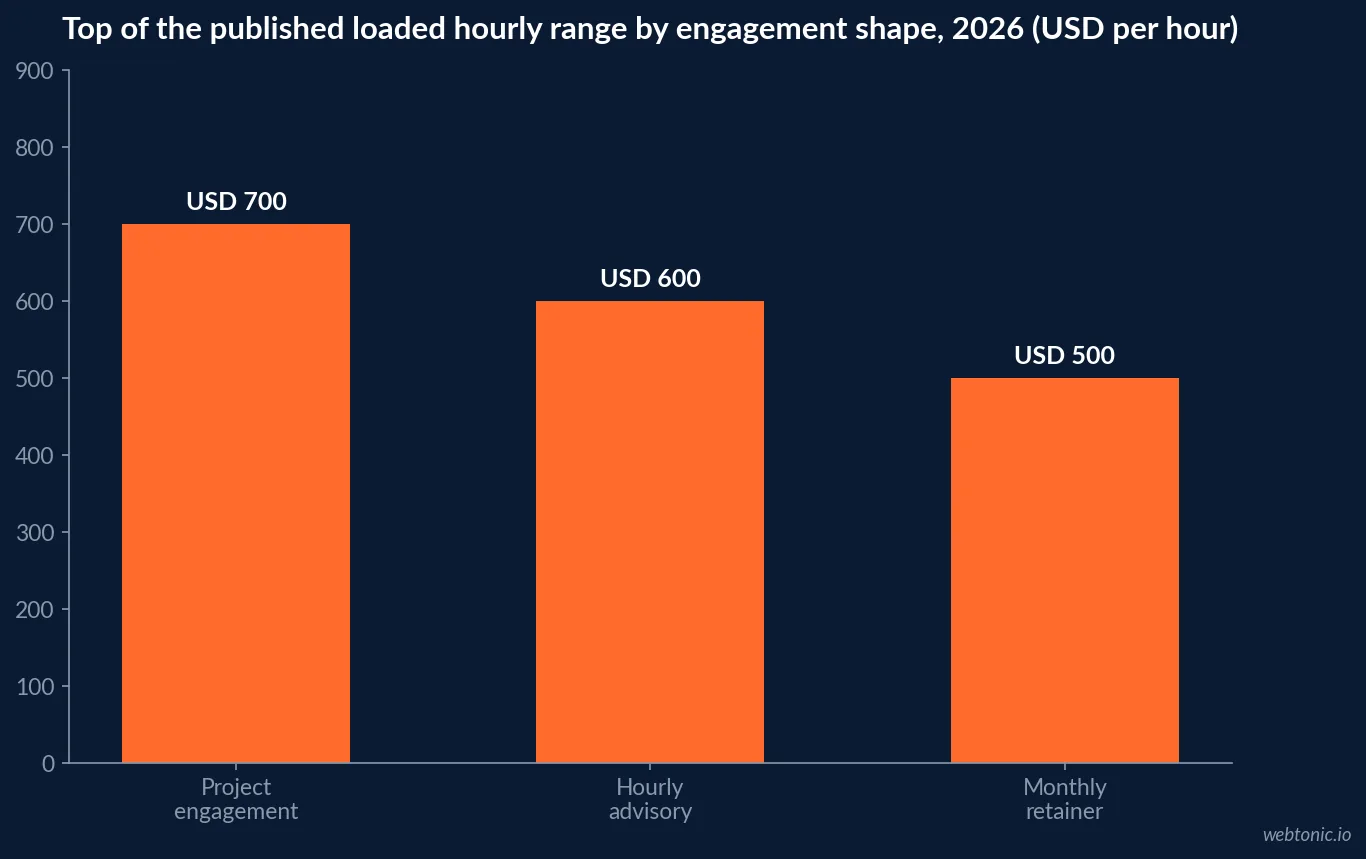
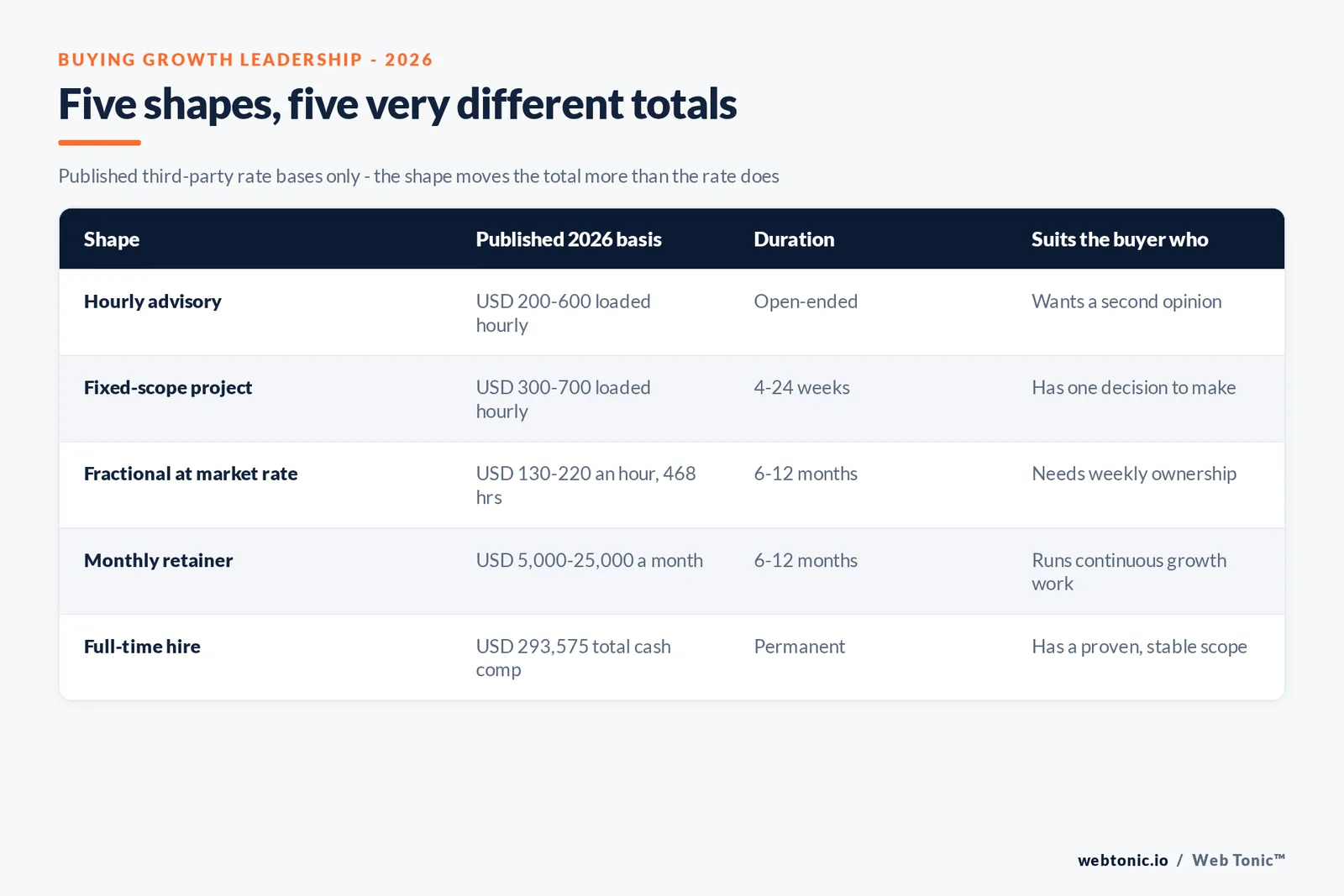
FractionalPulse's engagement comparison reports retainers of USD 5,000 to 25,000 a month on 6 to 12 month terms with 30-day notice, projects of 4 to 24 weeks, and loaded hourly equivalents of USD 200 to 500 on retainer, USD 300 to 700 on project work and USD 200 to 600 on hourly advisory.
Its sharpest finding is a mismatch cost: buying a retainer for work that is really a project costs 4 to 5 times more, USD 180,000 against USD 40,000 in its worked example. Most overspending on growth leadership is not a rate problem. It is an open-ended contract on a bounded question.
| Engagement shape | Published basis | Typical duration | Best fit |
|---|---|---|---|
| Hourly advisory | USD 200-600 loaded hourly | Open-ended | A second opinion on a plan |
| Fixed-scope project | USD 300-700 loaded hourly | 4-24 weeks | A diagnosis or a launch |
| Monthly retainer | USD 5,000-25,000 a month | 6-12 months | Ongoing ownership of growth |
| Retainer used for a project | 4-5x the project cost | Open-ended | Nobody - the mismatch case |
| Full-time hire | USD 293,575 total comp | Permanent | A proven, stable scope |
The full-time comparison, honestly stated
Built In's US compensation data puts chief marketing officer pay at USD 225,908 base plus USD 67,667 additional compensation, for USD 293,575 in total cash. That excludes benefits, equity, tooling and search fees - and Talentfoot puts retained search at 25% to 35% of first-year earnings.
The comparison is not fractional-versus-full-time on price alone. It is a question of when the scope is stable enough to be worth the fixed cost. Until then the cheaper structure is usually a defined engagement with a review date, as we structure in our growth marketing work.
| Cost line | 2026 published figure | Applies to |
|---|---|---|
| Base salary | USD 225,908 | Full-time hire |
| Additional compensation | USD 67,667 | Full-time hire |
| Total cash compensation | USD 293,575 | Full-time hire |
| Retained search fee | 25-35% of first-year earnings | Full-time hire |
| Fractional at average rate | About USD 84,240 a year | 468 hours at USD 180 |
| Retainer at USD 15,000 a month | USD 180,000 a year | Ongoing ownership |
The downside case is the real budget line
Talentfoot's 2026 data cites the US Department of Labor floor of at least 30% of first-year earnings for a bad hire, with senior mis-hires reaching up to 213% of salary once lost momentum, severance and replacement search are counted.
Set against USD 293,575 in total compensation, that ceiling is the number that justifies a paid diagnosis before a permanent search. A 4-to-24-week engagement that defines the role is cheap insurance against the 213% case - and it produces the scorecard the eventual hire inherits.
How the supply side prices itself
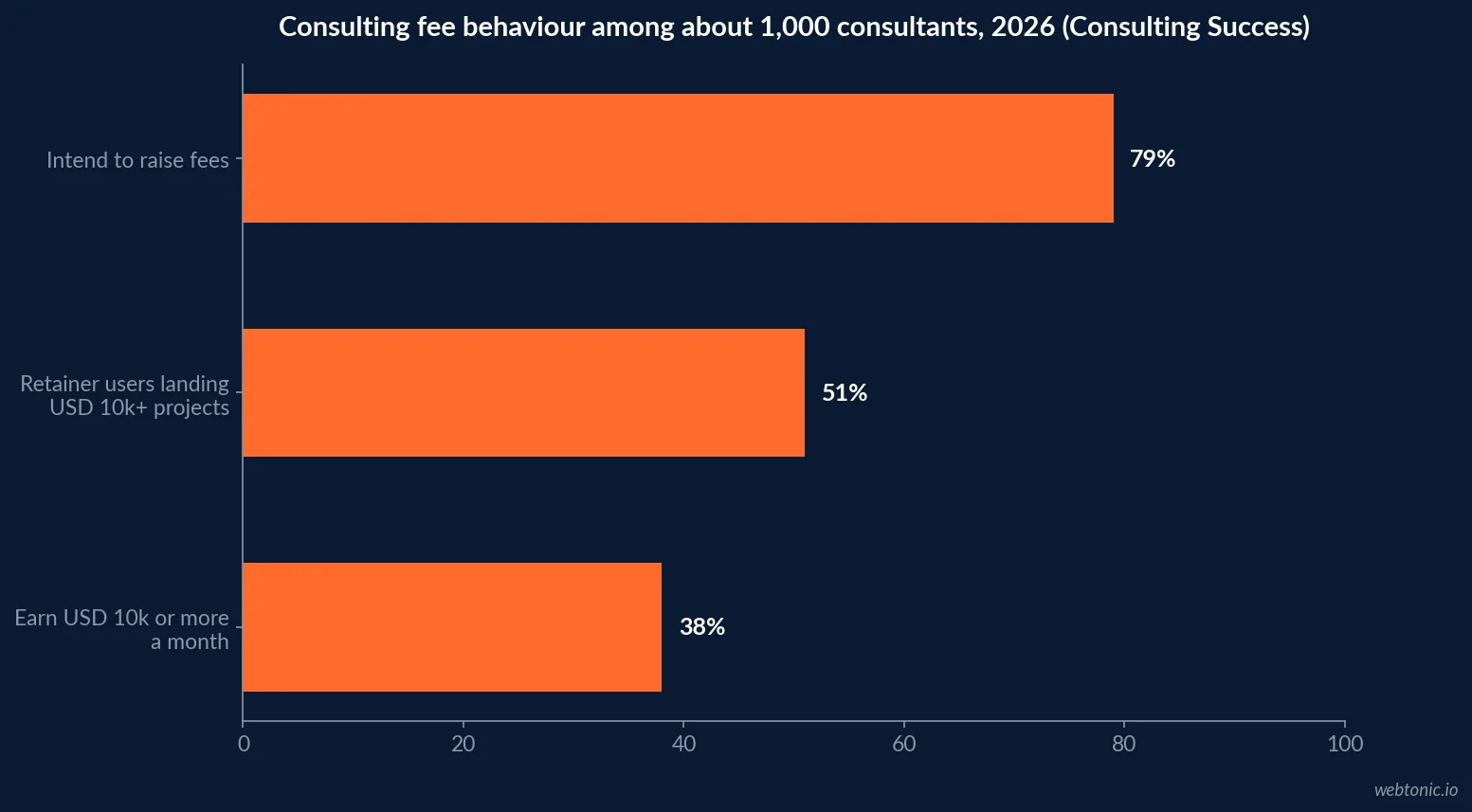
Consulting Success's fee survey of about 1,000 consultants reports pricing models split project 30%, hourly 29%, monthly retainer 16%, value-based 15% and daily 10%. It also finds 79% intend to raise their fees, 38% earn USD 10,000 or more a month, and 51% of retainer users land projects of USD 10,000 or more against 39% of non-users.
Two practical consequences. First, expect the proposal to arrive in the operator's preferred shape, not yours - so state the shape you want in the brief. Second, with 79% planning increases, multi-year rate assumptions built on today's numbers will drift upward.
| Pricing model | Share of consultants | What it means for your budget |
|---|---|---|
| Project based | 30% | Easiest to compare across bidders |
| Hourly | 29% | Flexible, hardest to forecast |
| Monthly retainer | 16% | Predictable, needs a scope boundary |
| Value based | 15% | Requires an agreed baseline metric |
| Daily rate | 10% | Good for a one-week diagnostic |
Fitting the cost into a 2026 marketing budget
The CMO Survey 2026 reports marketing budgets at 9.0% of revenue and 9.6% of firm budgets, spend growth of 1.7%, headcount growth down 50% year on year and training compressed to 3.8% of spend, from 5.8%. Hinge adds the cohort spread: 12.0% of revenue among High Growth firms against 5.0% among No Growth firms.
At a 9.0% envelope, a USD 10 million business runs about USD 900,000 in marketing spend. A retainer at USD 10,000 a month consumes roughly 13% of that - defensible if it improves allocation of the rest, hard to justify if it only adds a meeting. That is the same test we apply to channel budgets.
| Revenue | Marketing budget at 9.0% | Retainer at USD 10k a month | Share of budget |
|---|---|---|---|
| USD 5 million | USD 450,000 | USD 120,000 | About 27% |
| USD 10 million | USD 900,000 | USD 120,000 | About 13% |
| USD 25 million | USD 2,250,000 | USD 120,000 | About 5% |
| USD 50 million | USD 4,500,000 | USD 120,000 | About 3% |
Why demand - and therefore price - keeps rising
The Fractional Work Report cites 149% year-on-year demand growth, roughly 150,000 US practitioners, marketing at about 20% of demand, 87% with 11 or more years of experience, 64% working with multiple clients and 90% saying they will not return to full-time work. Gartner has projected that more than 30% of midsize companies will use fractional executives by 2027.
A supply of experienced operators who will not return to employment, meeting institutional demand, is not a discount market. Budget at the middle of the published band rather than the bottom.
What to put in the brief so the price is comparable
Comparable quotes require a comparable brief. Because rates cluster tightly and shapes do not, the variable that decides your total is what you ask for: the question, the hours, the end date and the artefacts. Get those four on one page and two proposals become genuinely comparable.
We do not publish a price list for this work either, for the reason the data shows - scope, not rate, sets the number. If you want a shaped estimate against your own revenue and stage, send the brief and we will price the scope. Background on how we work is on our about page.
| Brief element | What to state | Why it changes the price |
|---|---|---|
| The question | One decision to be made | Bounded questions price as projects |
| Hours a week | A number, not 'as needed' | 9 hours is the market default |
| End date | A review or exit date | Open-ended terms cost 4-5x |
| Artefacts | Scorecard, plan, tracking spec | Deliverables prevent scope drift |
| Decision rights | Who signs off on spend | Ownership drives the seniority needed |
Three budgeting mistakes the rate data exposes
The published figures make three common errors visible. The first is comparing an hourly rate against a salary: USD 180 an hour sounds expensive beside a monthly payroll line until the 468-hour annual commitment is applied and the total lands near USD 84,240. The second is treating a retainer as a discount on a hire, when FractionalPulse shows the mismatch costing 4 to 5 times the equivalent project.
The third is budgeting only the engagement. Growth leadership consumes internal time - review meetings, data pulls, decisions - and with marketing spend growing 1.7% and headcount growth down 50%, that internal time is the scarcer resource. Price the meeting load alongside the invoice, or the engagement quietly costs more than the quote.
Related reading
- Fractional CGO / Head of Growth: the first 90 days
- Fractional CGO / Head of Growth — How to Scope the Engagement
- Fractional CMO Statistics: Cost and Pricing
- Marketing Strategy Consulting services at Web Tonic
Frequently Asked Questions
How much does a fractional head of growth cost in 2026?
Published rate data, not quotes, gives the range. GoFractional reports an average of USD 180 an hour, a median of USD 175 and a 25th-to-75th percentile band of USD 130 to 220 for fractional marketing leadership. FractionalPulse reports monthly retainers of USD 5,000 to 25,000 on engagements of 6 to 12 months. The two reconcile through hours: about 9 hours a week, or roughly 468 hours a year, is the typical commitment.
Is a retainer or a project cheaper?
It depends on whether the work has an end. FractionalPulse's comparison is blunt about the failure mode: buying a retainer for what is really a project costs 4 to 5 times more - roughly USD 180,000 against USD 40,000 in its published example. Loaded hourly equivalents run USD 200-500 on retainer, USD 300-700 on project work and USD 200-600 on straight hourly advisory, so the shape matters more than the rate.
How does that compare with hiring a full-time growth leader?
Built In's 2026 US compensation data puts chief marketing officer pay at USD 225,908 base plus USD 67,667 additional, for USD 293,575 in total cash compensation - before benefits, equity, tooling and recruitment. Talentfoot reports retained search fees of 25% to 35% of first-year earnings on top. A fractional engagement at 468 hours and USD 180 an hour costs about USD 84,240 a year, which is why the comparison is usually about certainty rather than about savings.
What does a mis-hire cost if the decision is wrong?
More than the engagement it was meant to replace. Talentfoot's 2026 data cites the US Department of Labor floor of at least 30% of first-year earnings for a bad hire, with senior mis-hires reaching up to 213% of salary once lost momentum and replacement costs are counted. Against USD 293,575 in total compensation, the downside case dwarfs a 6 to 12 month fractional engagement used to define the role first.
How do consultants and fractional operators structure their fees?
Consulting Success's survey of about 1,000 consultants reports project pricing at 30%, hourly at 29%, monthly retainers at 16%, value-based at 15% and daily rates at 10%. It also finds 79% want to raise their fees, 38% earn USD 10,000 or more a month, and 51% of retainer users land projects of USD 10,000 or more against 39% of non-users. Expect a proposal shaped by the operator's own model as much as by your scope.
Sources
GoFractional - Fractional CMO Rates
FractionalPulse - Fractional Executive Engagement Comparison
Built In - CMO Salary Data
Talentfoot - The Cost of a Leadership Mis-hire, 2026 Data
Consulting Success - Consulting Fees Study
The CMO Survey - Highlights and Insights Report 2026
Hinge Research Institute - 2026 High Growth Study
Fractional Jobs - The Fractional Work Report
Vendux - Ten Numbers on Fractional Executives in 2026


