Table of contents

Average CMO tenure at S&P 500 companies is 4.1 years. A typical fractional engagement starts on a six to 12 month term. Those two numbers describe different clocks, and conflating them is the most common error in this category. Here is what each one measures, and what makes an engagement end early.
Key Takeaways
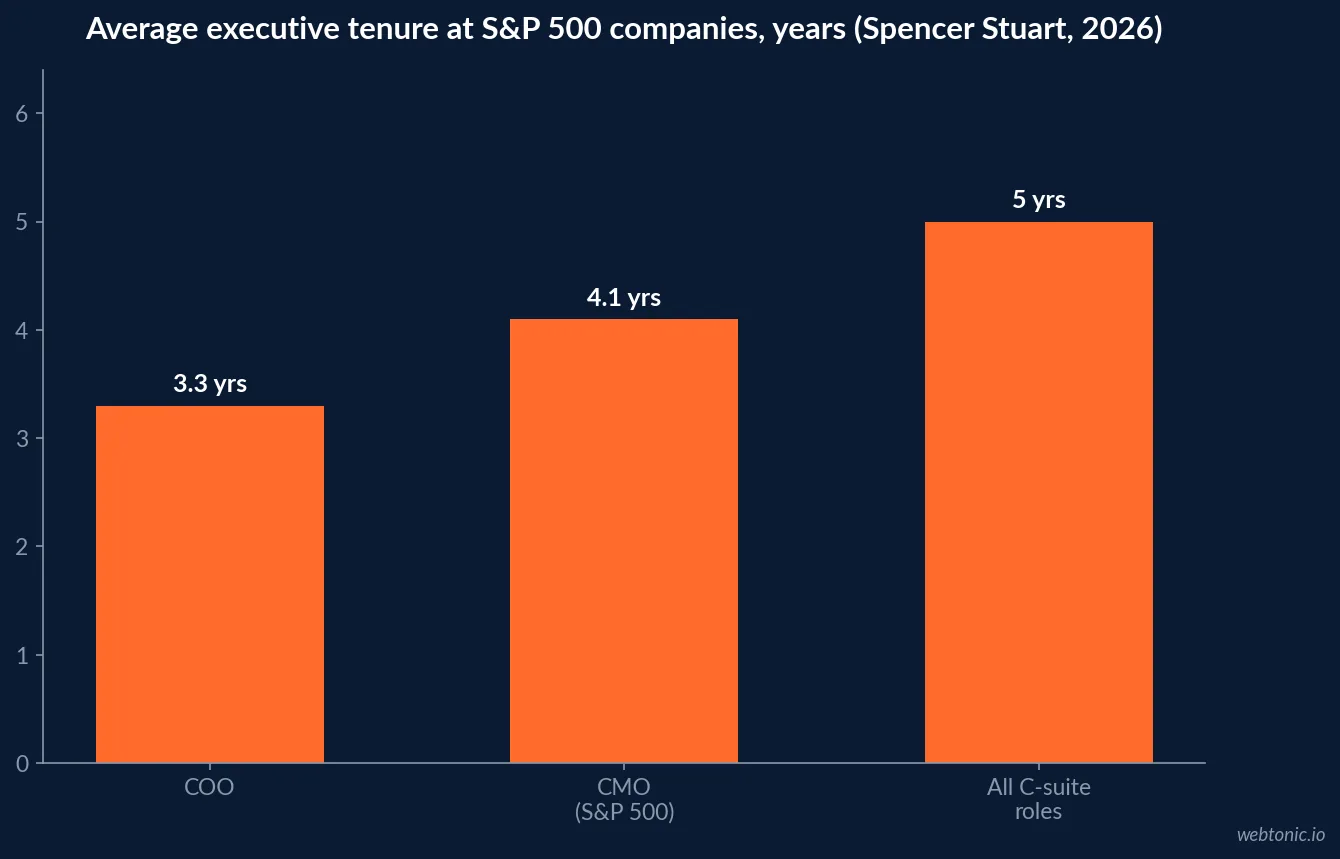
- Average S&P 500 CMO tenure is 4.1 years, against 5.0 years for all C-suite roles.
- Only COOs turn over faster, at 3.3 years on average.
- 31% of S&P 500 companies have no enterprise CMO at all, in line with historical averages.
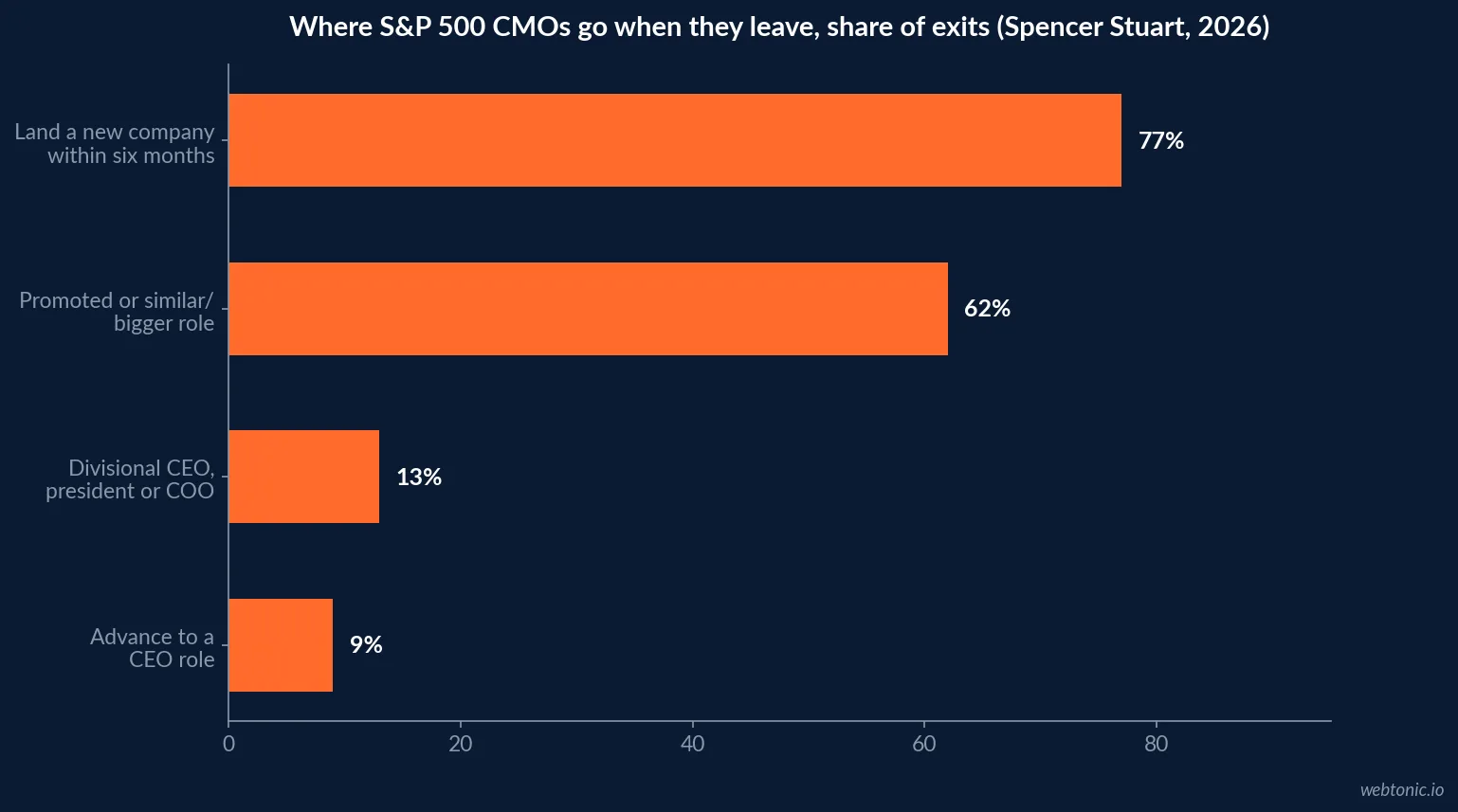
- 62% of exiting CMOs move to a similar or bigger role, internally or elsewhere.
- 9% go on to a CEO seat and 13% to a divisional CEO, president or COO role.
- 77% of those leaving land at a new company within six months.
- Fractional engagements typically start on six to 12 month terms that convert to month-to-month.
- Project engagements run four to 24 weeks, a different commitment entirely.
- Equity-only arrangements outside a narrow advisory band fail within six months.
- 90% of fractional practitioners say they will not return to full-time work.
- 64% run two or more client engagements at once and 87% have 11+ years of experience.
- Marketing headcount growth has slowed by more than 50% year over year in the 2026 CMO Survey.
Two clocks, measured separately
Executive tenure measures how long a person holds a seat. Engagement length measures how long a contract runs. They come from different datasets with different populations, and neither one predicts the other.
| Clock | 2026 figure | Population | Source |
|---|---|---|---|
| S&P 500 CMO tenure | 4.1 years | Large-cap public companies | Spencer Stuart, 2026 |
| All C-suite tenure | 5.0 years | Same companies | Spencer Stuart, 2026 |
| COO tenure | 3.3 years | Same companies | Spencer Stuart, 2026 |
| Fractional initial term | 6-12 months | Fractional engagements | Fractional Pulse, 2026 |
| Fractional project work | 4-24 weeks | Defined-deliverable work | Fractional Pulse, 2026 |
| Equity-only failure window | Under 6 months | Outside pre-revenue advisory | Fractional Pulse, 2026 |
The tenure number, stated accurately
Spencer Stuart's 2026 CMO tenure snapshot puts average tenure at 4.1 years across the S&P 500, compared with 5.0 years for all C-suite roles at the same companies and 3.3 years for COOs. The short-tenure narrative usually quoted at around two years does not come from this measurement, and rarely comes with a source at all.
The exits tell a different story from the one the narrative implies. 62% of departing CMOs were promoted internally or moved to a similar or larger role elsewhere, 13% moved into a divisional CEO, president or COO seat, and 9% became a chief executive. 77% of those who left their company landed somewhere new within six months. Turnover in this seat behaves like a ladder, not a failure rate.
The structural fact that matters more than tenure
Roughly 31% of S&P 500 companies operate without an enterprise CMO. Marketing still happens at those firms - it sits with a divisional leader, a general manager or the chief executive. That is the same structural decision a 40-person company makes when it engages an interim marketing director instead of hiring a full-time chief marketing officer, and it has been stable across years rather than being a 2026 anomaly.
The supporting pressure shows up in The CMO Survey, run by Duke University's Fuqua School of Business with Deloitte and the American Marketing Association: marketing headcount growth has slowed by more than 50% from last year's rate and training budgets have fallen to 3.8% of marketing spending, down from a pre-pandemic high of 5.8%. Fewer people, less development budget, same mandate - which is the condition part-time leadership is bought to cover.
How long fractional engagements actually run
Fractional Pulse's engagement model comparison describes the standard retainer as a six to 12 month initial term converting to month-to-month, with 30-day notice, a target hour range, overage priced at the hourly rate and a conversion clause if the company later hires full-time. Project engagements are a different animal: four to 24 weeks, milestone payments and a change-order protocol.
The choice between them predicts churn better than any personality fit. The most expensive error the same analysis identifies is paying retainer rates for project-shaped work - a 12-month retainer at USD 15,000 a month is USD 180,000 for scope that a defined project might have covered in eight to ten weeks. The engagement does not end because the operator underperformed. It ends because the real deliverable shipped in month three and nobody rewrote the contract.
| Structure | Typical length | Ends early when | Renewal signal |
|---|---|---|---|
| Retainer | 6-12 months, then rolling | Scope was actually a project | Hour range is consistently used |
| Project | 4-24 weeks | Change orders outpace the milestones | A second project is scoped |
| Hourly advisory | Open-ended or capped | Clock-watching replaces judgement | Scope stabilises into a retainer |
| Equity-only | 24-36 month vest | Used outside pre-revenue advisory scope | Cash component is added |
What causes early exits
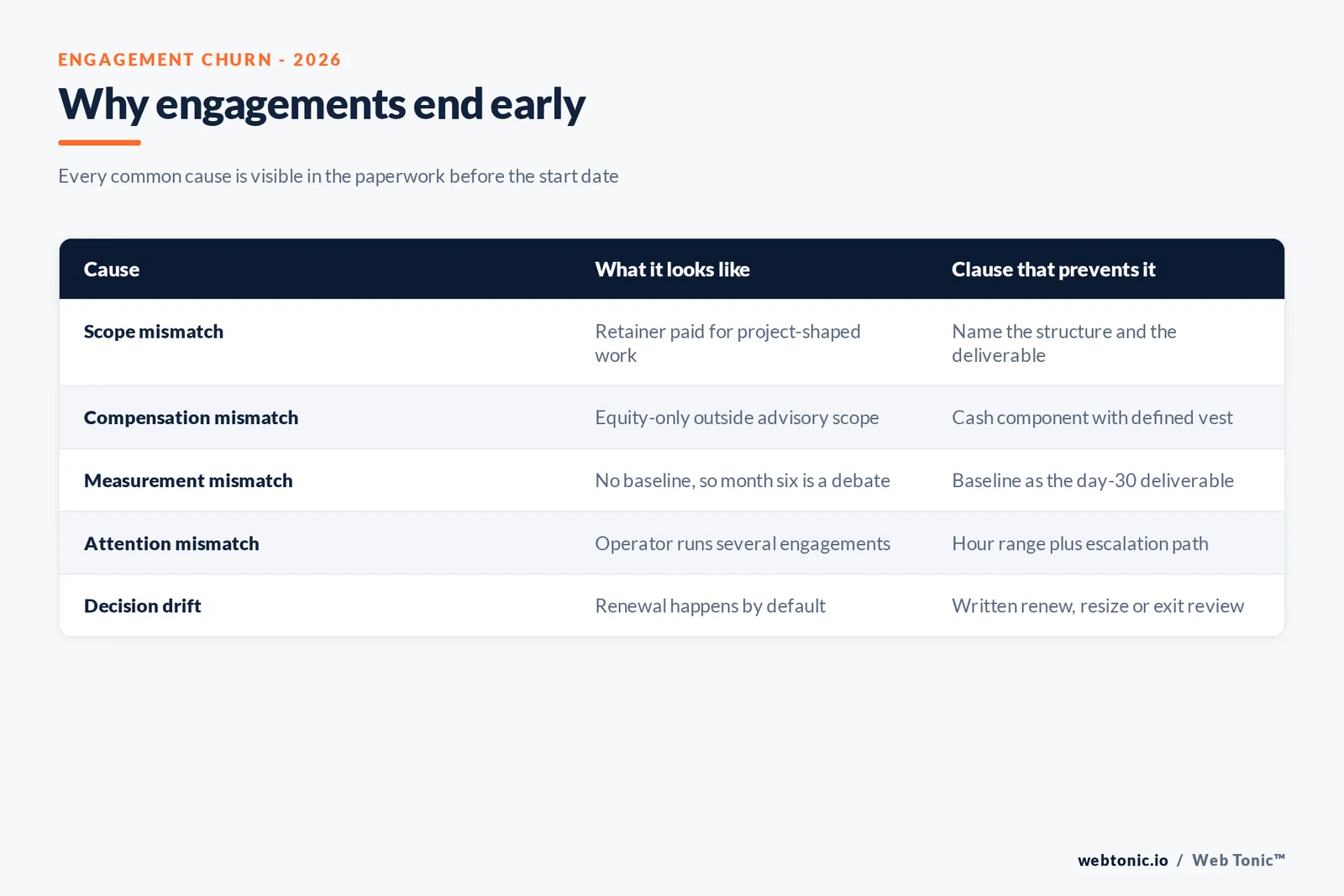
Three causes recur, and all three are visible in the paperwork before anyone starts. Scope mismatch, covered above. Compensation mismatch: equity-only arrangements work only in a narrow band - pre-revenue company, genuine advisory scope of four to eight hours a month, an operator with cash flow from other engagements - and outside that band they fail within six months. Measurement mismatch: no documented baseline means month six becomes a debate about whether anything improved, which is a debate nobody wins.
The fix for the third one is procedural rather than contractual. Make a documented baseline the first deliverable, with a date. If the numbers cannot be assembled, that finding is itself the most valuable output of the first month, and it is a measurement problem before it is a leadership one.
Supply-side stability: who is on the other side of the contract
The 2026 Fractional Work Report - 1,733 survey responses and 44,433 candidate profiles - describes an established practitioner base rather than a transitional one. 87% have 11 or more years of experience, 91% do hands-on execution rather than advice alone, 64% work with two or more clients at once, and 90% say they would not return to a full-time role.
For a buyer, the portfolio detail cuts both ways. An operator with several clients has less incentive to stretch an engagement past its useful life, which reduces one kind of churn risk. It also means your engagement competes for attention, which is why the target hour range and the escalation path belong in writing rather than in the kickoff call.
| Supply-side signal | 2026 figure | What it means for engagement stability |
|---|---|---|
| 11+ years of experience | 87% | Seniority is the norm, not the exception |
| Do hands-on execution | 91% | The output is broader than advice |
| Two or more concurrent clients | 64% | Attention is shared; define the hour range |
| Would not return to full-time | 90% | The model is a career, not a stopgap |
What the wider market data adds
Two datasets frame the churn question from outside the contract. Go Fractional rate data puts the typical fractional CMO scope at about nine hours a week, roughly 468 hours a year, at an average of USD 180 an hour. That is a small enough commitment that renewal is rarely blocked by cost alone - it is blocked by an unclear result.
Gartner's 2026 CMO Spend Survey of 401 marketing leaders adds the other half: budgets flat at 7.8% of revenue with 15.3% allocated to AI while only about 30% feel ready to scale it. A part-time leader inheriting a flat envelope and an unfinished technology programme is inheriting a two-year problem on a one-year contract, and the review cadence should say so.
| Renewal factor | 2026 evidence | How it shows up in month nine |
|---|---|---|
| Scope size | ~9 hrs/week typical | Too small to blame cost; results decide |
| Cash cost | USD 180/hour average | Compared against one junior hire |
| Budget envelope | 7.8% of revenue, flat | Plans needing new money stall |
| Competing AI spend | 15.3% of budget | Attention split across programmes |
| Readiness to scale AI | ~30% of organisations | Unfinished work outlasts the term |
Reading tenure data without being misled
Check the population behind every figure. Spencer Stuart measures the S&P 500, so it describes large-cap public companies rather than a 30-person business. The CMO Survey is a US-weighted survey of marketing leaders. Fractional Pulse describes contract structures in the fractional market. None of the three is a substitute for the others, and no one of them measures whether a given engagement will last.
| Claim you will see | Status | What the record supports |
|---|---|---|
| Average CMO tenure is about two years | Misstated | 4.1 years at S&P 500 companies, 2026 |
| CMO churn signals marketing failure | Contradicted | 62% of exits move to a similar or bigger role |
| Every large company has a CMO | Contradicted | 31% of the S&P 500 do not |
| Fractional engagements are short-term stopgaps | Partly true | 6-12 month terms that commonly extend |
| Fractional is a stepping stone back to full-time | Contradicted | 90% say they will not return |
Designing an engagement that survives its first term
Four clauses cover most of the churn risk: name the structure honestly, fix the hour range with an overage policy, make a documented baseline the day-30 deliverable, and set a written renew, resize or exit review before the initial term ends. Companies pairing outside leadership with an in-house team usually also need to say who owns channel execution - a question our growth marketing team settles in week one rather than month four, especially where paid media and creative already run on a separate cadence.
If you are weighing a proposal and want a second read on the term structure, get in touch.
Frequently Asked Questions
How long does a fractional CMO engagement last?
Fractional Pulse reports a standard structure of a six to 12 month initial term that often converts to month-to-month and frequently extends, with 30-day notice on either side. Project-shaped work runs much shorter, typically four to 24 weeks. The practical read is that the first term is a trial with a defined end date, and the renewal decision - not the signature - is where the real commitment happens.
What is the average CMO tenure in 2026?
Spencer Stuart measures average CMO tenure across the S&P 500 at 4.1 years, against 5.0 years for all C-suite roles at the same companies. Only COOs turn over faster, at 3.3 years. The widely repeated claim that average CMO tenure is around two years does not match that measurement and is usually quoted without a source.
Is high CMO turnover a sign of failure?
Usually not, on the measured data. Of S&P 500 CMO exits, 62% were promoted internally or moved to a similar or larger role elsewhere, 13% moved into a divisional CEO, president or COO seat and 9% became a chief executive. Of those leaving their company, 77% landed somewhere new within six months. That is a career ladder pattern rather than a churn pattern.
What causes a fractional engagement to end early?
Three recurring structural causes, all visible in the contract before anyone signs. Scope mismatch, where retainer pricing is applied to project-shaped work and the retainer runs long after the real deliverable shipped. Compensation mismatch, where equity-only arrangements are used outside the narrow pre-revenue advisory band in which they work - those tend to fail inside six months. And measurement mismatch, where no baseline was documented, so month six becomes an argument about whether anything improved.
Do fractional executives stay in the model or go back to full-time?
The 2026 Fractional Work Report, built on 1,733 survey responses and 44,433 candidate profiles, finds 90% of practitioners say they would not return to a full-time role, 64% work with two or more clients at once and 87% have 11 or more years of experience. Supply-side stability matters to a buyer: an operator running a portfolio has less incentive to stretch a single engagement past its useful life, and more incentive to leave a documented handover behind.
Sources
Spencer Stuart - CMO Tenure 2026 Snapshot
Fractional Pulse - Engagement Model Comparison 2026
Fractional Jobs - The Fractional Work Report 2026
The CMO Survey - Highlights and Insights Report 2026
Go Fractional - Fractional CMO Rate Data 2026
Gartner 2026 CMO Spend Survey (Business Wire release)