



Table of contents

Quick answer: Report a fractional CMO in four slides: the one outcome number versus target, the decisions made since last meeting, what you learned that changes the plan, and what you need from the board. Report decisions, never activity lists.
Last verified: 2026-09-03
Why fractional reporting is different
A full-time CMO is in the building; the board absorbs their thinking through osmosis, corridor conversations and a hundred small updates. A part-time CMO gets none of that. Whatever the board understands about marketing is whatever the pack says, which raises the bar on the pack considerably.
That shifts the emphasis. A board reporting on fractional marketing leadership is not evaluating effort, it is evaluating judgement — and judgement is only visible through decisions and their reasoning. This is the same principle behind conventional board oversight: directors are there to test the thinking, not to supervise the work. Harvard Business Review's account of CMO churn points at the same root cause — expectations that were never made explicit at the top of the company.
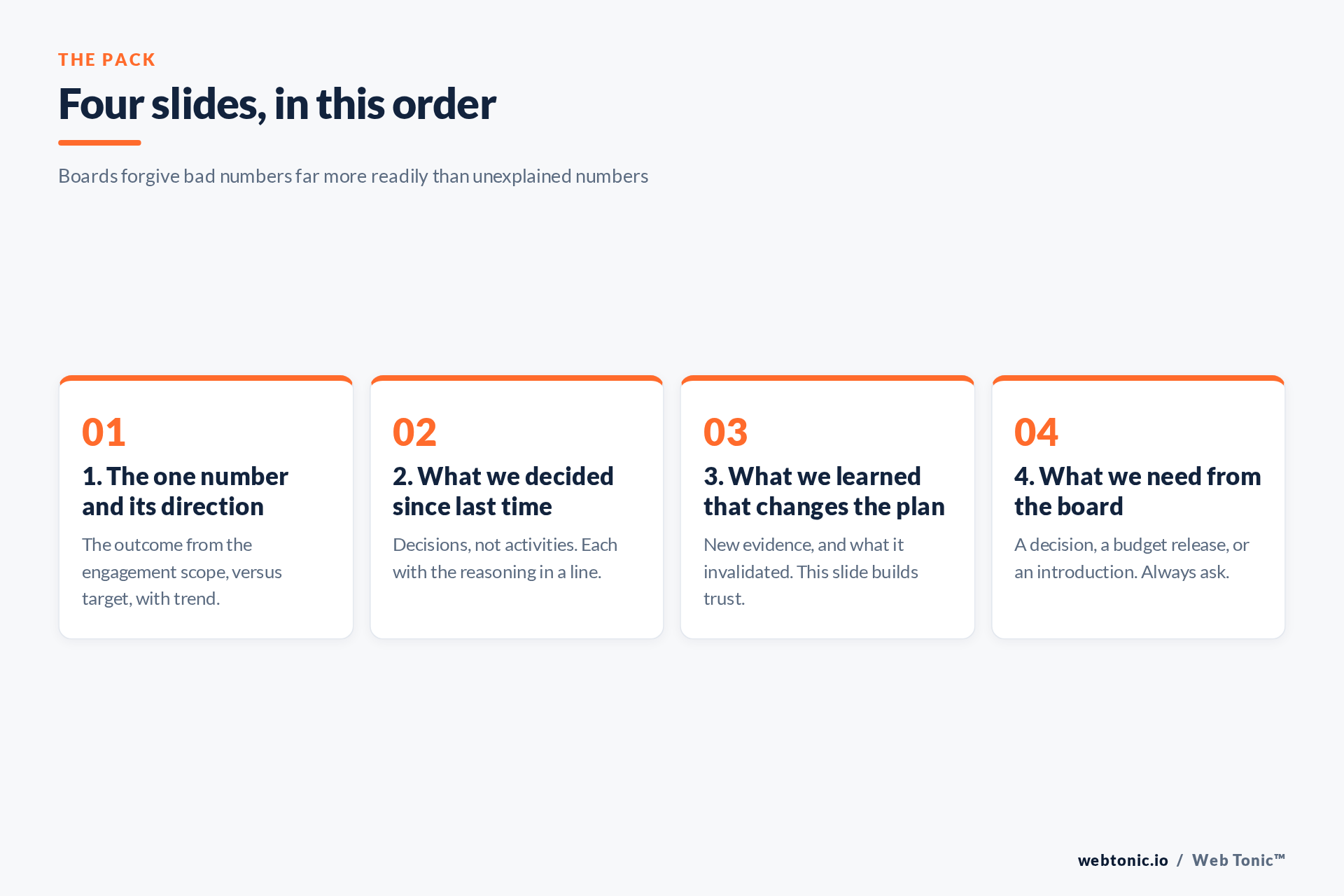
Slide 1 — The one number
Open with the outcome named in the engagement scope, shown against target, with a trend line long enough to see seasonality. One number, prominently. If the engagement was scoped around qualified pipeline, this slide is qualified pipeline — not a dashboard of fourteen tiles.
State the number even when it is bad, and state it first. A board that discovers the real figure on slide nine stops trusting slides one to eight.
Slide 2 — Decisions, not activities
List what was decided since the last meeting, each with one line of reasoning. "Moved 30% of paid budget from prospecting to retention because payback on prospecting stretched past two quarters" is a decision. "Launched five campaigns and refreshed the creative" is an activity list, and it invites the board to manage the work rather than the strategy.
This is the slide that justifies a senior engagement. An interim marketing director who can only report activity is being paid executive rates for coordination.
Slide 3 — What changed our mind
Name the evidence that arrived since the last meeting and what it invalidated. Counter-intuitively this is the strongest trust-building slide in the pack, because it demonstrates the plan responds to reality. Boards are wary of marketing precisely because the story never seems to change regardless of results.
Where measurement itself was the finding, say so plainly. Attribution disagreement between platforms is normal and worth explaining once, properly — single-touch models systematically flatter the last channel, which is why marketing mix modelling and incrementality testing exist. Our analytics and data intelligence notes cover how we frame that conversation.
Slide 4 — The ask
Every pack should end with a specific request: a decision, a budget release, a hiring approval, or an introduction. A pack with no ask trains the board to treat marketing as a status report rather than a function that needs anything.
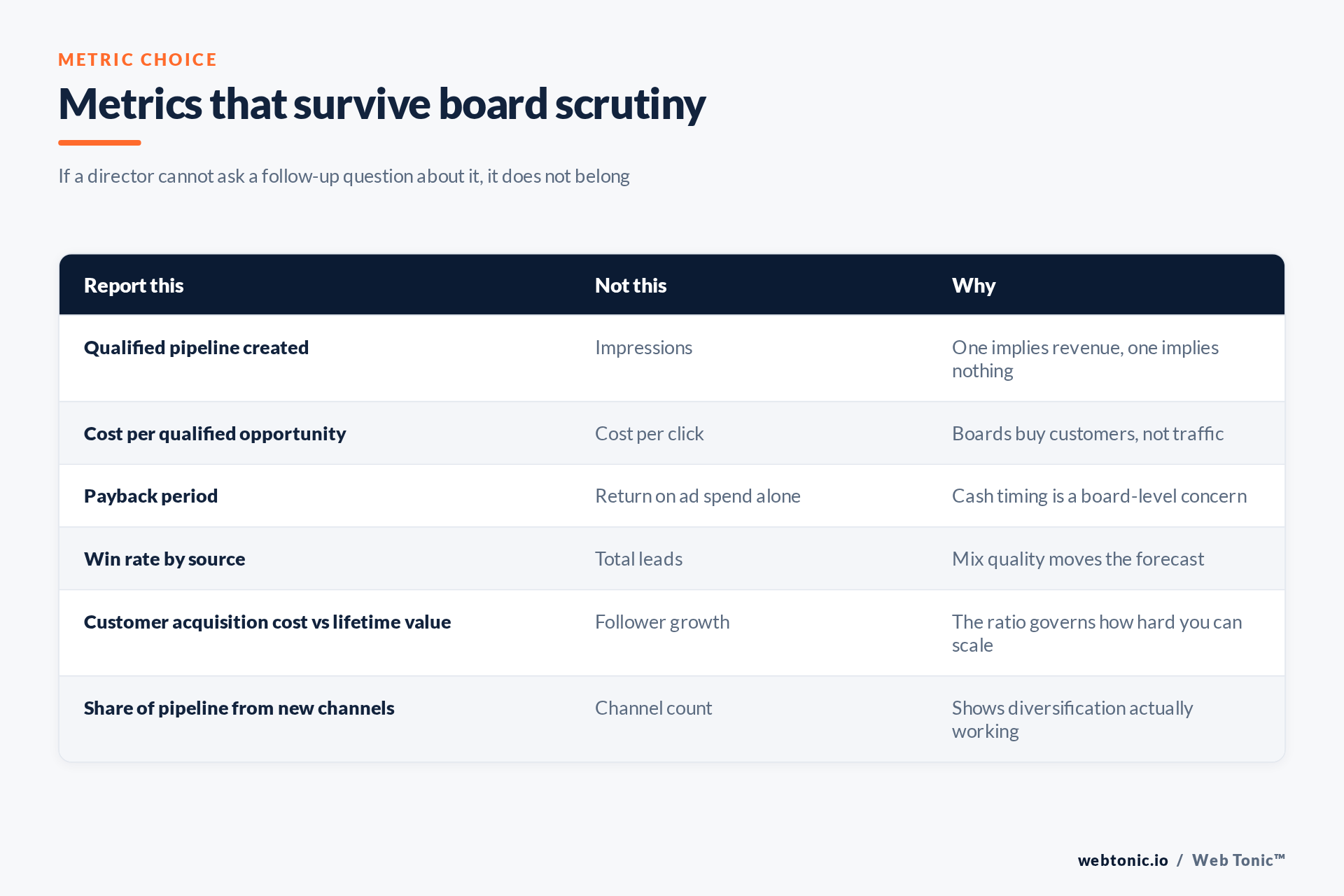
Choosing the metrics
The filter is simple: if a director cannot ask a sensible follow-up question about a metric, it does not belong in a board pack. Impressions fail that test. Customer acquisition cost measured against customer lifetime value passes it, because the ratio directly governs how aggressively the business can spend.
Keep the definitions stable. Changing how you calculate a headline metric between meetings — even for good reasons — reads as moving the goalposts. If a definition must change, show both versions for one cycle and explain why.
| Cadence | Audience | What it contains |
|---|---|---|
| Weekly | CEO / founder | Decisions taken, blockers, one-line pipeline read |
| Monthly | Leadership team | Channel performance, priorities on track vs slipped |
| Quarterly | Board | The four slides: number, decisions, learning, ask |
| Ad hoc | Board chair | Bad news, early, before it appears in a pack |
What goes wrong
The failure mode: the pack grows. Slide count creeps up each quarter as the fractional CMO pre-empts every possible question, and the board's attention thins across forty pages of context. Four slides with a strong appendix beats twenty slides of narrative. Put the detail in the appendix and let directors pull it.
The second failure mode is saving bad news for the meeting. If a quarter has gone badly, the chair should know before the pack circulates. Boards react far worse to surprise than to underperformance, and a fractional CMO who lets the board discover a miss in the room has spent credibility they will need later.
The third is reporting someone else's work as your own. Where an agency or in-house team delivered the result, say so. Attribution of credit inside the company matters more than it appears, and getting it wrong quietly costs the engagement its internal allies. It is also why we keep ownership explicit across our growth marketing engagements.
Frequently Asked Questions
Should the fractional CMO present to the board directly?
Preferably yes, at least once a quarter, even briefly. If they only prepare material the CEO presents, the board cannot test the thinking and the engagement's value stays invisible.
How long should a board marketing update be?
Four slides and roughly ten minutes of speaking, with an appendix for detail. The discussion is the point; the slides exist to start it.
What if the numbers are bad?
Lead with them, explain the cause, and bring the decision you have already taken in response. Bad numbers with a diagnosis and an action read as control; bad numbers buried read as a loss of it.
Which metrics do boards care about most?
Almost always the ones tied to cash: qualified pipeline, cost per qualified opportunity, payback period, and acquisition cost against lifetime value.
Sources: Board of directors, Customer acquisition cost, Customer lifetime value, Marketing mix modeling (Wikipedia); Harvard Law School Forum on Corporate Governance. Verified 2026-09-03.


