



Table of contents

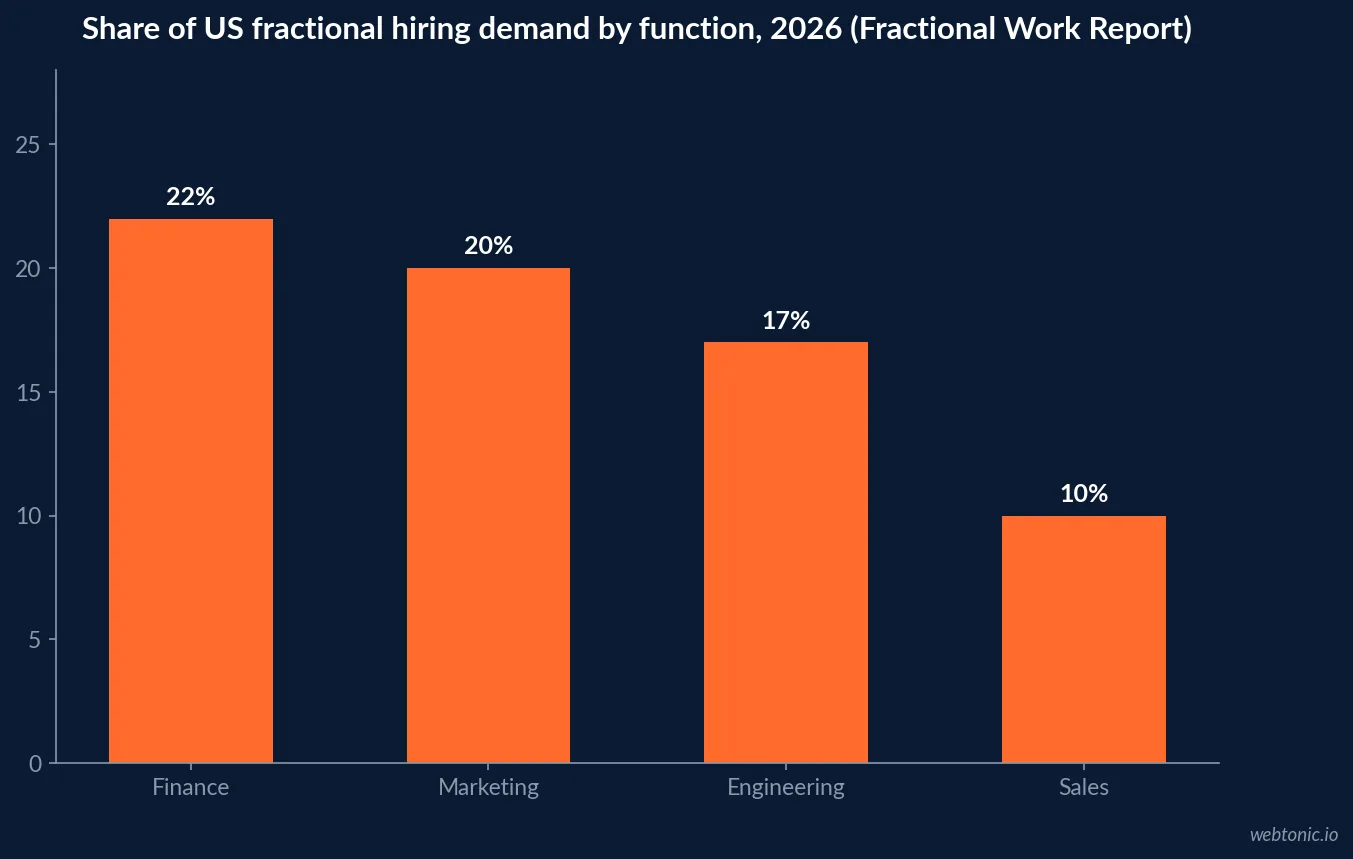
Marketing is the second most requested fractional function in the US at 20% of demand, behind finance at 22%. That makes "hire or outsource" a live question in most growth-stage companies. The data does not settle it, but it does narrow it - and it shows the real choice has four options, not two.
Key Takeaways
- Fractional hiring demand grew 149% year over year between Q1 2025 and Q1 2026.
- About 150,000 fractional professionals now work in the US.
- Marketing accounts for 20% of fractional demand, second only to finance at 22%.
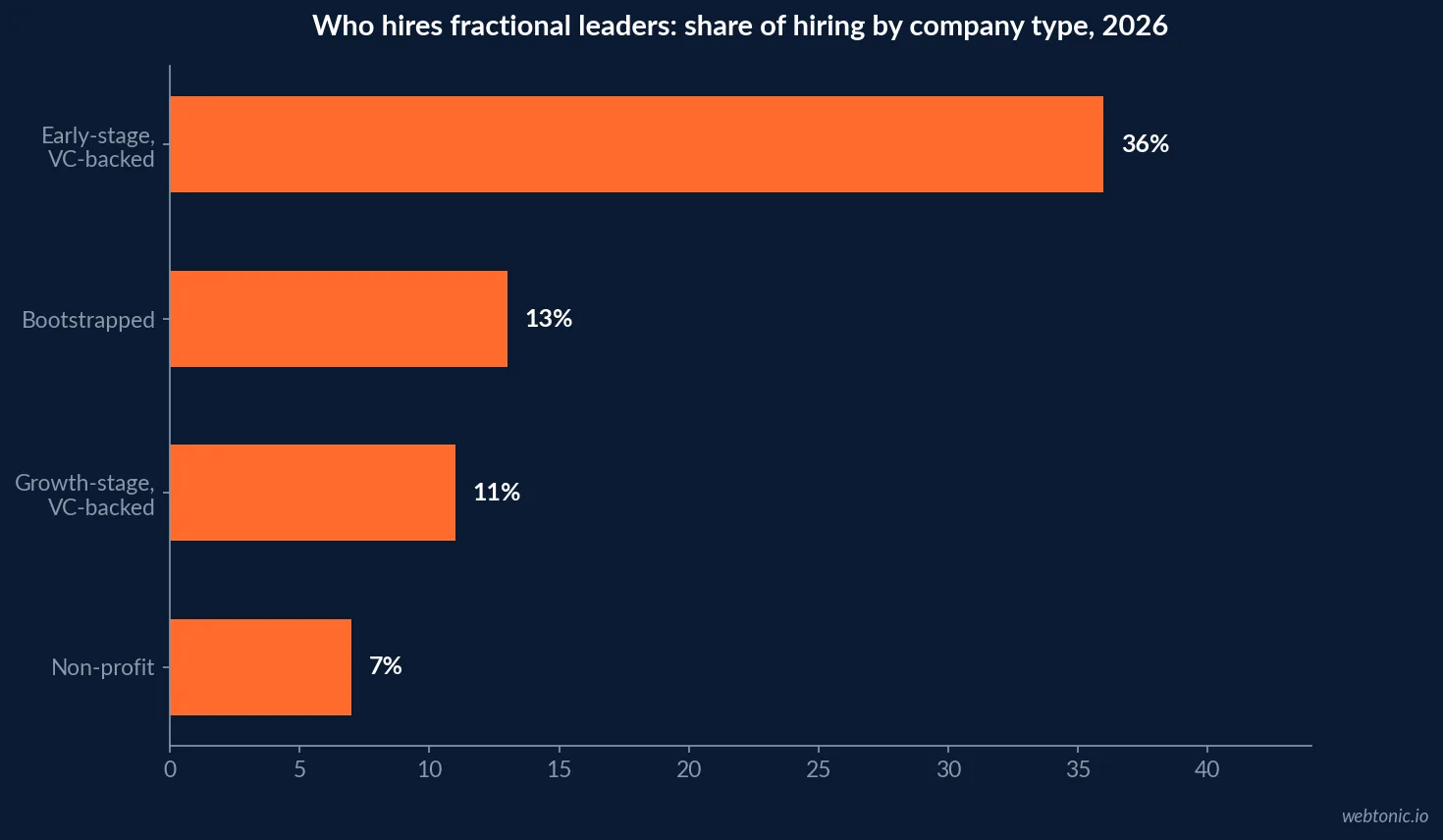
- Early-stage venture-backed companies drive 36% of fractional hiring.
- Bootstrapped companies account for 13% and growth-stage venture-backed 11%.
- 87% of fractional practitioners have more than 11 years of experience.
- 83% are director level or above, and 91% do hands-on execution.
- 31% of S&P 500 companies have no enterprise CMO at all.
- Average CMO tenure is 4.1 years, the second shortest in the C-suite.
- A bad senior hire costs at least 30% of first-year earnings, and usually far more.
- Average US CMO total cash compensation is about USD 293,600.
Who is actually buying fractional marketing leadership
The demand profile matters more than the trend line, because it tells you whether your company resembles the buyers who make this model work. The 2026 Fractional Work Report - 1,733 survey responses, 44,433 candidate profiles and 1,447 job postings analysed by an independent research firm - gives the clearest picture available.
| Segment | Share of fractional hiring | What that implies |
|---|---|---|
| Early-stage, VC-backed | 36% | Buying senior judgement before they can fund a permanent hire |
| Bootstrapped | 13% | Cost-constrained, buying decisions rather than headcount |
| Growth-stage, VC-backed | 11% | Filling a gap between a first marketer and a real CMO |
| Non-profit | 7% | Structural budget ceiling on executive pay |
| Finance roles | 22% of demand | Most mature fractional function |
| Marketing roles | 20% of demand | Second largest, and growing |
| Engineering roles | 17% of demand | Third |
The four options, not two
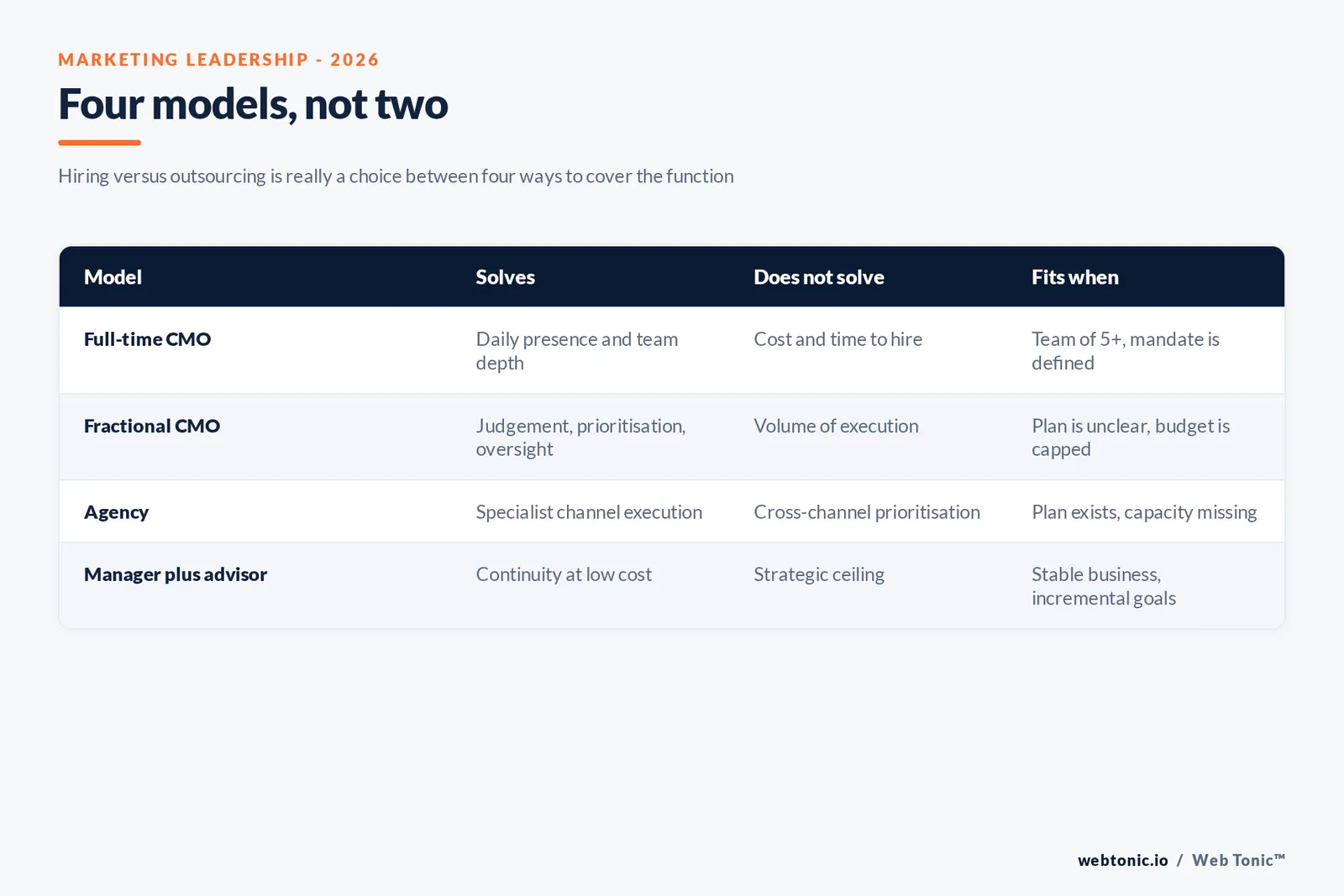
Framing this as hiring versus outsourcing hides the two options most companies should be comparing. In practice there are four ways to cover the marketing leadership function, and they solve different scarcities.
| Model | What it solves | What it does not solve | Typical fit |
|---|---|---|---|
| Full-time CMO | Daily presence, team leadership, institutional depth | Cost and time-to-hire; role must already be definable | Defined mandate, team of 5+ |
| Fractional CMO | Senior judgement, prioritisation, measurement, agency oversight | Volume of execution; needs someone to implement | Unclear plan, small team, cost pressure |
| Agency | Specialist channel execution at scale | Cross-channel prioritisation and internal decisions | Plan exists, capacity missing |
| In-house manager plus advisor | Continuity and low cost | Ceiling on strategic ambition | Stable business, incremental goals |
The deciding question is short: do you lack a plan, or lack hands? A company that cannot say which two channels it is betting on next quarter does not have a capacity problem. A company with a clear plan and a queue of unshipped campaigns does not have a judgement problem, and should probably be buying execution capacity instead.
What the supply side looks like
An outsourcing decision is partly a bet on talent quality, and here the data is unusually flattering to the fractional model. Per the Fractional Work Report, 87% of fractional practitioners have more than 11 years of experience, 83% are director level or above, 64% work with two or more clients at once and 83% chose the model for flexibility and autonomy rather than falling into it between jobs. Vendux's 2026 round-up cites Heidrick & Struggles data showing 85% of interim leaders have worked independently for more than a year.
The counterweight is equally real: 64% serving multiple clients means attention is divided by design. That is an argument for tight scope and written committed hours, not against the model.
The risk side of a permanent hire
Permanent hiring carries a cost that rarely appears in the comparison spreadsheet. Talentfoot's 2026 mis-hire benchmark puts the floor for any bad hire at at least 30% of first-year earnings, and notes that senior mis-hires compound across three windows: the months the wrong person underdelivers, the months spent finding a replacement, and the months that replacement takes to reach full output.
Set that against Spencer Stuart's finding that average CMO tenure is 4.1 years against 5.0 years for the wider C-suite, and that 31% of S&P 500 companies have no enterprise CMO. Permanent marketing leadership is neither permanent nor universal, even at the top of the market.
A decision rule you can actually apply
Score the six statements below. Four or more agreements point to fractional or advisory leadership first; two or fewer point to a permanent hire or, if the plan is settled, to buying execution.
| Statement | If true, points to |
|---|---|
| We cannot name our two priority channels for next quarter | Fractional or advisory |
| We have no agreed customer acquisition cost baseline | Fractional or advisory |
| Marketing headcount is fewer than five people | Fractional or advisory |
| The plan is agreed and the backlog is execution | Agency or in-house hire |
| The role manages five or more direct reports | Full-time hire |
| We are raising or selling within 12 months | Full-time hire |
Speed, exit cost and reversibility
Cost per month is the number most companies compare. Time to value and cost of reversal are the numbers that decide whether the choice was right. A permanent executive search runs months before a start date and carries a notice period at the other end; a retained part-time engagement usually starts within weeks and ends on 30 days. An agency sits in between, fast to start and slow to unwind when campaigns are mid-flight.
| Model | Typical time to start | Typical exit notice | What is lost on exit |
|---|---|---|---|
| Full-time CMO | Months, plus notice period | 1-3 months | Institutional knowledge, team continuity, recruiting cost |
| Fractional CMO | Weeks | 30 days | Judgement layer; the plan stays if it was documented |
| Agency | Weeks | 30-90 days | Channel momentum and platform learning if accounts are not owned |
| In-house manager plus advisor | Weeks to months | Statutory notice | Little, provided the advisor documented the plan |
Reversibility is why so many companies now start fractional and convert later. The engagement produces the artefacts a permanent job description needs - a defined mandate, a baseline, a scorecard and a shortlist of what the role must own - which is exactly the material missing when a mis-hire happens. Given that a bad senior hire starts at 30% of first-year earnings and compounds from there, buying the definition before buying the person is a cheap sequence.
What the model does not fix
Three failure patterns recur, and none of them are about the operator's quality. The first is buying leadership when the gap is capacity: a part-time leader with no one to execute the plan produces a very good plan and no movement. The second is undefined hours, which turns every request into a negotiation and every month into a dispute. The third is no baseline, which makes the engagement unfalsifiable in either direction.
All three are contract problems, and all three are avoidable in an afternoon. Write the committed hours, name who executes, and agree the numbers that will be reviewed at day 90 before the first invoice - the same discipline that applies to any external marketing partner.
Why the two models are usually bought together
The framing that ages best is layered rather than either-or. A part-time leader sets positioning, budget allocation and the scorecard; specialist teams execute against it. That structure removes the weakest link in pure outsourcing, which is that the party executing a channel is also the party judging whether that channel deserves the budget.
It also matches how the market behaves. Marketing is 20% of fractional demand while agency spend remains the largest line in most budgets, and Gartner's 2026 CMO Spend Survey found budgets flat at 7.8% of company revenue - a flat envelope rewards better allocation far more than it rewards more suppliers. Where the constraint is measurement rather than either, that is a data problem to fix before any contract is signed.
| Layer | Owns | Measured on | Review cadence |
|---|---|---|---|
| Leadership (fractional or full-time) | Positioning, allocation, scorecard, hiring | CAC payback, pipeline quality, structural outcomes | Monthly and quarterly |
| Channel execution (agency or in-house) | Campaign build, creative, media, publishing | Channel efficiency and throughput | Weekly |
| Measurement | Tracking, attribution, reporting | Data completeness and decision latency | Monthly |
| Guardrails (finance or founder) | Budget envelope and margin | Blended efficiency and gross margin | Quarterly |
Reading this market honestly
The adoption and supply data in this category is credible because marketplaces and search firms can observe it. The outcome data is not: comparative studies of fractional versus permanent marketing leadership performance do not exist, and the percentages quoted in vendor case studies are unverifiable. Market-size estimates are similarly unstable, with the same fractional executive market valued at several different figures for overlapping years in 2026.
So decide on structure, not on statistics. Which scarce thing is missing, how many senior hours it takes to supply it, and what proof you will accept in 90 days. If you want a second opinion before you commit either way, talk to our team - and bring the scorecard, not the CV.
Frequently Asked Questions
Is it better to hire a CMO or use a fractional one?
It depends on which scarce resource is missing. If the company knows what to do and needs execution capacity, a full-time hire or an agency is usually better value. If it does not know what to do, has conflicting channel bets and no measurement baseline, part-time senior judgement is the cheaper way to buy the decision. The data supports the second case being common: 31% of S&P 500 companies operate without an enterprise CMO, so running marketing without a permanent chief is a normal structural choice, not a compromise.
What is the difference between a fractional CMO and a marketing agency?
Scope of accountability. An agency is accountable for the execution of a defined channel or deliverable; a fractional marketing leader is accountable for the decisions above that layer - positioning, budget allocation, sequencing, hiring and measurement - and often manages agencies as part of the mandate. The 2026 Fractional Work Report found 91% of fractional practitioners do hands-on execution too, so the line blurs in practice. The useful test is whether you need someone to choose the plan or to run it.
How common is fractional hiring in 2026?
More common each year. Fractional Jobs reported 149% year-over-year growth in fractional hiring demand between Q1 2025 and Q1 2026, and estimates roughly 150,000 fractional professionals working in the US. Industry trackers put current US business adoption around 25%, with projections in the mid-thirties by the end of 2026, and Gartner expects more than 30% of midsize enterprises to have at least one fractional executive on retainer by 2027.
When should a company hire a full-time CMO instead?
When the marketing mandate is large enough to need daily presence, when the team reporting into the role exceeds a handful of people, when the category demands deep institutional context, or when the company is raising or selling and needs a permanent executive in the story. Cost is a factor but rarely the deciding one; average US CMO total cash compensation sits near USD 293,600, and that is affordable for many companies whose real problem is that they cannot yet define the role.
Can a fractional CMO and an agency work together?
That is the most common working arrangement, and it usually improves both. The fractional leader sets strategy, budget allocation and success criteria, then holds the agency to them, which removes the structural weakness of an agency effectively grading its own homework. It only fails when the two layers are bought separately with no agreed scorecard, so define who owns which metric before either contract is signed.
Sources
Fractional Jobs - The Fractional Work Report 2026
Fractional Jobs press release - 149% growth in fractional hiring
Spencer Stuart - CMO Tenure 2026 Snapshot
Talentfoot - Cost of a Senior Leadership Mis-Hire, 2026
Vendux - Fractional executive numbers for 2026
Gartner 2026 CMO Spend Survey (Business Wire release)
Built In - CMO Salary in the US, 2026


