Table of contents

A rate card answers the wrong question. Price the leadership seat for twelve months, including the costs a salary line hides, and the fractional comparison becomes easy to defend.
Key Takeaways
- Median fractional marketing leadership rate is USD 175 an hour.
- The reported average is USD 180 an hour.
- The interquartile range runs USD 130 to 220.
- Typical commitment is about nine hours a week.
- That works out near 468 hours a year.
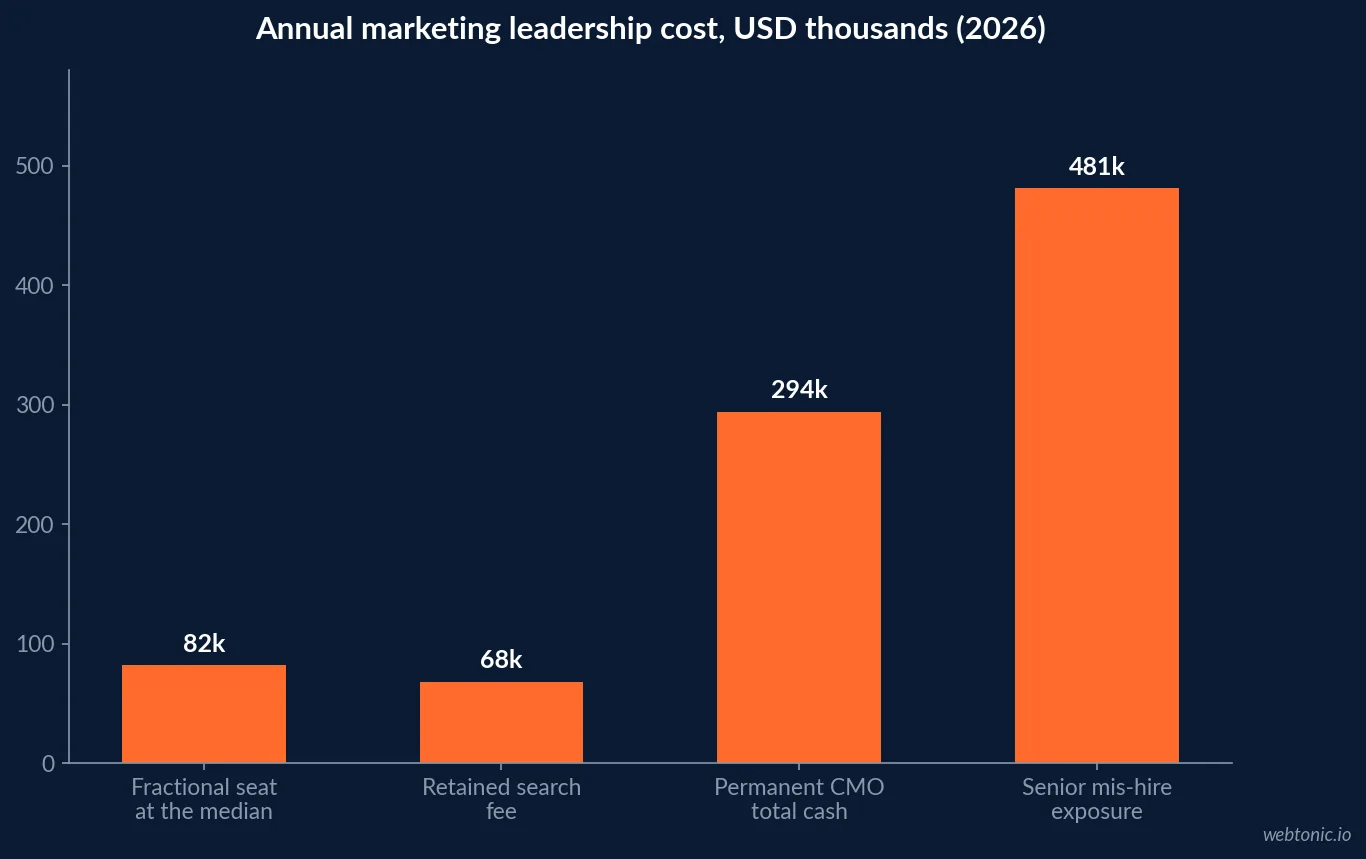
- At the median that is roughly USD 82,000 a year.
- Advisory retainers run USD 5,000 to 25,000 a month.
- Retainer terms are six to twelve months plus 30 days notice.
- A US CMO costs USD 225,908 in base pay.
- Total cash compensation reaches USD 293,575.
- Retained search adds 25% to 35% of first-year earnings.
- A bad hire starts at 30% of first-year earnings.
- A senior mis-hire can reach 213% of salary.
- Buying a project through a retainer costs four to five times more.
- Fixed-price projects are 30% of consulting billing models.
- 79% of consultants say they want to charge more.
- Marketing budgets sit at 9.0% of revenue.
- Martech has fallen to 19.4% of the marketing budget.
The twelve-month view, not the hourly one
Built In puts US chief marketing officer pay at USD 225,908 base and USD 293,575 total cash. Go Fractional reports a fractional median of USD 175 an hour, an average of USD 180, an interquartile range of USD 130 to 220, and engagements of roughly nine hours a week, about 468 hours a year.
Multiply it out and the fractional seat costs around USD 82,000 a year at the median. The gap against total cash is not the interesting part; the costs that only one of the two options carries are.
| Cost line | Fractional seat | Permanent hire | Source basis |
|---|---|---|---|
| Direct cost, year one | ~USD 82,000 at the median rate | USD 293,575 total cash | Go Fractional, Built In |
| Recruitment fee | None | 25-35% of first-year earnings | Talentfoot |
| Mis-hire exposure | Notice period only | 30% floor, up to 213% of salary | Talentfoot, US DoL |
| Commitment | 6-12 months plus 30 days | Permanent | Fractional Pulse |
| Ramp risk | Carried by the operator | Carried by the company | Engagement structure |
| Scale-down cost | Reduce hours | Severance | Engagement structure |
The risk premium nobody quotes
Talentfoot's 2026 data prices a bad hire at a floor of 30% of first-year earnings, citing US Department of Labor guidance, with senior mis-hires reaching 213% of salary and retained search adding 25% to 35%. On a USD 225,908 base, that is roughly USD 68,000 of search fees and an exposure near USD 481,000 if the hire fails.
You do not budget for a mis-hire, which is precisely why it belongs in the comparison. A cancellable engagement converts that tail risk into a notice period.
What a month actually buys
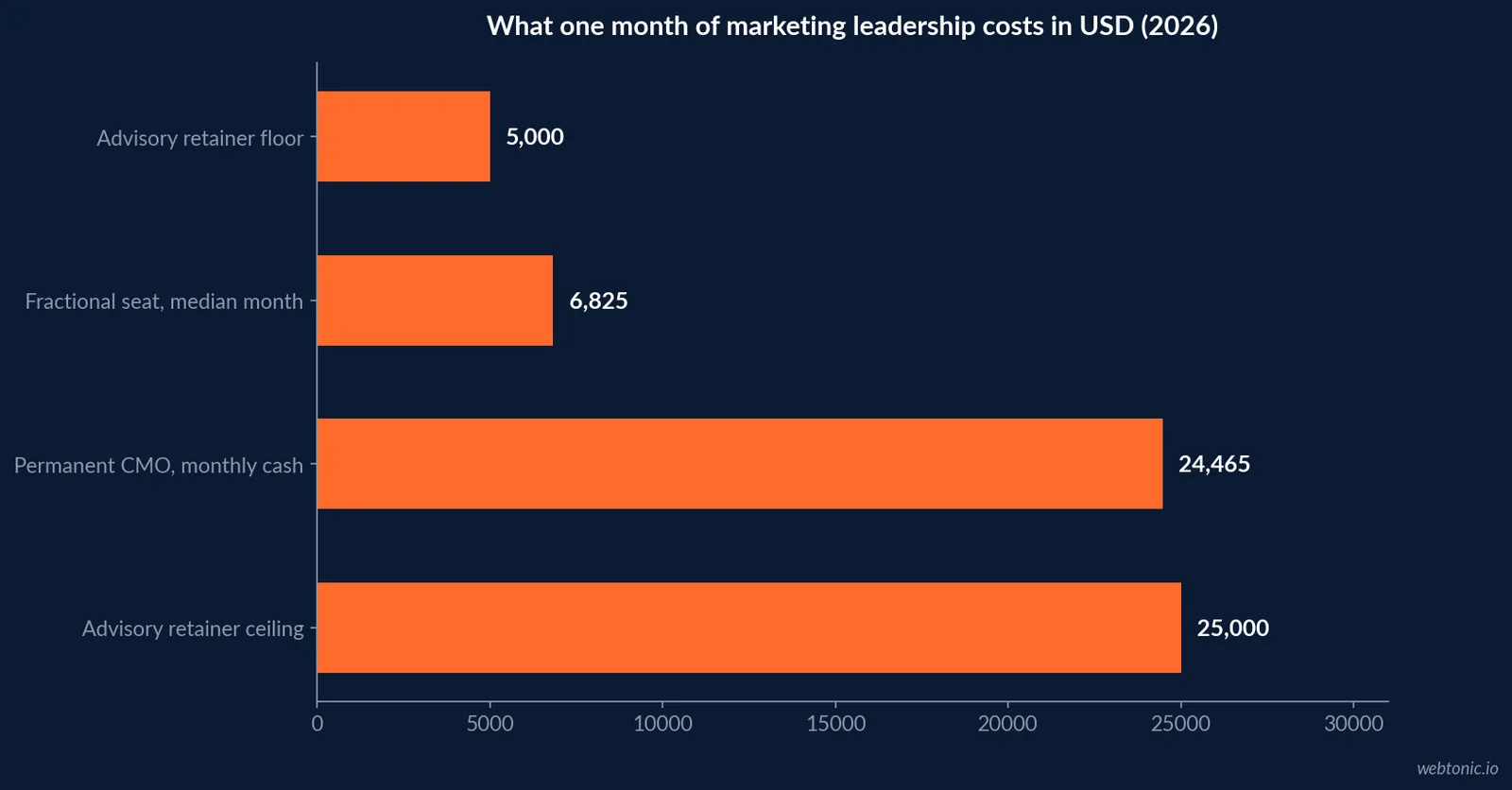
Fractional Pulse reports advisory retainers of USD 5,000 to 25,000 a month, with loaded hourly rates of USD 200 to 500 inside a retainer, USD 300 to 700 for project work and USD 200 to 600 for hourly advisory. Against that, nine hours a week at the USD 175 median is about USD 6,800 a month, and a permanent CMO on total cash is roughly USD 24,500 a month.
Most fractional quotes therefore sit in the lower half of the published retainer band. A quote at the top of it is buying something other than nine hours - usually team management or interim execution.
| What you are buying | Monthly cost | Hours behind it | Typical trigger |
|---|---|---|---|
| Advisory retainer, floor | USD 5,000 | Review cadence only | A plan exists, needs a second opinion |
| Fractional seat, median | ~USD 6,825 | ~39 hours | No senior marketing owner |
| Fractional seat, upper quartile | ~USD 8,580 | ~39 hours | Category specialist or turnaround |
| Loaded project work | Quoted per scope | USD 300-700 an hour | A build with a defined end |
| Advisory retainer, ceiling | USD 25,000 | Team leadership included | Interim execution capacity |
| Permanent CMO | ~USD 24,465 | Full time | A funded, mature programme |
Billing shape explains most of the spread
Consulting Success surveyed roughly 1,000 consultants: fixed-price projects 30%, hourly 29%, monthly retainers 16%, value-based fees 15%, day rates 10%. Some 79% want to charge more, 38% already earn USD 10,000 or more a month, and specialists win USD 10,000-plus projects at 51% against 39% for generalists.
Two candidates quoting the same scope on different shapes can differ by a multiple. Ask for hours, deliverables and the end condition before you compare a single figure - and note that the specialist premium is real, which argues for hiring against a named problem.
The expensive mistake: buying a project through a retainer
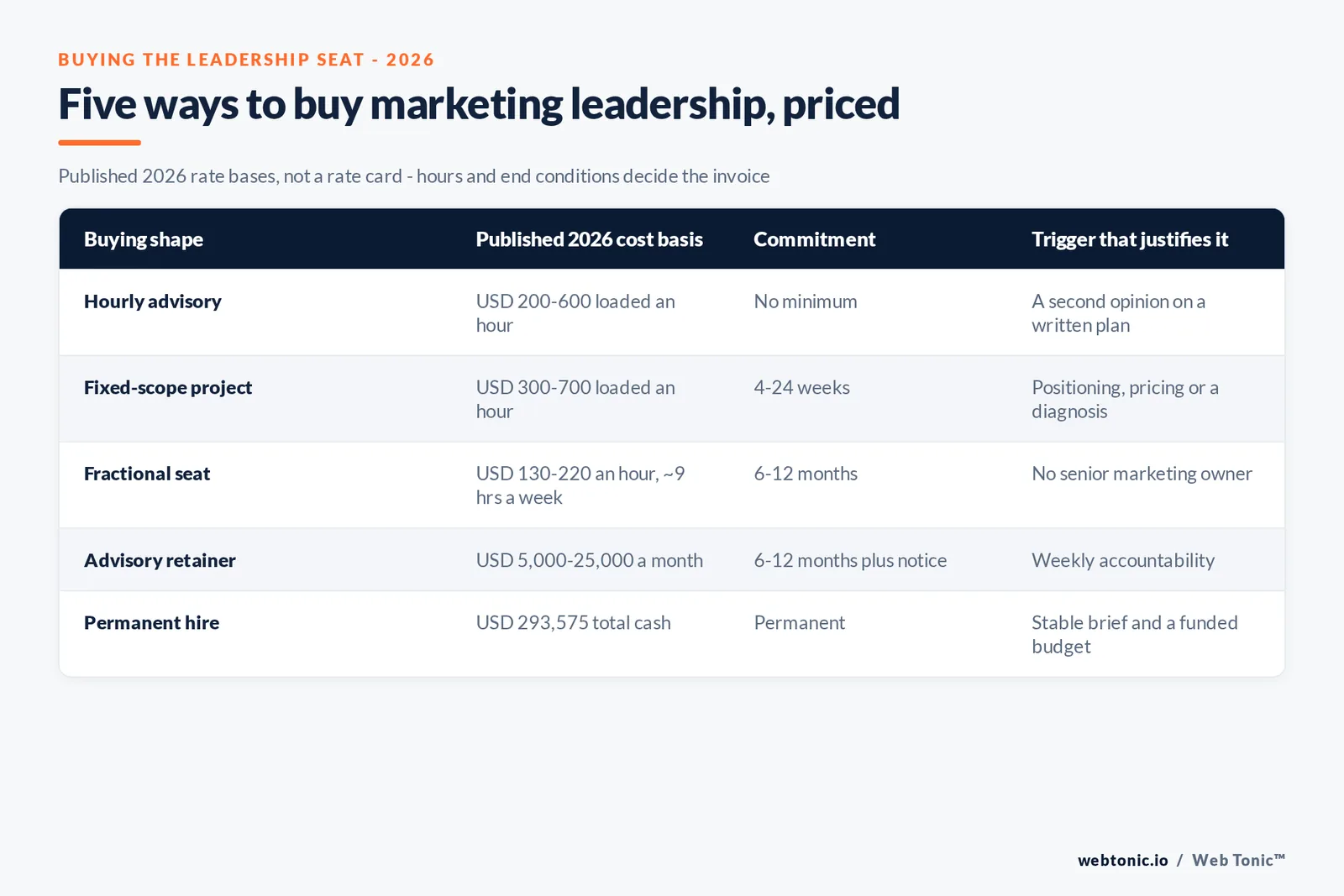
Fractional Pulse's worked comparison finds retainer-shaped buying of project work costing four to five times more - USD 180,000 against USD 40,000. Projects there run 4 to 24 weeks; retainers commit for 6 to 12 months plus a 30-day notice period.
Positioning work, a pricing review and a channel diagnosis all have an end. Buy them as projects, and keep the retainer for the thing that genuinely recurs: weekly accountability for a plan already written.
What moves a quote up or down
Three things, in order: hours, ownership and stage. Sagefrog's 2026 B2B Marketing Mix Report shows why ownership matters - teams structure external help as hybrid at 35%, project-based at 28%, retainer at 24% and freelancers at 12%. A fractional CMO inside a hybrid structure is priced for coordination as well as strategy.
Stage matters because the failure mode differs: pre-product-market-fit work is diagnostic and short, while a scaling team needs someone in the room every week. Both can be bought at the same hourly rate and produce wildly different invoices.
The budget it competes with
The CMO Survey 2026 reports budgets at 9.0% of revenue, spend growth of 1.7%, headcount growth down 50% and training down to 3.8% of spend from 5.8%. Gartner's 2026 CMO Spend Survey puts martech at 19.4% of budget against 26.6% in 2021, with 56% of that spend on consumption pricing.
Nothing in those numbers funds a new line. A fractional seat is almost always paid for by stopping something, which is a useful test of whether the mandate is real.
| Budget constraint | 2026 figure | Effect on the quote |
|---|---|---|
| Marketing budget, share of revenue | 9.0% | Scope has to be named and finite |
| Marketing spend growth | 1.7% | New spend displaces old spend |
| Headcount growth | Down 50% year on year | Renting the seat is the realistic route |
| Training share of spend | 3.8%, from 5.8% | Handover has to be inside the fee |
| Martech share of budget | 19.4%, from 26.6% in 2021 | Tooling cannot absorb the cost |
Why the supply side is firming up
Fractional Jobs reports 149% year-on-year demand growth, about 150,000 US practitioners, 87% with eleven or more years of experience, 64% serving several clients at once and 90% who will not return to full-time work. Vendux cites Gartner expecting more than 30% of midsize companies to use fractional executives by 2027.
Experienced operators with multiple clients do not discount for vagueness. A tight scope is the only reliable way to buy at the median rather than the upper quartile.
What the fee has to include to be worth it
Three things are routinely left out of a fractional quote and then argued about in month four: documentation, handover and the training line. The CMO Survey reports training falling to 3.8% of marketing spend from 5.8% and marketing headcount growth down 50%, which means whatever the engagement teaches is the only capability the team keeps.
Ask for the artefacts by name - a written plan, a scorecard, a channel brief and a documented handover - and price them inside the fee. A fractional seat that leaves nothing behind costs the same as one that does, which makes the comparison easy.
| Deliverable | Why it belongs in the fee | What its absence costs |
|---|---|---|
| Written plan | It is the artefact the board reviews | Renewal turns into a trust exercise |
| Scorecard with benchmarks | Median CAC payback of 16 months needs a baseline | No way to show progress |
| Channel briefs | Agencies and freelancers need an owner's brief | Execution drifts between vendors |
| Documented handover | Training is down to 3.8% of spend | Capability leaves with the operator |
| Exit condition | Terms run 6-12 months plus notice | The retainer renews by default |
Who is buying at these prices
Smaller teams, mostly, and under pressure. The CMO Survey finds firms under USD 10 million in revenue building 64.1% of marketing in-house, while marketing budgets overall sit at 9.0% of revenue with 1.7% growth. A fractional seat is the only senior option that fits between a freelancer and a USD 293,575 hire.
That is also why the median rather than the upper quartile is the right target. You are buying judgement on a specific problem, not a full-time presence, and our team prices leadership work the same way.
How to make the numbers comparable
Ask every candidate for five things: hours per month, the deliverable list, the billing shape, the end condition and the notice period. Then price your permanent alternative honestly at USD 293,575 plus 25% to 35% search, and compare against roughly USD 82,000 of fractional cost.
If you want a second read on a quote already in hand, send it over. We apply the same normalisation to media budgets - see our Google Ads cost guide - and our growth marketing team scopes leadership mandates the same way.
Frequently Asked Questions
What does a fractional CMO cost per month in 2026?
Two published bases bracket it. Go Fractional reports a median hourly rate of USD 175 with an interquartile range of USD 130 to 220 and engagements of about nine hours a week, which is roughly USD 6,800 a month at the median. Fractional Pulse reports advisory retainers of USD 5,000 to 25,000 a month on six to twelve month terms. Anything materially outside that band should come with an explanation of scope.
Is a fractional CMO cheaper than hiring one?
On cash, yes, and by more than the rate suggests. Built In puts US chief marketing officer pay at USD 225,908 base and USD 293,575 total cash. At the USD 175 median and about 468 hours a year, a fractional seat lands near USD 82,000 - before retained search at 25% to 35% of first-year earnings and mis-hire exposure that Talentfoot prices at a floor of 30% and up to 213% of salary for a senior mis-hire.
Why do fractional CMO quotes differ so much for the same scope?
Because the billing shape moves the invoice more than the rate. Consulting Success surveyed roughly 1,000 consultants and found fixed-price projects at 30%, hourly at 29%, monthly retainers at 16%, value-based fees at 15% and day rates at 10%, with 79% saying they want to charge more. Normalise quotes onto a deliverable list before comparing headline numbers.
Should a first engagement be a retainer or a project?
Start with a project if the work has an end. Fractional Pulse's comparison finds project-shaped work bought through a monthly retainer costing four to five times more - USD 180,000 against USD 40,000 in its worked example - because projects run 4 to 24 weeks while retainers commit for 6 to 12 months plus notice.
What budget does this have to fit inside?
The CMO Survey 2026 reports marketing budgets at 9.0% of revenue with spend growth of 1.7% and headcount growth down 50% year on year, while Gartner's 2026 CMO Spend Survey puts martech at 19.4% of budget, a five-year low. In practice a fractional seat is funded by displacing an existing line, not by new money, which is why the scope has to name what it replaces.
Sources
Go Fractional - Fractional CMO rates
Fractional Pulse - Fractional executive engagement comparison
Built In - CMO salary data
Talentfoot - The cost of a leadership mis-hire, 2026 data
Consulting Success - Consulting fees study
Sagefrog - 2026 B2B Marketing Mix Report
The CMO Survey - Highlights and Insights Report 2026
Gartner 2026 CMO Spend Survey via Chief Marketer
Fractional Jobs - The Fractional Work Report
Vendux - Ten numbers on fractional executives in 2026