



Table of contents

Fractional CMO rates average USD 180 an hour, while retainers cluster between USD 5,000 and USD 20,000 a month. Those two numbers come from the same market and describe different products. This page sets out the 2026 pricing data by percentile, the variables that move it, and what the annualised comparison with a full-time hire actually looks like.
Key Takeaways
- The average fractional CMO rate is USD 180 an hour, median USD 175.
- The middle 50% of rates fall between USD 130 and USD 220 an hour.
- Employers post an average of USD 136 an hour while talent asks USD 182 - a USD 46 negotiation gap.
- Retainers run USD 5,000 to USD 20,000 a month, median USD 10,000 to 12,000.
- A typical engagement is scoped at about 9 hours a week, or 468 hours a year.
- Managing direct reports adds roughly 20% to 30% over advisory-only engagements.
- Marketplace sourcing can add USD 3,000 to 4,000 a month on a USD 10,000 direct rate.
- Fractional executives cost 50% to 80% less than a full-time hire fully loaded.
- Average US CMO base salary is about USD 225,900, with total cash near USD 293,600.
- Most engagements run 9 to 18 months, which sets the real contract value.
- Only 3% of observed rates sit below USD 94 an hour, so deep discounts are rare and worth questioning.
The 2026 rate card, by percentile
Rate benchmarks are the best-measured part of this market because marketplaces observe both sides of the transaction. The distribution below comes from Go Fractional's 2026 fractional CMO benchmark, which tracks posted jobs and candidate profiles.
| Percentile or measure | Hourly rate | What sits here |
|---|---|---|
| 25th percentile | USD 130 | Earlier-career operators, advisory-only scopes |
| Median | USD 175 | The realistic planning number |
| Average | USD 180 | Pulled up by a long right tail |
| 75th percentile | USD 220 | Category specialists, complex or regulated buyers |
| Top band observed | USD 298-332 | 6% of samples; enterprise or turnaround work |
| Employer posted average | USD 136 | What companies advertise |
| Talent asking average | USD 182 | What candidates list on profiles |
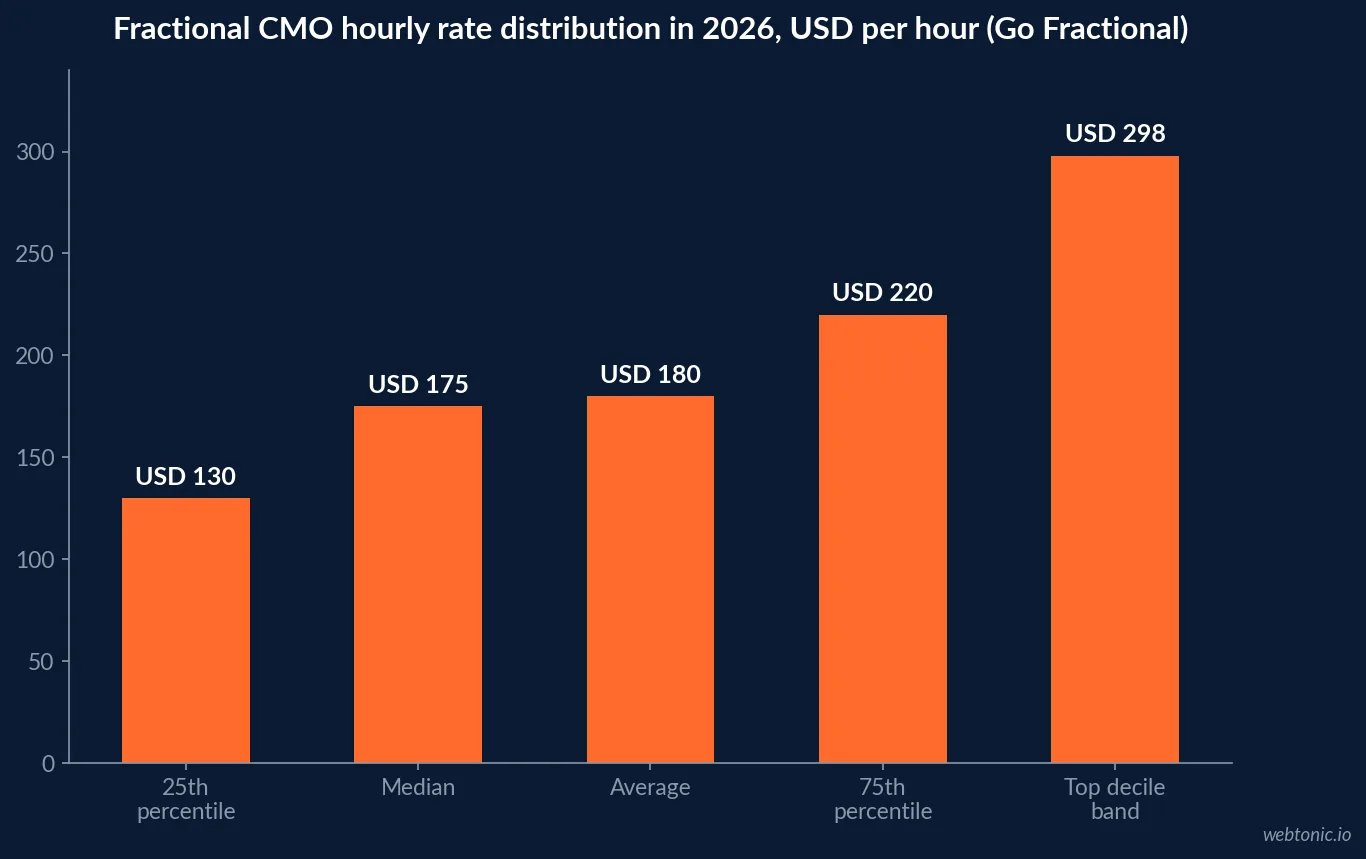
The gap between the USD 136 employers post and the USD 182 candidates ask is the single most useful line in the dataset. It says the market has not settled, and that the negotiating room sits in scope definition rather than in the rate itself. Only 3% of observed rates fall below USD 94 an hour; a quote far under the 25th percentile usually signals a junior operator with a senior title.
Hourly rates versus monthly retainers
Most buyers do not purchase hours. The 2026 Fractional Work Report found 46% of fractional executives bill primarily on a monthly retainer, and reported a mean marketing rate of USD 209 an hour against USD 223 across all executive functions (sample of 546). Fractional Pulse's 2026 pricing data puts retainers at USD 5,000 to USD 20,000 a month, with a median of USD 10,000 to USD 12,000 for 15 to 25 hours, and Series A companies typically at USD 8,000 to USD 15,000.
Convert before you compare. A retainer divided by committed hours gives an effective hourly rate, and that is the number to hold against the percentile table. A USD 12,000 retainer for 20 hours a month is USD 600 an hour; the same retainer for 20 hours a week is USD 150. Both are quoted the same way in a proposal.
| Pricing model | Typical range | Best suited to | Main risk |
|---|---|---|---|
| Hourly | USD 130-220/hr | Short diagnostics, advisory bursts | Cost creeps with every meeting |
| Monthly retainer | USD 5,000-20,000 | Ongoing leadership with defined hours | Scope drift if hours are not written down |
| Retainer plus outcome bonus | Base plus variable | Clear single-metric mandates | Metric gaming when the metric is narrow |
| Project or sprint | Fixed fee | Repositioning, launch, or measurement rebuild | Handover gap when the project ends |
| Via marketplace | 20-40% above direct | Speed of sourcing and vetting | Same operator, higher landed cost |
What actually moves the price
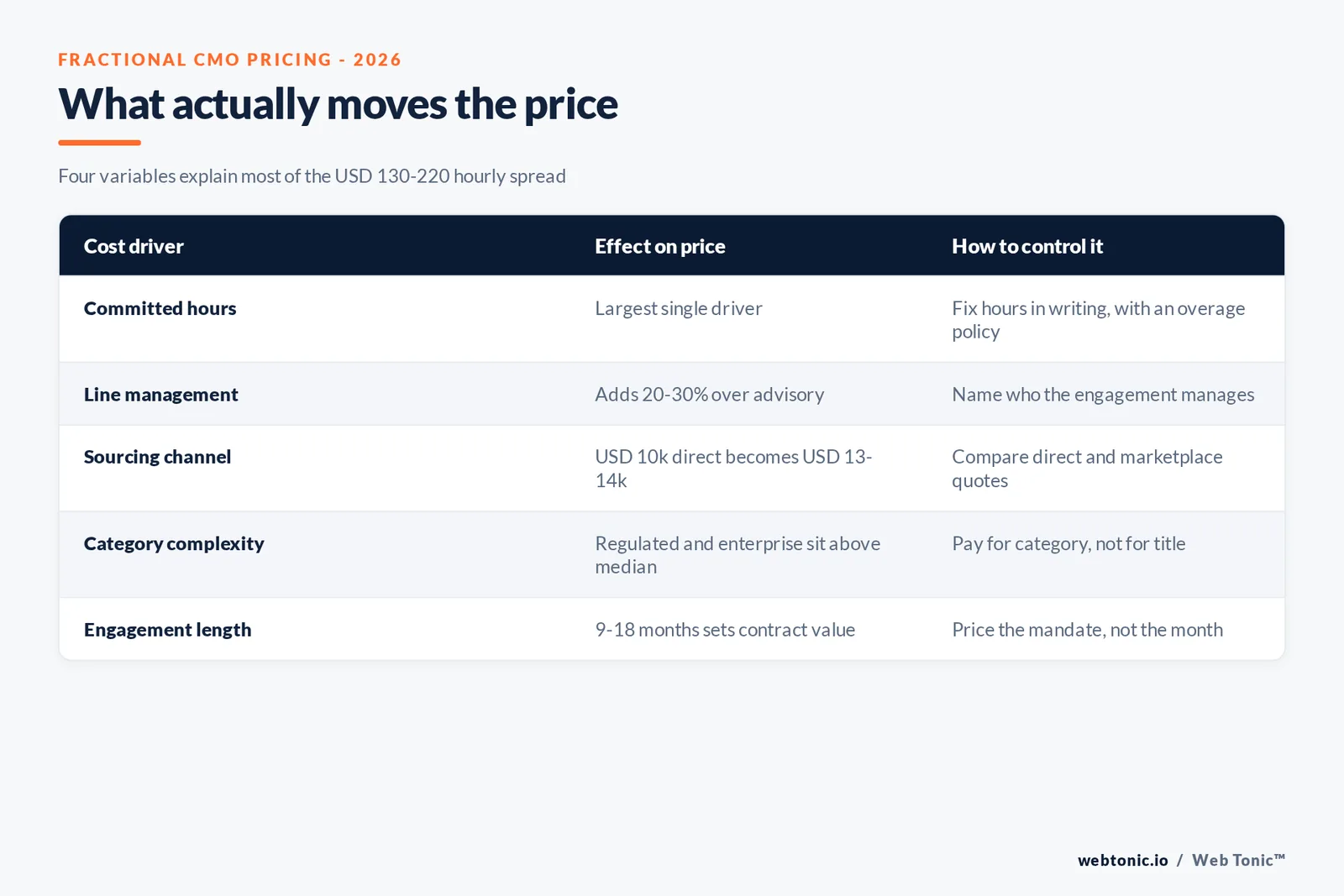
Four variables explain most of the spread, and only one of them is seniority. Hours committed is the largest. Line management is the second: Fractional Pulse reports that engagements where the executive manages direct reports run 20% to 30% above advisory-only work. Sourcing channel is the third, with a marketplace typically turning a USD 10,000 direct retainer into USD 13,000 to USD 14,000. Category complexity is the fourth, and it is why regulated and enterprise-sales businesses sit above the median.
None of those are negotiable by arguing about the hourly rate. They are negotiable by changing the shape of the engagement - which is the same discipline that governs any senior marketing resourcing decision.
Annualised against a full-time hire
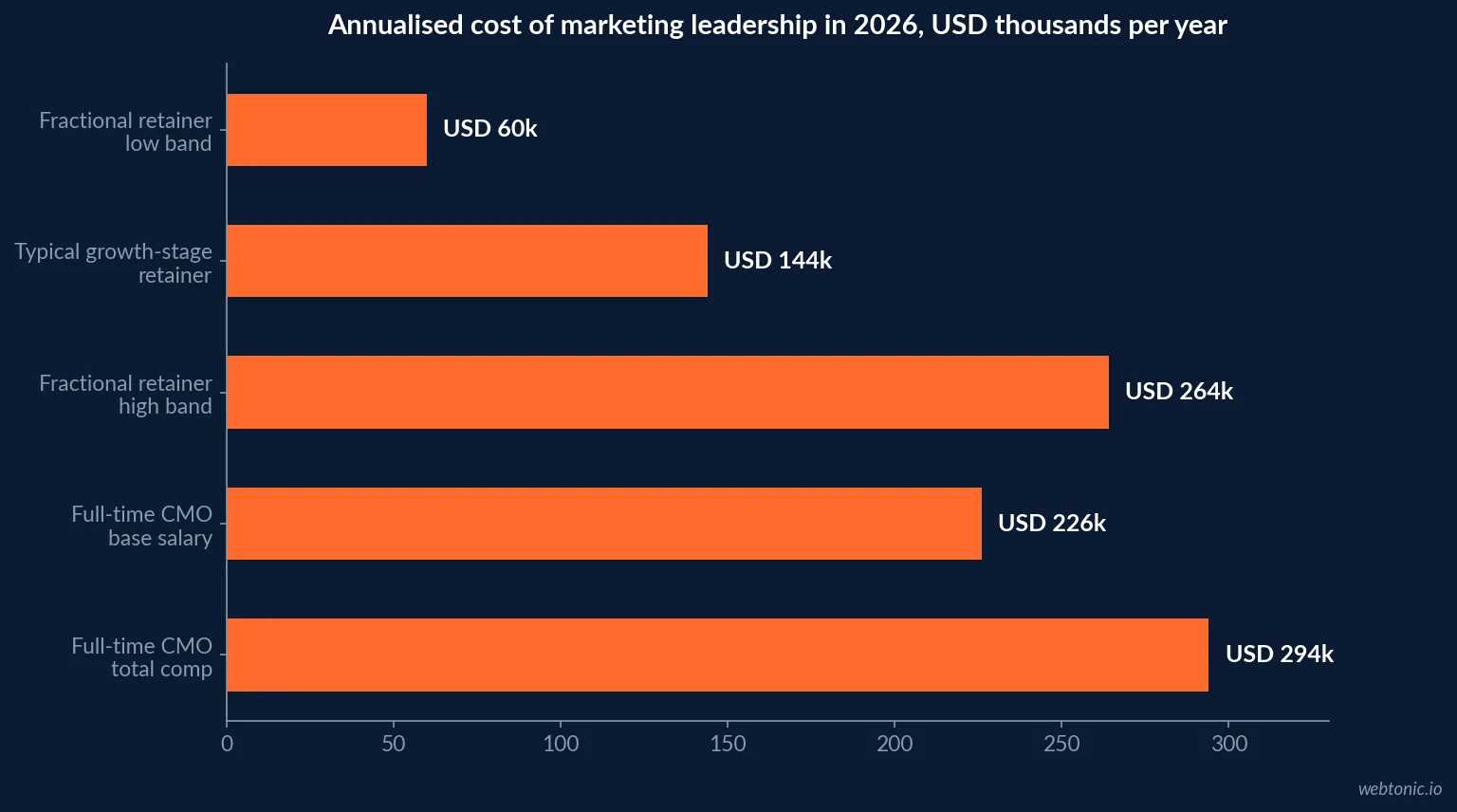
The honest comparison is annual, fully loaded, and against a defined scope. US compensation data from Built In puts the average CMO base salary at about USD 225,900 and total compensation near USD 293,600. That excludes recruiting fees, benefits loading, equity and the ramp period, all of which are real costs of a permanent hire.
On the other side, a ten-hour-a-week fractional executive runs about half the fully loaded cost of a full-time hire for the same seniority, per the Fractional Work Report, and Fractional Pulse puts the broader fractional saving at 50% to 80% once recruiting and onboarding are included. The saving is real, but it is a saving on a smaller quantity of time, not a discount on the same job.
| Option | Annualised cash cost | Senior hours bought | What else is included |
|---|---|---|---|
| Fractional, low band | ~USD 60,000 | About 470-600 hrs | No benefits, equity or recruiting fee |
| Fractional, typical growth stage | ~USD 144,000 | About 900-1,200 hrs | Notice-period flexibility |
| Fractional, high band | ~USD 264,000 | Near half-time senior cover | Often includes line management |
| Full-time CMO, base only | ~USD 226,000 | About 1,900 hrs | Excludes bonus, benefits and equity |
| Full-time CMO, total cash | ~USD 294,000 | About 1,900 hrs | Before recruiting fee and ramp |
The cost of getting the permanent hire wrong
Any pricing comparison that ignores hiring risk is incomplete. Executive search and workforce data consistently place the floor for a bad hire at at least 30% of first-year earnings, and senior mis-hires cost far more once the underperformance window, the search for a replacement and the replacement's own ramp are counted. Because CMO tenure averages 4.1 years at large companies, the probability of at least one transition inside a five-year plan is high.
The practical implication is not "hire fractional to avoid risk". It is that the two options should be priced across a three-year horizon including one transition, rather than as a monthly line item. That is also where measurement discipline pays for itself: a documented baseline makes an underperforming engagement visible in month three instead of month twelve.
What a retainer buys at each scope level
Retainers are quoted as a single number, so the only way to compare two proposals is to restate them as hours and responsibilities. The table below converts the published retainer bands into what each level can realistically carry, using the nine-hour typical scope and the 15-to-25-hour retainer ranges reported by the marketplaces.
| Monthly retainer band | Implied monthly hours | Realistic remit | Who it usually suits |
|---|---|---|---|
| USD 4,000-6,000 | 20-30 hrs | Strategy, quarterly plan, monthly review | Bootstrapped or pre-revenue teams buying decisions only |
| USD 8,000-12,000 | 40-60 hrs | Strategy plus channel oversight and agency management | The most common growth-stage engagement |
| USD 12,000-16,000 | 60-80 hrs | Adds hands-on execution in one or two channels | Companies with no senior marketer in place |
| USD 16,000-20,000+ | 80-100 hrs | Near half-time cover with line management | Interim cover during a vacancy or transition |
Two sanity checks fall straight out of that table. If a proposal quotes a retainer without committed hours, the effective rate is undefined and so is the scope. And if the implied hourly rate lands far outside the USD 130 to USD 220 middle band, either the seniority or the hours are not what the title suggests. Both checks take a minute and prevent the most common form of overpaying in this market, which is paying a senior rate for junior availability.
Stage, category and geography
Published benchmarks are US-weighted and averaged across categories, so adjust before using them as a budget. Stage is the clearest driver: Fractional Pulse reports Series A companies typically paying USD 8,000 to USD 15,000 a month, which sits above the low band because early-stage mandates usually include execution rather than advice alone. Category complexity moves the number again - regulated industries, long enterprise sales cycles and multi-market operations all sit above the median because the work includes compliance, channel and localisation decisions that a simpler business does not carry.
Geography matters less than it used to. Half of engagements are fully remote and 43% hybrid, per Go Fractional's 2026 work-model data, so the local market rate is a weaker constraint than the operator's category experience. Where in-person presence is genuinely required, expect that requirement to narrow the candidate pool before it moves the rate.
How to budget for it without guessing
Work backwards from the decision the company needs made, not from a rate card. The sequence below converts a vague "we need marketing leadership" into a number a finance team can approve.
| Step | Question to answer | Output |
|---|---|---|
| 1 | What decision or capability is missing? | One-sentence mandate |
| 2 | How many senior hours does that mandate need per week? | Committed hours |
| 3 | Does the role manage anyone? | Advisory or operating scope, plus the 20-30% premium |
| 4 | Direct or via marketplace? | Sourcing premium, if any |
| 5 | How long until the mandate is done? | Contract value across 9-18 months |
| 6 | What proves it worked? | Scorecard and 90-day review gate |
Reading fractional CMO pricing claims critically
Three habits protect a budget. Convert every quote to an effective hourly rate before comparing anything. Ask which of the four cost drivers a quote assumes, in writing, because a proposal that does not name committed hours is not a price. And treat market-size and savings percentages published by firms selling the service as directional - the same market has been valued at three different figures for overlapping years in 2026 alone, which is a good reason to anchor on transaction-level rate data instead.
If you want an outside read on a proposal you have received, our team will look at the scope split rather than the rate. Send it over with the committed hours attached.
Frequently Asked Questions
How much does a fractional CMO cost in 2026?
Marketplace benchmark data from Go Fractional puts the average fractional CMO rate at USD 180 an hour, with a median of USD 175 and a middle band of USD 130 to USD 220. On a retainer basis, Fractional Pulse reports USD 5,000 to USD 20,000 a month, with a median of USD 10,000 to USD 12,000 for 15 to 25 hours of work. The gap between the two views is scope: the hourly benchmark reflects a typical nine-hour week, while retainers are usually sold against a larger commitment.
Why do fractional CMO quotes vary so much?
Four variables explain most of the spread. Hours committed per week is the largest. Whether the engagement includes managing direct reports adds roughly 20% to 30% over advisory-only work. Sourcing channel matters too: a marketplace intermediary typically adds a margin, so an operator who charges USD 10,000 direct can cost USD 13,000 to USD 14,000 through a platform. Finally, company stage and category complexity move the band, with regulated and enterprise-sales categories at the top.
Is a fractional CMO cheaper than a full-time CMO?
For the same seniority, yes, and the gap is structural rather than a discount. The 2026 Fractional Work Report puts a ten-hour-a-week fractional executive at roughly half the fully loaded cost of a full-time hire, and fractional executives generally at 50% to 80% less once salary, benefits, equity, recruiting fees and onboarding are counted. The comparison only holds if the fractional scope genuinely covers the work; buying nine hours a week and expecting 40 hours of output is where the maths breaks.
What does a full-time CMO cost by comparison?
US market data puts average CMO base salary at about USD 225,900 with total compensation near USD 293,600 when additional cash is included. Enterprise and public-company packages run far higher once long-term incentives are counted. On top of base and bonus, a full-time hire carries recruiting fees, benefits, equity dilution and a ramp period, which is why fully loaded cost is the only fair basis for comparison.
What should be in a fractional CMO contract to control cost?
Committed hours per month with a written overage policy, a named scope split between strategy and execution, a defined list of who the engagement manages, notice terms on both sides, and a review gate at 90 days with explicit renew, resize or exit criteria. Pricing disputes in this category almost always trace back to scope drift rather than to the rate itself.
Sources
Go Fractional - Fractional CMO Benchmarks 2026
Fractional Pulse - Fractional CMO Cost 2026
Fractional Pulse - Fractional Executive Cost Guide
Fractional Jobs - The Fractional Work Report 2026
Built In - CMO Salary in the US, 2026
Spencer Stuart - CMO Tenure 2026 Snapshot
Talentfoot - Cost of a Senior Leadership Mis-Hire, 2026


