



Table of contents

Fractional hiring demand grew 149% year over year while 98% of fractional practitioners said AI tools made them more efficient. Those two facts are connected. Adoption of part-time senior marketing leadership is rising because the tooling changed what a limited weekly commitment can cover. Here is the 2026 data.
Key Takeaways
- Fractional hiring demand rose 149% year over year from Q1 2025 to Q1 2026.
- Monthly job postings rose fivefold between 2024 and Q1 2026.
- About 150,000 fractional professionals now work in the US.
- Around 25% of US businesses use fractional hiring today, with mid-thirties projections for end-2026.
- Gartner expects 30%+ of midsize enterprises to retain a fractional executive by 2027.
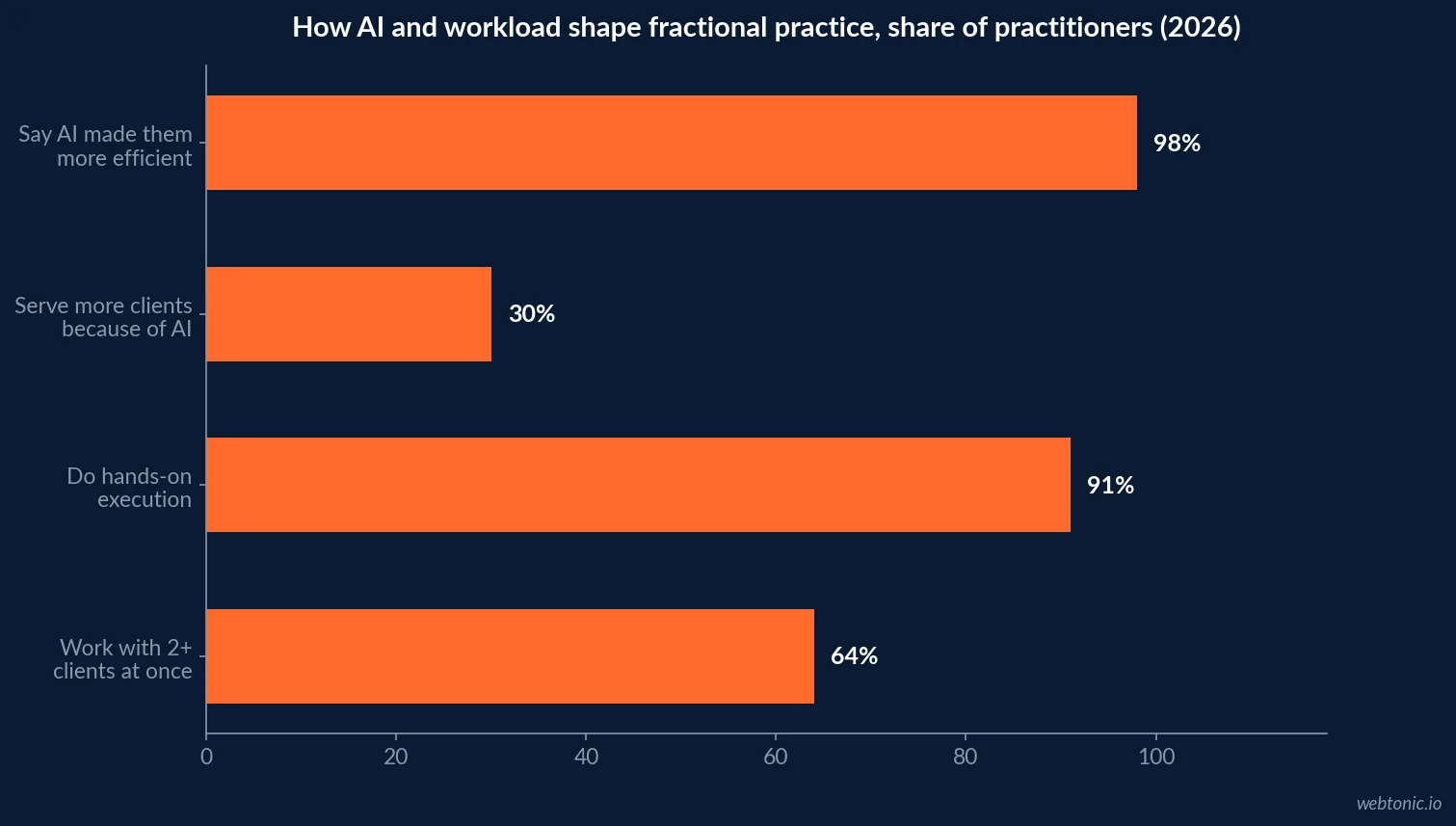
- 98% of practitioners say AI made them more efficient, and 30% now serve more clients because of it.
- CMOs allocate 15.3% of marketing budget to AI in 2026.
- Only about 30% of marketing organisations say they are ready to scale AI.
- AI-ready organisations put 21.3% of budget into AI and run budgets at 8.9% of revenue.
- 90% of fractional workers do not want to return to full-time work.
- 64% work with two or more clients at once.
Adoption, measured rather than asserted
Until 2026 this category had no dataset worth quoting. The Fractional Work Report changed that with 1,733 survey responses, 44,433 candidate profiles and 1,447 job postings analysed by an independent research firm, and the accompanying release put numbers on the trend line.
| Adoption measure | 2026 figure | Period or source |
|---|---|---|
| Fractional hiring demand growth | 149% YoY | Q1 2025 to Q1 2026, Fractional Jobs |
| Rise in monthly job postings | 5x | 2024 to Q1 2026 |
| Platform member growth | 83% | During 2025 |
| US fractional professionals | ~150,000 | Fractional Work Report, 2026 |
| US businesses using fractional hiring | ~25% | Industry trackers, 2026 |
| Projected US adoption | ~35% | By end of 2026 |
| Midsize enterprises with a fractional exec | 30%+ | Gartner projection for 2027 |
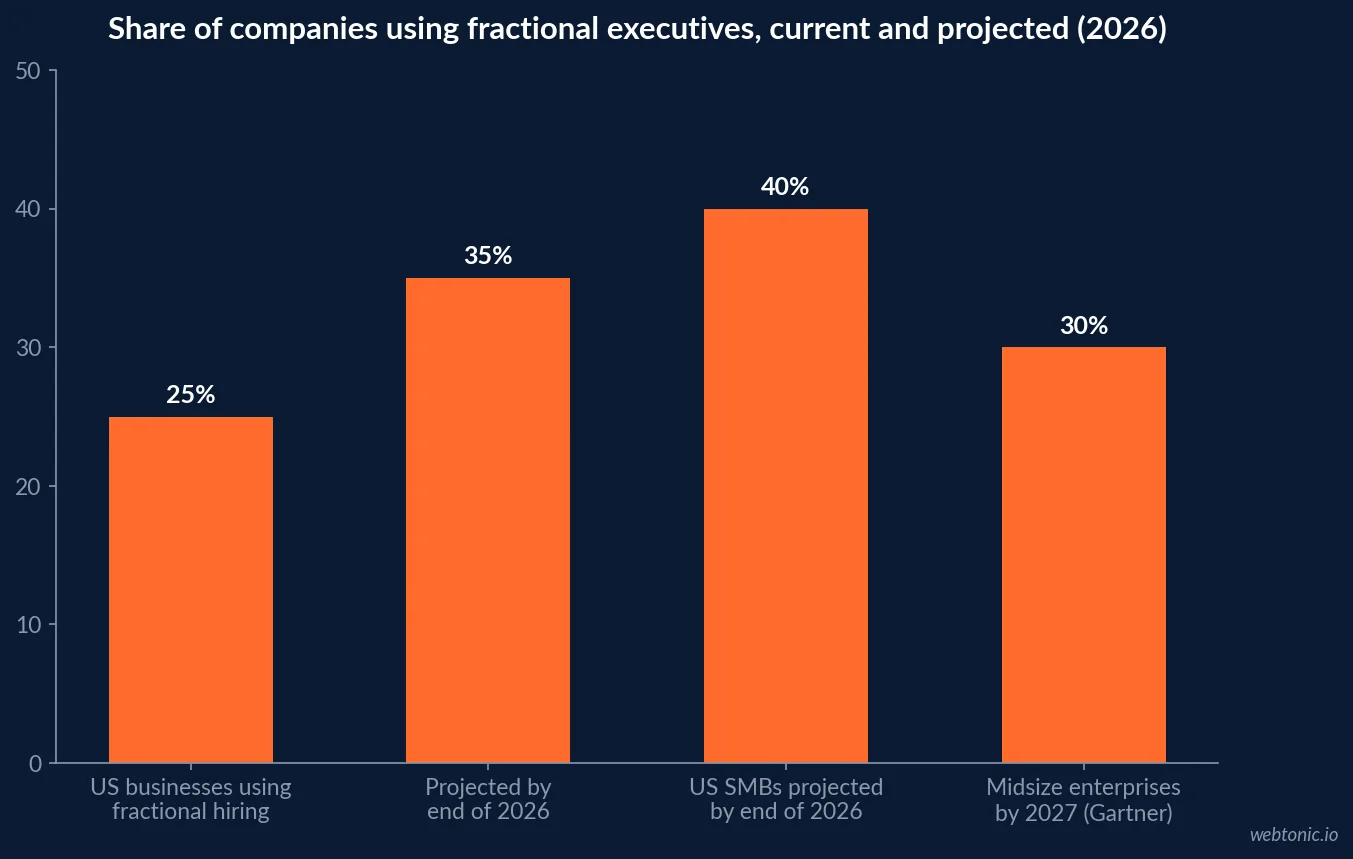
Two cautions belong next to that table. Adoption percentages published by trade bodies and marketplaces are not census data, and definitions of "using fractional hiring" vary. Market-size estimates are worse: the same fractional executive market has been valued at several different figures for overlapping years, which is why this page leans on transaction and survey counts rather than dollar totals.
The tooling shift behind the model
The economics of a nine-hour week only work if the low-value hours compress. According to the Fractional Work Report, 98% of surveyed fractional professionals said AI tools made them more efficient and 30% said those efficiencies let them serve more clients. Research, competitive analysis, first-draft production and reporting are the tasks most commonly cited - the same tasks that used to consume the first month of an engagement.
Read that against the buyer side. Gartner's 2026 CMO Spend Survey (n=401, fielded January to March 2026) found CMOs allocating 15.3% of marketing budget to AI while only about 30% consider their organisation ready to scale it. The gap between practitioner capability and organisational readiness is precisely the arbitrage a part-time senior operator sells into.
| Signal | Practitioner side | Buyer side | What it implies |
|---|---|---|---|
| AI efficiency | 98% report gains | 15.3% of budget allocated to AI | Spend is committed before capability exists |
| Readiness | 30% serve more clients | ~30% ready to scale AI | External operators are ahead of internal teams |
| Budget envelope | Rates broadly stable | 7.8% of revenue, effectively flat | Gains must come from allocation, not new money |
| Maturity premium | Senior, multi-client supply | AI-ready firms run 8.9% budgets and 21.3% to AI | The mature end is pulling away |
What the supply side chose
Adoption data describes buyers. The other half of the story is that the talent pool is no longer transitional. Per the same report, 87% of fractional practitioners have more than 11 years of experience, 83% are director level or above, 91% do hands-on execution, 64% work with two or more clients and 90% are not interested in returning to full-time work. Vendux cites Heidrick & Struggles data showing 85% of interim leaders have worked independently for more than a year, with new entrants rising from 6% in 2020 to 15% in 2025.
A supply base that has opted in permanently behaves differently from one waiting for a full-time offer. It specialises, it invests in its own tooling, and it prices on outcome density rather than availability.
Where adoption is concentrated
Growth is not evenly spread, and the concentration tells you which conditions make the model work. Early-stage venture-backed companies account for 36% of fractional hiring, followed by bootstrapped businesses at 13% and growth-stage venture-backed companies at 11%, with non-profits at 7%. Those four groups share one trait: a hard ceiling on executive payroll combined with a real need for senior judgement.
| Buyer group | Share of hiring | Why the model fits | What usually goes wrong |
|---|---|---|---|
| Early-stage, VC-backed | 36% | Needs senior judgement before it can fund a permanent hire | Expects execution volume the hours cannot cover |
| Bootstrapped | 13% | Permanent budget ceiling, decision-heavy problems | Under-scopes the hours to protect cash |
| Growth-stage, VC-backed | 11% | Bridges a first marketer and a real CMO | Delays the permanent hire past the point it was needed |
| Non-profit | 7% | Structural limits on executive pay | No internal owner for the plan after handover |
| Midsize enterprise | 30%+ projected by 2027 | Specialist mandates alongside an existing team | Unclear authority against permanent leaders |
What to expect over the next 12 months
Three things are reasonably safe to project from the current data, and one is not. Supply will keep growing: new entrants to independent executive work rose from 6% in 2020 to 15% in 2025, and 90% of current practitioners say they will not return to full-time work. Buyer adoption has an explicit forecast attached, with Gartner expecting 30%+ of midsize enterprises to hold a fractional executive on retainer by 2027. And budgets will stay tight, with the 7.8% of revenue figure effectively flat for a third consecutive year.
What is not safe to project is price. The USD 46 gap between posted and asked rates can close from either end, and a rapid supply increase usually pushes the median down while the specialist top band holds. Budget on the current median, negotiate on scope, and revisit the assumption at renewal rather than locking a multi-year rate.
The tooling questions that actually matter
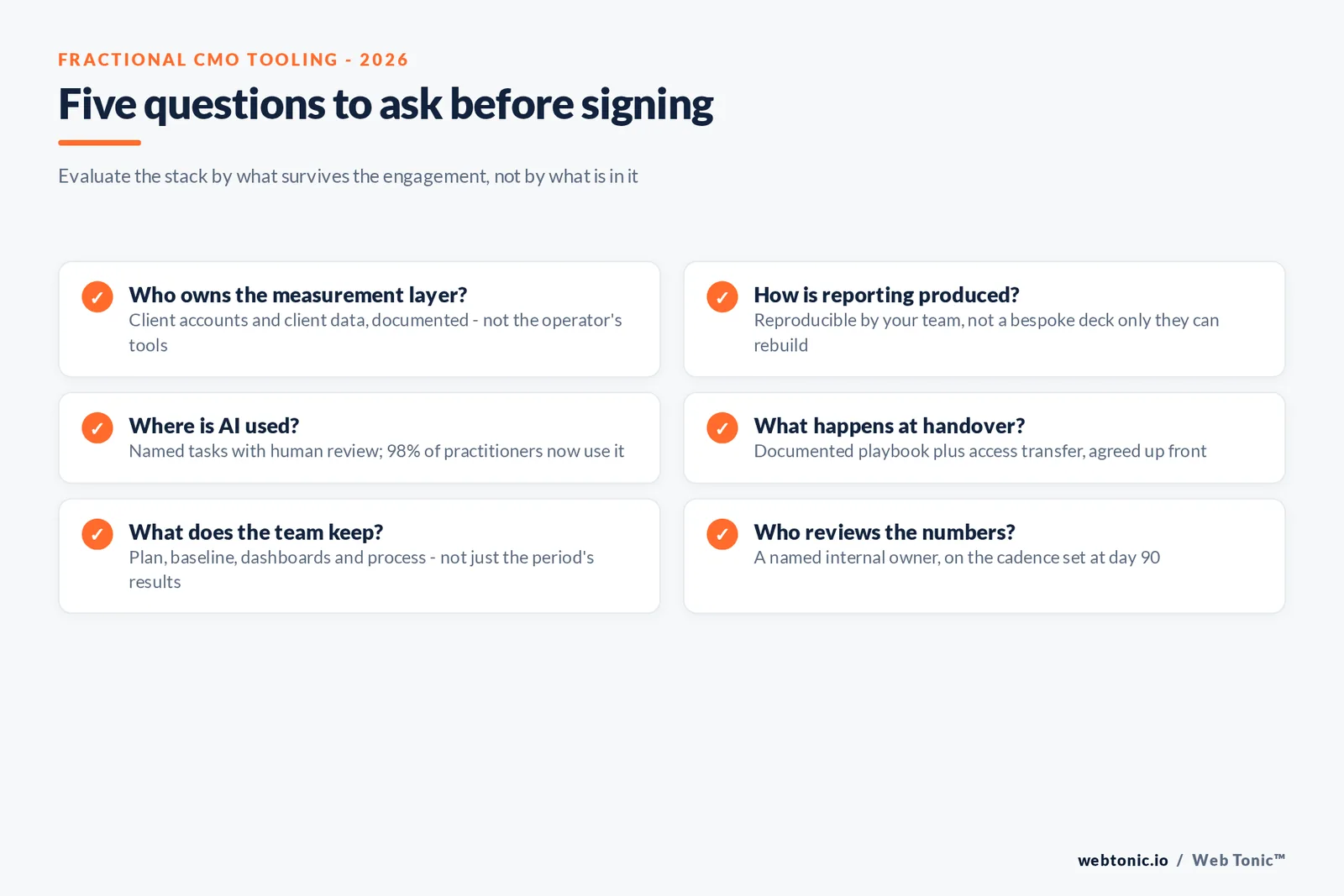
Vendor names age badly, so evaluate the stack by what survives the engagement rather than by what is in it. These are the five questions worth asking any part-time marketing leader before signing, and the same questions we ask when auditing a client's measurement and reporting setup.
| Question | Good answer | Warning sign |
|---|---|---|
| Who owns the measurement layer? | Client accounts, client data, documented | Tracking lives in the operator's own tools |
| How is reporting produced? | Repeatable and reproducible by the team | A bespoke deck only they can rebuild |
| Where is AI used in the workflow? | Named tasks, human review before publication | Vague or defensive answers |
| What happens at handover? | Documented playbook and access transfer | Knowledge sits in the operator's head |
| What does the team keep? | Plan, baseline, dashboards, process | Only the outcomes of the period |
What rising adoption changes for buyers
A bigger market is a mixed blessing. Supply growth of this speed brings in operators whose titles outrun their track record, and the same reporting shows a USD 46 an hour gap between employer postings and candidate asking rates - a market that has not converged on price has not converged on quality signals either. Three practical consequences follow.
First, reference checks matter more than credentials, because there is no certification layer here. Second, ask for the last two engagements' scorecards rather than the case studies. Third, expect the first 30 days to be spent building a baseline - a claim of instant impact is a claim that measurement was already in place, which is rarely true. That baseline work is ordinary growth marketing hygiene, and it is the cheapest insurance available on a senior retainer.
| Trend | 2026 evidence | Buyer implication |
|---|---|---|
| Rapid supply growth | 150,000 US practitioners; 5x posting growth | Vet harder; titles are self-assigned |
| Unconverged pricing | USD 136 posted vs USD 182 asked | Negotiate scope, not rate |
| AI-compressed delivery | 98% report efficiency gains | Ask what the tools do and who reviews output |
| Flat budgets | 7.8% of revenue in 2026 | Value comes from reallocation, not new spend |
| Structural, not cyclical | 90% will not return to full-time | Expect the model to persist through the cycle |
Where the data still cannot help
Adoption, supply and tooling are measurable in 2026. Outcomes are not. There is no independent study comparing companies that used fractional marketing leadership with those that hired permanently, no controlled measure of AI-assisted delivery quality, and no standard definition of what counts as a fractional engagement across the trackers quoted above. Anyone presenting a performance percentage for this model is presenting a sales figure.
The right response is not scepticism about the model - the adoption numbers are real and the supply is genuinely senior. It is to buy on structure and measure on your own scorecard. If you want help building that scorecard before you sign, get in touch.
Frequently Asked Questions
How fast is fractional executive adoption growing?
Fractional Jobs measured 149% year-over-year growth in hiring demand between Q1 2025 and Q1 2026, an 83% increase in platform members during 2025 and a fivefold rise in monthly job postings from 2024 to Q1 2026. Industry trackers put current US business adoption around 25%, with projections in the mid-thirties by the end of 2026, and Gartner expects more than 30% of midsize enterprises to have at least one fractional executive on retainer by 2027.
How many fractional professionals are there in the US?
Roughly 150,000 as of 2026, according to the Fractional Work Report, which drew on 1,733 survey responses and 44,433 candidate profiles. Marketing accounts for about 20% of fractional demand, second to finance at 22%. Supply is senior: 87% have more than 11 years of experience and 83% are director level or above.
Has AI changed what a fractional CMO can deliver?
By practitioner account, substantially. 98% of surveyed fractional professionals said AI tools made them more efficient, and 30% said those gains let them serve more clients. That is the mechanism behind the model's unit economics: research, competitive analysis, drafting and reporting compress, leaving more of a limited weekly commitment for judgement. Independent verification of output quality does not exist yet, so treat efficiency claims as self-reported.
What tools should a fractional marketing leader bring?
A measurement layer they can stand up quickly, a reporting cadence that does not depend on someone else's spreadsheet, a research and competitive analysis workflow, and a documented operating rhythm. The specific vendors matter far less than whether the stack survives their departure. Gartner's 2026 survey found CMOs putting 15.3% of budget into AI while only about 30% of organisations feel ready to scale it, so tooling that nobody internally can operate is a liability, not an asset.
Is the fractional trend a recession artefact?
The composition of demand argues against it. Growth is led by early-stage venture-backed companies at 36% of hiring, but bootstrapped businesses at 13% and non-profits at 7% are structurally cost-constrained rather than cyclically cautious, and 90% of practitioners say they do not want to return to full-time work. A labour supply that has chosen the model and a buyer base with permanent budget ceilings is a structural pattern, not a downturn one.
Sources
Fractional Jobs - The Fractional Work Report 2026
Fractional Jobs press release - 149% growth in fractional hiring
Gartner 2026 CMO Spend Survey (Business Wire release)
Vendux - Fractional executive numbers for 2026
Go Fractional - Fractional CMO Benchmarks 2026
Gartner 2025 CMO Spend Survey


