



Table of contents
Key Takeaways
Google Ads in the food service sector deliver a $2.05 average CPC — 62% below the $5.42 cross-industry average. Restaurants achieve a 6.83% CTR on search campaigns, while catering businesses convert at 4.6% with a $2.85 CPC. Documented case studies show ROI ranging from 700% to 2,419% for catering PPC campaigns.
Google Ads Benchmarks for Food Service at a Glance
The table below compares core Google Ads performance metrics for the restaurants and food vertical, catering businesses specifically, and all-industry averages, drawing from WordStream's 2026 benchmarks, Hawky, and CuFinder.
| Metric | Restaurants & Food | Catering Specific | All-Industry Average |
|---|---|---|---|
| CPC (Search) | $1.95–$2.05 | $2.85 | $5.42 |
| CTR (Search) | 6.83–7.60% | 5.2% | 6.42% |
| Conversion Rate | 6.8–7.09% | 4.6% | 8.18% |
| CPA | $18.50–$30.27 | $42.50 | $66.69 |
| Google Shopping CPC | — | $0.95 | $1.17 |
| Landing Page CVR | ~5.0% | 5.5% | 4.3% |
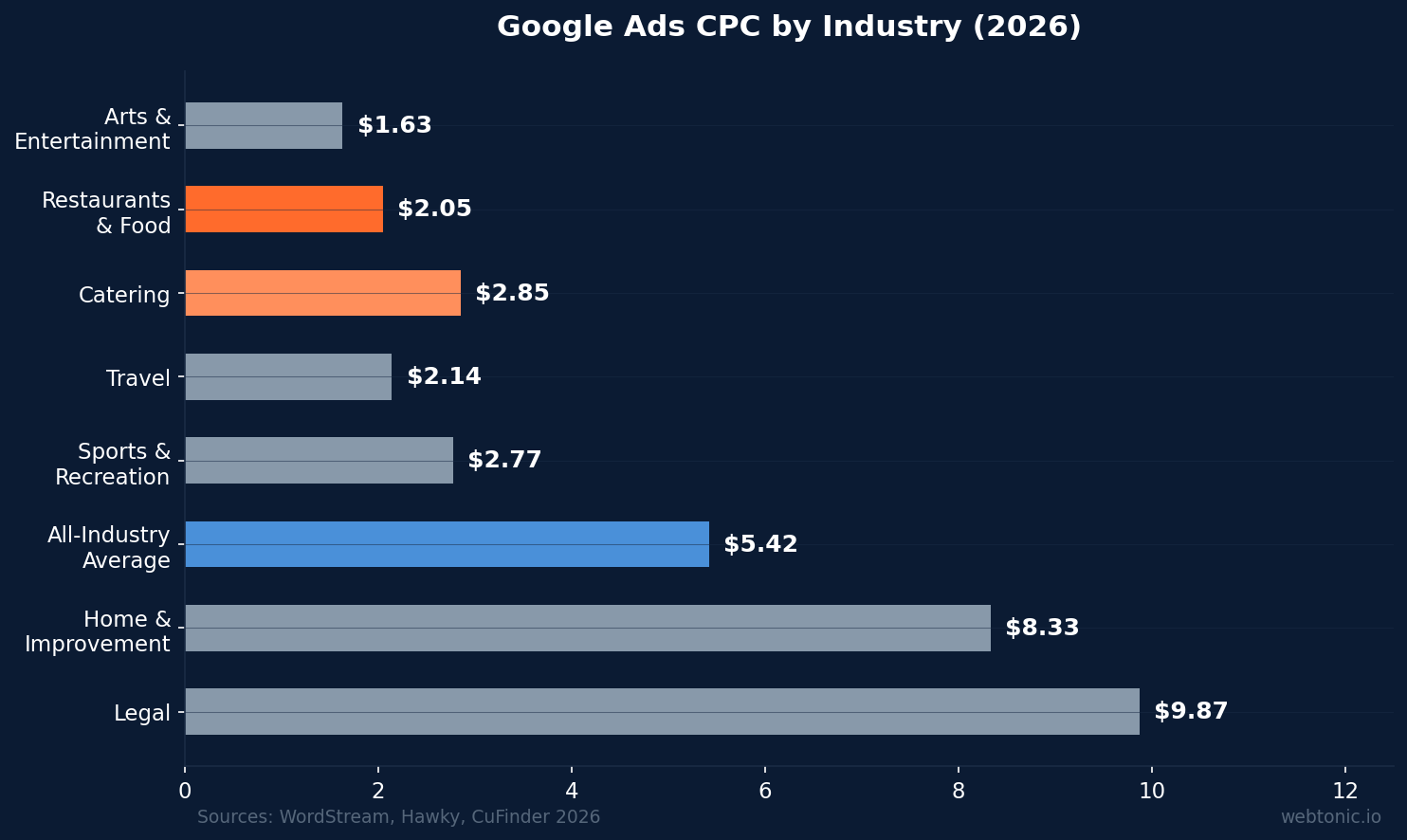
The restaurant vertical's CPC advantage is striking: at $2.05, it ranks among the three cheapest industries on Google Ads, according to Hawky's 2026 analysis — only Arts & Entertainment ($1.63) costs less. Catering's higher $2.85 CPC reflects more competitive B2B event-planning keywords but remains nearly half the cross-industry average.
CPC and Cost-Per-Lead Breakdown
PPC Chief's restaurant analysis places the expected CPC range at $1.54–$2.77, with an industry midpoint of $2.05. Most restaurant advertisers see cost per lead between $23 and $41, depending on quality score, location targeting, and keyword match strategy. Well-optimized campaigns can achieve 20–40% lower costs than the industry average through Quality Score improvements.
AdManage's 2026 cost report confirms the Restaurants & Food vertical at a $2.05 CPC, 7.58% CTR, 7.09% CVR, and $30.27 CPL — positioning it as one of the most efficient verticals for lead generation on the platform. For catering businesses specifically, CuFinder reports a $42.50 CPA with a 4.6% conversion rate. As with Meta Ads, the higher CPA reflects larger average order values ($1,500–$5,000 per event) rather than inefficiency.
Google Shopping — increasingly relevant for catering supply companies and meal kit brands — shows a notably low $0.95 CPC for catering-related products (CuFinder), compared to the $1.17 cross-industry average. This makes Google Shopping campaigns a particularly cost-effective channel for food service eCommerce.
CTR and Conversion Rate Analysis
The food service vertical enjoys above-average click-through rates on search. Hawky's 2026 data shows Restaurants & Food achieving a 6.83% CTR, while AdManage reports 7.58% CTR — both above the 6.42% all-industry average. The strong CTR reflects high commercial intent: someone searching "catering near me" or "corporate lunch delivery" is typically ready to act.
Conversion rates tell a more nuanced story. The restaurant vertical converts at 6.8–7.09% (CuFinder, AdManage), while catering converts at 4.6%. Both sit below the 8.18% all-industry average reported by WordStream, but this is partly because the cross-industry figure is inflated by high-conversion verticals like Animals & Pets (15.5%) and Physicians (13.1%). Within the food and hospitality segment, these rates are competitive.
Landing page conversion rates for catering specifically outperform the average: 5.5% landing page CVR versus 4.3% across all industries (CuFinder). This suggests that catering businesses with dedicated quote-request pages convert traffic more efficiently than their aggregate search CVR implies — the gap is in keyword-level intent qualification, not landing page quality.
Scale Growth Digital's restaurant PPC guide notes that the strongest-performing search campaigns use location-modified exact match keywords combined with call extensions, which simultaneously boost Quality Score and capture high-intent mobile searchers. For catering campaigns specifically, the data shows that event-type keywords (wedding, corporate, holiday) convert at 2–3× higher rates than generic "catering near me" queries, because searchers specifying event types are further along the decision process and closer to submitting a quote request.
ROAS and ROI Case Studies
Documented Google Ads case studies for catering companies show exceptional returns, driven by high average order values and relatively low CPCs:
| Case Study | Ad Spend | Results | ROI / ROAS |
|---|---|---|---|
| Owen Brothers Catering (RVS Media) | 3-month campaign | 340+ orders, 1,530+ leads, 7.30% CTR | 2,419% ROAS |
| Cooked Goose Catering (Icecube Digital) | $3,941 total | Account restructure + optimization | 700% ROI |
| Catering Company (PDF Case Study) | Ongoing | 132,783 impressions, 513 calls, 489 conversions, 3.45% CTR | Strong conversion volume |
| Example ROI Model (Cynthia Concierge) | $2,000/month | 12 bookings at $3,500 avg = $42,000 revenue | 2,000% ROI (20×) |
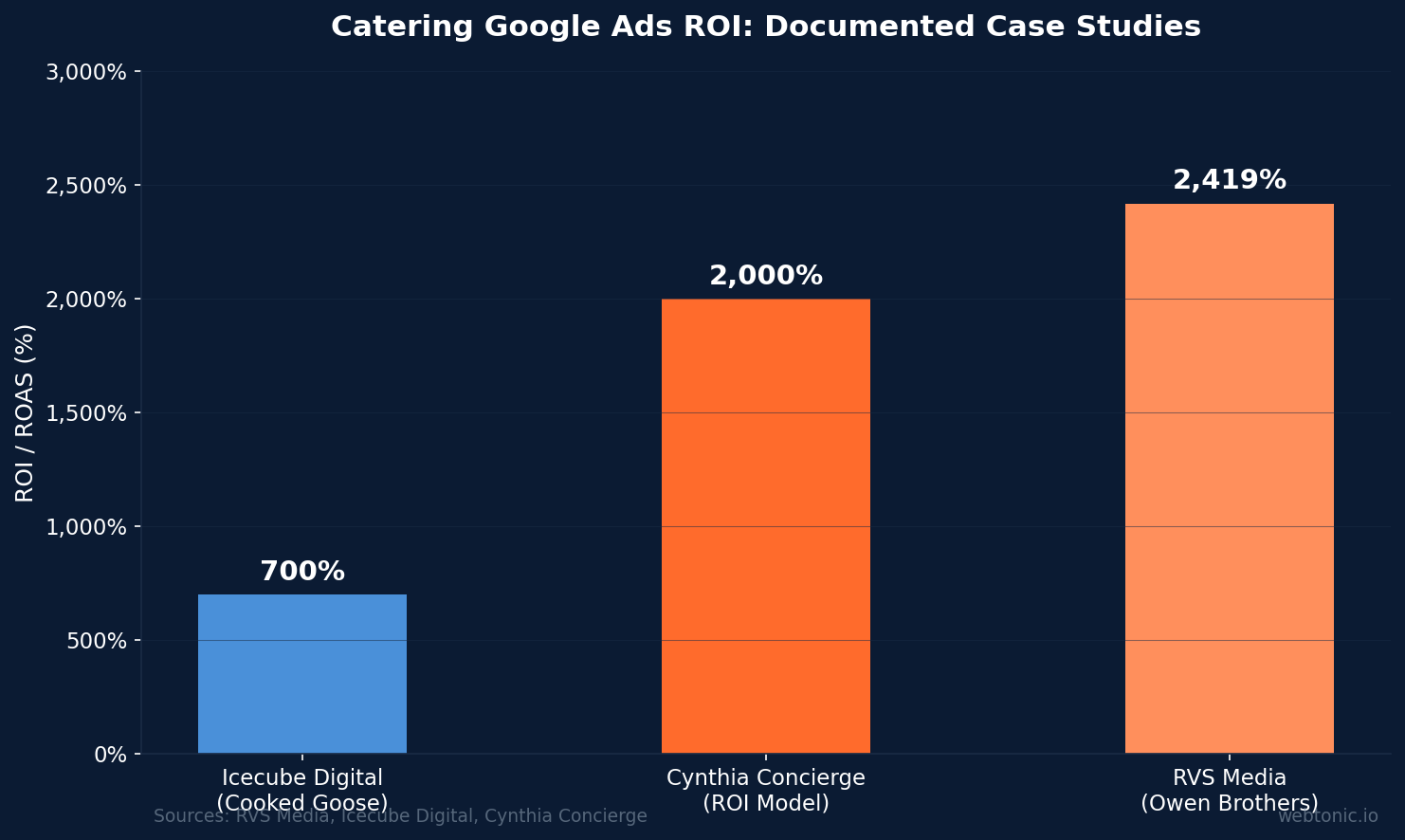
RVS Media's Owen Brothers case study stands out with a 2,419% ROAS — meaning every dollar in ad spend returned over $24 in revenue. The campaign generated 340+ orders and 1,530+ leads with a 7.30% CTR across three months. Icecube Digital's Cooked Goose case study achieved a 700% ROI from just $3,941 in total ad spend through comprehensive account restructuring.
Cynthia Concierge's ROI model provides a practical benchmark: spending $2,000 per month on Google Ads yields approximately 12 catering bookings at an average of $3,500 each — generating $42,000 in revenue for a 20× ROI. These economics make Google Ads strategy optimization one of the highest-leverage investments a catering business can make.
What unites all three case studies is the combination of low CPCs and high transaction values. Even at the sector's higher $2.85 CPC for catering keywords, a campaign generating 500 clicks per month produces 23 leads at a 4.6% conversion rate — and converting just 5–6 of those leads into bookings at $3,500 average order value delivers $17,500–$21,000 in revenue from approximately $1,425 in ad spend. The math works at nearly any reasonable conversion-to-booking ratio, which explains why Google Ads consistently ranks as the highest-ROI channel for catering operators across multiple independent studies.
Restaurant vs. Catering Google Ads Performance
While both share the food service umbrella, their Google Ads cost structures differ in important ways:
| Dimension | Restaurants | Catering |
|---|---|---|
| CPC | $1.95 | $2.85 |
| CTR | 6.83% | 5.2% |
| CVR | 6.8% | 4.6% |
| CPA | $18.50 | $42.50 |
| Avg Order Value | $25–$50 | $1,500–$5,000 |
| Primary Keywords | Near-me, cuisine type | Event-specific, corporate |
MDMPPC's restaurant hospitality benchmarks from 2025 data show the vertical achieving a 41.30% impression share at a $0.79 CPC on their tracked campaigns — suggesting that well-optimized restaurant accounts can drive CPCs significantly below the category average. They recorded 9,275 clicks from 684,324 impressions at a 1.40% CTR (lower than Hawky's benchmarks, likely due to broader match type usage) and 3,833 conversions. The real takeaway: catering's $42.50 CPA is offset by order values that are 30–100× larger than the typical restaurant transaction, making the cost-per-acquisition economics dramatically favorable.
GROAS's 2026 cross-industry analysis contextualizes these numbers further: while B2B SaaS companies pay $50–$100+ per marketing-qualified lead, the food service vertical achieves comparable lead quality at a fraction of the cost. This cost efficiency makes Google Ads particularly attractive for independent catering operators with limited marketing budgets — even $500–$1,000 per month in ad spend can generate meaningful lead flow when campaigns are properly structured around high-intent keywords and location targeting.
Best Practices for Catering Google Ads
Data from across the food service vertical points to several proven optimization strategies for growth marketing through Google Ads:
- Target high-intent event keywords. Terms like "corporate catering [city]," "wedding catering near me," and "office lunch delivery" drive the strongest conversion rates. Broad informational queries waste spend on users not ready to book.
- Optimize for Quality Score aggressively. PPC Chief notes that well-optimized food service campaigns achieve 20–40% lower CPCs through Quality Score improvements. Ad-to-keyword relevance and landing page experience are the primary levers.
- Use separate campaigns for restaurant and catering. The CPC, CVR, and CPA differences between the two sub-sectors are substantial enough that mixing them in one campaign dilutes bidding signals and budget allocation.
- Build dedicated landing pages for each service type. Catering's 5.5% landing page CVR (above the 4.3% average) demonstrates that purpose-built quote pages convert better than homepage traffic. Include menu galleries, testimonials, and a prominent quote-request form.
- Leverage Google Shopping for food eCommerce. At $0.95 CPC, Shopping campaigns are the cheapest acquisition channel for catering supply or meal kit businesses — lower than both search ($2.85) and Facebook ($1.15).
- Track phone calls and form fills separately. The PDF case study showing 513 phone calls alongside 489 form conversions confirms that call tracking captures a significant share of catering leads that form-only tracking would miss entirely.
- Front-load budget during peak seasons. Q4 (holiday corporate parties, year-end galas) and Q2 (wedding season) drive the highest catering search volume. Increase bids and budgets 30–50% during these windows to capture seasonal demand spikes before competitors saturate the auction.
- Use negative keywords aggressively. Catering keywords trigger irrelevant traffic from job seekers ("catering jobs"), recipe hunters, and DIY planners. Building a comprehensive negative keyword list from the first week prevents wasted spend and improves Quality Score across the account.
The data consistently shows that food service Google Ads campaigns benefit from granular geographic targeting. A catering company serving a 30-mile radius around a major city should use radius targeting combined with bid adjustments for high-density commercial zones where corporate offices cluster. CuFinder's restaurant data confirms that 48.2% of catering website traffic comes from organic search, making paid search a complementary capture channel for the remaining intent-driven queries that organic rankings haven't yet secured. Combining Google Ads with strong local SEO creates a compound effect: paid captures immediate demand while organic builds sustainable, zero-cost lead flow over time.
Frequently Asked Questions
How much does Google Ads cost for restaurants?
Restaurant Google Ads average $1.95–$2.05 per click, with a CTR of 6.83–7.58% — among the lowest CPCs on the platform. Cost per lead ranges from $23 to $41 depending on Quality Score and location targeting (PPC Chief, WordStream, Hawky).
What is the average conversion rate for food service Google Ads?
Restaurants convert at 6.8–7.09% on Google search ads, while catering businesses convert at 4.6%. Landing page conversion rates for catering run higher at 5.5%, indicating that dedicated event-specific pages outperform generic traffic paths (CuFinder).
What ROI can a catering company expect from Google Ads?
Documented catering Google Ads case studies show ROI ranging from 700% to 2,419%. A practical benchmark: spending $2,000/month typically generates 12 bookings averaging $3,500 each, yielding roughly $42,000 in monthly revenue — a 20× return (Icecube Digital, RVS Media, Cynthia Concierge).
Is Google Ads or Facebook Ads better for catering businesses?
Both channels serve different funnel stages. Google Ads captures high-intent searchers ready to book (5.2% CTR, 4.6% CVR at $2.85 CPC), while Facebook excels at visual awareness and retargeting ($1.15 CPC, 2.8% CVR). The strongest catering ad strategies use both: Google for search capture, Meta for audience building and remarketing.
What is a good CPA for catering Google Ads?
The average catering CPA is $42.50 (CuFinder), which is profitable against average booking values of $1,500–$5,000. A CPA below $60 is considered strong for event catering. For restaurant-specific lead gen, a $18.50–$30 CPA is the competitive benchmark.
Sources
wordstream.com — Google Ads Benchmarks 2026
hawky.ai — Google Ads Benchmarks by Industry 2026
cufinder.io — Catering Industry Marketing Benchmarks 2026
cufinder.io — Restaurants Industry Marketing Benchmarks 2026
ppcchief.com — Restaurants & Food Google Ads CPC 2026
admanage.ai — Google Ads Cost 2026 Benchmarks
mdmppc.com — Restaurant & Hospitality Google Ads Benchmarks
rvsmedia.com — Owen Brothers Catering PPC Case Study
icecubedigital.com — Cooked Goose Catering PPC Case Study
cynthiaconcierge.com — Google Ads for Catering Companies


