



Table of contents
Key Takeaways
Restaurants and food businesses achieve some of the lowest CPCs on Meta platforms — just $0.72–$0.85 per click versus the $1.72 cross-industry average. Catering businesses specifically convert at 2.8% on Facebook and Instagram, with documented case studies showing 8× to 17.6× ROAS. The food category earns a 25.47% hook rate on UGC video ads, outperforming most verticals on creative engagement.
Facebook Ads Benchmarks for Food Service at a Glance
The table below consolidates 2025–2026 Meta Ads performance data for the restaurants and food vertical from Hawky, AdManage, and CuFinder.
| Metric | Restaurants & Food | Catering Specific | All-Industry Average |
|---|---|---|---|
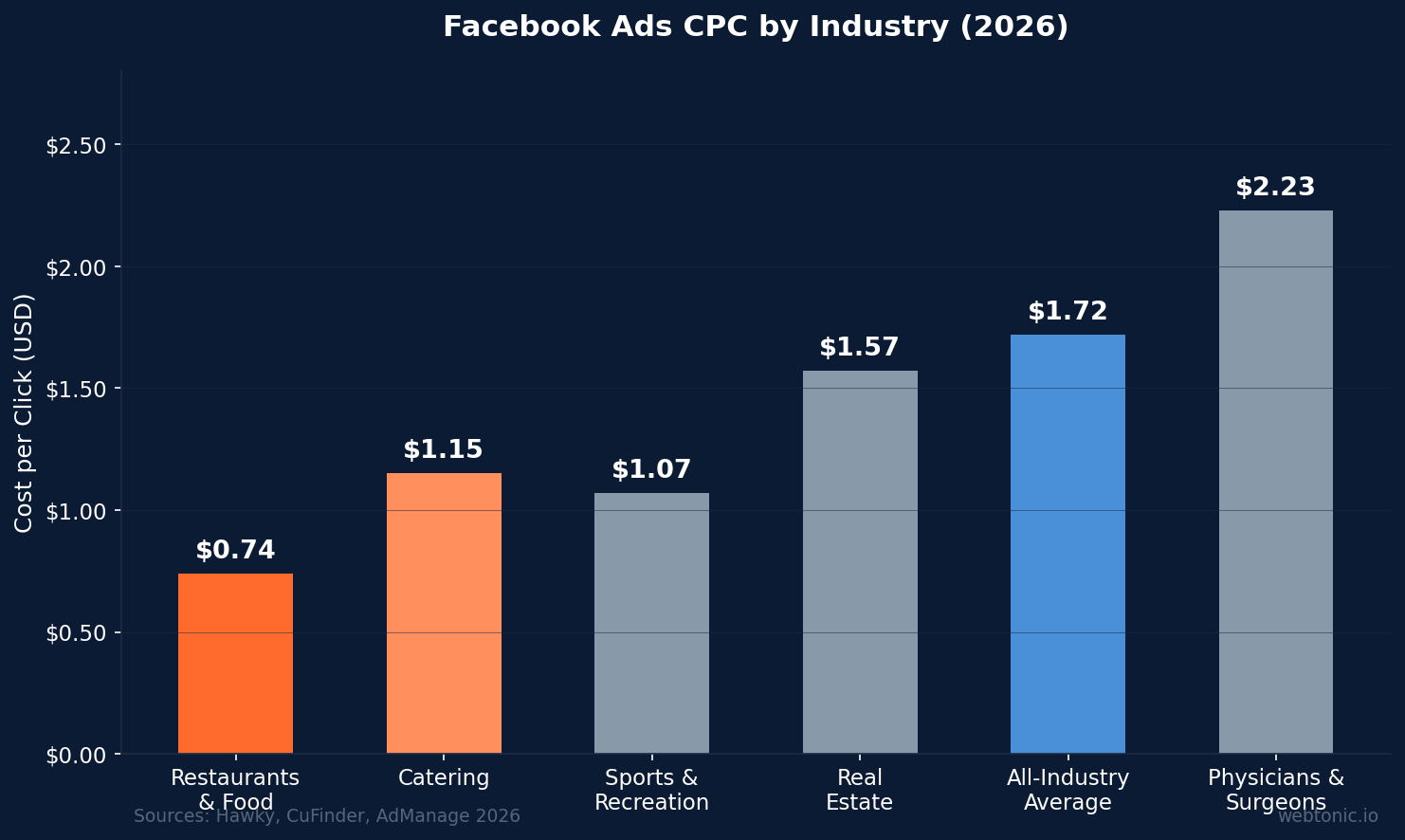
| CPC (Facebook) | $0.72–$0.74 | $1.15 | $1.72 |
| CTR | 1.67–2.97% | ~1.8% | 1.49% |
| CVR (Lead Ads) | 18.25% | 2.8% | 9.21% |
| CPL | $3.16 | $42.50 | $27.66 |
| CPM | $8.75 | ~$12.00 | $11.54 |
| ROAS (eCommerce) | 2.5–4.5× | 8×–17.6× | 1.57× |
The gap between restaurant CPL ($3.16) and catering CPL ($42.50) reflects fundamentally different conversion paths: restaurants capture quick reservations through native lead forms, while caterers sell high-ticket event bookings ($1,500–$5,000+) that require longer sales cycles. Despite the higher CPL, catering's ROAS of 8×–17.6× confirms strong unit economics. Industry data confirms that Facebook remains the strongest platform for reaching food service customers aged 30–65, with an average CPM of approximately $8.75 — reaching 1,000 local diners for under $9.
CPC and CTR Performance by Platform
Hawky's 2026 Facebook Ads benchmarks place Restaurants & Food at a $0.74 CPC and 2.97% CTR — the second-lowest CPC of any industry they track, behind only Shopping & Collectibles. Sovran's analysis corroborates this at $0.72 CPC and 1.67% CTR using 2025 data.
For catering specifically, CuFinder's catering benchmarks show a higher $1.15 CPC on Facebook and Instagram — still 33% below the all-industry average, but reflecting the competitive B2B and event-planning keyword landscape. The catering conversion rate of 2.8% is lower than the restaurant vertical's 18.25% lead-form rate, largely because catering conversions involve multi-step quote requests rather than one-tap reservations.
Adligator's vertical breakdown ranks Restaurants & Food as having the highest CTR (1.67%) among food-adjacent categories, ahead of Health & Fitness (1.63%) and Education (1.45%). This performance advantage stems from the inherently visual nature of food content — well-shot dishes and event setups trigger immediate engagement in the feed.
ROAS and Revenue Case Studies
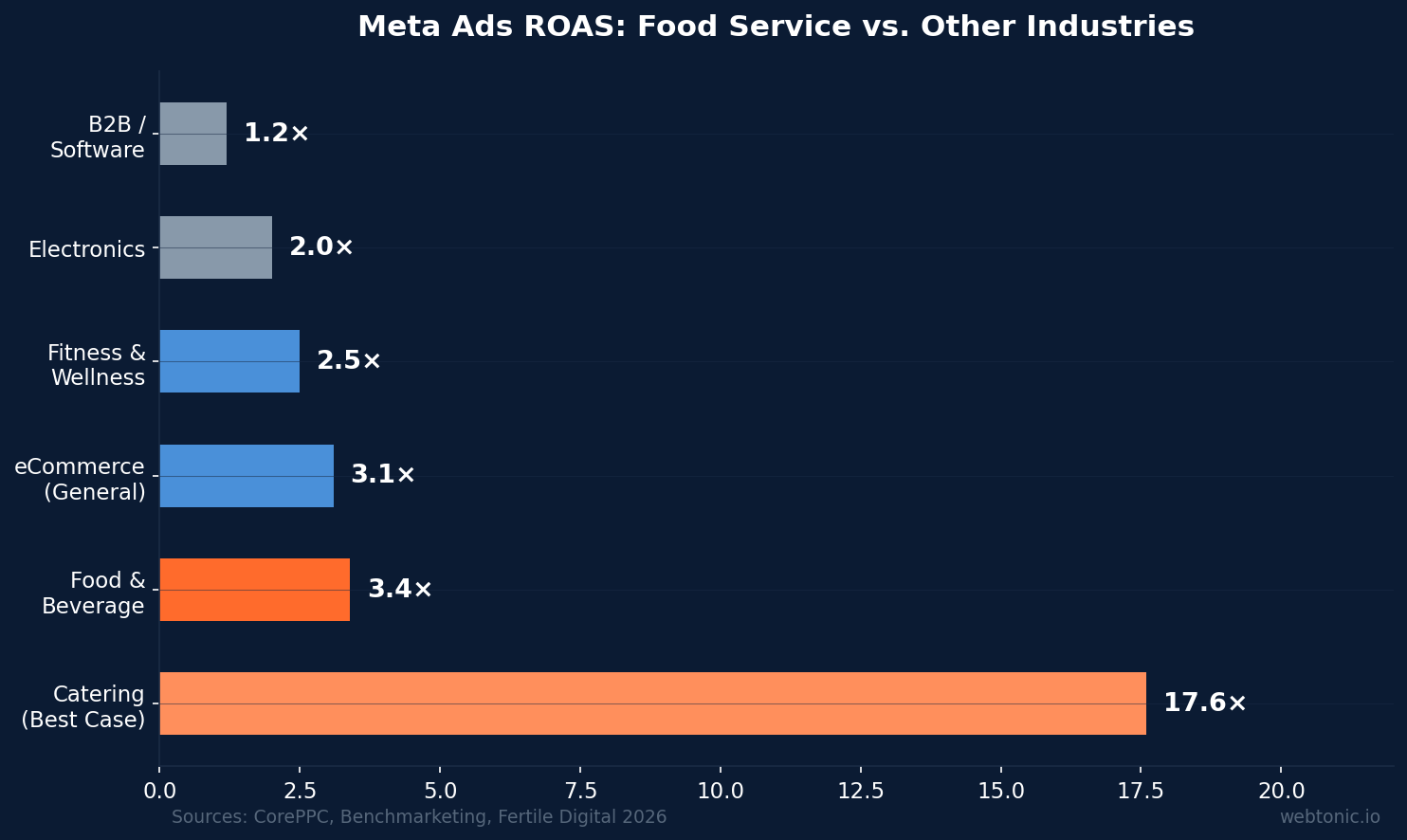
Meta Ads deliver outsized returns for food service businesses, both in aggregate benchmarks and individual case studies. CorePPC's 2026 industry report places Food & Beverage ROAS at 2.5–4.5× on a 7-day click, 1-day view attribution window — the highest-performing vertical alongside Pets.
Catering businesses outperform even these benchmarks. Fertile Digital's corporate catering case study documents a 17.6× ROAS — every £1 spent returned £17.60 in revenue — generating £36,150 from just £2,055 in ad spend through strategic paid social targeting corporate clients. A second documented case shows a catering company achieving 8× ROAS consistently over four months, generating $32,000 in new bookings from $4,000 in Meta ad spend.
Visible Factors reports that twelve of fifteen industry verticals posted year-over-year ROAS improvements in 2025, with Food & Beverage holding its position as the top-performing category. The takeaway is clear: food content naturally converts on visual platforms, and catering's high average order values amplify returns on every conversion.
For context on cross-channel efficiency, the all-industry average Meta ROAS sits at 1.57× (Visible Factors), meaning the food vertical performs 2.2× better than the median advertiser on the same platform. This advantage compounds with higher ticket sizes: a catering company spending $2,000 per month on Meta at 8× ROAS generates $16,000 in booked revenue — a return that justifies scaling to $5,000–$10,000 monthly budgets if creative quality and audience freshness are maintained. Operators looking to maximize growth marketing returns should treat Meta as their primary top-of-funnel channel alongside Google search.
The CPM advantage compounds over time for food service advertisers. At $8.75 CPM, a catering company spending $3,000 per month on Meta reaches approximately 342,857 impressions — substantial local awareness for a business that typically serves a 50-mile radius. Combined with the 2.97% CTR that the restaurant vertical commands (Hawky), this translates to roughly 10,181 clicks per month, feeding the conversion funnel with high-intent prospects who have already engaged with compelling food imagery.
Instagram Ads Performance for Food Businesses
Benchmarketing's 2026 Instagram benchmarks show Food & Beverage outperforming most verticals on the platform:
| Metric | Food & Beverage | eCommerce (General) | B2B / Software |
|---|---|---|---|
| CTR | 1.62% | 1.38% | 0.48% |
| CPM | $12.80 | $16.10 | $21.40 |
| CVR | 2.10% | 1.95% | 0.88% |
| ROAS | 3.40× | 3.10× | 1.20× |
Zipdo's 2026 restaurant social media statistics show Instagram ad campaigns driving a 28% increase in reservations, with social media channels averaging 15% of total revenue for restaurants that actively advertise. For catering, Instagram's visual format is particularly effective for showcasing event setups, plated dishes, and behind-the-scenes prep — content that builds trust before a high-ticket inquiry.
UGC and Creative Performance in Food Advertising
Billo's H2 2025 benchmark report, drawn from 80,000+ Meta video ads in Food & Beverages, reveals the category earns attention above the Meta average but has a specific weakness in mid-video retention:
- 25.47% hook rate — the percentage of viewers who watch past the first 3 seconds, outperforming the cross-industry average
- 1.51% CTR on food UGC video ads
- 2.57 ROAS average across food UGC campaigns
- December peak: 3.07 ROAS — the holiday catering season drives the highest returns
The data confirms that food UGC converts well but loses viewers in the middle of the video. For catering advertisers, this means front-loading the hero shot (finished spread, event reveal, client reaction) within the first 2–3 seconds, then using text overlays and quick cuts to maintain attention through the pitch. Performance creative strategies that emphasize hook-rate optimization see the strongest returns in this vertical.
The Missing Ingredient's 2026 analysis adds that Food & Beverage brands achieve a 2.53% CTR benchmark across Meta platforms, with native lead campaigns hitting an 18.25% conversion rate — driven by Meta's autofill capabilities and reduced-friction form design. This confirms that lead generation, not just brand awareness, is a viable primary objective for food service Meta campaigns. For agencies managing food service accounts, these benchmarks provide clear performance baselines to measure campaign health against industry peers.
Catering vs. Restaurant Meta Ads Comparison
The two food service sub-sectors approach Facebook differently, and their metrics reflect distinct business models:
| Dimension | Restaurants | Catering |
|---|---|---|
| Primary Objective | Reservations, foot traffic | Quote requests, event bookings |
| CPC | $0.72–$0.85 | $1.15 |
| CVR | 18.25% (lead forms) | 2.8% |
| CPL | $3.16 | $42.50 |
| Average Booking Value | $25–$50 | $1,500–$5,000+ |
| Best-Case ROAS | 2.5–4.5× | 8×–17.6× |
While restaurants benefit from high-volume, low-friction lead forms, catering businesses should optimize for qualified inquiries over raw lead volume. A $42.50 CPL is expensive for a $30 dinner, but it is trivially profitable for a $3,500 corporate luncheon. The key is targeting: corporate catering campaigns using firmographic targeting (job titles, company size, industry) outperform broad interest-based audiences by reducing unqualified click volume.
The seasonal dynamics also differ sharply. Catering sees peak demand during Q4 holiday season (corporate parties, year-end galas) and Q2 wedding season, while restaurants maintain steadier year-round advertising. CuFinder's restaurant benchmarks confirm a $1.95 Google Ads CPC for the restaurant vertical — more than double their Facebook CPC of $0.85 — which explains why Meta remains the preferred paid channel for most independent restaurants seeking cost-efficient awareness and reservation volume.
Best Practices for Catering Facebook Ads
Performance data across the food service vertical points to several evidence-backed Facebook advertising strategies:
- Lead with food imagery, not logos. The 25.47% hook rate on food UGC (Billo) confirms that authentic, mouth-watering visuals outperform branded creative. Show the finished spread first, then introduce your brand.
- Use native lead forms for restaurants, landing pages for catering. Restaurant lead forms convert at 18.25% (Hawky), but catering's complex booking process benefits from dedicated landing pages that qualify budget, headcount, and event type before submission.
- Target corporate buyers for catering campaigns. The Fertile Digital case study (17.6× ROAS) used strategic targeting focused on corporate procurement. Interest-based targeting for social events works too but yields lower booking values.
- Run Advantage+ Shopping for food eCommerce. Food & Beverage holds the top ROAS position on Meta (CorePPC), making ASC the ideal campaign type for meal kit, specialty food, and catering supply businesses on Shopify or WooCommerce storefronts selling direct-to-consumer meal packages.
- Optimize for December peak. Billo's data shows December holiday catering season peaks at 3.07 ROAS — plan creative refreshes and budget increases for Q4 well in advance.
- Invest in UGC video, but fix the mid-video drop-off. Food brands hook well (25.47%) but lose viewers mid-video. Use text overlays, quick cuts, and menu callouts to maintain attention through the CTA.
Frequently Asked Questions
How much do Facebook ads cost for restaurants?
Restaurant Facebook ads average $0.72–$0.85 per click, with a CTR of 1.67–2.97% — among the lowest CPCs and highest CTRs of any industry (Hawky, AdManage, CuFinder). The average CPL for restaurant lead ads is just $3.16, making it one of the most cost-effective channels for reservation generation.
What is a good ROAS for food service Meta ads?
A good ROAS for food and beverage Meta ads ranges from 2.5× to 4.5× on a 7-day click attribution window (CorePPC). Catering businesses with high-ticket bookings regularly achieve 8×–17.6× ROAS due to their larger average order values.
Do Instagram ads work for catering businesses?
Yes. Instagram Food & Beverage ads achieve a 1.62% CTR, $12.80 CPM, 2.10% CVR, and 3.40× ROAS (Benchmarketing) — all above the platform average. For catering specifically, Instagram's visual format drives a 28% increase in reservations/inquiries from ad campaigns (Zipdo), and Reels are the highest-reach format for food content.
What type of ad creative works best for food service?
UGC video performs best, achieving a 25.47% hook rate across 80,000+ Meta food ads (Billo). The key is front-loading the hero shot within the first 3 seconds. For catering, event setup reveals and client testimonials outperform polished brand videos. Carousel ads with menu items also convert well for both restaurants and caterers. December holiday season is peak performance, with Billo data showing ROAS climbing to 3.07 during Q4.
How does catering CPL compare to restaurant CPL on Facebook?
Catering CPL averages $42.50 versus $3.16 for restaurants (CuFinder, Hawky). The 13× difference reflects catering's longer sales cycle and higher booking value ($1,500–$5,000+ vs. $25–$50 per cover). On a ROAS basis, catering often outperforms restaurants due to superior unit economics.
Sources
hawky.ai — Facebook Ads Benchmarks by Industry 2026
cufinder.io — Catering Industry Marketing Benchmarks 2026
admanage.ai — Facebook Ads for Restaurants 2026
sovran.ai — Restaurant Facebook Ads Targeting & ROI Guide
fertile.digital — Corporate Catering 17.6x ROAS Case Study
billo.app — UGC for Food and Beverage Brands
coreppc.com — Meta Ads Benchmarks by Industry 2026
benchmarketing.org — Instagram Ads Benchmarks 2026
themissingingredient.com — Facebook Benchmarks for Food Brands
zipdo.co — Restaurant Social Media Statistics 2026
visiblefactors.com — Facebook Ads Benchmarks Performance Analysis
adligator.com — Facebook Ad Benchmarks by Vertical 2026


