Table of contents
Key Takeaways
Restaurant and catering email campaigns deliver open rates between 32–44% — nearly double the 21% all-industry average. Automated flows generate 320% more revenue than manual sends. The industry earns roughly $42 in ROI for every $1 spent on email, and welcome emails hit 48% open rates for catering businesses specifically.
Food Service Email Marketing Benchmarks at a Glance
The table below compares core email performance metrics for catering and restaurants against the all-industry average, based on 2025–2026 benchmark data from CuFinder, Stripo, and Brevo.
| Metric | Catering / Food Service | All-Industry Average |
|---|---|---|
| Open Rate | 26.5–43.7% | 21.0% |
| Click-Through Rate | 2.4–2.8% | 2.3% |
| Conversion Rate | 0.3–2.2% | 0.2% |
| Bounce Rate | 0.4% | 0.6% |
| Revenue per Recipient | $0.10–$0.40 (broadcast) | $0.11 |
| ROI (per $1 spent) | $42 | $36 |
Open Rates and Click-Through Performance
Email engagement in the food service sector consistently outperforms cross-industry averages. According to Tablein's 2024 analysis, the average restaurant email open rate stands at 40.03%, while click-through rates average 2.44%. Stripo's research reports similar numbers through dining-specific benchmarks: 32.54% open rates and 0.81% CTR for the broader dining and food services vertical (OptinMonster data), while their Sender-sourced figure places restaurant open rates even higher at 43.69%.
For catering businesses specifically, CuFinder's 2026 catering benchmarks report a 26.5% average open rate and 2.4% CTR. Welcome emails sent after an initial inquiry reach 48.0% open rates — making the first touchpoint the single most valuable email a catering company sends. The gap between catering (26.5%) and the restaurant average (40%) likely reflects the B2B nature of many catering clients, where corporate procurement inboxes are more saturated.
The US Tech Automations 2026 report consolidates these findings, noting that email campaigns average 35–45% open rates for restaurants — nearly double the 21% all-industry average tracked by Mailchimp. When it comes to email marketing strategy, the food sector's advantage is built on immediacy: menus, limited-time offers, and seasonal promotions create natural urgency that office supply or SaaS emails rarely match.
Email Marketing ROI and Revenue Impact
The financial return on restaurant email marketing is among the strongest in digital advertising. Stripo cites WifiTalents data showing the food service industry earns approximately $42 for every $1 spent on email — outpacing the all-industry average of $36 by 17%. Personalization alone drives a 10–15% increase in income from email campaigns.
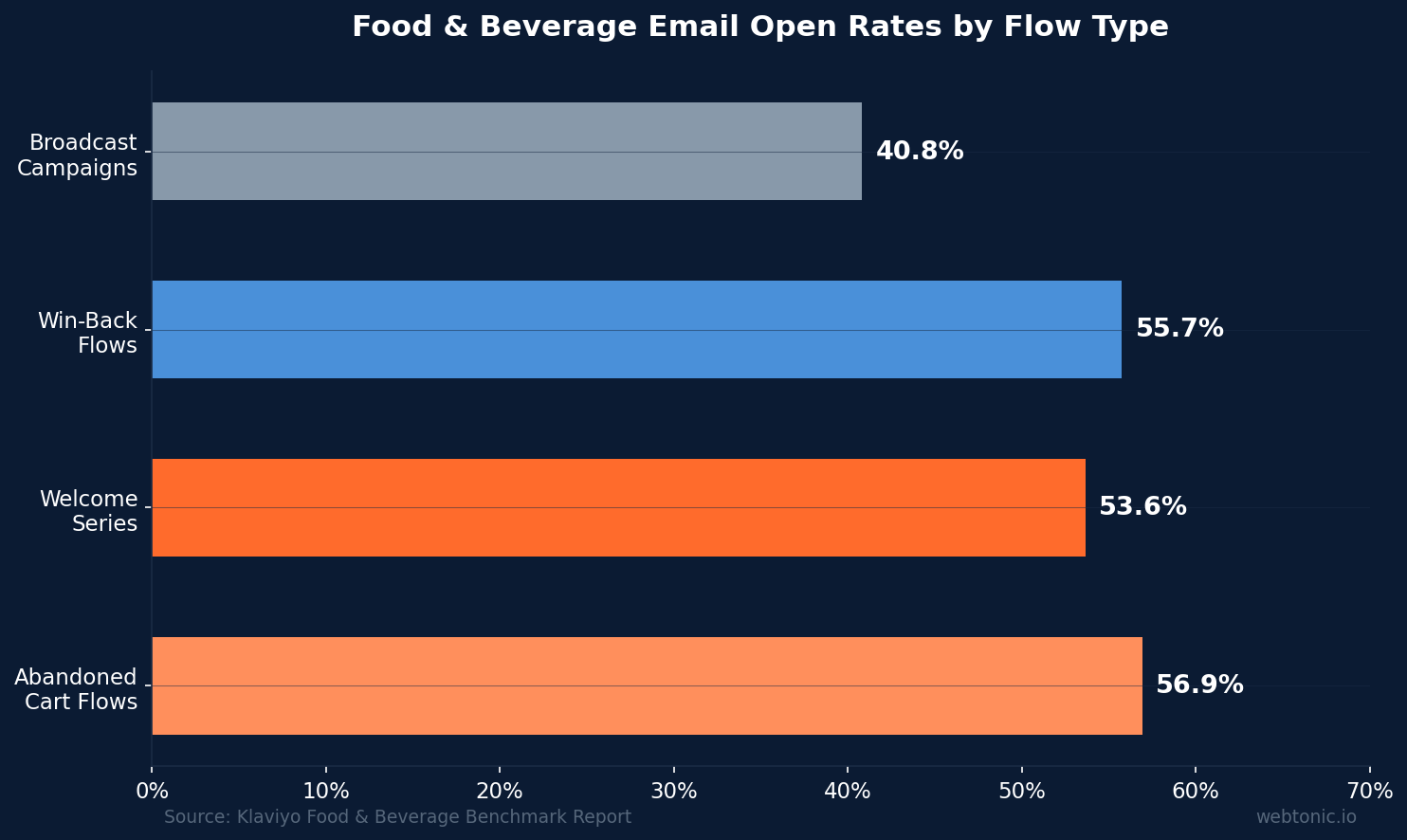
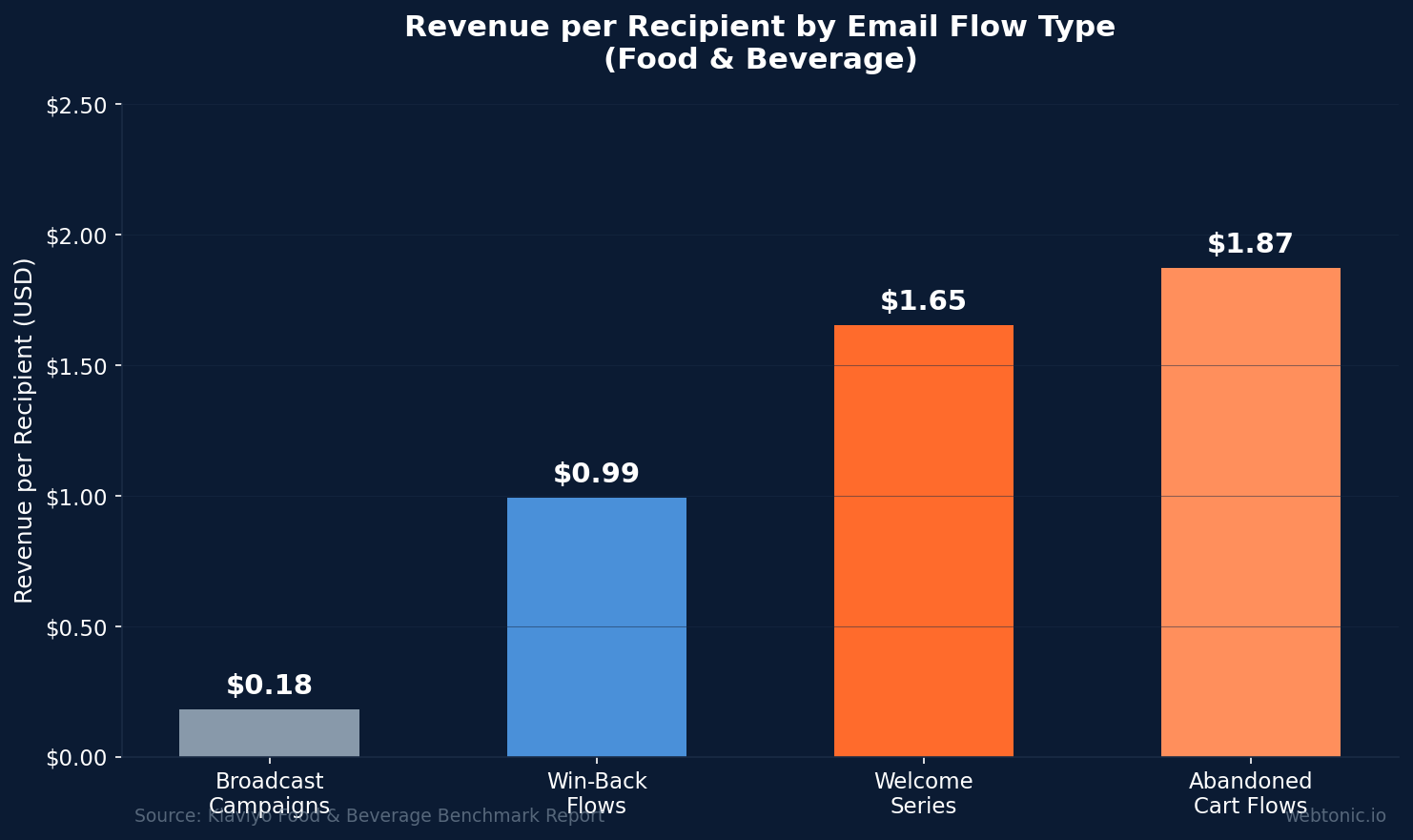
Revenue-per-recipient (RPR) data from the Klaviyo Food & Beverage Benchmark Report reveals wide performance variation by flow type:
| Email Flow Type | Open Rate | CTR | Conversion Rate | Revenue per Recipient |
|---|---|---|---|---|
| Broadcast Campaigns | 40.80% | 1.54% | 0.21% | $0.18 |
| Welcome Series | 53.65% | 6.09% | 2.20% | $1.65 |
| Abandoned Cart | 56.92% | 7.14% | 2.62% | $1.87 |
| Win-Back | 55.74% | 5.98% | 1.36% | $0.99 |
Triggered lifecycle flows earn $0.50–$2.00 per recipient — up to 10× more than broadcast sends at $0.10–$0.40, according to Everything PR's 2026 playbook. The US Tech Automations ROI model projects that a mid-size restaurant running automated campaigns can generate $20,736 in annual email revenue, delivering a 172× return on a modest email platform investment. For catering operators with higher average order values ($1,500–$5,000 per booking), those unit economics scale even further.
Email Automation Adoption and Performance
Automation is no longer optional in food service email marketing — it is the baseline. Tablein reports that 67% of restaurateurs have already automated their email marketing, with an additional 30% actively planning adoption. Combined, 97% of the industry either uses or intends to adopt automation.
The performance gap between automated and manual campaigns is substantial. Stripo's data shows automated email sequences generate 320% more revenue than non-automated marketing campaigns. This aligns with broader marketing automation intelligence: triggered messages — birthday offers, post-event follow-ups, seasonal reactivation — reach subscribers at moments of peak intent.
For catering companies specifically, automation covers the full client lifecycle: inquiry acknowledgment (48% open rate on welcome emails), proposal follow-ups, event-day logistics reminders, and post-event review requests. RestaurantVelocity's 2026 operator guide notes that the two metrics operators track most are open rate and list size — but RPR and conversion rate provide far better indicators of actual revenue impact.
The ROI case for automation extends beyond email itself. US Tech Automations' model projects a 15% click-through rate on automated restaurant campaigns — 6× higher than the broadcast average. When combined with a $144 average monthly spend per email subscriber calculated from BentoBox data, even modest list growth compounds quickly. A catering operator adding 200 new subscribers per month through inquiry forms and event sign-ups can project $1,728 in monthly email-attributed revenue from automation alone.
Segmentation and Personalization Statistics
Segmented and personalized emails drive measurably better results. Stripo's Gitnux-sourced data shows personalized subject lines produce 26% higher open rates, while personalized body content achieves 41% higher CTR. Personalization also boosts customer retention by 20%.
The impact scales with sophistication. Broad segmentation (e.g., corporate vs. social events in catering) is the entry point, but behavioral triggers — past order value, cuisine preferences, booking frequency — unlock the highest RPR. Everything PR's 2026 analysis notes that Apple Mail Privacy Protection has eroded open-rate reliability, making revenue-per-recipient the metric that truly matters in the current environment.
For catering operators managing both B2B corporate accounts and B2C social event clients, segmentation is essential: corporate clients respond to efficiency messaging and volume discounts, while social clients respond to menu customization and visual storytelling. The 65% corporate repeat rate within 90 days (CuFinder) makes retention-focused email sequences particularly high-value for the B2B catering segment.
Catering vs. Restaurant Email Performance Comparison
While both sub-sectors share the food service umbrella, their email profiles differ significantly. The table below summarizes key distinctions based on CuFinder's 2026 data for catering and restaurants.
| Metric | Catering | Restaurants |
|---|---|---|
| Average Open Rate | 26.5% | 40.0–43.7% |
| Welcome Email Open Rate | 48.0% | 53.7% (Klaviyo) |
| Click-Through Rate | 2.4% | 2.4–2.8% |
| Conversion Rate | 0.3% | 0.2–2.2% |
| Customer Retention (Annual) | 38% | ~30% |
| Corporate 90-Day Repeat Rate | 65% | N/A |
| Average Booking Value | $1,500–$5,000 | $25–$50 per cover |
Catering's lower open rate but comparable CTR suggests a more qualified, intent-driven audience: corporate procurement managers and event planners who open fewer emails but engage deeper when they do. The 38% annual retention rate and 65% corporate repeat rate confirm that email nurturing for caterers is fundamentally a retention and upsell channel — not a prospecting tool.
Best Practices for Catering Email Campaigns
Industry data points to several evidence-backed strategies that outperform generic approaches for food service email marketing:
- Prioritize automated welcome sequences. With 48% open rates on post-inquiry welcome emails (CuFinder), the first touchpoint sets the conversion baseline. Include a menu preview, testimonials, and a booking CTA within the first three messages.
- Invest in abandoned-inquiry recovery. Klaviyo's data shows abandoned cart flows in food & beverage achieve $1.87 RPR — the highest of any flow type. Apply the same logic to catering quote requests that go unanswered.
- Segment by client type. Corporate clients (65% 90-day repeat) respond to volume offers and logistics reliability; social event clients respond to visual menus and seasonal promotions. A single unsegmented list leaves money on the table.
- Track revenue per recipient, not just open rates. Apple Mail Privacy makes open rates unreliable. RPR ($0.18 broadcast, $1.65 welcome) directly measures email's contribution to the top line.
- Use behavioral triggers over calendar-based sends. Automated flows deliver 320% more revenue than batch campaigns (Stripo). Build triggers around inquiry dates, event anniversaries, and seasonal peaks (Q4 holiday catering, Q2 wedding season).
- A/B test subject lines and send times. Personalized subject lines lift open rates by 26%, but optimal send windows vary between B2B (Tuesday–Thursday 10 AM) and B2C (weekend evenings) audiences.
Food Service Email Marketing Trends for 2026
Several macro shifts are reshaping how food service businesses approach email as a growth channel:
| Trend | Impact | Adoption Level |
|---|---|---|
| AI-Powered Personalization | Dynamic content blocks based on order history and preferences | Early majority |
| SMS–Email Hybrid Flows | Combining channels for event reminders and flash offers | Growing (25–35% adoption) |
| Revenue-Per-Recipient Focus | Replacing open rate as primary KPI due to Apple Mail Privacy | Advanced operators |
| Zero-Party Data Collection | Preference surveys and quiz funnels replacing third-party cookies | Early adopters |
| Post-Event Review Automation | Triggered review requests driving Google/Yelp ratings | Mainstream |
Everything PR highlights the SMS-to-email channel mix as one of the most important 2026 developments: restaurants and caterers combining text confirmations with email nurture sequences see higher event completion rates and stronger post-event engagement. As third-party cookies continue to deprecate, zero-party data collected through email preference centers becomes the foundation for all downstream performance creative and retargeting.
AI-powered personalization is accelerating fast. Dynamic content blocks that adjust menu recommendations based on past order history, dietary preferences, and seasonal availability are moving from enterprise-only tools into mainstream platforms like Klaviyo and Mailchimp. For catering operators, this means a corporate client who previously ordered Mediterranean platters receives a curated seasonal menu update — not a generic blast. The result is measurably higher engagement: personalized campaigns earn 26% higher opens and 41% higher CTR than their generic counterparts, compounding the already-strong food service email baseline.
Frequently Asked Questions
What is a good open rate for food service email marketing?
A good open rate for food service emails ranges from 32% to 44%, depending on the sub-sector. Restaurants typically see 40–44% (Tablein, Sender), while catering businesses average around 26.5% due to their B2B audience mix (CuFinder). Both significantly outperform the 21% all-industry average.
How much revenue does email marketing generate for restaurants?
Email marketing generates approximately $42 for every $1 spent in the restaurant industry (WifiTalents via Stripo). A mid-size restaurant running automated campaigns can project roughly $20,736 in annual email revenue based on US Tech Automations' 2026 ROI model, with even higher returns for catering companies due to larger average order values.
What percentage of restaurants use email automation?
According to Tablein, 67% of restaurateurs have already automated their email marketing, and 30% more plan to adopt it. That places total intent-to-automate at 97% across the food service industry. Automated sequences generate 320% more revenue than manual sends.
What is revenue per recipient and why does it matter for catering?
Revenue per recipient (RPR) measures the dollar amount each email generates on average. For food & beverage broadcast emails, RPR sits at $0.10–$0.40, while triggered flows like welcome series reach $1.65 and abandoned cart flows hit $1.87 (Klaviyo). RPR matters more than open rate because Apple Mail Privacy inflates open metrics, making RPR the most reliable measure of email's actual revenue contribution.
How does catering email performance compare to restaurant email performance?
Catering emails have lower open rates (26.5% vs. 40%+) but comparable click-through rates (~2.4%), reflecting a more qualified B2B audience. Catering's key advantage is its 65% corporate 90-day repeat rate and far higher average booking values ($1,500–$5,000 vs. $25–$50 per restaurant cover), making each converted email subscriber significantly more valuable over their lifetime.
Sources
cufinder.io/blog/benchmarks/catering
stripo.email — Restaurant Email Marketing Statistics
ustechautomations.com — Restaurant Email Marketing Automation ROI 2026
tablein.com — Restaurant Email Marketing Statistics
Klaviyo — Food & Beverage Benchmark Report
everything-pr.com — Email Marketing in Food & Beverage 2026
brevo.com — Email Marketing Benchmarks 2026
restaurantvelocity.com — Restaurant Email Marketing Guide
geysera.com — Email Marketing Benchmarks by Industry 2026