Table of contents
Key Takeaways
- Snapchat reaches 483 million daily active users globally as of Q1 2026, with 46.4 million Gen Z users in the U.S. alone — making it a prime channel for fitness brands targeting younger demographics.
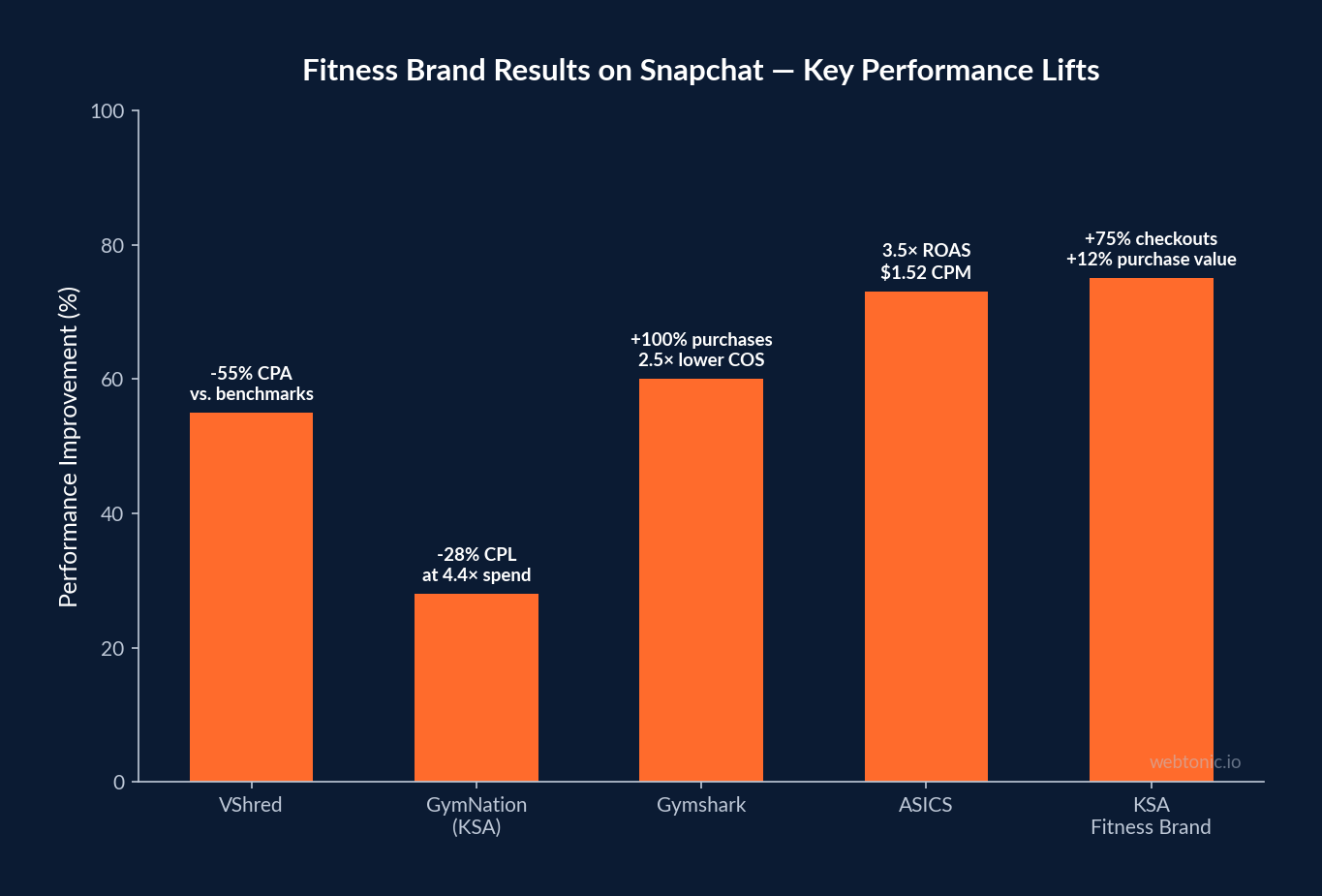
- Fitness brands on Snapchat see CPAs up to 55% lower than on competing platforms, with VShred increasing its Snapchat budget by 360% while maintaining stable cost per action year over year.
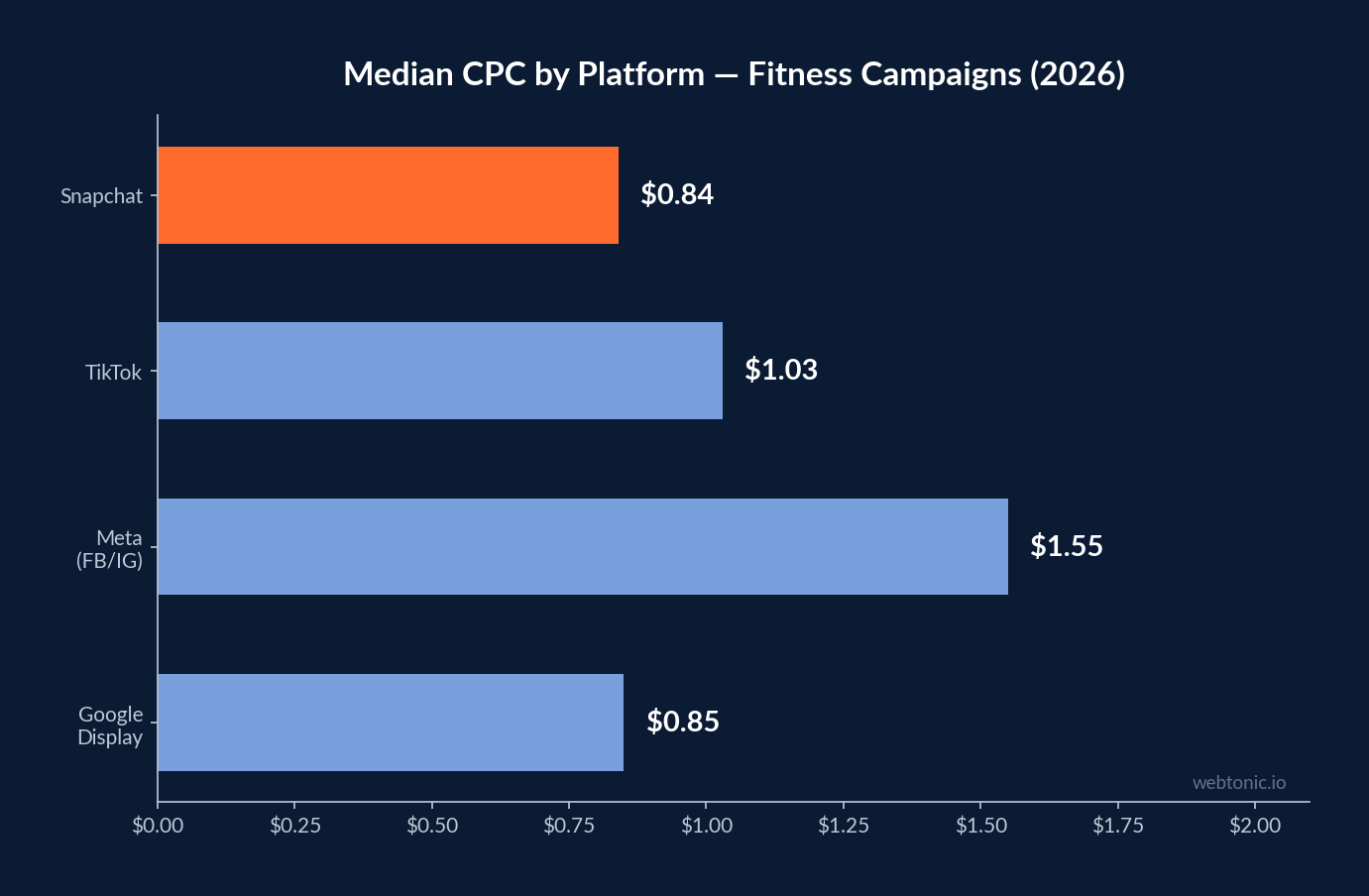
- The median Snapchat CPC sits at $0.84, materially cheaper than Meta's typical $1.10–$2.00 range, and CPMs average $5.84–$8.39 depending on the objective and targeting.
- GymNation generated 6.2× more leads while cutting CPL 28% by scaling Snapchat spend 4.4× — proving the platform's efficiency at volume for gym membership acquisition.
- Gymshark achieved 100% more purchases and 2.5× lower cost of sale using Story Ads with Lookalike Audiences and Snap Pixel targeting in the US, UK, and Canada.
- Snap's total Q1 2026 revenue hit $1.53 billion (+12% YoY), with advertising revenue at $1.24 billion and AI-powered Sponsored Snaps now driving new conversion opportunities for fitness advertisers.
- AR Lenses deliver an 8-point Brand Association lift for fitness brands, with share rates of 6.0–6.4% — far above standard ad engagement on most social platforms.
Snapchat Advertising Benchmarks for Fitness Brands at a Glance
These benchmarks compile data from multiple agency studies and platform reports, giving fitness marketers a realistic picture of what to expect when advertising on Snapchat in 2026.
| Metric | Fitness / Wellness Benchmark | Cross-Industry Average | Source |
|---|---|---|---|
| Median CPC | $0.84 | $0.90–$1.02 | AdLiftr / AdCredits |
| Average CPM | $5.84–$8.39 | $8.39–$9.63 | Hackceleration / AdCredits |
| Link CTR | 0.94%–1.2% | 0.94% | ATTN Agency / AdCredits |
| Engagement Rate | 1.9% | 1.2% | ATTN Agency |
| Avg. CPA (Lead Gen) | $27–$42 | $42.80 (local services) | AdLiftr |
| AR Lens Share Rate | 6.0–6.4% | 4.2% | Basic-Fit / Snap |
| Story Ad Purchase Lift | +100% | N/A | Gymshark / Snap |
Snapchat vs. Other Platforms: Fitness Ad Cost Comparison
One of Snapchat's key advantages for fitness advertisers is its lower cost structure compared to Meta and TikTok. According to AdLiftr's 2026 benchmark study, the median Snapchat CPC of $0.84 is roughly 24–58% cheaper than Meta for comparable creative. The platform's CPM of $5.84 to $8.39 also undercuts Meta's typical range for health and wellness campaigns.
For fitness brands running growth marketing campaigns, this cost advantage translates into more efficient prospecting. ASICS reported a $1.52 CPM and 3.5× ROAS on their Sponsored Snap campaigns, with 58% of purchases coming from Gen Z — their priority demographic (Snap for Business).
| Platform | Median CPC | Median CPM | Typical Fitness CTR | Relative Cost Index |
|---|---|---|---|---|
| Snapchat | $0.84 | $5.84–$8.39 | 0.94–1.2% | 1.0× (baseline) |
| Meta (Facebook/IG) | $1.10–$2.00 | $8.50–$14.00 | 0.80–1.1% | 1.3–2.4× |
| TikTok | $0.55–$1.50 | $6.00–$12.00 | 1.02% | 0.7–1.8× |
| Google Display | $0.50–$1.20 | $3.00–$8.00 | 0.35–0.50% | 0.6–1.4× |
Snapchat Platform Growth and Advertising Revenue
Snap's Q1 2026 earnings revealed total revenue of $1.529 billion, up 12% year over year, with advertising revenue contributing $1.243 billion (PPC Land). Daily active users reached 483 million globally, returning to global growth. The launch of AI-powered Sponsored Snaps introduced new conversion pathways that fitness brands are beginning to test.
Non-advertising revenue is accelerating even faster — Snapchat+ subscriptions and other non-ad revenue hit $285 million in Q1 2026, up 87% YoY (Digital Applied). For fitness advertisers, this signals that Snap is investing heavily in user retention and premium features, which deepens daily engagement and extends time-on-platform.
In the U.S., Snapchat will have 46.4 million Gen Z users in 2026, putting it close behind TikTok in this critical age bracket (SocialPilot). Given that 72.4% of fitness website traffic comes from mobile devices (CuFinder), Snapchat's mobile-native, full-screen ad format is naturally aligned with how gym-goers consume content.
Fitness Brand Case Studies: Real Snapchat Ad Performance
Snap's official case study library contains several fitness-specific success stories with verified performance metrics. These provide concrete benchmarks beyond platform-wide averages.
| Brand | Campaign Type | Key Result | Additional Metric |
|---|---|---|---|
| VShred (Kendago) | Full-funnel conversion | 55% lower CPA vs. other platforms | 360% budget increase, stable CPA YoY |
| GymNation (KSA) | Lead generation | 6.2× more leads | 28% lower CPL, 4.4× spend increase |
| Gymshark | Story Ads conversion | 100% more purchases | 2.5× lower cost of sale |
| Basic-Fit | AR Lens + brand awareness | 8-pt Brand Association lift | 6.4% share rate (France: 15-pt Ad Awareness) |
| McFIT | Full-funnel, multi-format | Incremental online memberships | Q5 seasonal activation |
| PureGym | Conversion-focused | Efficient cost-per-purchase | Shifted larger budget share to Snap |
| ASICS | Sponsored Snaps | 3.5× ROAS | $1.52 CPM, 58% Gen Z purchases |
VShred's results are particularly instructive for fitness subscription brands: the 55% CPA reduction versus other platforms drove a 360% budget increase on Snapchat while maintaining consistent cost per action (Snap for Business). Similarly, GymNation's KSA campaign proved that gym lead generation can scale on the platform — scaling spend 4.4× while reducing CPL by 28%.
AR Lenses and Interactive Creative Formats for Fitness
Snapchat's AR capabilities offer fitness brands a unique engagement layer that no other major ad platform can replicate at scale. Basic-Fit's AR-powered campaign delivered an 8-point increase in Brand Association and a 6.4% share rate (Snap for Business). In France, the same campaign achieved a 15-point increase in Ad Awareness with an equally strong 6% share rate.
The fitness industry is well-suited for AR advertising because workouts are inherently visual and interactive. Sweat, the fitness app from Kayla Itsines, launched a 3D AR workout lens that let Snapchatters earn points based on exercise form accuracy — gamifying the ad experience while showcasing the app's core value proposition.
For performance creative teams, AR Lenses represent a mid-funnel engagement tool that builds brand recall before retargeting with conversion-focused Story Ads or Collection Ads.
Snapchat Audience Demographics for Fitness Marketers
Understanding Snapchat's user composition is critical for fitness brands evaluating the platform. The platform reaches 483 million daily active users globally as of Q1 2026, with North America accounting for approximately 55.5% of total revenue (Axis Intelligence). The platform's audience skews young: 46.4 million Gen Z users in the U.S. represents one of the densest concentrations of 18–29 year-olds on any social platform.
For gym chains and fitness app brands, this demographic alignment is a strategic advantage. The 18–29 age group has the highest gym membership penetration rate of any demographic, and their mobile-first behavior — 72.4% of fitness website traffic is mobile (CuFinder) — makes Snapchat's full-screen, vertical-first format a natural fit. Unlike older platforms where fitness content competes with news and family updates, Snapchat's Discover and Stories environments are designed for entertainment and lifestyle content, which naturally accommodates workout tutorials, gym tours, and transformation stories.
The average Snapchat user opens the app 40+ times per day, creating multiple daily touchpoints for fitness advertisers. This frequency advantage is particularly valuable for gym brands running membership promotions — repeated exposure over a short timeframe drives trial visit bookings and free pass redemptions more effectively than platforms with lower daily open rates.
Snapchat Ad Format Performance for Fitness Campaigns
Snapchat offers several ad formats, each suited to different fitness marketing objectives. Understanding format-level performance helps allocate creative production resources efficiently.
Story Ads have proven most effective for fitness conversion campaigns. Gymshark's six-card Story Ad narratives, tailored by exercise type and activity level, delivered 100% more purchases and 2.5× lower cost of sale (CaseStudies.com). The multi-card format allows fitness brands to tell a complete story — from workout demonstration to product benefit to purchase CTA — without leaving the user's content stream.
Sponsored Snaps, Snap's newest format powered by AI, offer direct response capabilities similar to chat-based marketing. ASICS achieved 3.5× ROAS on Sponsored Snap campaigns with an exceptionally low $1.52 CPM, and 58% of resulting purchases came from Gen Z — confirming that the format resonates with Snapchat's core demographic. The AI-powered targeting optimization reduced the need for manual audience refinement, making it accessible for fitness brands without dedicated performance creative teams.
Collection Ads and Dynamic Product Ads work best for fitness e-commerce brands selling supplements, activewear, or equipment. These catalog-driven formats pull product imagery directly from the brand's feed and optimize display based on user signals, similar to Meta's Dynamic Product Ads but at Snapchat's lower CPM price point.
Best Practices for Fitness Snapchat Ad Campaigns
- Lead with full-screen, vertical video creative — Snapchat's immersive format mirrors how users interact with the platform organically, so ads that feel native outperform polished studio content.
- Use Snap Pixel and CAPI for signal quality — a KSA fitness brand saw 75% more checkouts and 12% higher purchase value after improving signal accuracy through better event data (Journify).
- Layer Lookalike Audiences with interest targeting — Gymshark's Story Ads campaign combined Lookalike Audiences from Snap Pixel data with activity-level interest targeting to reach women 18–45 across three countries.
- Allocate budget for full-funnel activation — McFIT's Q5 multi-format strategy combined awareness formats (Lenses, Commercials) with conversion formats (Story Ads, Dynamic Product Ads).
- Test AR Lenses for mid-funnel engagement — Basic-Fit's AR campaign showed brand association lifts comparable to TV advertising at a fraction of the cost.
- Scale spending confidently with CPL guardrails — GymNation scaled spend 4.4× while cutting CPL 28%, proving that paid social platforms can maintain efficiency at higher budgets.
- Leverage Snapchat's younger demo skew — with 46.4M Gen Z users in the U.S. alone, the platform is ideal for fitness brands targeting the 18–29 age group where gym membership acquisition costs are typically lowest.
Fitness vs. Other Industries on Snapchat
Fitness brands enjoy a structural advantage on Snapchat because their target audience — young, mobile-first, health-conscious consumers — over-indexes on the platform. Here's how fitness ad performance compares to other major verticals:
| Industry | Typical CPA | Avg. CTR | Platform Fit Score | Notes |
|---|---|---|---|---|
| Fitness & Wellness | $27–$42 | 0.94–1.2% | ★★★★★ | Strong Gen Z overlap, visual content |
| E-commerce (DTC) | $18–$35 | 1.0–1.5% | ★★★★☆ | Strong for apparel/supplements |
| Mobile Apps (Fintech) | $34–$59 | 0.7–0.9% | ★★★☆☆ | High LTV justifies higher CPA |
| Local Services (US) | $42–$71 | 0.5–0.8% | ★★☆☆☆ | Younger audience is a weaker fit |
| Gaming | $8–$20 | 1.2–2.0% | ★★★★★ | Highest engagement on Snap |
Signal Quality and Measurement Optimization
Ad signal quality has become a decisive factor in Snapchat campaign performance for fitness brands. A KSA-based fitness brand working with Journify demonstrated this dramatically: after migrating to improved event tracking, checkouts grew 75% and total purchase value rose 12%. The improvement came not from creative or audience changes, but from giving Snap's algorithm better data about which users actually converted.
For fitness membership businesses, signal quality optimization includes implementing the Snap Pixel on all conversion-critical pages (membership signup, class booking, free trial request), configuring the Conversions API (CAPI) for server-side event deduplication, and ensuring that offline conversions — gym visits after an online ad click — are fed back into the platform for optimization. Fitness brands running campaigns across multiple objectives should use separate Pixel events for each conversion type (lead form submission, membership purchase, app download) rather than a single generic "Purchase" event, which allows Snap's algorithm to optimize delivery for the specific action each campaign targets.
The ATTN Agency benchmark study found that Gen Z fitness campaigns on Snapchat achieve engagement rates of 1.9% versus a cross-industry average of 1.2%, but ROAS of $1.52 versus $1.27 for Gen Z non-fitness campaigns (ATTN Agency). This suggests that fitness audiences engage deeply with Snap ads but require robust attribution to measure full-funnel value beyond last-click purchase events.
Frequently Asked Questions
How much do Snapchat ads cost for fitness businesses?
Fitness brands typically pay a median CPC of $0.84 and CPMs between $5.84 and $8.39 on Snapchat. Lead generation campaigns for gyms see CPAs in the $27 to $42 range, significantly below Meta's typical fitness CPA. The minimum daily budget starts at just $5, though most fitness advertisers allocate $20–$50 per day for meaningful data collection.
Is Snapchat effective for gym membership acquisition?
Yes — multiple gym chains have demonstrated strong results. GymNation scaled Snapchat spend 4.4× while cutting CPL by 28%, generating 6.2× more leads. PureGym reported an efficient cost-per-purchase that led them to shift a larger share of their overall social budget to the platform. The key is using full-funnel strategies that combine awareness formats with conversion-focused Story Ads.
What Snapchat ad formats work best for fitness brands?
Story Ads and AR Lenses deliver the strongest fitness results. Gymshark's Story Ads achieved 100% more purchases with 2.5× lower cost of sale, while Basic-Fit's AR Lens campaign lifted Brand Association by 8 points with a 6.4% share rate. For app-install campaigns, Snap's full-screen video format outperforms because it mirrors how users naturally engage with the platform.
How does Snapchat's audience compare to TikTok for fitness marketing?
Snapchat reaches 46.4 million Gen Z users in the U.S., slightly behind TikTok in this demographic. However, Snapchat's cost structure is generally cheaper — the median CPC of $0.84 is 24–58% below Meta and competitive with TikTok. Snapchat users tend to be slightly younger (skewing 13–24) compared to TikTok's broader 18–34 sweet spot, which makes Snap better suited for brands targeting college-age and early-career fitness consumers.
What ROAS can fitness brands expect from Snapchat ads?
ROAS on Snapchat for fitness varies by campaign type. ASICS reported 3.5× ROAS on Sponsored Snap campaigns and up to 11× ROAS on prospecting campaigns. For Gen Z-focused fitness campaigns, ATTN Agency data shows ROAS around $1.52 with higher engagement rates but lower direct purchase intent compared to Meta. Fitness e-commerce brands selling supplements or apparel typically see 2.0–3.5× ROAS when using data intelligence to optimize audience targeting.
Sources
AdLiftr — Snapchat Ads Cost 2026: CPM, CPC, CPA Benchmarks
Axis Intelligence — Snapchat Statistics 2026
PPC Land — Snap Q1 2026 Revenue Analysis
AdCredits Expert — Snapchat Ads Pricing 2026
Hackceleration — Snapchat Ads Pricing Data
Snap for Business — VShred Case Study
Snap for Business — GymNation KSA Case Study
CuFinder — Fitness and Wellness Marketing Benchmarks 2026
ATTN Agency — Snapchat Ads for Gen Z Brands
Journify — KSA Fitness Brand Signal Quality Case Study