Table of contents
Fitness businesses do not cold email prospective members - membership growth runs through local search, referrals and trial offers. Cold email has a real job in this industry pointed at a different target: corporate wellness buyers, HR benefits leaders, franchise development prospects and equipment vendors. This page benchmarks that B2B channel against vendors' own 2025-2026 platform data.
Key Takeaways
- Woodpecker's platform data shows a 26% median open rate across 37,000 campaigns.
- The same dataset shows a 1.5% median reply rate across 56,614 campaigns.
- Belkins' 2026 study reports a stricter 0.45% average reply rate across 7.5 million emails.
- Instantly's 2026 benchmark reports a 3.43% platform-wide average, with top performers exceeding 10%.
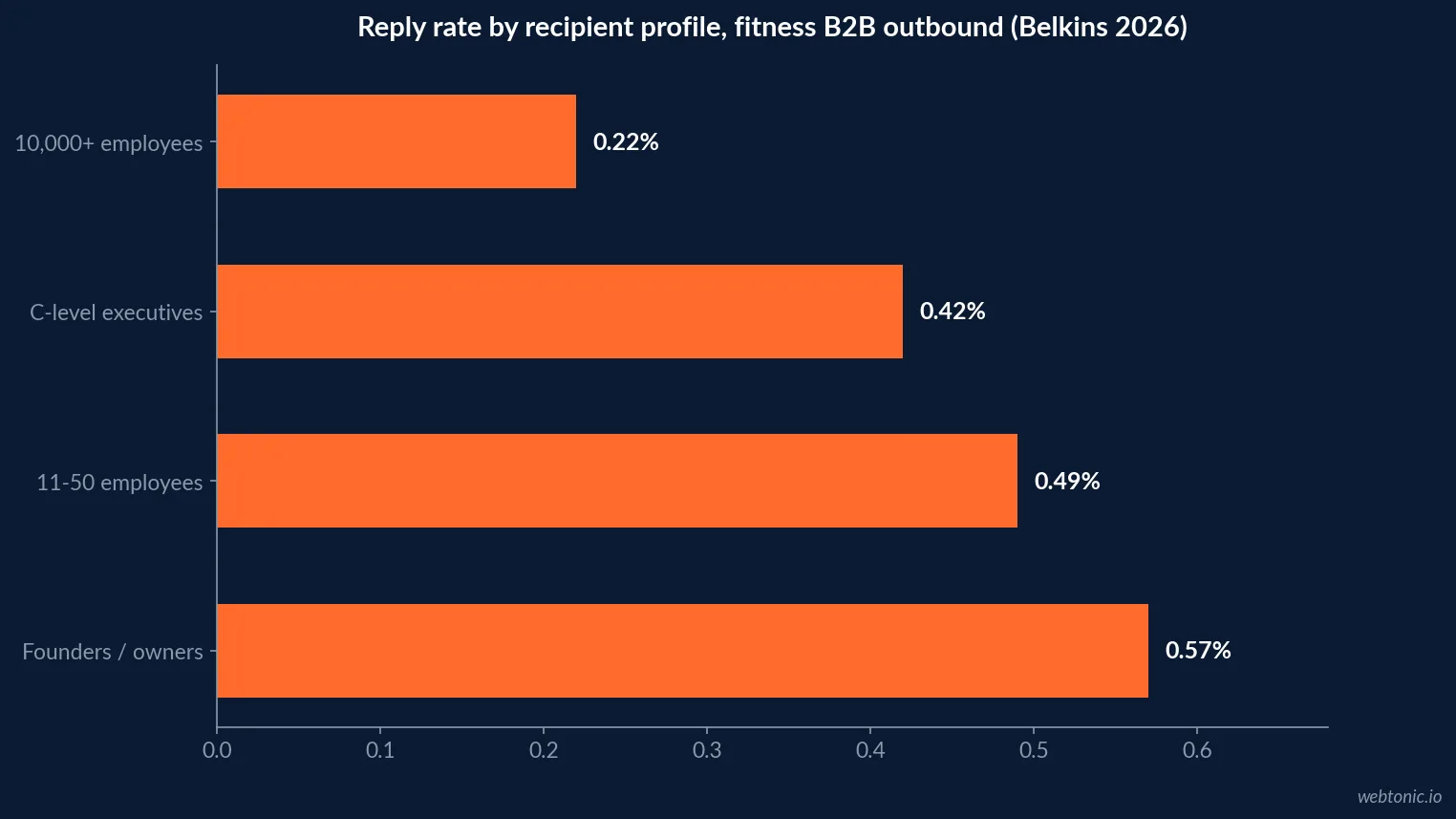
- Companies with 11-50 employees reply at 0.49% in Belkins' data.
- Enterprises of 10,000-plus employees reply at just 0.22% - less than half the smaller-company rate.
- The first half of 2025 averaged a 0.50% reply rate, dropping 20% to 0.40% in the second half.
- December 2025 hit the year's low at 0.35% in the same monthly trend.
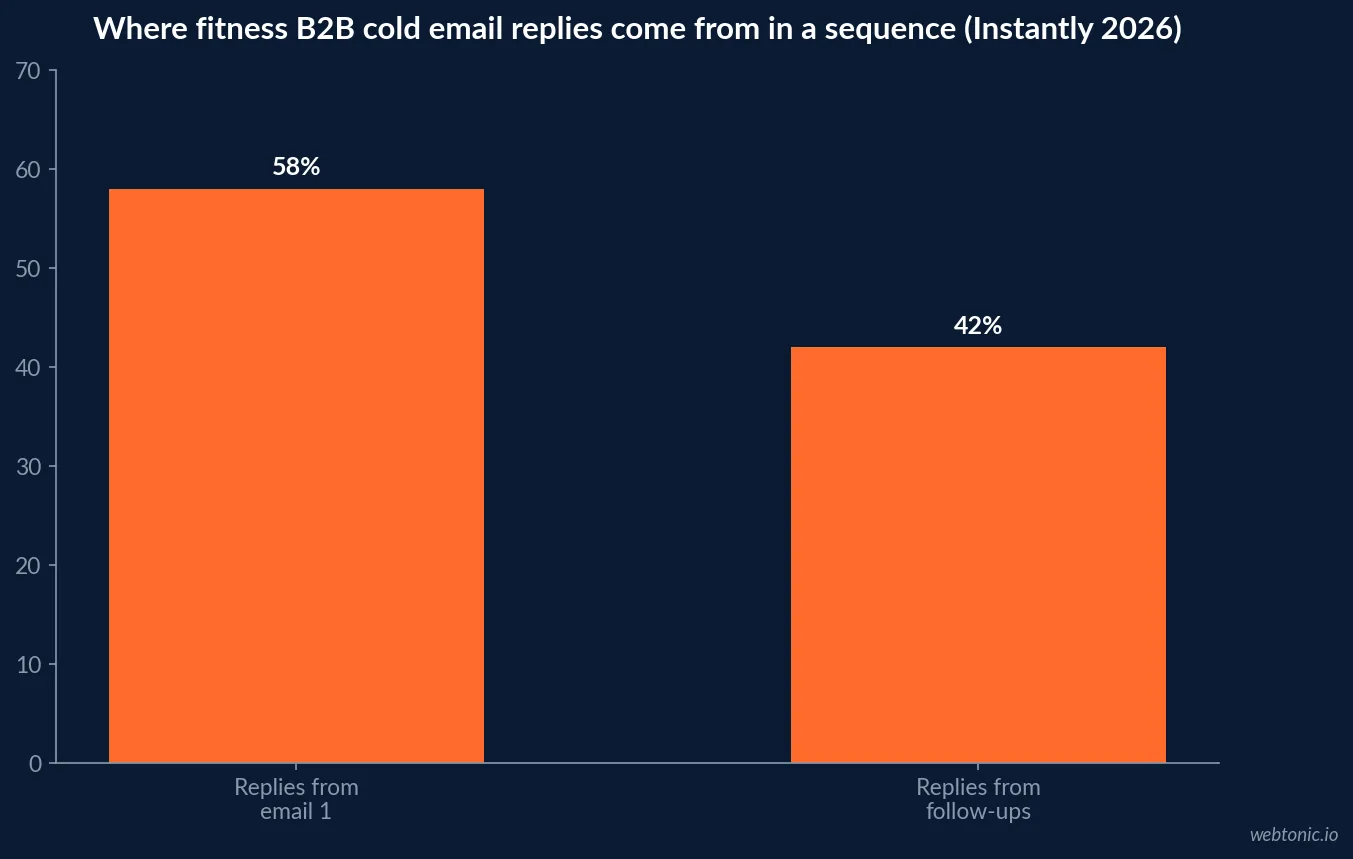
- 58% of all replies in Instantly's data come from the first email, not a follow-up.
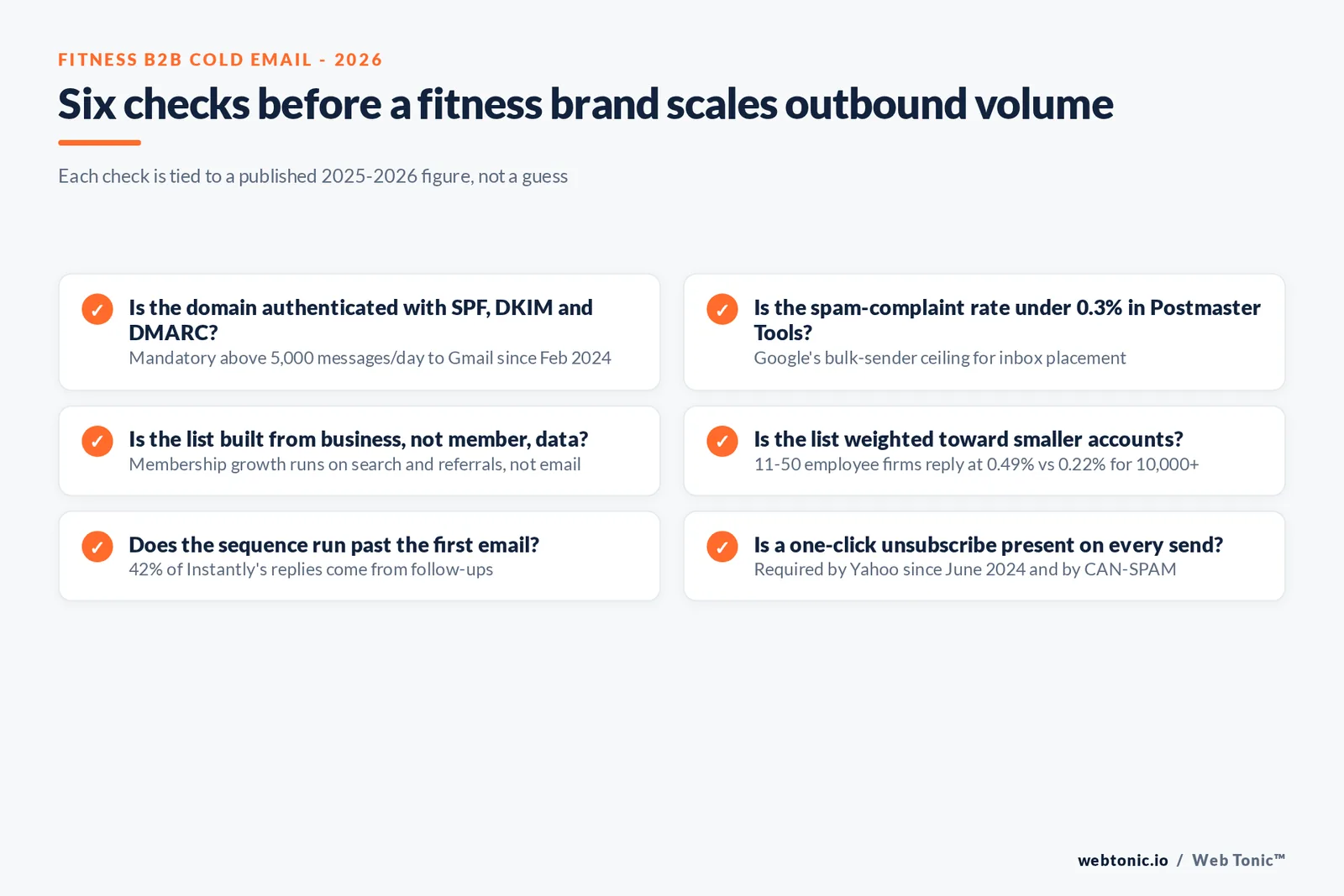
- Google requires SPF, DKIM and DMARC from any sender pushing 5,000-plus daily messages since February 2024.
- Google caps bulk-sender spam complaints at 0.3% in Postmaster Tools.
- InMails are accepted 6 times more often than cold email, per LinkedIn's own 2022 data.
- A record 81 million Americans belonged to a fitness facility in 2025, per the Health & Fitness Association's 2026 report.
- That is 26.1% of the U.S. population aged 6 and up, the highest penetration on record.
- CAN-SPAM requires opt-outs honored within 10 business days, per 16 CFR Part 316.
Where cold email actually fits in a fitness operator's funnel
The consumer side of fitness marketing - trial offers, referral programs, local SEO, paid social - has nothing to do with cold email, and pretending otherwise wastes a domain's sending reputation on people who will never open a B2B pitch. Cold email's real job is reaching businesses: HR and benefits leaders evaluating a corporate wellness partnership, employers negotiating a discounted group membership, other studio or gym owners in a franchise development conversation, and equipment, flooring or facility vendors on the supply side. Every figure below is drawn from B2B outbound platforms' own labelled data, none of it fitness-specific.
The open-rate and reply-rate gap
Woodpecker's platform data puts the median open rate at 26% across 37,000 campaigns and the median reply rate at 1.5% across 56,614 campaigns - a wide gap that the vendor attributes partly to tracking-pixel blocking (Apple Mail Privacy Protection among others), which makes open rate the noisier of the two metrics. Instantly's 2026 report puts its platform-wide average reply rate at 3.43%, with 58% of all replies generated from the first email in a sequence and the remaining 42% from follow-ups - a reason not to abandon a sequence after one send, even at fitness-industry volumes.
| Metric (2025-2026 vendor data) | Figure | Sample | Source |
|---|---|---|---|
| Median open rate | 26% | 37,000 campaigns | Woodpecker |
| Median reply rate | 1.5% | 56,614 campaigns | Woodpecker |
| Average reply rate, platform-wide | 3.43% | Billions of emails | Instantly |
| Share of replies from email 1 of a sequence | 58% | Platform-wide | Instantly |
| Average reply rate, strict total-send basis | 0.45% | 7.5 million emails, 2025 | Belkins |
Company size changes who replies to a wellness partnership pitch
Belkins' 2026 study found companies with 11-50 employees replied at 0.49%, while enterprises of 10,000-plus employees replied at just 0.22% - less than half the rate. The same data shows the first half of 2025 averaged a 0.50% reply rate before dropping 20% to 0.40% in the second half, bottoming at 0.35% in December. For a fitness operator choosing between chasing one large national wellness contract and building a portfolio of regional employer and franchise-development leads, the size data argues for the portfolio - and the seasonal trend argues for front-loading outreach earlier in the year.
| Recipient company size | Reply rate (Belkins 2026) | Fitness B2B target this maps to |
|---|---|---|
| 11-50 employees | 0.49% | Independent studios in franchise development talks |
| Founders/owners (any size) | 0.57% | Single-location gym and studio owners |
| C-level executives | 0.42% | Regional employer benefits leaders |
| 10,000+ employees | 0.22% | National corporate wellness programs |
Deliverability rules that apply the moment volume scales
Since February 1, 2024, Google's sender guidelines require SPF or DKIM from every sender to Gmail addresses, and senders of 5,000 or more messages a day must add DMARC and hold the Postmaster Tools spam-complaint rate under 0.3%. Yahoo's Sender Hub confirms the equivalent requirement took effect the same month, with one-click unsubscribe enforcement added in June 2024. A multi-location fitness brand running franchise-development or wellness-partnership outbound at any real volume crosses that 5,000-message threshold quickly once it is emailing across dozens of markets, and needs the authentication in place before it does.
| Rule | Effective | Threshold | Requirement |
|---|---|---|---|
| Google, all senders | Feb 1, 2024 | Any volume | SPF or DKIM |
| Google, bulk senders | Feb 1, 2024 | 5,000+/day to Gmail | SPF + DKIM + DMARC, spam rate under 0.3% |
| Yahoo, bulk senders | Feb 2024 (enforcement) | Bulk volume, unspecified threshold | Equivalent authentication |
| Yahoo, one-click unsubscribe | June 2024 | Promotional/marketing mail | One-click unsubscribe link required |
| CAN-SPAM | Ongoing (FTC / 16 CFR 316) | Any commercial email | Accurate headers, 10-day opt-out |
The industry backdrop that makes B2B outreach worth building
The Health & Fitness Association's 2026 US Consumer Report found a record 81 million Americans belonged to a gym, studio or other fitness facility in 2025, pushing membership penetration to 26.1% of the population aged 6 and older - the highest on record. That scale is exactly why corporate wellness buyers keep showing up as a viable B2B account for fitness operators: employers with a fitness-inclined workforce are easier to sell a group benefit into, which is the whole premise behind targeting them with outbound in the first place.
LinkedIn versus email for the highest-value targets
LinkedIn's own 2022 analysis of every Sales Navigator InMail sent that year found InMails accepted 3 times more often than a cold call and 6 times more often than a cold email, with a complete profile lifting acceptance by 87%. That edge is worth using on a short list of national wellness-program buyers or franchise development targets; it does not scale economically across the hundreds of regional employer contacts a volume email program can reach for a fraction of the cost. Our growth marketing practice builds both channels into one account plan rather than picking one - talk to us about which mix fits a given fitness brand's B2B targets.
Frequently Asked Questions
Do fitness studios cold email prospective members?
No - membership growth runs through local search, referrals, trial offers and social proof, not cold outbound. Cold email has a real, narrower job in the fitness industry: reaching corporate wellness buyers evaluating a gym partnership benefit, HR and benefits leaders at employers, franchise development targets for multi-unit operators, and equipment or facility vendors negotiating supply terms. Every benchmark on this page describes that B2B channel, not consumer acquisition.
What open and reply rates should a fitness operator's B2B outbound expect?
Woodpecker's platform data across 37,000 campaigns puts the median open rate at 26% and the median reply rate at 1.5% across 56,614 campaigns. Belkins' 2026 study of 7.5 million emails reports a stricter 0.45% average reply rate measured against total sends. Instantly's 2026 benchmark reports 3.43% platform-wide with top performers over 10%. None of these studies are fitness-specific, so use the range, not a single number, to set a first-campaign target.
Does company size change who replies to a fitness partnership pitch?
Yes, and the direction favors smaller accounts. Belkins' 2026 data shows companies with 11-50 employees reply at 0.49%, while enterprises of 10,000-plus employees reply at just 0.22% - useful for a studio deciding whether to chase a single national wellness contract or a portfolio of regional employers and franchise groups that reply more often per email sent.
What do the Google and Yahoo 2024 rules mean for a fitness brand's outbound domain?
Since February 2024, Google requires SPF and DKIM from every sender to Gmail addresses, and anyone sending 5,000 or more messages a day must add DMARC and keep the spam-complaint rate under 0.3% in Postmaster Tools, per Google's own sender guidelines. Yahoo's Sender Hub enforces an equivalent bar. A studio chain running B2B outreach from the same domain that sends member billing and class-booking emails risks deliverability for both if the outbound program is not authenticated and warmed separately.
Is LinkedIn worth using instead of email for corporate wellness pitches?
For a short list of high-value targets, yes. LinkedIn's own 2022 analysis of Sales Navigator InMails found they are accepted 3 times more often than a cold call and 6 times more often than a cold email, and that a complete profile lifts acceptance by 87%. For volume outreach across dozens of regional employers, cold email's lower cost per contact and CAN-SPAM-compliant opt-out trail still make it the better default channel.
What a realistic first-campaign target looks like
Set against the vendor spread - Belkins' strict 0.45%, Woodpecker's 1.5% median and Instantly's 3.43% platform average - a fitness operator's first B2B outbound campaign should target somewhere in the 0.5% to 1.5% band on a well-built list of regional employers and franchise-development contacts, treating anything above that as evidence the list or the message is working better than the industry baseline, not as a floor to expect from campaign one. A studio chain running its first quarter of outbound should judge the program against that band, not against Instantly's reported 10%+ top-performer tier, which describes senders with years of list-building and message testing behind them.
| Sequence position (Instantly 2026) | Share of total replies | Practical read for fitness B2B outbound |
|---|---|---|
| Email 1 (initial send) | 58% | Still the single highest-value touch |
| Follow-up emails (2 through 4+) | 42% | Worth building into every wellness-partner sequence |
Building the list without touching member data
The same rule that protects a med spa's patient data applies here in spirit even without a HIPAA trigger: a fitness brand's outbound list should be built from public business sources - employer benefits directories, franchise disclosure filings, corporate wellness association member lists - never from the member database that runs billing and class bookings. Keeping the two lists structurally separate is also what keeps a B2B sending misstep from ever touching the domain that sends a member's payment receipt.
Our data and analytics practice builds and instruments that separation for multi-location fitness brands, so B2B outbound performance reports on its own dashboard rather than blending into consumer acquisition metrics.
Reading the monthly trend before scheduling a launch
Belkins' 2026 data shows the first half of 2025 outperformed the second half by a wide margin - a 0.50% average reply rate against 0.40%, a 20% decline within the same calendar year, with the weakest month, December, landing at 0.35%. A multi-location fitness brand planning its first corporate wellness or franchise-development outbound push should treat that seasonality as a scheduling constraint, not background noise: launching a first sequence in the fourth quarter stacks a program's weakest historical window on top of a program with no track record yet to fall back on.
The inverse also holds. A February launch, the single strongest month Belkins measured at 0.54%, gives a new program its best chance to post an early result worth reporting back to whoever approved the budget.
Sources
Woodpecker - Cold Email Benchmarks (platform data)
Instantly - Cold Email Benchmark Report 2026
Belkins - B2B Cold Email Response Rates, 2026 study
Google - Email sender guidelines
Yahoo - Sender Hub FAQs, 2024 requirements
Federal Trade Commission - CAN-SPAM Act Compliance Guide
eCFR - 16 CFR Part 316, CAN-SPAM Rule
Health & Fitness Association - 2026 US Health & Fitness Consumer Report
LinkedIn Sales Solutions - 2022 InMail acceptance analysis