Table of contents
No study prices account-based marketing specifically for the fitness industry, so this page builds the budget question from account math instead of a borrowed percentage. The unit of analysis is the buying committee size and win-rate data cross-industry ABM research reports, paired with the corporate wellness market data that sizes the accounts worth the effort.
Key Takeaways
- Demandbase's 2026 platform data reports a 58.7% win rate for accounts run with four advertising products.
- That is a 71% lift over accounts run with none, across the same 1,452-tenant dataset.
- Companies tracking 3-4 buying groups see a 48.5% higher win rate than those taking a broader, less structured approach.
- A typical B2B buying group includes 13 to 17 stakeholders, per Demandbase's 2026 platform data.
- 22%-plus of marketing-qualified accounts convert to pipeline with a fully integrated stack.
- The typical B2B buying group reached roughly 12 people by 2019, up from 5.4 in 2009, per Challenger.
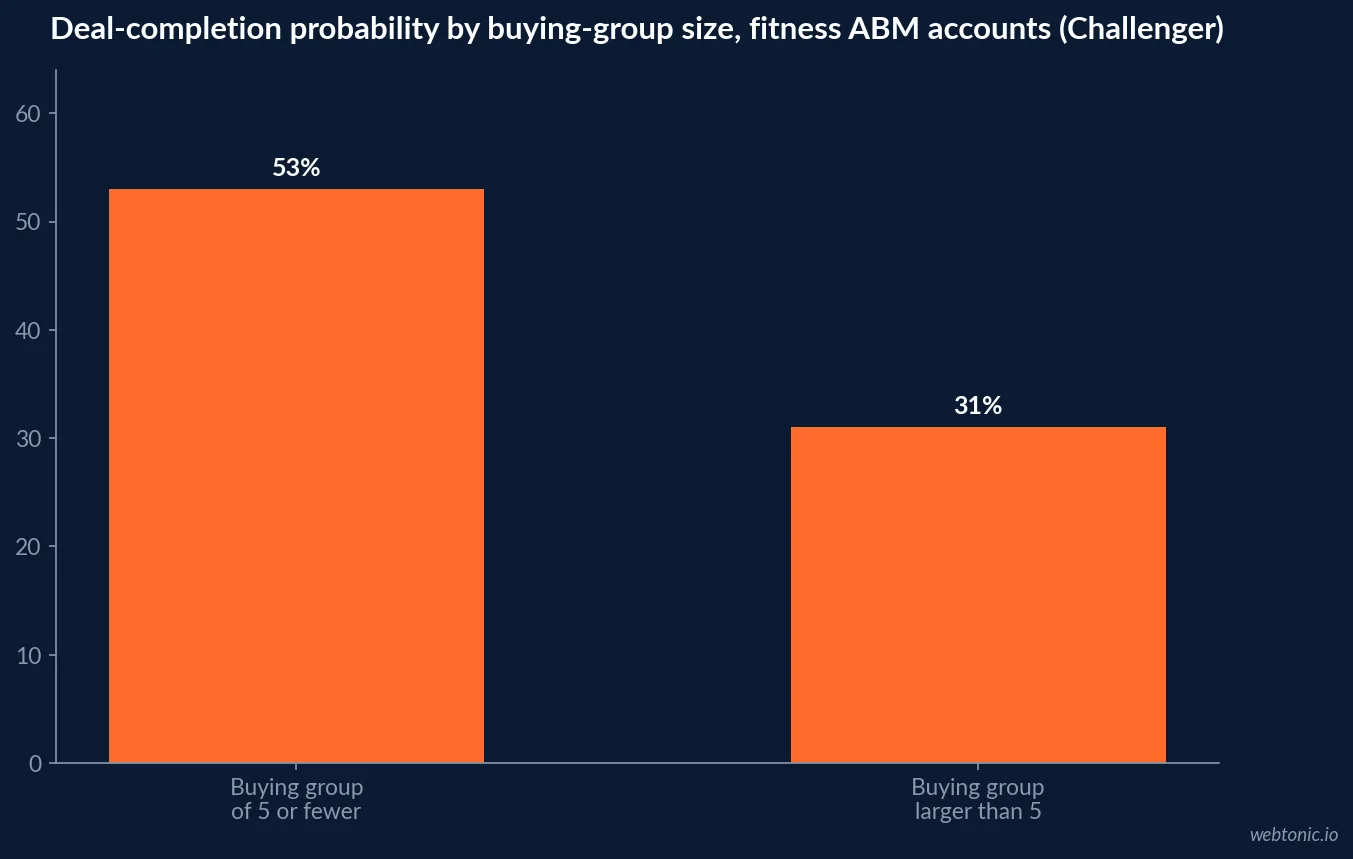
- Deal completion falls from 53% to 31% once a buying group passes five people.
- 38% of B2B purchase attempts end in "no decision" rather than a lost sale.
- Only 22% of ABM programs run on a dedicated platform, N.Rich's 2025 survey of 107 leaders found.
- Just 26% of those programs call themselves successful in the same survey.
- 67% treat ABM as a core go-to-market motion regardless of that success rate.
- The employer-sponsored wellness and fitness benefits market is estimated at $16.2 billion in 2025, forecast toward $41.8 billion by 2034.
- 95% of employers that measure wellness ROI report a positive return, Wellhub's 2026 survey of 1,500 HR leaders found.
- A record 81 million Americans held a fitness membership in 2025, 26.1% of the population aged 6 and up.
- ITSMA's benchmark study surveyed more than 200 ABM leaders for its most recent annual report.
The budget question, framed honestly
No vendor or association has published an ABM budget benchmark specific to fitness brands, so pricing this by a borrowed "X% of revenue" figure from an unrelated industry would be a guess wearing a citation. The defensible way to size a first ABM budget is by account count and buying-committee size, both of which cross-industry research does measure - and then to price the tooling question separately, once a manual program has proven which accounts are worth it.
What the account actually looks like: buying-committee size
Challenger's tracking shows the typical B2B buying group grew from 5.4 people in 2009 to 6.8, then 10.2, then just under a dozen by 2019 - and that once a group passes five people, the odds of completing a purchase fall from 53% to 31%. Its separate research on customer indecision found 38% of purchase attempts end in "no decision." Demandbase's 2026 platform data confirms the modern range: a typical buying group now runs 13 to 17 stakeholders per account - closer to Challenger's 2019 figure than its 2009 one - while win rates separately peak when a program tracks 2 to 3 buying groups per product, which is the committee size a corporate wellness or multi-site franchise decision now realistically involves.
| Buying-group data point | Figure | Source | Budget implication |
|---|---|---|---|
| Buying group size, 2009 | 5.4 people | Challenger | Single-champion outreach once worked |
| Buying group size, 2019 | ~12 people | Challenger | Budget for multi-stakeholder content, not one pitch |
| Deal completion, group > 5 | 31% (down from 53%) | Challenger | Concentrate spend on fewer, mapped accounts |
| Typical buying group size | 13-17 stakeholders | Demandbase 2026 | Matches modern corporate wellness committees |
| Purchase attempts ending in no decision | 38% | Challenger | Budget for a longer nurture, not just first contact |
The return data: does concentrating spend actually pay off
Demandbase's inaugural State of ABM 2026 report, built from 1,452 of its own tenants and 9.7 million sales interactions, reports a 58.7% win rate for accounts run with four advertising products working together against those accounts - a 71% lift over accounts run with none - and companies tracking 3-4 buying groups per product saw a 48.5% higher win rate than those taking a broader, less structured approach. That is platform data describing Demandbase's own customer base across industries, not a fitness-specific result, but it is the strongest evidence available in 2026 that concentrating budget on fewer, better-mapped accounts outperforms spreading the same spend across a broad, shallow list.
| Program depth (Demandbase 2026) | Win rate | Lift vs. baseline |
|---|---|---|
| 0 advertising products active | ~34.3% (implied baseline) | Baseline |
| 4 advertising products active | 58.7% | +71% vs. baseline |
| 3-4 buying groups tracked per product | +48.5% relative lift | vs. a broader, less structured approach |
| Fully integrated CRM/MAP/predictive stack | 22%+ MQA-to-pipeline | vs. fragmented tooling |
Should tooling be part of the first budget?
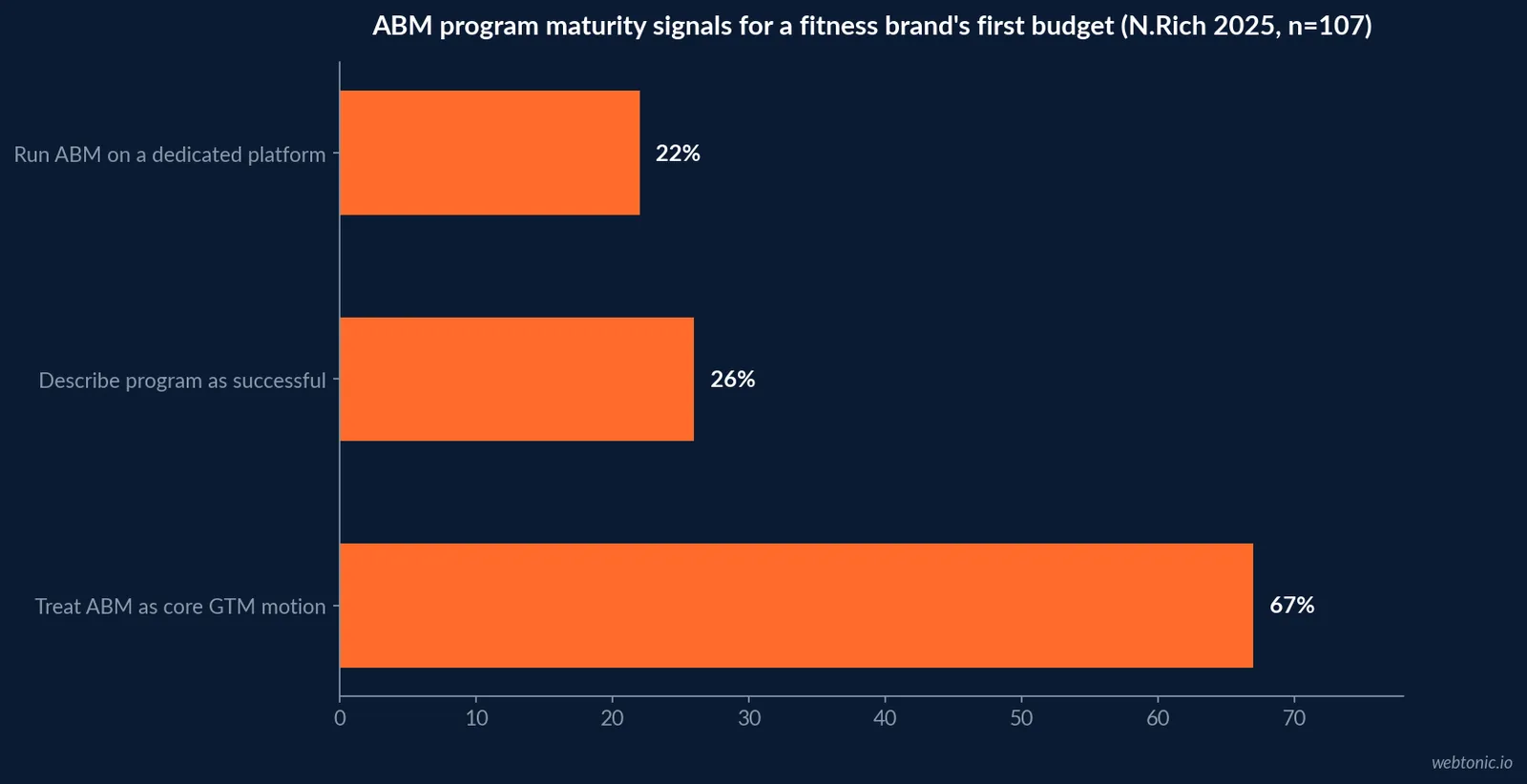
N.Rich's 2025 State of ABM report, surveying 107 B2B go-to-market leaders, found 67% treat ABM as a core go-to-market motion, but only 26% call their program successful and just 22% run it on a dedicated ABM platform - most still work from LinkedIn, a CRM and spreadsheets. Demandbase, Terminus and 6sense all sell on custom, sales-gated quotes rather than published list pricing, which means the honest first-year budget line for a fitness brand is headcount time to build and run the account map manually, with a platform evaluation held for year two once the account list and messaging are proven.
| ABM maturity signal (2025-2026) | Figure | Source | First-budget implication |
|---|---|---|---|
| Treat ABM as core GTM motion | 67% | N.Rich 2025 | Budget the discipline, not just a campaign |
| Describe program as successful | 26% | N.Rich 2025 | Most spend is not yet proving out |
| Run ABM on a dedicated platform | 22% | N.Rich 2025 | Tooling is a second-stage purchase |
| ABM leaders surveyed, most recent annual study | 200+ | ITSMA / ABM Leadership Alliance | Strategy commitment still outruns execution |
Sizing the accounts: what the employer side of fitness is worth
The employer-sponsored corporate wellness and fitness benefits platform market is estimated at $16.2 billion in 2025, forecast to reach $41.8 billion by 2034 at an 11.2% compound annual growth rate, according to a 2026 market research report. Wellhub's own 2026 survey of 1,500 HR and benefits leaders across 10 markets found 95% of the companies that actually measure their wellness program's ROI report seeing a positive return - the buyer-side confidence that makes this an account worth a dedicated budget line rather than a side effect of consumer marketing. The backdrop on the supply side is just as large: the Health & Fitness Association's 2026 report counted a record 81 million Americans holding a fitness membership in 2025, 26.1% of the population aged 6 and up.
A first-year budget shape, stated as a model
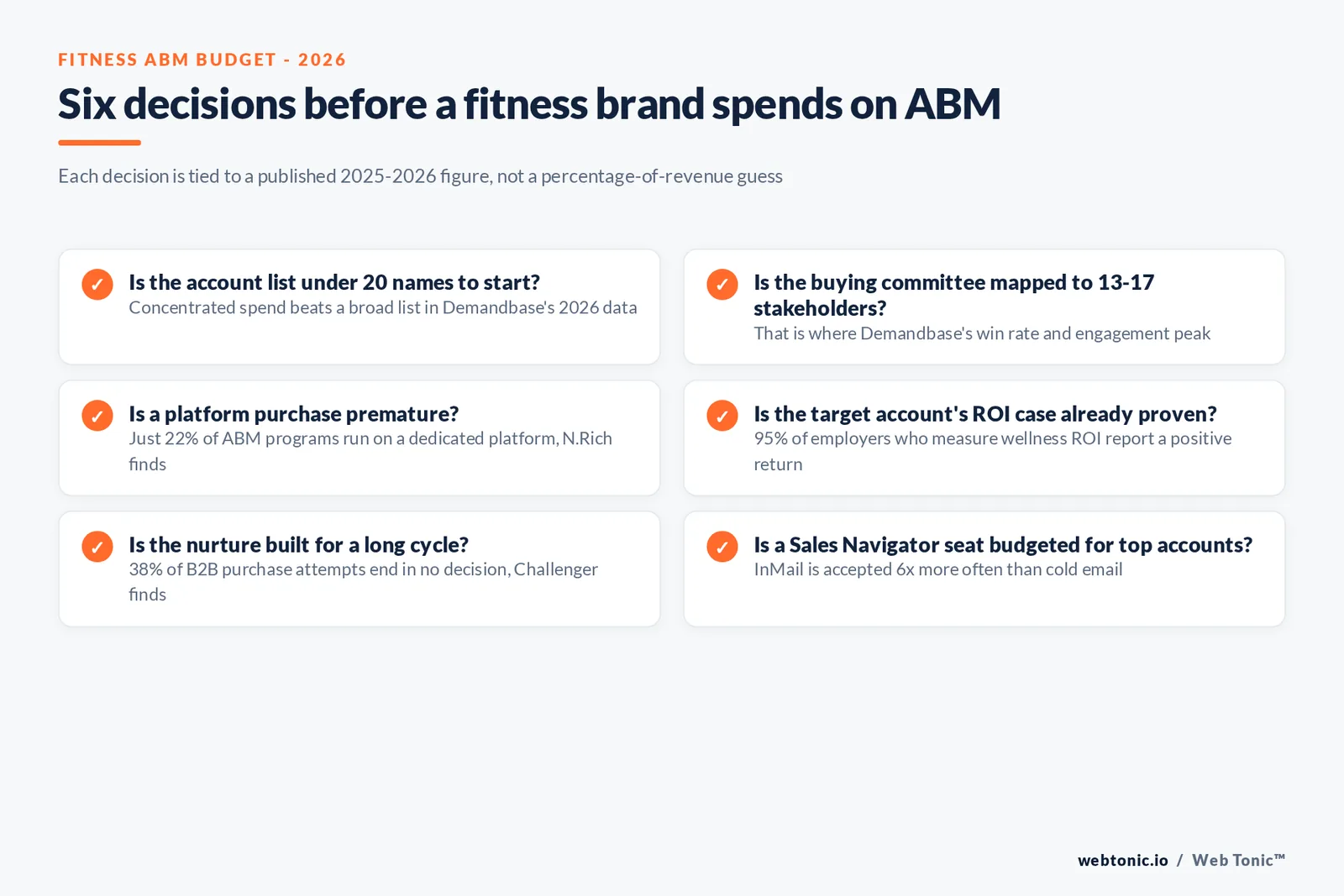
Given the data above, the defensible first-year ABM budget for a fitness brand is not a percentage of marketing spend - it is a headcount allocation to map 10 to 20 corporate wellness and franchise-development accounts at the 13-to-17-stakeholder size Demandbase's data measures, a Sales Navigator seat for the highest-value contacts, and existing CRM fields rather than new platform spend. Only once that list shows the win-rate lift the platform data predicts does a Demandbase, Terminus or 6sense contract become a defensible next line item. None of the three publishes list pricing; third-party trackers that estimate their contracts at tens of thousands of dollars a year are not vendor sources, which is exactly why this page prices the manual first stage instead of guessing at year-two software cost. Our growth marketing practice builds that first account map, and a conversation with us is the right way to scope it before any platform quote is requested.
Frequently Asked Questions
What should a fitness brand budget for ABM?
No published study prices ABM specifically for the fitness industry, so the honest answer is built from account count, not a percentage. A short list of a dozen corporate wellness and franchise accounts, run through an existing CRM with a Sales Navigator seat for outreach, costs closer to a part-time headcount allocation than a platform contract. Demandbase-grade ABM platforms are sold on custom, sales-gated quotes rather than published pricing, so a first program should prove the account list and message before evaluating that spend.
Who sits on a corporate wellness buying committee, and why does the number matter for budget?
Demandbase's 2026 platform data, drawn from 1,452 tenants, finds a typical buying group runs 13 to 17 stakeholders per account, while win rates peak when a program tracks 2 to 3 buying groups per product - a committee size Challenger's research shows a modern B2B buying group easily reaches. A budget built to reach one benefits manager will not move a committee that size; the line item that matters most early is the time spent mapping who else votes, not the media spend behind any single message.
Does ABM actually outperform broader demand generation for this kind of account?
Demandbase's 2026 data reports a 58.7% win rate for accounts run with four advertising products working together - a 71% lift over accounts run with none - which is the strongest platform-level outcome figure published in 2026. It describes Demandbase's own customer base across industries, not fitness specifically, so treat it as directional evidence that concentrated account effort beats spreading the same budget across a wide, undifferentiated list.
Is ABM tooling worth buying before a fitness brand has proven the account list?
The market data argues against it initially. N.Rich's 2025 survey of 107 B2B go-to-market leaders found just 22% run ABM on a dedicated platform, with most managing it through a CRM, LinkedIn and spreadsheets - and only 26% call their program successful regardless of tooling. ABM platforms like Demandbase, Terminus and 6sense sell on custom quotes, not published list pricing, which makes them a second-stage purchase once a manual program has proven which dozen accounts are worth the spend.
How big is the market these accounts actually represent?
Employer-sponsored corporate wellness and fitness benefits is estimated at $16.2 billion in 2025, forecast to reach $41.8 billion by 2034 at an 11.2% compound annual growth rate, per a 2026 market research report. Separately, Wellhub's own 2026 survey of 1,500 HR and benefits leaders across 10 markets found 95% of companies that measure their wellness program ROI report a positive return - the kind of buyer confidence that makes the employer side of this market worth a dedicated account plan.
The messaging gap a budget line has to close
LinkedIn's own Hidden Buyer Gap research, conducted with Bain & Company and NewtonX, found that "Hidden Buyers" carry roughly 49% of a buying group's decision influence against 51% for the recognized target buyer, despite leaving almost no visible activity behind. A budget built to reach one benefits manager at a corporate wellness account leaves that other half of the room unaddressed - which is consistent with Challenger's finding that larger buying groups complete purchases less often even when a deal looks well advanced on paper.
| Buying-group role | Share of decision influence | Source |
|---|---|---|
| Target buyer (economic buyer) | 51% | LinkedIn / Bain & Company / NewtonX |
| Hidden Buyer (low visible activity) | 49% | LinkedIn / Bain & Company / NewtonX |
Where the budget actually goes in year one
Translating the account math into a spend plan: the largest line item is analyst or marketer time mapping the 13-to-17-stakeholder committee at each target account, not media. A Sales Navigator seat covers outreach into the highest-value contacts inside that committee at a cost far below any ABM platform's sales-gated quote. The platform question - Demandbase, Terminus, 6sense or RollWorks - is worth reopening only once a handful of accounts on the manual list have shown the win-rate lift the 2026 platform data predicts. Our data and analytics practice builds the tracking that proves out that first list before any platform spend is committed.
Sources
Demandbase - The state of ABM in 2026 (1,452 companies)
N.Rich - State of ABM Report 2025
Challenger - Growing B2B Buying Groups Are Driving Purchasing Gridlock
ABM Leadership Alliance / ITSMA - Research Reports
ITSMA / ABM Leadership Alliance - Rethinking ABM, 7th Annual Benchmark Study
Research Intelo - Employer-Sponsored B2B Corporate Wellness & Fitness Benefits Platform Market Report
Wellhub - ROI of Employee Wellness Programs: 2026 Benchmarks
Health & Fitness Association - 2026 US Health & Fitness Consumer Report