Table of contents
Key Takeaways
- Only 39% of large national bank websites pass Core Web Vitals on mobile, while 57.4% of local credit unions and community banks meet the threshold (PageSpeedMatters, 2026).
- Fintech sites with schema markup see 20–40% higher search visibility for financial product pages compared to unstructured competitors (WOLF Financial, 2026).
- 36% of fintech sites deliver less than 80% of homepage content in raw HTML, creating significant crawlability gaps for AI search agents (Web Performance Tools, 2026).
- LCP above 2.5 seconds acts as a ranking penalty for financial sites, and most fintech platforms can improve Largest Contentful Paint by 40–60% through image and script optimization (Bill Rice Strategy Group, 2026).
- Schema-valid pages receive 3.1× more AI Overview citations than pages without structured data markup (Presenc AI, 2026).
- Fintech sites with faceted navigation problems waste 40%+ of their crawl budget on low-value parameter URLs and redirect chains (UrbanGeko Design, 2026).
- Financial services achieve near-100% HTTPS enforcement on both login portals and public-facing pages, leading all industries in SSL adoption (CompareCheapSSL, 2026).
FinTech Technical SEO Benchmarks at a Glance
Technical SEO performance varies sharply across the fintech landscape. Large institutions struggle with legacy infrastructure while agile startups often neglect compliance-related crawlability. The table below captures the core metrics that define fintech technical health in 2026.
| Metric | FinTech Benchmark | General Web Average | Source |
|---|---|---|---|
| Core Web Vitals Pass (Mobile) | 39–57% (varies by segment) | ~45% | PageSpeedMatters 2026 |
| LCP (Largest Contentful Paint) | 2.5–3.4s (top banks) | 2.5s threshold | MakeWebsite.fast 2025 |
| INP (Interaction to Next Paint) | ≤200ms target | 200ms good threshold | Eknix 2026 |
| Schema Markup Adoption | Higher with financial product schema | 30–45% of indexed pages | Presenc AI / AuthoritySpecialist 2026 |
| HTTPS Enforcement | ~100% (login + public) | 92–94% | CompareCheapSSL 2026 |
| Content in Raw HTML | 64% deliver ≥80% | Varies | Web Performance Tools 2026 |
| Crawl Budget Waste | 40%+ (faceted navigation) | ~20% | UrbanGeko Design 2026 |
| Render-to-Fetch Ratio | 21× (median) | ~10× | Web Performance Tools 2026 |
Core Web Vitals Performance in FinTech
Core Web Vitals have become a non-negotiable ranking signal, and fintech sites face unique challenges meeting Google's thresholds. Heavy JavaScript for calculators, authentication flows, and real-time data feeds all drag performance metrics.
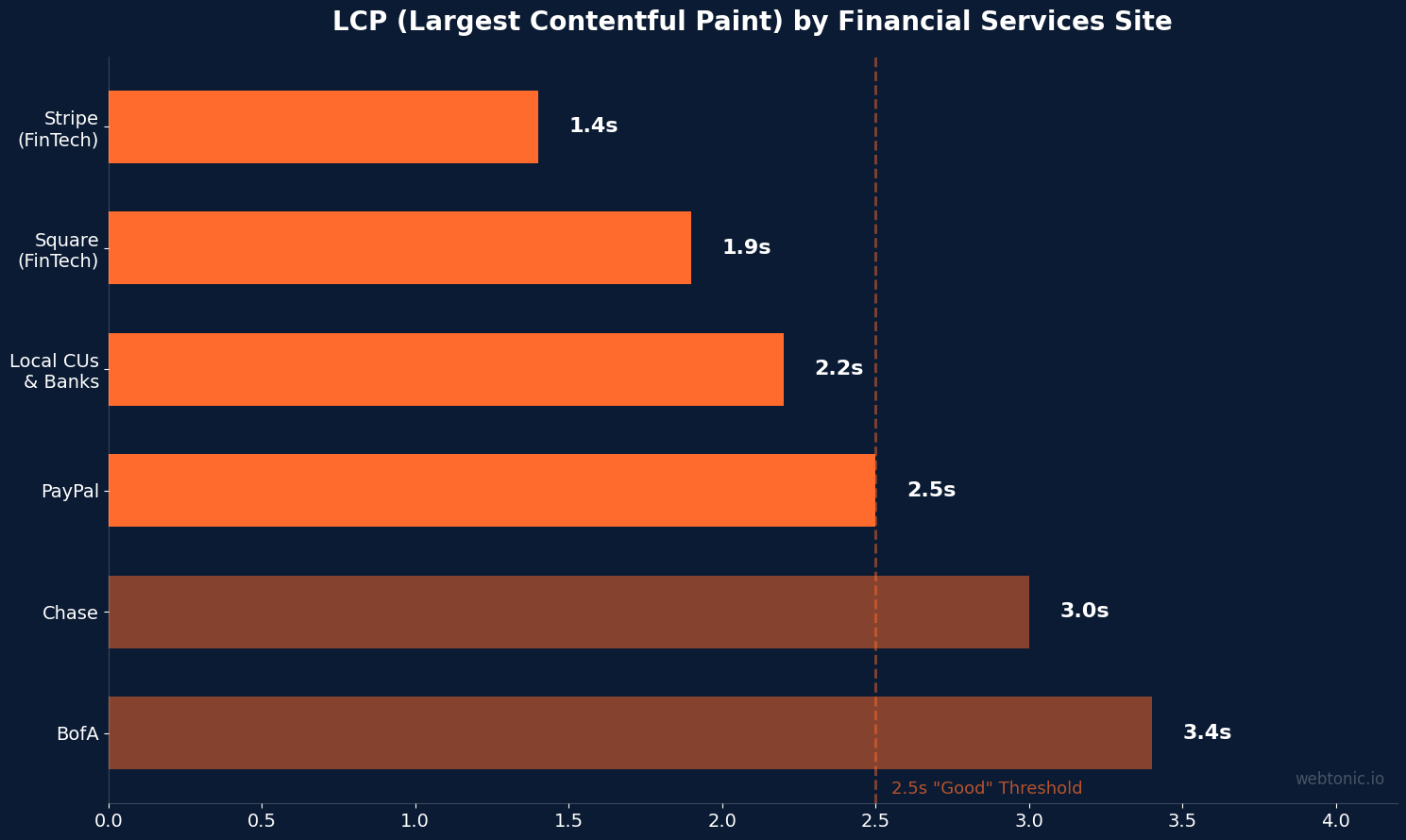
Only 39% of major national banks pass Core Web Vitals on mobile, compared to 57.4% of local credit unions and community banks that meet the threshold across 32 US metros (PageSpeedMatters, 2026). The gap exists because local institutions typically run leaner tech stacks without the legacy systems burdening enterprise banking platforms.
LCP above 2.5 seconds is effectively a ranking penalty for financial services pages, and it signals poor user experience to AI quality evaluators as well (ChatterBubble, 2026). Top-performing fintech sites like Stripe achieve LCP of 1.4 seconds with Lighthouse scores of 91, while legacy banking platforms like Bank of America sit at 3.4 seconds with scores of 48 (MakeWebsite.fast).
The INP (Interaction to Next Paint) threshold is 200 milliseconds, and mortgage calculators built in React, Vue, or Angular are the most common violator on fintech sites (Eknix, 2026). Debounced event handlers and efficient script execution are essential for JavaScript-heavy fintech frontends to meet this benchmark.
Most fintech sites can improve LCP by 40–60% through image optimization, script deferral, and critical path cleanup alone (Bill Rice Strategy Group, 2026). Financial advisor websites perform worst, with the average page taking 10.7 seconds to render main content — 8.2 seconds above Google's passing threshold (Borah Labs, 2026).
Crawlability and Indexation Challenges
Fintech sites face a unique crawlability paradox: compliance requirements demand extensive page structures, but those same structures create crawl budget waste that undermines discoverability.
Fintech sites with faceted navigation problems routinely waste 40% or more of their crawl budget on low-value URLs including parameter variations, redirect chains, and session pages (UrbanGeko Design, 2026). Product comparison pages, rate calculators with URL parameters, and multi-step application flows generate thousands of URLs that search engines must crawl but provide no ranking value.
The median fintech site takes 21× longer to render than to fetch as raw HTML (Web Performance Tools, 2026). This render gap matters enormously for AI search crawlers: 36% of fintech sites (99 of 274 measured) deliver less than 80% of their homepage content in raw HTML. Since GPTBot, ClaudeBot, and most production AI crawlers receive only the raw HTML view without JavaScript execution, over a third of fintech sites are effectively invisible to AI search.
CSR-rendered links take an average of 7.4 days longer to be discovered by Googlebot compared to links present in raw HTML, according to an audit of 50,000 enterprise URLs (SearchEngineZine, 2026). For fintech companies, where product pages update frequently with rate changes and new offerings, this delay can mean missed ranking opportunities during high-intent windows.
Schema Markup and Structured Data Adoption
Structured data implementation gives fintech sites a measurable edge in both traditional and AI-powered search, yet adoption remains uneven across the industry.
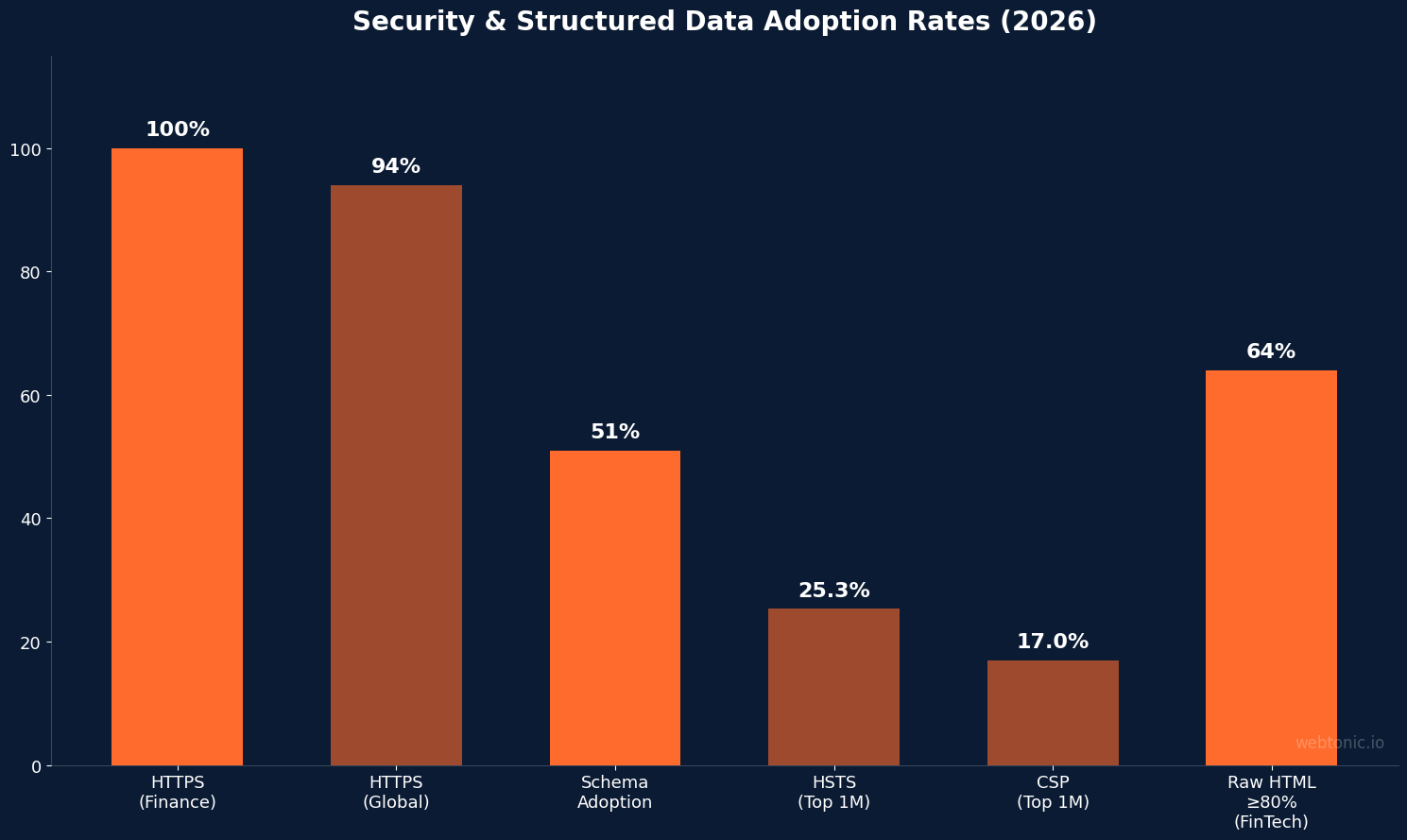
Schema.org adoption hit 51% of web pages globally in 2024, with JSON-LD dominating at 70% of structured-data implementations (Presenc AI, 2026). For fintech specifically, financial product schema markup improves search visibility by 20–40% for banks, ETFs, and fintech companies using specialized schema types (WOLF Financial, 2026).
The AI citation advantage is even more compelling: schema-valid pages receive 3.1× more AI Overview citations than pages without structured data (Presenc AI, 2026). Fintech brands with verified author schemas and regulatory disclosure pages rank in the top 5 for competitive YMYL terms requiring 10–16 months of authority building (AuthoritySpecialist, 2026).
Fintech brands with structured, data-rich content libraries are 3.5× more likely to receive unprompted AI citations from AI search engines like ChatGPT and Perplexity (Awilix AI, 2026). An Article+BreadcrumbList schema combination delivers a 47% citation lift in AI search results (DigitalApplied, 2026).
HTTPS and Security Infrastructure
Financial services lead all industries in HTTPS enforcement — and that leadership creates both a baseline expectation and a competitive differentiator for fintech startups.
Financial services achieve approximately 100% HTTPS enforcement on both login portals and public-facing pages (CompareCheapSSL, 2026). By comparison, education sites lag at 85–92% and small business sites at 70–80%. The global web average has reached 92–94% HTTPS adoption, with over 99% of Chrome browsing time spent on HTTPS pages (SSL Dragon, 2026).
Beyond basic HTTPS, advanced security headers show more variation. HSTS adoption reached 252,846 of the top million sites (25.3%) by June 2026, more than doubling from 132,466 in March 2020 (Scott Helme, 2026). Content Security Policy (CSP) adoption has grown even faster, rising from 51,986 to 170,057 sites in the same period — a 227% increase.
For fintech SEO specifically, a single insecure resource on an otherwise secure lending page triggers browser warnings functionally identical to a trust collapse (UrbanGeko Design, 2026). Mixed-content issues deserve dedicated monitoring because they erode both user trust and search engine quality signals simultaneously.
Mobile Performance and Page Speed Optimization
Google completed its mobile-first indexing rollout in 2024, meaning every fintech URL is now ranked based on its mobile version. Mobile performance gaps directly translate to ranking losses.
Mobile traffic accounts for over 60% of all web visits in 2026, and Google's crawler primarily accesses the mobile version of every URL (DigiMavrick, 2026). Fintech sites face special challenges because forms converting at 68% on desktop often drop to 31% on mobile — a device-specific UX problem, not a general mobile issue (UrbanGeko Design, 2026).
B2B fintech companies can expect meaningful SEO traction by month 18–24 of consistent technical optimization (Bill Rice Strategy Group, 2026). Organic SQL rates for B2B SaaS PLG fintech range from 0.3–1.2% initially, with top performers driving 1.5–3% (Daydream, 2026).
Technical SEO Performance by FinTech Page Type
Different page types within fintech sites present distinct technical challenges. Transactional pages carry the heaviest JavaScript loads, while content pages face E-E-A-T scrutiny from quality raters.
| Page Type | Common Technical Issue | Impact on SEO | Priority Level |
|---|---|---|---|
| Mortgage Calculators | INP violations from JS-heavy frameworks | CWV failure, ranking penalty | Critical |
| Rate Comparison Pages | Faceted URL proliferation | 40%+ crawl budget waste | Critical |
| Application Flows | Multi-step CSR, session URLs indexed | Thin content signals, wasted crawl | High |
| Product Landing Pages | Missing financial product schema | 20–40% lower search visibility | High |
| Compliance Disclosures | Indexation gaps, noindex over-use | E-E-A-T trust erosion | Medium |
| Blog/Content Hub | Missing author schema, slow LCP | Lower AI citation rate | Medium |
| API Documentation | CSR-only rendering, no SSR | 7.4-day discovery delay | Medium |
Technical SEO Best Practices for FinTech
Implementing these practices requires a combination of data intelligence and hands-on technical work. Companies that partner with a performance marketing agency alongside their technical SEO efforts see compounding returns as paid and organic channels reinforce each other.
Based on the data from top-performing fintech sites, these practices separate ranking leaders from the rest of the pack:
- Implement server-side rendering or pre-rendering for all core transactional and product pages. Client-side rendering creates a 7.4-day crawl discovery delay and leaves 36% of content invisible to AI crawlers.
- Optimize LCP below 2.5 seconds through image compression, script deferral, and critical CSS inlining. Most fintech sites can achieve 40–60% improvement with these changes alone.
- Deploy financial product schema on every product page using JSON-LD format. Structured data delivers 20–40% more search visibility and 3.1× more AI citations.
- Audit crawl budget monthly by tracking crawl stats in Google Search Console segmented by page type. Fix faceted navigation to eliminate the 40%+ waste common in fintech architectures.
- Maintain INP under 200ms by debouncing event handlers on calculators, forms, and interactive financial tools. Test on real devices, not just lab conditions.
- Segment XML sitemaps by product vertical to monitor indexation health per business line rather than relying on aggregate metrics that mask product page gaps.
- Implement HSTS and Content Security Policy headers beyond basic HTTPS. A single mixed-content resource triggers trust-collapse browser warnings on sensitive financial pages.
- Build structured content libraries with author E-E-A-T signals including verified author schemas, LinkedIn sameAs links, and regulatory disclosure pages to attract 3.5× more AI citations.
AI Search Visibility for FinTech Sites
AI-powered search is reshaping how users discover financial products. Technical SEO for fintech now must account for both traditional Googlebot crawling and AI agent visibility.
Fintech brands with structured, data-rich content libraries are 3.5× more likely to receive unprompted AI citations from platforms like ChatGPT, Perplexity, and Google AI Overviews (Awilix AI, 2026). The technical foundation matters because AI crawlers parse raw HTML without JavaScript execution, making SSR and pre-rendering essential for fintech sites that rely on dynamic content.
Keyword difficulty for fintech terms ranges from 62–81, placing most target terms in the high-competition tier requiring 10–16 months of consistent authority building (AuthoritySpecialist, 2026). The compound effect of technical health — fast pages, clean crawlability, rich structured data — accelerates this timeline significantly for sites that leverage growth marketing frameworks. Learn more about the full cost landscape of digital marketing for sites that invest in all three pillars simultaneously.
Frequently Asked Questions
What Core Web Vitals thresholds should fintech sites target?
Fintech sites should target LCP under 2.5 seconds, INP under 200 milliseconds, and CLS under 0.1. Currently only 39% of major national banks pass these thresholds on mobile, while 57.4% of smaller financial institutions meet the standard. Mortgage calculators and interactive financial tools are the most common violators due to heavy JavaScript frameworks.
How does schema markup impact fintech SEO performance?
Financial product schema markup improves search visibility by 20–40% for fintech sites. Schema-valid pages also receive 3.1× more AI Overview citations, making structured data one of the highest-ROI technical SEO investments for financial services companies that want visibility in both traditional and AI-powered search.
What percentage of fintech sites have crawlability issues?
About 36% of fintech sites deliver less than 80% of their content in raw HTML, creating significant crawlability gaps. Sites with faceted navigation problems waste 40% or more of their crawl budget on low-value URLs. The median fintech site takes 21× longer to render than to fetch, which delays AI crawler access to critical content.
How long does fintech technical SEO take to show results?
B2B fintech companies can expect meaningful SEO traction by month 18–24 of consistent technical optimization. Trust and topical authority compound over time, making technical SEO a durable channel rather than a quick win. Companies that address CWV, crawlability, and structured data simultaneously see faster results than those fixing issues sequentially.
Why do AI crawlers struggle with fintech websites?
AI crawlers like GPTBot and ClaudeBot receive only the raw HTML without JavaScript execution. Since the median fintech site takes 21× longer to render than to fetch, and 36% of sites hide key content behind client-side rendering, AI search engines cannot access a significant portion of fintech product and service pages without server-side rendering or pre-rendering solutions.
Sources
pagespeedmatters.com — Bank & Credit Union Speed 2026
eknix.com — Core Web Vitals for Fintech
webperformancetools.com — State of Agent Visibility in Fintech 2026
presenc.ai — State of Schema.org for AI Search 2026
authorityspecialist.com — Fintech SEO Benchmarks 2026
wolf.financial — Financial Product Schema SEO
urbangekodesign.com — Fintech Website Architecture SEO
comparecheapssl.com — HTTPS Industry Breakdown
chatterbubble.co — SEO for Fintech 2026 Playbook
billricestrategy.com — SEO Strategy for Fintech