Table of contents
LinkedIn now delivers the highest ROAS of any major B2B paid media channel at 121%, while fintech advertisers pay a premium CPC of $5.50–$15.20 for access to the platform's 1.2 billion professionals. These benchmarks show exactly what fintech marketers should expect from LinkedIn in 2026.
Key Takeaways
- LinkedIn ROAS reached 121% in 2025, up from 113% in 2024, making it the only major B2B channel with positive return on ad spend.
- FinTech LinkedIn CPC ranges from $5.50 to $8.00 for enterprise SaaS, rising to $7.80–$15.20 for broader financial services targeting.
- Average fintech CPL on LinkedIn is $125–$220, significantly lower than the $250–$600+ range for broader financial services.
- Lead Gen Forms convert at 6–10%, delivering roughly double the conversion rate of external landing pages and ~25% lower CPL.
- Top-performing LinkedIn campaigns achieve 279% ROAS, compared to 133% for Meta and 138% for Google Search at the 75th percentile.
- LinkedIn's 1.2 billion members include the highest-income professional audience on any social platform.
FinTech LinkedIn Ads Benchmarks at a Glance
| Metric | FinTech / Financial Services | LinkedIn Average |
|---|---|---|
| CPC | $5.50–$15.20 | $6.50 |
| CPL | $125–$300 | $276 |
| CTR (Sponsored Content) | 0.30–0.55% | 0.52% |
| Conversion Rate | 4.2–6.8% | ~5% |
| ROAS | 105–121% | 121% |
| CPM | $50–$100 (high-comp) | $31–$38 (median) |
| Lead Gen Form CVR | 6–10% | 6–10% |
| Platform Members | 1.2 billion | 1.2 billion |
LinkedIn CPC and Cost Benchmarks for FinTech
Cost per click on LinkedIn varies significantly by targeting precision. According to MetadataONE's 2026 B2B Ad Benchmarks (64,000 ads analyzed), financial services and fintech B2B campaigns pay $7–$15 per click with average CPL of $100–$300 and lead-to-opportunity rates of 4–10%.
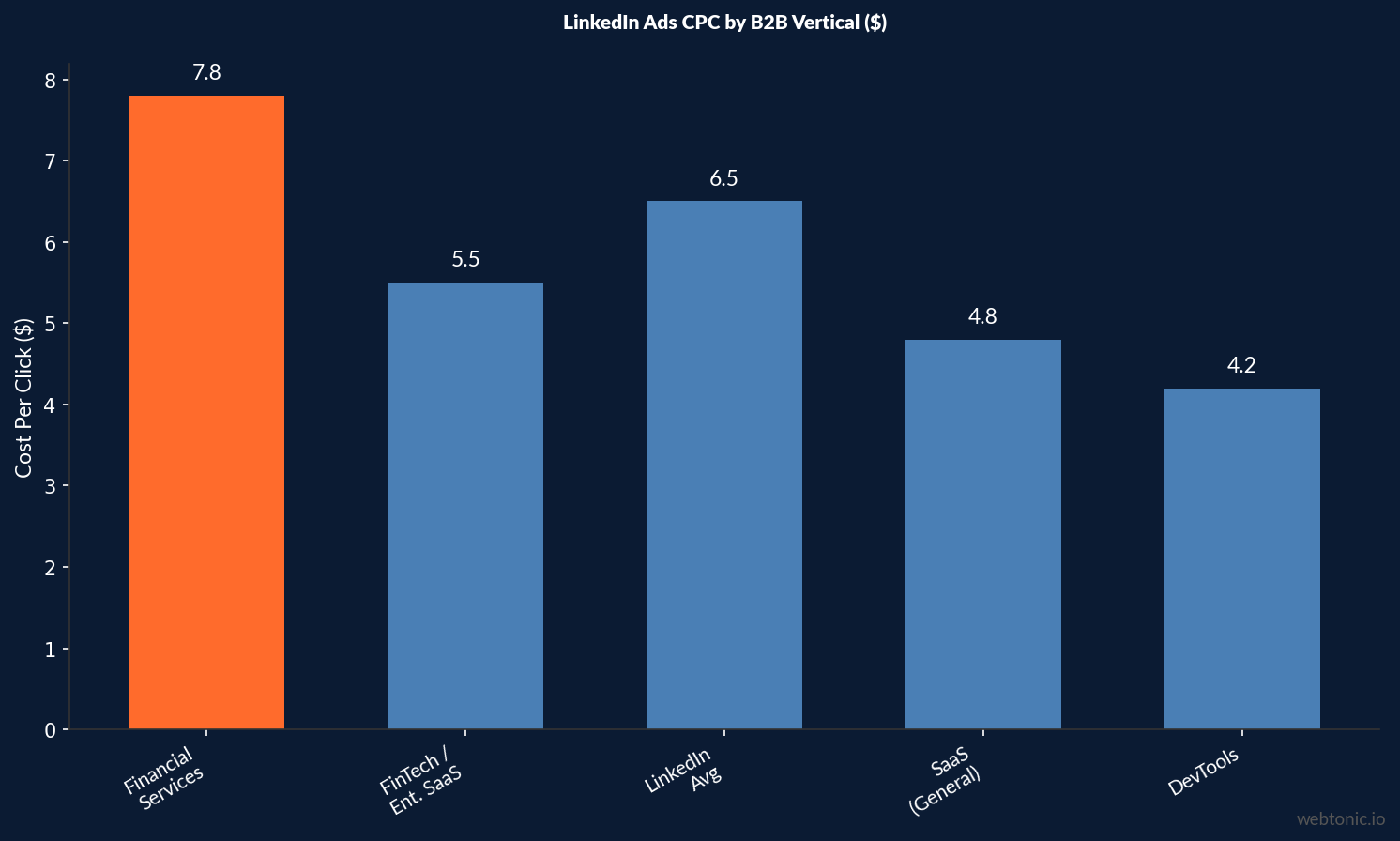
The Ryze 2026 benchmark report shows average LinkedIn CPC reached $6.50, up 8% from $6.02 in 2025, driven by increased competition for senior-level targeting. Financial services specifically pay $7.80–$15.20 per click with CPL of $148–$200 and CTR of 0.35–0.52%.
However, Nav43's fintech-specific analysis reveals an important nuance: broad finance and insurance targeting shows surprisingly low CPCs of $2.50–$3.00, but these numbers include consumer finance and insurance, which behave nothing like enterprise fintech. Effective growth marketing requires segmenting these audiences carefully.
LinkedIn ROAS: Why FinTech Marketers Are Shifting Budget
The return-on-ad-spend story makes the strongest case for LinkedIn investment. Dreamdata's 2026 LinkedIn Ads Benchmarks Report found that LinkedIn ROAS grew to 121% in 2025, up from 113% in 2024. It is now the only major B2B channel generating positive returns.
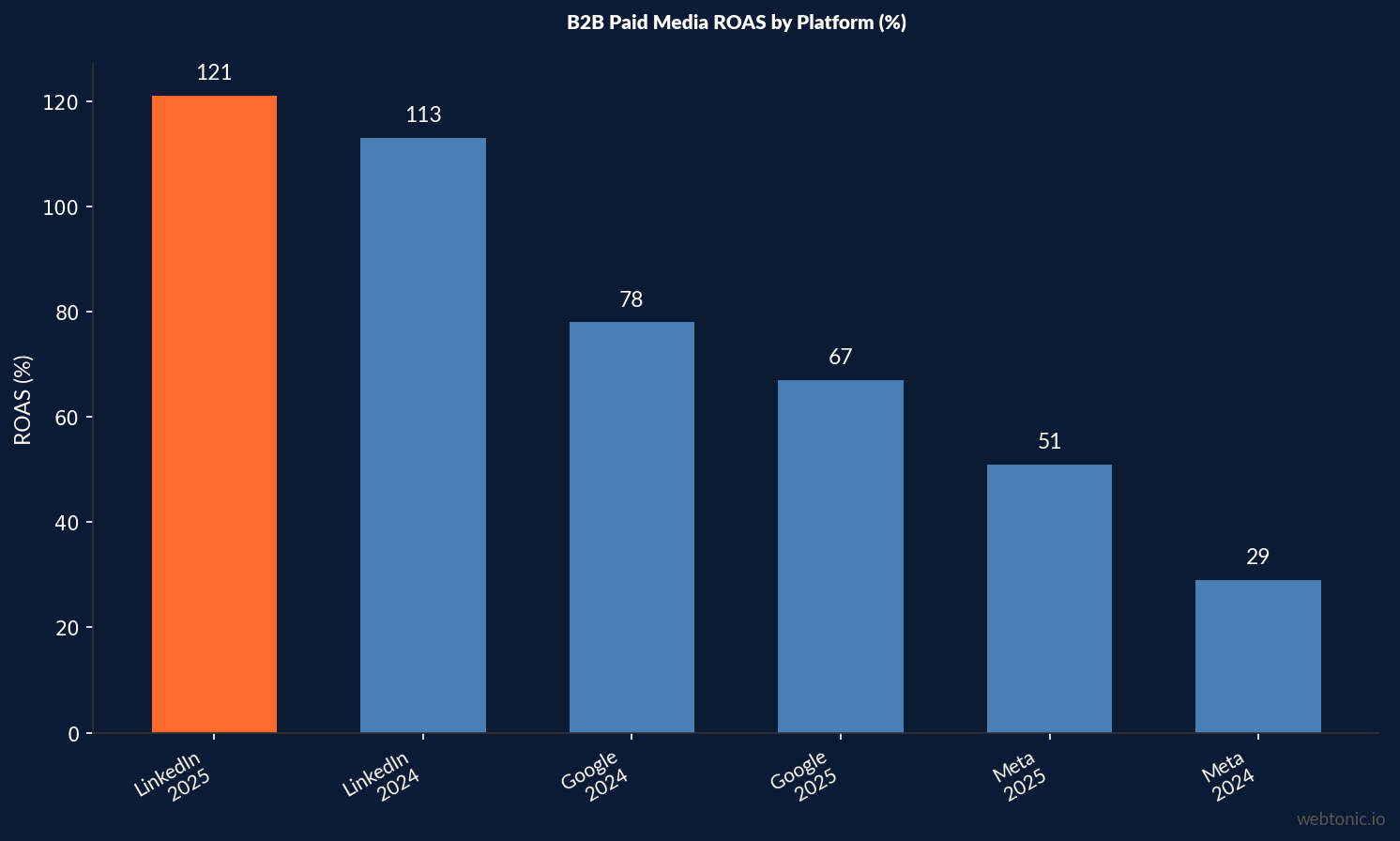
| Platform | ROAS 2024 | ROAS 2025 | Trend |
|---|---|---|---|
| 113% | 121% | ↑ Only positive ROAS | |
| Google Search | 78% | 67% | ↓ Declining |
| Meta | 29% | 51% | ↑ Still sub-breakeven |
For top-performing campaigns (75th percentile), the gap widens further: LinkedIn reaches 279% ROAS, compared to 133% for Meta and 138% for Google Search (Financial Marketer). This data explains why B2B financial services marketers who judge LinkedIn in monthly increments systematically undervalue the channel — its impact compounds over longer attribution windows.
Lead Gen Forms: FinTech's Highest-Converting LinkedIn Format
LinkedIn Lead Gen Forms are the standout performer for fintech advertisers. According to CloselyHQ's 2025 benchmarks, Lead Gen Forms convert at 6–10%, roughly double the rate of external landing pages. Lever Digital confirms they deliver approximately 25% lower CPL than sending traffic off-platform.
Nav43's fintech analysis explains the mechanism: LinkedIn auto-fills professional information, so users can submit without leaving the platform. Lead Gen Forms typically achieve a 0.5% submit CTR with 6–10% form completion rates once opened. Each additional field reduces completion by roughly 5–10%, making progressive profiling essential for maximizing conversions in B2B paid social campaigns.
FinTech LinkedIn Ads CTR Benchmarks by Format
| Ad Format | Average CTR | Best Use Case |
|---|---|---|
| Sponsored Content (Single Image) | 0.40–0.60% | Thought leadership and brand awareness |
| Sponsored Content (Video) | 0.35–0.55% | Product demos and explainers |
| Message Ads (InMail) | 0.03% open rate (3%) | Direct ABM outreach |
| Carousel Ads | 0.30–0.50% | Multi-product showcases |
| Lead Gen Forms | 6–10% form CVR | Direct lead capture (highest conversion) |
| Text Ads | 0.02–0.05% | Low-cost retargeting |
Datavinity's 2026 analysis reports that financial services achieves the highest average CTR at 0.74% across LinkedIn, followed by consulting firms. FinTech specifically, with its high-competition dynamics, sees slightly lower CTR (0.30–0.55%) but higher-quality leads that justify the premium (Stackmatix).
FinTech LinkedIn Ads Best Practices for 2026
- Use Lead Gen Forms as your primary conversion mechanic. The 6–10% conversion rate and 25% CPL reduction make them the highest-ROI format for fintech B2B.
- Segment beyond "Financial Services." Broad finance targeting shows $2.50 CPC — but enterprise fintech needs precision targeting at $5.50–$8.00 to reach actual decision-makers.
- Measure on a 90-day window. LinkedIn's ROAS of 121% emerges over longer attribution periods. Monthly measurement systematically undervalues the channel.
- Leverage ABM sequencing. A Series A fintech case study by MV3 Marketing showed meeting acceptance rates climbing from 8% to 27% when outbound follow-ups referenced specific assets each buyer engaged with.
- Benchmark CPL at $125–$220. If you're above $220 CPL for fintech, audit your targeting. If you're below $100, verify you're reaching actual enterprise buyers, not consumer finance.
- Budget for premium CPMs. High-competition fintech targeting pushes CPM to $50–$100 — plan for this and measure by pipeline value, not volume.
LinkedIn Ads for FinTech vs. Other Channels
| Metric | LinkedIn Ads | Google Ads | Meta Ads |
|---|---|---|---|
| Avg CPC (FinTech) | $5.50–$15.20 | $3.50–$8.00 | $1.50–$4.00 |
| Avg CPL (FinTech) | $125–$300 | $165–$380 | $80–$200 |
| ROAS (2025) | 121% | 67% | 51% |
| ROAS (Top 25%) | 279% | 138% | 133% |
| Best For | B2B pipeline & ABM | High-intent search | Consumer fintech scale |
| Audience Quality | Highest (job-title targeting) | Intent-based | Broad demographic |
LinkedIn's cost premium is justified by data-driven targeting precision. While Google Ads captures high-intent searchers and Meta delivers consumer scale, LinkedIn uniquely enables job-title, company-size, and seniority-level targeting that fintech B2B sales teams need. The 121% ROAS benchmark proves the premium converts to revenue.
LinkedIn Audience Quality for FinTech Targeting
LinkedIn's value proposition for fintech goes beyond cost metrics — it is fundamentally about audience quality. The platform hosts 1.2 billion members globally, with four consecutive years of double-digit member growth reported in Microsoft's Q4 FY25 earnings. Critically for fintech, LinkedIn members have higher median household incomes and are more likely to own high-consideration financial products than users on other social platforms.
Financial services content achieves an average engagement rate of 3.2% on LinkedIn, slightly below the platform average but with a notably loyal and consistent audience. This engagement quality matters because fintech B2B buyers do not make impulsive decisions — they engage with thought leadership content over weeks or months before entering a sales conversation. The platform's professional context means users encounter fintech ads while in a business mindset, not while scrolling through entertainment content.
For enterprise fintech companies, LinkedIn's targeting precision is unmatched. The ability to target by job title, company size, seniority level, and industry means every impression reaches a potential decision-maker. This explains why fintech CPCs of five to fifteen dollars, while significantly higher than Meta or Google Display, deliver qualified pipeline rather than raw traffic. The cost premium is essentially a quality filter that eliminates the wasted spend inherent in broader platforms.
Account-based marketing strategies amplify this advantage further. By uploading target account lists and layering job-function targeting, fintech advertisers can reach the exact buying committee at their ideal customer profile companies. The MV3 Marketing case study demonstrates this precision in action: ABM sequencing that references specific content each buyer engaged with pushed meeting acceptance rates from 8 percent to 27 percent — a transformation that justifies LinkedIn's premium positioning in the fintech media mix.
Budget Planning for FinTech LinkedIn Campaigns
Effective budget planning for fintech LinkedIn campaigns requires understanding the relationship between spend level and return timeline. LinkedIn's 121 percent ROAS does not materialize in week one — it compounds as the platform's algorithm optimizes toward your ideal audience profile and as retargeting pools build from initial engagement.
For Series A and Series B fintech companies, monthly LinkedIn budgets of five thousand to fifteen thousand dollars are typical starting points. These budgets allow for meaningful testing across two to three audience segments while generating enough data for the algorithm to optimize. Enterprise fintech campaigns with larger deal sizes and longer sales cycles typically run twenty thousand to fifty thousand dollars monthly, justified by the six-figure contract values that a single marketing-qualified lead can generate.
The critical mistake most fintech marketers make is evaluating LinkedIn on the same timeline as Google Search. A Google Ads campaign targeting high-intent keywords delivers measurable leads in days. LinkedIn builds pipeline over quarters. The Dreamdata benchmark data showing 121 percent ROAS used a twelve-month attribution window — marketers using 30-day windows would see a fraction of this return and incorrectly conclude that LinkedIn underperforms. Setting the right measurement window is not a technical detail, it is the difference between an expanding LinkedIn budget and a cancelled program.
The most sophisticated fintech LinkedIn advertisers also allocate budget for sequential messaging strategies. Rather than running a single campaign continuously, they design multi-stage journeys: an initial awareness campaign introduces the company and its unique value proposition, followed by consideration-stage content that demonstrates expertise through case studies and benchmark data, and finally a conversion-focused campaign with Lead Gen Forms targeting users who have already engaged with the first two stages. This approach typically improves overall campaign ROAS by fifteen to twenty-five percent compared to single-stage campaigns because each impression builds on prior exposure rather than starting from zero. The key is ensuring that each stage runs for at least three to four weeks before progressing to the next, giving the LinkedIn algorithm sufficient time to optimize within each audience segment and build the retargeting pools that make the subsequent stages effective.
Frequently Asked Questions
What is the average CPC for fintech LinkedIn Ads?
FinTech LinkedIn Ads CPC ranges from $5.50–$8.00 for enterprise SaaS targeting to $7.80–$15.20 for broader financial services campaigns. The overall LinkedIn average CPC is $6.50 in 2026, up 8% from 2025, with fintech paying a premium due to high-competition senior-level targeting.
What ROAS can fintech companies expect from LinkedIn Ads?
LinkedIn delivers an average ROAS of 121% in 2025, the only major B2B channel with positive return. Top-performing campaigns (75th percentile) reach 279% ROAS. By comparison, Google Search averages 67% and Meta averages 51% ROAS for B2B.
Are LinkedIn Lead Gen Forms effective for fintech?
Yes — Lead Gen Forms convert at 6–10%, roughly double the rate of external landing pages, and deliver approximately 25% lower CPL. They work because LinkedIn auto-fills professional information, reducing friction for B2B fintech leads.
How much should fintech companies spend on LinkedIn Ads?
Fintech LinkedIn CPL benchmarks range from $125–$220 for enterprise SaaS to $250–$600+ for broader financial services. Monthly budgets of $5,000–$15,000 are typical for Series A–B fintechs, with enterprise campaigns running $20,000–$50,000+.
Is LinkedIn Ads better than Google Ads for fintech B2B?
For B2B pipeline building, LinkedIn outperforms with 121% ROAS vs Google Search's 67%. Google Ads is stronger for capturing high-intent bottom-of-funnel searches. The optimal strategy typically combines both: Google for demand capture, LinkedIn for demand generation and ABM.
Sources
MetadataONE — B2B Ad Benchmarks 2026 (64,000 Ads)
Ryze — LinkedIn Ads CPC & CPL Benchmarks by Industry (2026)
Nav43 — LinkedIn Ads Benchmarks for Fintech (2025)
Stackmatix — LinkedIn Ads Benchmarks 2026: CPC, CTR, Conversion Rates
Dreamdata — LinkedIn Ads 2026 Benchmarks Report
Financial Marketer — LinkedIn Ads for B2B Financial Services
Datavinity — LinkedIn Ads Benchmarks 2026
CloselyHQ — LinkedIn Ad Benchmarks 2025
WOLF Financial — Financial Services CPL Benchmarks
Lever Digital — Fintech Marketing Benchmarks 2026
MV3 Marketing — Series A Fintech LinkedIn Case Study
LinkedIn — Q4 FY25 Earnings: 1.2B Members