



Table of contents
Key Takeaways
The average cost of an editorially placed do-follow link in financial services reached $1,200 in 2026, up 41% from $850 in 2023. Finance and insurance sites average 101 new referring domains per month, the fastest link velocity of any industry. Top-ranking fintech pages carry a median DR of 74 and 412 referring domains, while position-five results average DR 66 with 187 referring domains. Credible fintech link building campaigns cost between $4,000 and $25,000 per month depending on product complexity and competitive intensity. A healthy ROI on quality links (DR 30+) is 5–10× the link cost in organic revenue, with the payoff curve flattening after month six.
Fintech Link Building at a Glance — 2026 Benchmarks
| Metric | Fintech / Finance | All-Industry Average |
|---|---|---|
| Avg. cost per editorial link | $1,200 | $350–$500 |
| Link velocity (new RDs/mo) | 101 | 48 |
| DR of #1-ranking pages | 74 | 55–65 |
| RDs needed for top-5 rank | 187–412 | 80–200 |
| Monthly campaign budget | $4,000–$25,000 | $1,500–$8,000 |
| ROI on quality links | 5–10× | 3–7× |
Sources: Link Building Journal, WebFX 2026 Backlink Study, RankTracker
Link Costs in FinTech vs. Other Verticals
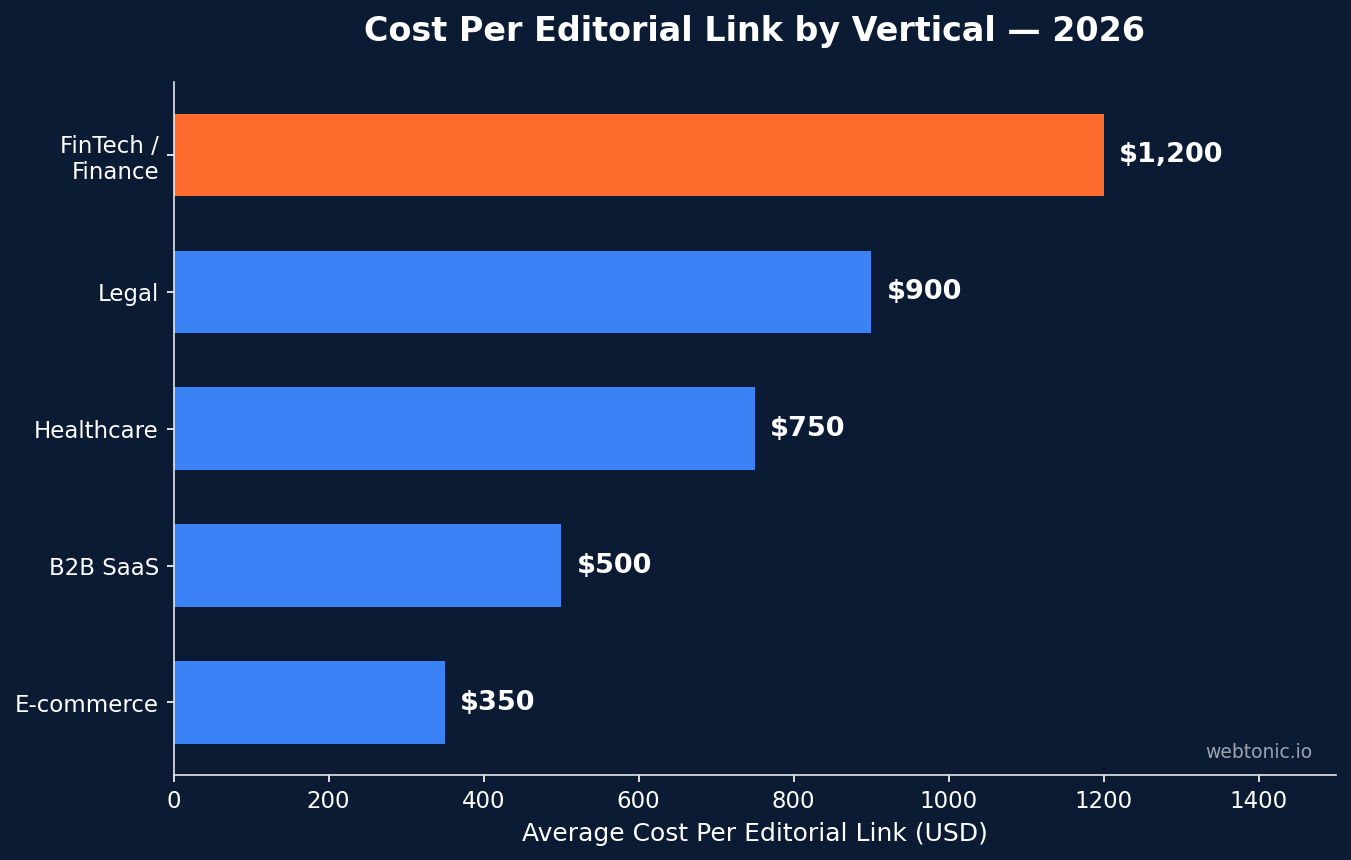
Fintech sits near the top of the cost-per-link ladder because of strict editorial standards around financial content. According to uSERP's 2026 State of Backlinks report, the average finance editorial link costs $1,200 — more than double the SaaS average of $500 and roughly triple the e-commerce median of $350. The same budget that secures 30 links in general B2B SaaS buys only 8–10 links in fintech.
Niche-relevant, DR 30+ links cost between $100 and $300 across all industries according to RankTracker's 2025 ROI benchmarks, but fintech-specific placements on publications like Bloomberg, NerdWallet, or The Financial Brand command significantly higher premiums. Full-service fintech link building retainers range from $4,000 to $25,000 per month depending on product category, with lending and payments verticals at the top end.
| Vertical | Avg. Cost Per Link | Premium vs. All-Industry |
|---|---|---|
| FinTech / Finance | $1,200 | +140% |
| Legal | $900 | +80% |
| Healthcare | $750 | +50% |
| B2B SaaS | $500 | Baseline |
| E-commerce | $350 | −30% |
Source: Link Building Journal — uSERP 2026 State of Backlinks
Domain Authority and Backlink Thresholds for Ranking
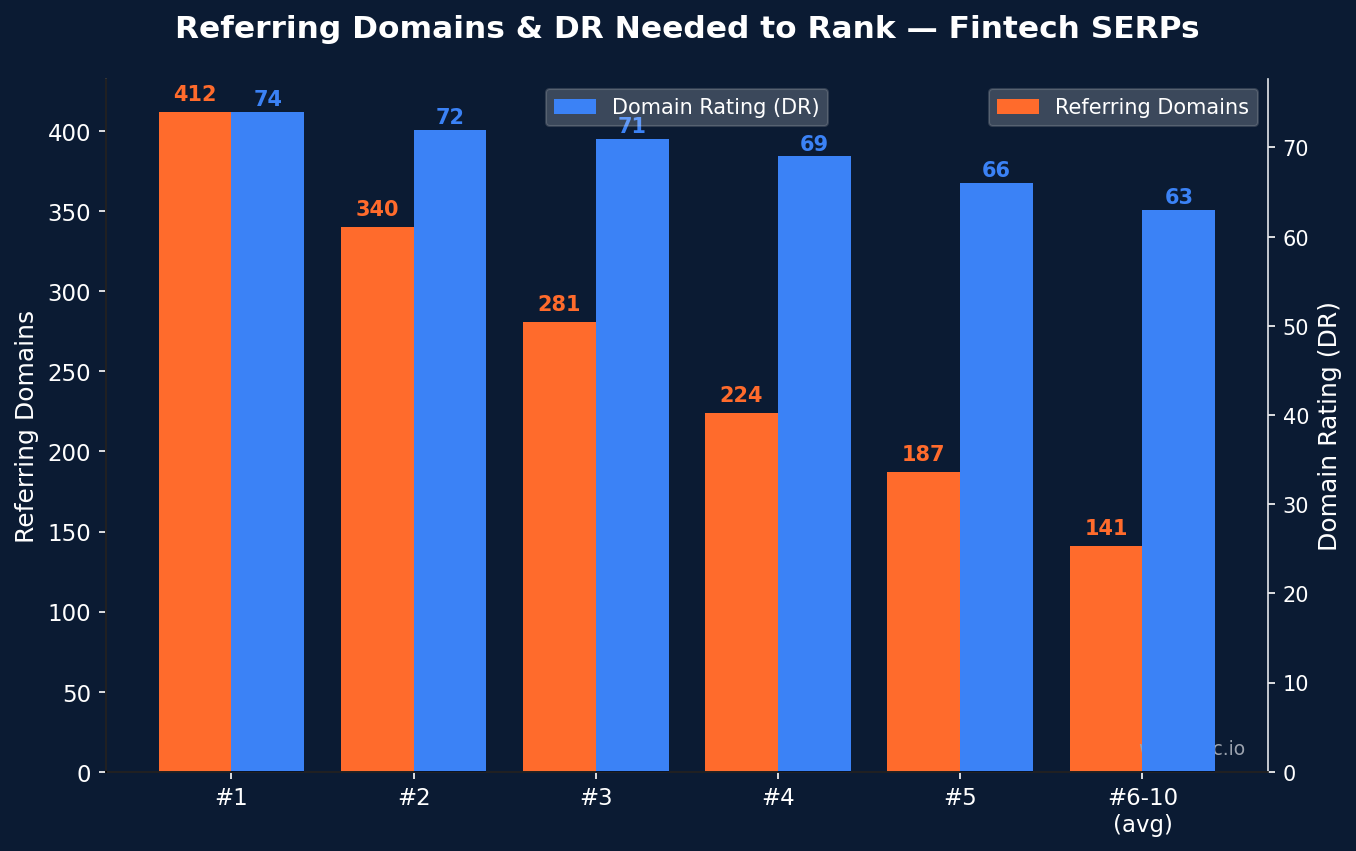
Ranking in fintech search results demands substantially more authority than most verticals. An Ahrefs SERP analysis of 30 fintech queries (UK and US, March 2026) revealed a clear authority ladder:
- Position 1: Median 412 referring domains, DR 74, DA 39
- Position 3: 281 referring domains, DR 71, DA 35
- Position 5: 187 referring domains, DR 66, DA 29
- Positions 6–10: 118–164 referring domains, DR 61–65, DA 22–28
The gap between first and fifth position represents 225 additional referring domains and 8 DR points — a meaningful investment even for well-funded fintechs. The all-industry average of 48 new referring domains per month trails the finance sector's 101 new RDs by more than double (WebFX 2026 study), underscoring the pace at which competitors accumulate authority in this space.
Link Velocity and Acquisition Trends
Finance and insurance companies lead all industries with an average link velocity of 101 new referring domains per month, according to WebFX's 2026 backlink study. That figure reflects both the volume of financial content being produced and the depth of partnership ecosystems across fintech verticals. By comparison, the technology sector averages around 72 new referring domains per month, and healthcare trails at roughly 55.
However, velocity alone doesn't guarantee rankings. Authority Specialist's 36-company audit shows that fintechs investing in quality over volume — targeting editorial placements on TechCrunch, Finextra, and American Banker — build more durable ranking positions than those relying on directory submissions or generic guest posts. The median fintech in their sample ranks for 110 keywords at P75 and generates roughly 700 organic visits per month, while top performers push past 8,000 keywords and 24,000+ visits (Content RevOps 2026).
Digital PR remains the highest-value link acquisition channel for fintech. Bloomberg, Business Insider, Bankrate, and NerdWallet are the publications that Google and AI discovery systems consider gold-standard sources for financial citations (Outreachz). Original data studies tied to proprietary fintech datasets generate 3–5× more links than opinion or listicle content. This makes fintech one of the few verticals where investing in first-party research consistently outperforms outreach volume as a growth lever.
Link Building ROI and Performance Metrics
Measuring link building return on investment requires patience, but the data supports the case for sustained investment. RankTracker's benchmark data shows that a healthy ROI on quality links is 5–10× the link cost in organic revenue or retained value. In fintech specifically, the payoff curve flattens after approximately six months as initial authority gains stabilize and rankings consolidate.
One Stellar SEO case study illustrates the compounding effect: a financial services lender scaled from 180 referring domains to more than 1,000 over the course of the campaign, growing monthly organic traffic from 3,000 visits to sustained five-figure volumes. The campaign combined guest contributions, data-driven PR, and niche citation building to create a diversified backlink profile that withstood multiple algorithm updates.
Similarly, Growpad's fintech SaaS case study documented top-5 rankings and a 2× increase in organic MQLs within five months of combined content-plus-link-building investment. The key factor was aligning link acquisition targets with high-intent keyword clusters rather than building authority broadly and hoping it would trickle down to commercial pages.
For growth marketing teams, the takeaway is clear: link building in fintech is expensive but delivers outsized organic returns when sustained beyond the initial six-month lag period. Teams that cut campaigns short at month three or four typically miss the inflection point where authority compounds into consistent ranking gains.
| Link Building Metric | Benchmark | Source |
|---|---|---|
| ROI on quality links (DR 30+) | 5–10× cost | RankTracker |
| Payoff flattening point | ~6 months | EMGI Group |
| Traffic value uplift (P75 fintech) | $50,000/mo | Content RevOps |
| MQL growth from link+content | 2× in 5 months | Growpad |
| RDs scaled over campaign | 180 → 1,000+ | Stellar SEO |
Most Effective Link Acquisition Strategies for Fintech
Not all tactics deliver equal value in a regulated space. Based on the data from our sources, the highest-performing strategies are:
- Proprietary data studies — Original research using internal fintech data generates 3–5× more backlinks than opinion content and earns placements on tier-one publications.
- Digital PR and earned media — Fintech PR focused on industry-specific outlets like Finextra, American Banker, and The Financial Brand builds authority that Google and AI systems trust (Outreachz).
- Strategic partnerships — Links from real business relationships (tools, service providers, banking integrations) carry more weight than manufactured placements (Fortis Media).
- Comparison and benchmark content — Content with interactive tools, comparison tables, and calculators earns sustained editorial links in financial verticals.
- Regulatory and compliance guides — Authoritative explainers on regulations attract links from both media and government resource pages.
For agencies managing fintech accounts, integrating link building with data intelligence initiatives produces compound returns — the same research assets that drive links also feed content calendars and paid creative.
Fintech vs. All-Industry Backlink Profile Comparison
How fintech stacks up against industry-wide baselines helps teams calibrate expectations. The Content RevOps 2026 fintech report provides a useful comparison framework:
| Metric | FinTech Median | FinTech P75 | FinTech P90 |
|---|---|---|---|
| Ranked keywords | 110 | 1,500 | 8,000+ |
| Organic traffic/mo | ~700 | 4,271 | 24,211 |
| Est. traffic value/mo | ~$4,900 | $50,000 | $200,000+ |
Source: Content RevOps — State of Content Marketing for Fintech 2026
Top-tier fintech companies such as Revolut rank for over 126,000 keywords with 2,768 in positions 1–3 (SALT Agency), demonstrating the ceiling that sustained link building and content investment can reach. For teams building paid and organic strategies together, these benchmarks frame realistic growth corridors.
Best Practices for Fintech Link Building Campaigns
Building a sustainable link acquisition program in financial technology requires a different playbook than most industries. The regulatory environment, editorial gatekeeping, and competitive intensity all influence which tactics succeed and which waste budget. The following practices reflect what consistently works across the data we reviewed.
- Budget for premium placements — Fintech links cost 2–3× more than SaaS. Plan $4,000–$25,000/month for meaningful authority gains and don't expect results from low-budget campaigns.
- Prioritize editorial links over directories — The DR 30+ links that move rankings come from publications, not link farms. Directory submissions may boost domain counts but rarely influence core rankings.
- Lead with data — Proprietary research generates 3–5× more links than thought leadership alone. Fintech companies sitting on transaction data, user behavior patterns, or market benchmarks should package those assets for media consumption.
- Track link velocity relative to competitors — At 101 new RDs/month, finance is the fastest-growing vertical; falling behind the sector's pace means losing ground to competitors who maintain consistent acquisition.
- Build E-E-A-T signals in tandem — Author bios, regulatory disclosures, and verified schemas amplify the trust value of each link. Google's quality rater guidelines explicitly reward financial sites that demonstrate expertise and accountability.
- Set a 6-month ROI window — Most fintech link building ROI materializes after the initial plateau; shorter measurement windows undercount returns and lead to premature campaign cancellations.
- Diversify link sources — Relying on a single acquisition channel (e.g. only guest posts or only digital PR) creates fragile profiles. Mix earned media, partnerships, data studies, and resource page placements.
- Combine link building with content and paid — The same data assets that earn links can fuel ad creative and performance creative campaigns, maximizing ROI on research investments.
Related reading
- Plumbing Link Building Statistics: Backlink Benchmarks & SEO Authority Data
- Pool Building Link Building Statistics: Costs, Tactics & ROI Data
- Rehab & Addiction Treatment Link Building Statistics (2026)
- Link Building Services services at Web Tonic
Frequently Asked Questions
How much does link building cost for fintech companies?
The average cost of a single editorial do-follow link in financial services is $1,200 in 2026, with full-service retainers ranging from $4,000 to $25,000 per month. This is significantly higher than B2B SaaS ($500/link) or e-commerce ($350/link) because of strict editorial standards around financial content.
How many backlinks does a fintech site need to rank on the first page?
According to an Ahrefs analysis of 30 fintech queries, the median first-page result carries 118–412 referring domains depending on position, with a minimum DR of 61. Position one requires approximately 412 referring domains with a DR of 74.
What is the average link velocity in the finance industry?
Finance and insurance sites average 101 new referring domains per month — the highest of any industry and more than double the all-industry average of 48 new referring domains per month, according to WebFX's 2026 backlink study.
What is the ROI of link building for fintech?
Quality link building (DR 30+ placements) delivers a 5–10× return on investment in organic revenue, though results typically take six months to materialize fully. Case studies show lenders scaling from 180 to 1,000+ referring domains with corresponding organic traffic growth from 3,000 to five-figure monthly visits. The key is maintaining consistent investment past the initial plateau phase rather than cutting budgets at the three-month mark.
What are the most effective link building strategies for fintech?
Proprietary data studies generate 3–5× more links than opinion content and remain the single highest-performing tactic in the sector. Digital PR targeting tier-one finance publications (Bloomberg, NerdWallet, Finextra) and strategic partnerships with complementary fintech tools and banking platforms round out the most effective acquisition channels. Regulatory compliance content and benchmark reports also attract editorial links organically from industry resource pages.
Sources
linkbuildingjournal.co.uk
webfx.com
ranktracker.com
contentrevops.com
stellarseo.com
authorityspecialist.com
outreachz.com
fortismedia.com
growpad.pro
salt.agency


