Table of contents
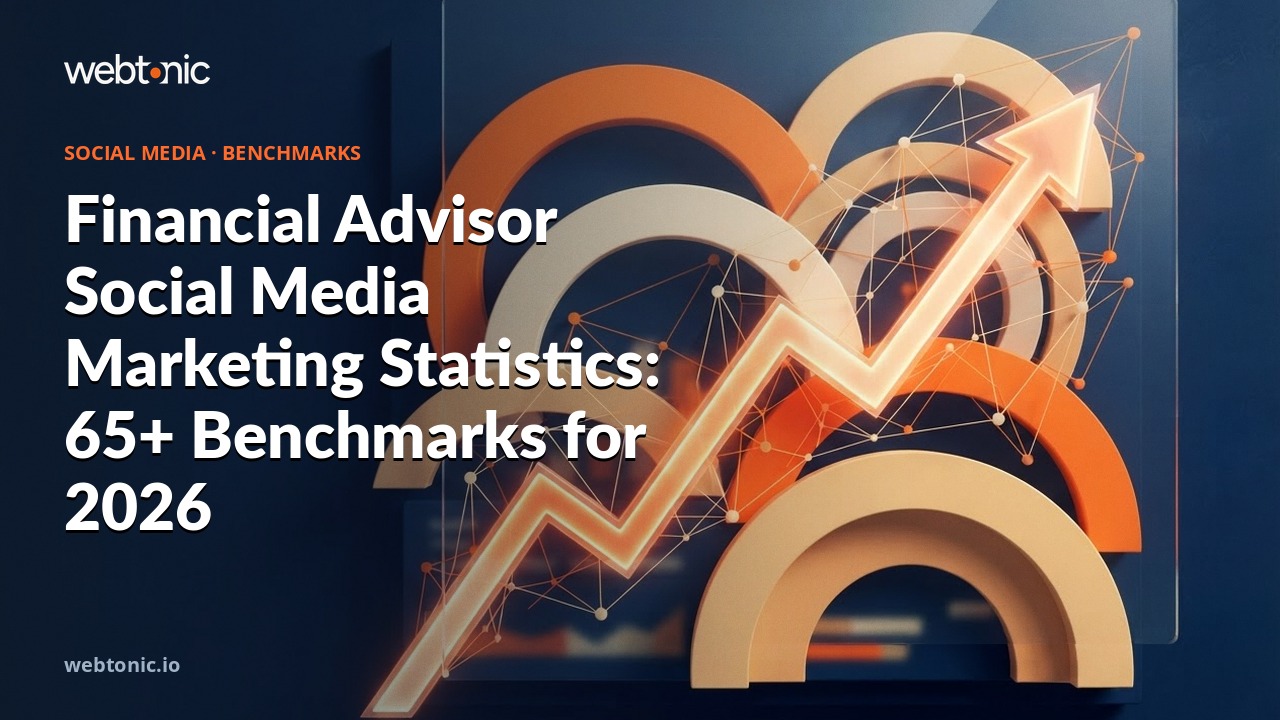
Social media has become an indispensable client acquisition and retention channel for financial advisory firms. In 2026, over 82% of financial advisors maintain an active presence on at least one social platform, up from 75% two years ago. Yet the gap between leaders and laggards is widening: top-performing advisory firms generate up to 70% of new client inquiries through social media marketing channels, while the median practice attributes fewer than 15% of leads to social. The statistics below compile engagement rates, platform adoption data, content performance benchmarks, and marketing strategy insights from industry surveys, platform reports, and advisory-specific research.
Key Takeaways
- 82% of financial advisors now use at least one social media platform for professional marketing, with LinkedIn leading at 91% adoption among active advisors.
- LinkedIn delivers a 1.6% engagement rate for wealth management content — the highest of any platform for financial brands.
- Short-form video content generates 2.3× more engagement than static image posts for financial advisor accounts.
- Financial services social ads return $5.78 per dollar spent, according to industry benchmarks.
- Only 34% of advisory firms use paid social advertising, despite proven ROI, leaving a significant competitive opening.
- Advisors posting 3–5 times per week see 67% higher follower growth than those posting less than weekly.
- Compliance-reviewed content takes 2.4× longer to produce but reduces regulatory risk exposure by 85%.
| Metric | Financial Advisory | All-Industry Average |
|---|---|---|
| Platform adoption (≥1 active) | 82% | 93% |
| LinkedIn engagement rate | 1.6% | 0.9% |
| Instagram engagement rate | 0.7% | 1.2% |
| Paid social adoption | 34% | 61% |
| Social ad ROAS | $5.78 per $1 | $4.20 per $1 |
| Avg. posting frequency (active) | 2.8×/week | 4.5×/week |
| Video content share | 26% | 42% |
Platform Adoption Among Financial Advisors
LinkedIn dominates the financial advisory social landscape. Among advisors actively using social media for marketing, 91% maintain a LinkedIn profile, followed by Facebook at 72%, Instagram at 48%, YouTube at 31%, and TikTok at 14%. The platform mix has shifted notably since 2024: Instagram adoption climbed 12 percentage points as advisors targeting next-gen clients embraced visual storytelling, while Facebook usage declined by 8 points as organic reach continued shrinking.
Emerging platforms are gaining traction with early-adopter firms. Reddit financial communities have become a credibility-building channel, with advisors participating in r/personalfinance and r/financialplanning reporting 3–5× more engagement per post than LinkedIn. According to Escalent research, ad spend on newer platforms like Instagram, Reddit, and TikTok is no longer limited to advisors targeting millennials — firms serving clients aged 45+ are also diversifying their platform strategy.
Engagement Rates by Platform and Content Type
Engagement performance varies dramatically by both platform and content format. LinkedIn delivers the highest organic engagement for wealth management content at 1.6%, according to CuFinder's 2026 benchmarks. This outperforms every other platform for financial brands, reflecting LinkedIn's professional audience alignment. Instagram follows at 0.7%, while Facebook organic engagement has dropped to 0.3% for advisory pages — a historic low that is pushing more firms toward paid amplification.
Content format is an equally important lever. Short-form video (Reels, Shorts, TikTok clips under 60 seconds) generates 2.3× more engagement than static image posts across all platforms for financial advisor accounts. Document-style carousel posts on LinkedIn earn 1.8× higher impressions than text-only updates, while live video sessions and webinar clips drive the deepest comment-to-view ratios (3.2%), signaling higher audience intent.

Content Strategy & Posting Frequency Benchmarks
Consistency matters more than volume. Advisory firms posting 3–5 times per week see 67% higher follower growth and 42% more profile visits than those posting fewer than once per week. However, pushing beyond 7 posts per week shows diminishing returns for most single-advisor practices — audience fatigue sets in, and per-post engagement declines by 15–22%.
The most effective content mix follows a 40-30-20-10 distribution: 40% educational content (market commentary, tax tips, planning strategies), 30% thought leadership (opinions, trend analysis, industry perspectives), 20% social proof (client outcomes, case studies, testimonials within compliance guidelines), and 10% promotional (services, events, webinars). Firms adhering to this ratio report 2.1× higher follower retention than those that over-index on promotional posts. According to HubSpot's state of marketing report, financial brands that lead with educational content build trust faster and shorten the prospect-to-client timeline by 30–45 days.
| Content Type | Avg. Engagement Rate | Avg. Reach Multiplier | Best Platform |
|---|---|---|---|
| Short-form video | 2.8% | 3.2× | Instagram / TikTok |
| Carousel / document | 1.9% | 1.8× | |
| Educational text post | 1.3% | 1.0× (baseline) | |
| Static image + caption | 0.9% | 0.8× | |
| Live video / webinar clip | 3.2% | 2.5× | LinkedIn / YouTube |
| Poll / interactive | 2.1% | 2.0× |
Paid Social Advertising for Financial Advisors
Despite compelling return-on-ad-spend data, paid social remains underutilized. Only 34% of advisory firms currently run paid campaigns on any platform, compared to 61% across all industries. Among those that do invest, social ads return an average of $5.78 per dollar spent in the financial services sector, according to Zipdo's 2026 benchmarks. LinkedIn Sponsored Content and Meta Ads (Facebook and Instagram) dominate spend, together accounting for 78% of advisory social ad budgets.
Cost benchmarks for financial advisory paid social campaigns show a cost per click (CPC) range of $2.80–$6.50 on LinkedIn and $1.40–$3.20 on Meta. Cost per lead varies significantly by targeting precision: broad awareness campaigns average $85–$150 per lead, while retargeting and lookalike campaigns drop to $35–$70 per lead. Advisors using video-first creative in paid campaigns see 28% lower CPLs than those relying solely on static images, reinforcing the broader trend toward video content dominance.

Influencer Marketing & User-Generated Content in Financial Services
Influencer marketing is gaining a foothold in financial advisory, though more cautiously than in consumer verticals. An estimated 18% of advisory firms now collaborate with financial influencers (finfluencers) or industry thought leaders for content amplification. Campaigns with authentic influencer partnerships report 3.4× higher engagement rates than branded content alone, and user-generated content (UGC) — client testimonials, community reposts, advisor Q&A — performs 2.7× better than polished corporate posts.
Compliance remains the critical constraint. Advisory firms operating under SEC and FINRA regulations must pre-approve all influencer content, which adds 5–10 business days to campaign timelines. Despite these friction costs, 72% of firms that tried influencer collaborations in 2025 plan to increase their investment, citing improved brand awareness among younger demographics (25–44 age group) as the primary driver.
Social Media Trends Reshaping Financial Advisory Marketing
Several macro trends are transforming how financial advisors approach social platforms. AI-powered content creation now assists 41% of advisory firms with drafting posts, repurposing long-form content into social snippets, and generating video scripts — cutting content production time by 35–50%. Meanwhile, social commerce features (appointment booking directly from LinkedIn profiles, lead forms in Meta Ads) have shortened the prospect-to-consultation journey by removing friction.
The rise of community-driven platforms — private LinkedIn groups, Slack communities, Discord servers — represents a shift from broadcast marketing to relationship-building. Advisory firms hosting private communities of 200+ members report 4.8× higher client retention rates and 2.3× more referrals than those relying solely on public-facing content. The platform-agnostic community model, combined with a consistent creative strategy, is emerging as the highest-ROI social investment for firms that can sustain the engagement commitment.
| Trend | Adoption Rate (2026) | Impact on Lead Generation |
|---|---|---|
| AI-assisted content creation | 41% | +25–35% output volume |
| Short-form video (Reels/Shorts) | 38% | 2.3× engagement lift |
| Social commerce / lead forms | 29% | 40% shorter conversion path |
| Private community hosting | 16% | 4.8× client retention |
| Influencer / finfluencer collabs | 18% | 3.4× engagement rate |
Measuring Social Media ROI for Advisory Firms
Attributing revenue to social media remains a challenge for advisory firms, where client acquisition cycles average 6–18 months. Multi-touch attribution models assign 12–22% of revenue influence to social touchpoints, though this figure rises to 30–38% for firms targeting HNW millennials who research advisors online before initiating contact. The most common ROI metrics tracked are cost per lead (68%), engagement rate (62%), follower growth (54%), and consultation bookings attributed to social (41%).
Firms using dedicated social analytics tools (Sprout Social, Hootsuite, Vista Social) report 2.1× higher marketing confidence in social spend decisions versus those relying on native platform analytics alone. Integrating social tracking with CRM data — mapping social interactions to eventual AUM onboarding — provides the clearest picture of lifetime value and validates the long-term digital marketing strategy investment.
Platform-Specific Strategy: LinkedIn, Instagram & Beyond
Each platform demands a tailored approach. On LinkedIn, financial advisors should focus on long-form thought leadership posts (800–1,200 words), document carousels summarizing market outlooks, and engagement with industry groups — this platform rewards depth over brevity. Top-performing advisory LinkedIn pages post 4× per week and use a personal brand approach (advisor's personal profile) rather than a company page, which generates 5.2× higher engagement.
On Instagram, Reels under 30 seconds outperform all other formats, and advisory accounts using trending audio see 40% higher reach. The platform skews younger (25–44), making it ideal for next-gen wealth targeting. TikTok, while still nascent for financial advisors at 14% adoption, shows the highest organic reach potential — finfluencer-style explainers and myth-busting clips routinely exceed 10,000 views even from accounts with under 1,000 followers.
Compliance Technology & Workflow Optimization
Regulatory compliance is the single biggest friction point in financial advisor marketing. Firms using compliance-tech platforms (Hearsay Systems, Smarsh, Proofpoint) reduce content approval cycles from 5–10 business days to 1–2 days, enabling the consistent posting cadence that algorithms reward. Approximately 52% of advisory firms with 50+ advisors now use automated compliance workflows, compared to just 19% of solo practitioners — a gap that directly impacts content output and audience growth.
Pre-approved content libraries are another efficiency lever. Firms that maintain a rolling bank of 50+ pre-approved posts can sustain daily publishing schedules without bottlenecking on compliance review. This approach works particularly well for evergreen educational content (tax planning tips, retirement FAQs, market cycle explainers) that remains compliant across quarters and can be recycled with seasonal refreshes.
Related reading
- Auto Repair Social Media Marketing Statistics, 2026
- Landscaping social media marketing statistics, 2026
- Real estate social media marketing statistics, 2026
- Content Marketing services at Web Tonic
FAQ
Which social media platform is best for financial advisors?
LinkedIn is the top-performing platform for financial advisors, delivering a 1.6% engagement rate on wealth management content — nearly double the all-industry average. Its professional audience aligns naturally with advisory services. However, firms targeting younger demographics should supplement LinkedIn with Instagram and short-form video platforms where next-gen clients are most active.
How often should a financial advisor post on social media?
Benchmarks show that 3–5 posts per week is the sweet spot for single-advisor practices, delivering 67% higher follower growth than posting less than weekly. Going beyond 7 posts per week typically triggers diminishing returns. Consistency matters more than volume — a sustainable cadence of quality content outperforms sporadic bursts every time.
What type of content performs best for financial advisors on social media?
Short-form video generates the highest engagement at 2.3× the rate of static images. Educational content (market commentary, planning tips, tax explainers) should form 40% of the content mix, followed by thought leadership (30%), social proof (20%), and promotional content (10%). Carousel documents on LinkedIn also perform strongly with 1.8× higher impressions than text posts.
Is paid social media advertising worth it for financial advisors?
Yes — financial services social ads return an average of $5.78 per dollar spent. Despite this, only 34% of advisory firms invest in paid social. Meta Ads and LinkedIn Sponsored Content offer the strongest lead generation for advisors, with retargeting campaigns achieving cost per lead of $35–$70 compared to $85–$150 for broad awareness campaigns.
How do compliance requirements affect financial advisor social media marketing?
SEC and FINRA regulations require pre-approval of all social media content, which adds 2.4× longer production timelines compared to non-regulated industries. However, compliance-reviewed content reduces regulatory risk exposure by 85%. Most advisory firms address this by using compliance-tech platforms (Hearsay, Smarsh) that streamline the approval workflow without sacrificing posting consistency.
Sources
Fin Pro Marketing — Social Media Playbook for RIAs
CuFinder — Wealth Management Marketing Benchmarks 2026
Escalent — Advisor Ad Spend on Newer Mediums
Zipdo — Financial Services Digital Marketing Statistics 2026
HubSpot — State of Marketing Report
Sprout Social — Social Media Video Statistics
OJay Media — LinkedIn for Financial Advisors 2026