Table of contents
Key Takeaways
- 73% of RIAs view branding as critical for differentiation, yet 42% of CNBC Top 100 financial advisory firms score in the "generic" range for brand originality.
- Financial advisors spend an average of $15,900–$17,400 annually on marketing, with branding and PR accounting for approximately 10.6% of total marketing budgets at mid-size firms.
- Digital marketing ROI for RIA firms averages 5.1:1, with full-service marketing budgets delivering 3.6x–9.5x return in year one.
- Client retention is the number one marketing objective for 69% of advisors in 2026, fueling referrals that remain the leading client acquisition source at 65%.
- Financial advisors with strong brand positioning see 9x higher lifetime client value compared to firms competing primarily on price or product features.
- Only 6 out of 100 top-rated RIA firms scored 8+ out of 10 for brand originality, revealing a massive differentiation gap in the advisory industry.
Financial Advisor Brand Originality Scores
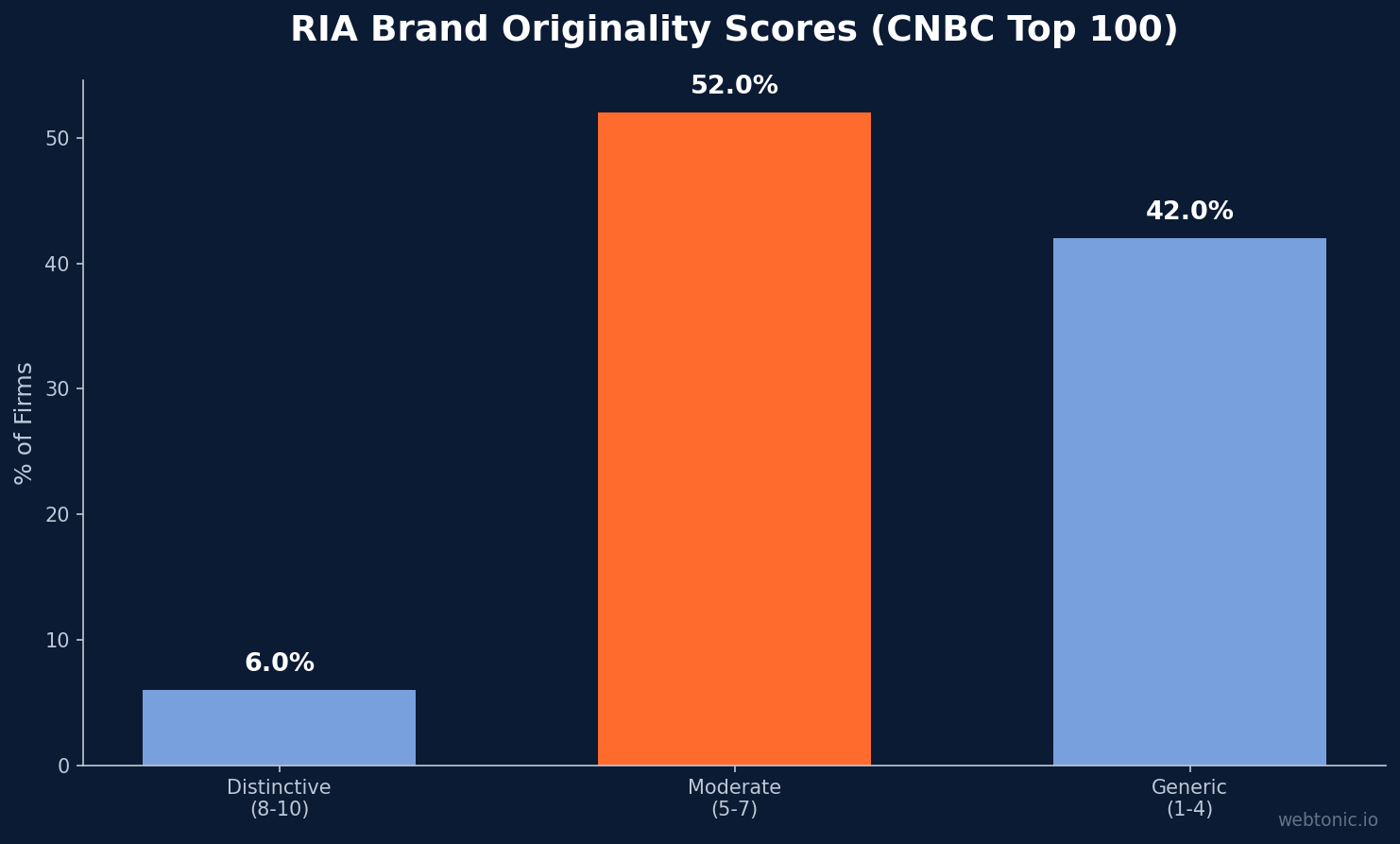
A brand analysis study by strategic communications firm Gregory examined 94 firms listed on the CNBC Financial Advisor 100 and found a striking differentiation gap. Only 6 firms scored 8 or higher out of 10 for brand originality, meaning their website messaging was specific, memorable, and hard to confuse with competitors. 42% of the list scored in the "generic" range, using interchangeable language about "comprehensive wealth management" and "personalized service" that could belong to virtually any advisory firm (PLANADVISER).
InvestmentNews described this phenomenon as a "cliche crisis" affecting the advisory industry, noting that top-performing firms in terms of AUM and client satisfaction often trail smaller, more brand-forward competitors in terms of messaging distinctiveness (InvestmentNews). This finding validates the 73% of RIAs who view branding as critical for differentiation (Gitnux) — most firms recognize the problem but have not solved it, creating a significant competitive opportunity for those willing to invest in distinctive brand identity.
| Brand Originality Score | % of CNBC Top 100 | Interpretation |
|---|---|---|
| 8–10 (Distinctive) | 6% | Specific, memorable, hard to confuse |
| 5–7 (Moderate) | 52% | Some differentiation, room to improve |
| 1–4 (Generic) | 42% | Interchangeable, easily confused with competitors |
Financial Advisor Marketing and Branding Spend
Financial advisors allocated an average of $15,900–$17,400 annually to marketing in recent surveys, according to Broadridge data and Paladin Digital Marketing's 2026 analysis. For RIA firms specifically, the typical marketing spend ranges from 3–7% of gross revenue, or roughly $0.05–$0.15 per dollar of new AUM targeted (OJay Media).
Branding-specific budget allocation breaks down as follows for a mid-size RIA firm with a total annual marketing investment of approximately $510,000:
| Category | Monthly Budget | Annual Budget | % of Total |
|---|---|---|---|
| Website + SEO/AEO | $8,500 | $102,000 | 20.0% |
| Paid Ads (Google + Meta) | $7,000 | $84,000 | 16.5% |
| Events (10+ annually) | $7,000 | $84,000 | 16.5% |
| Content Marketing | $5,000 | $60,000 | 11.8% |
| Brand / PR / Sponsorships | $4,500 | $54,000 | 10.6% |
| Email Marketing & CRM | $3,500 | $42,000 | 8.2% |
| Social Media Management | $3,000 | $36,000 | 7.1% |
| Video / Podcast | $1,500 | $18,000 | 3.5% |
Source: OJay Media (mid-size RIA budget model). For firms considering how to allocate paid advertising budgets, the branding component amplifies returns across every other channel category.
Branding and Marketing ROI for Financial Advisors
Digital marketing ROI for RIA firms averages 5.1:1, according to Gitnux's 2026 industry data. This represents a significant improvement from earlier benchmarks, reflecting better targeting, attribution capability, and content maturity across the advisory sector. For firms with a structured data intelligence approach, ROI can exceed this average substantially.
Channel-specific ROI varies dramatically across marketing tactics:
| Channel | First-Year ROI | Lifetime ROI | Payback Period |
|---|---|---|---|
| Workshops / Seminars | 220–540% | 600–1,400% | 5–10 months |
| SEO / Content Marketing | 150–450% | 500–1,200% | 6–12 months |
| Paid Ads (Google + Meta) | 100–350% | 400–900% | 3–6 months |
| Email Nurture Campaigns | 80–280% | 350–800% | 4–8 months |
| LinkedIn Outbound | 50–180% | 280–620% | 6–12 months |
Source: OJay Media. The highest-ROI channels require the most branding consistency: a recognizable brand elevates event attendance, email open rates, and referral conversion simultaneously.
Only 15% of financial advisors report being very satisfied with their marketing ROI, and just 26% have a defined marketing plan. Firms with structured branding and marketing strategies generated 2.4x new assets from new clients and 4.8x more assets from existing clients compared to unstructured competitors, according to Ficomm research data.

Brand Trust and Client Acquisition
Referrals remain the number one client acquisition source for financial advisors at 65% (Financial Planning), and brand recognition is the primary amplifier of referral quality. When a referred prospect arrives already familiar with the firm's brand identity, conversion rates are significantly higher than cold referrals where the prospect has no prior brand exposure.
Client retention is the number one marketing objective for 69% of advisors in 2026, reflecting a strategic shift from acquisition-first to retention-first marketing. Satisfied clients who identify with the firm's brand become its most effective marketing channel, creating a compounding cycle where brand investment drives retention, which drives referrals, which drives growth at progressively lower marginal cost.
Financial advisors with strong brand positioning see 9x higher lifetime client value compared to firms competing on price or product features alone (Innerlight Digital). This multiplier effect makes branding one of the highest-leverage investments available to advisory firms, though the payback period extends beyond the typical quarterly reporting cycle that drives most marketing budget decisions. The immediate costs are visible; the compounding returns are not — which is precisely why 74% of firms underinvest in brand relative to performance marketing channels.
Financial Advisory Rebranding Case Studies
Documented advisory firm rebrands demonstrate that brand investment translates directly to measurable business outcomes when executed with strategic intent rather than superficial visual updates.
| Firm | Rebrand Focus | Key Result |
|---|---|---|
| Monument Wealth | Visual + digital repositioning | Measurable increase in new client meetings and credibility |
| Stuart Investment ($550M AUM) | Generational brand modernization | Updated identity preserving 46-year trust equity |
| WorthPointe | Values-based brand from ground up | Scaled to $55M AUM via influencer + digital |
| Financial Planner (Dow Digital) | Full digital rebrand and web presence | 2x client base within one year |
Sources: Atelier LKS (Monument Wealth), ProFundCom (Schwab Benchmarking Study).
Financial Advisor Branding Trends for 2026
- Digital-first brand experiences. Schwab's 2026 RIA Benchmarking Study confirms that marketing strategy now separates growth leaders from laggards, regardless of asset size. Firms without a written strategic and succession plan consistently rank lower on Schwab's composite performance index (ProFundCom).
- Niche positioning over generic messaging. Advisors are moving beyond "comprehensive wealth management" toward specific demographic, life-event, or financial-situation positioning that creates genuine brand distinction. Firms targeting women in tech, physicians, or business owners see measurably higher engagement than generalist competitors.
- Visual identity as trust infrastructure. With 9,000–10,000 advisors switching firms annually, a generic logo is a liability that forces price-based competition rather than value-based relationships. Strong visual systems signal stability and professionalism before the first conversation happens (Azella).
- Brand consistency across compliance boundaries. Emerging trends include transparent, compliance-safe brand strategies that maintain authenticity within regulatory constraints while still creating memorable, distinctive positioning (Bedrock).
- Content-led brand building. Content marketing and thought leadership are generating the highest ROI for brand recognition in 2026. Advisors who publish educational content consistently drive measurably more organic website traffic and higher-quality leads than those who rely solely on paid advertising and event sponsorships.
Brand Impact on Marketing Channel Performance
Branding does not operate in isolation — it amplifies the performance of every other marketing channel a financial advisory firm deploys. Firms with strong, distinctive brand identities see measurably higher open rates on email campaigns, better click-through rates on paid ads, and higher attendance at educational events and webinars compared to generic competitors running identical tactical playbooks with undifferentiated messaging.
The mechanism is straightforward: brand recognition reduces friction at every stage of the client acquisition funnel. A prospect who recognizes the firm's name and visual identity from prior content exposure is significantly more likely to open an email, click a search ad, attend a seminar, and ultimately schedule a discovery meeting than a prospect encountering the firm for the first time with no prior brand exposure. This recognition effect compounds over time, meaning firms that invest early in brand building accumulate a growing competitive moat that late movers cannot quickly replicate.
Schwab's 2026 benchmarking study reinforces this compounding dynamic: firms with documented marketing strategies that include explicit brand positioning systematically outperform those without, regardless of their asset size or market position. The study specifically identifies strategic consistency and succession planning as markers of growth-leading firms — both of which require a coherent brand foundation to execute effectively over multi-year horizons and across leadership transitions.
For financial advisors evaluating where to allocate marginal marketing dollars, the data suggests that brand investment generates the highest returns when it precedes tactical spending. Building a distinctive brand identity first, then deploying paid advertising, content marketing, and events under that brand umbrella, produces compounding returns that purely tactical spending cannot match. The average 5.1:1 ROI for RIA digital marketing reflects the blended performance of branded and unbranded campaigns — firms with distinctive brands consistently exceed this average, while generic firms consistently fall below it.
Frequently Asked Questions
How much should a financial advisor spend on branding?
Branding and PR typically account for approximately 10.6% of a financial advisor's total marketing budget. For a mid-size RIA, this translates to roughly $4,500/month or $54,000/year. The total marketing budget itself should be 3–7% of gross revenue, with the brand component amplifying returns across all other channels.
What is the ROI of financial advisor branding?
Digital marketing ROI for RIA firms averages 5.1:1. Branding specifically amplifies all other marketing channels: firms with strong brands see 2.4x more assets from new clients and 4.8x more from existing clients. The lifetime impact includes 9x higher client lifetime value for firms with distinctive, well-executed brand positioning compared to generic competitors.
Why do most financial advisors have generic brands?
A Gregory Communications study found 42% of top-100 RIA firms use interchangeable messaging. The primary causes are compliance conservatism that discourages distinctive claims, commoditized service offerings, and systematic underinvestment in brand strategy. Only 26% of advisors have a defined marketing plan that includes specific brand positioning and measurement.
How does branding affect client retention for financial advisors?
69% of advisors cite client retention as their number one marketing objective in 2026. Strong branding creates emotional connection and identity alignment that reduces churn and increases referral quality. Retained clients who identify with the brand generate the highest-value referrals, creating a compounding growth cycle that generic firms cannot replicate.
What are the biggest financial advisor branding trends in 2026?
The top trends are digital-first brand experiences, niche positioning over generic messaging, visual identity investment, and content-led brand building. Schwab's 2026 benchmarking study confirms that marketing strategy and brand quality now separate growth leaders from underperformers regardless of firm asset size.
Sources
gitnux.org
ojaymediamarketing.com (ROI)
ojaymediamarketing.com (Cost)
paladindigitalmarketing.com
planadviser.com
investmentnews.com
profundcom.net
atelierlks.com
azella.io
innerlight.digital