Table of contents
Key Takeaways
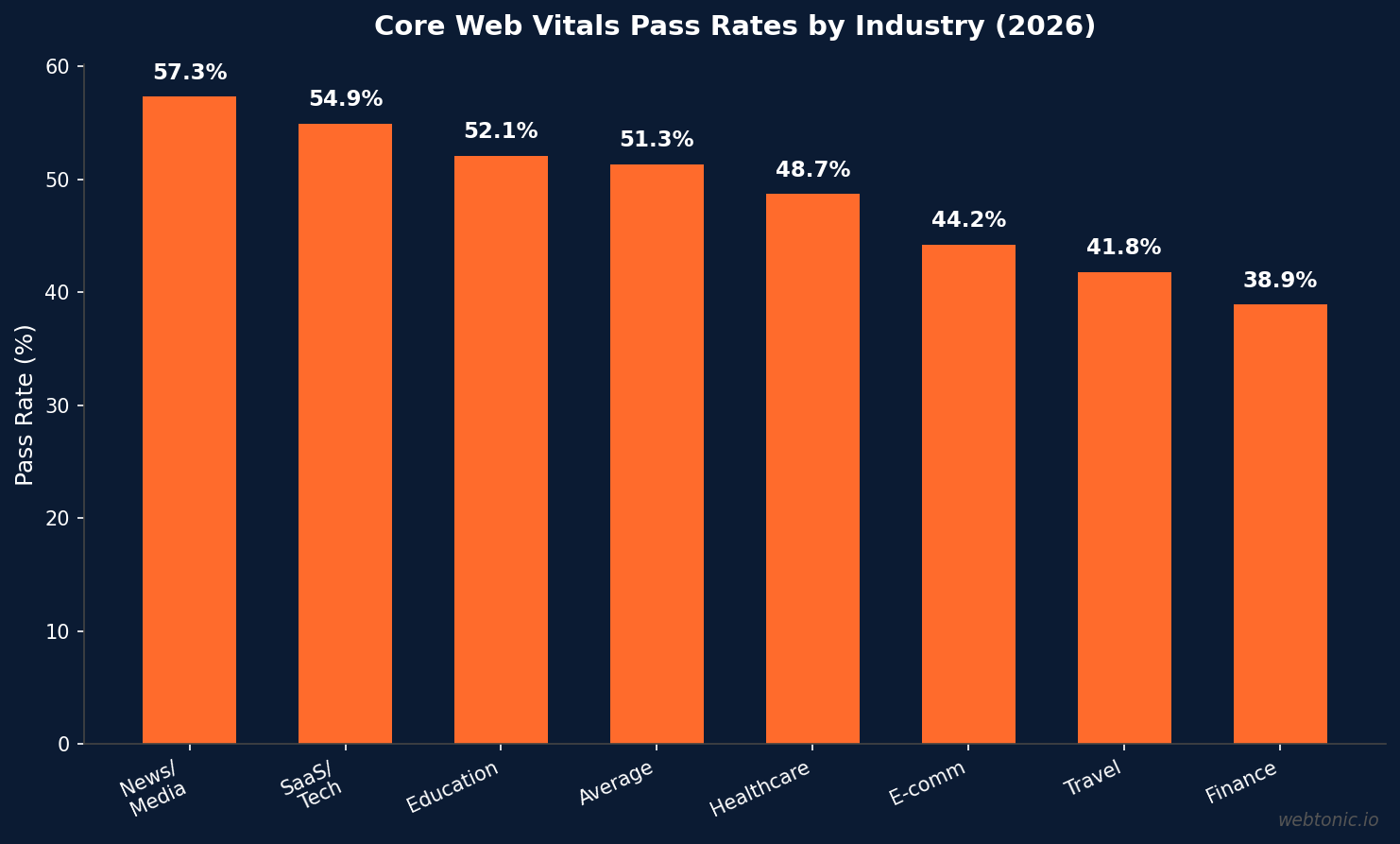
- Only 48.7% of healthcare websites pass Core Web Vitals, trailing the cross-industry average of 51.3% and lagging far behind news/media sites at 57.3% (JustAnalytics 2026).
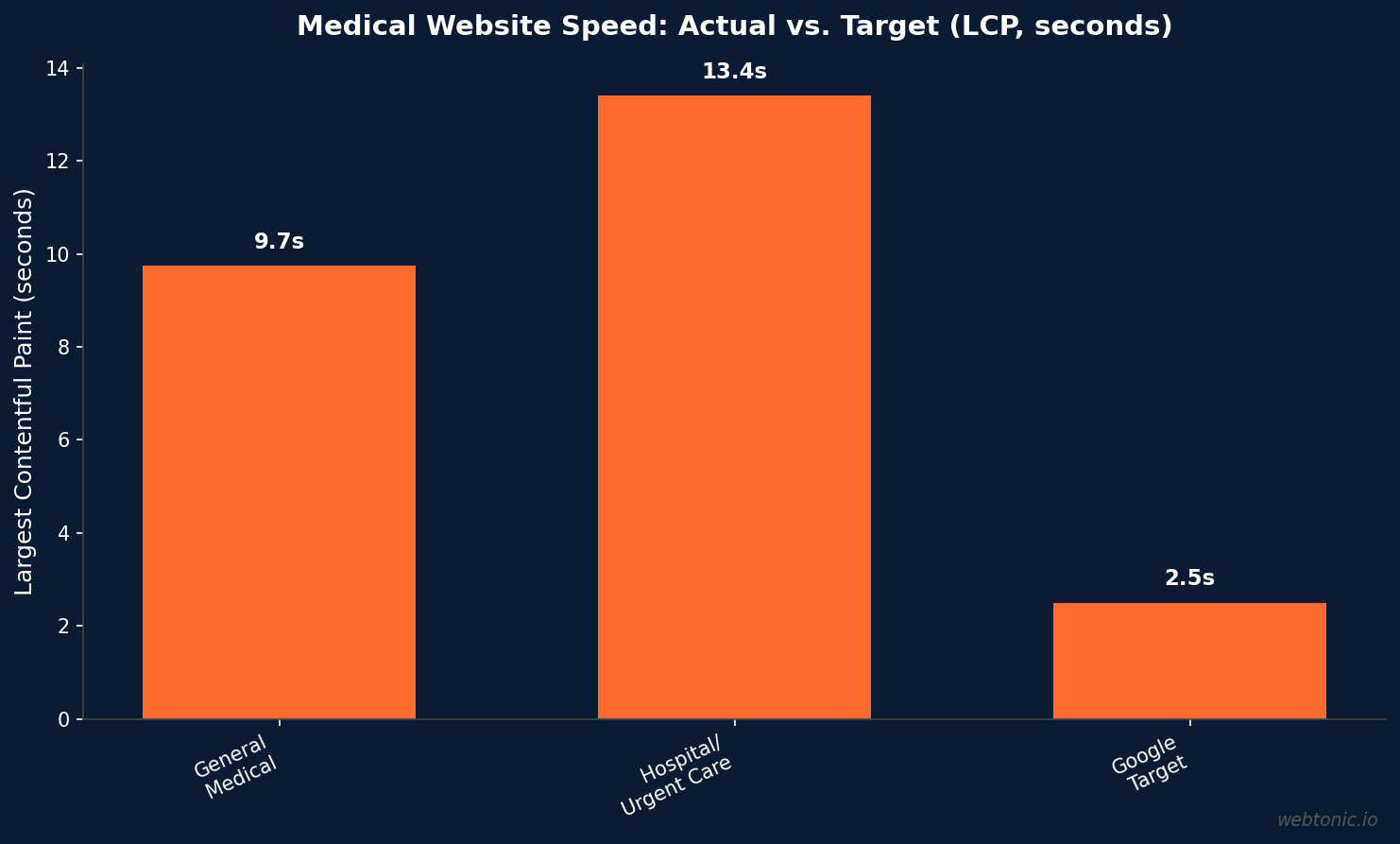
- The average general medical website has a Largest Contentful Paint (LCP) of 9.74 seconds — nearly 4× the 2.5-second "Good" threshold, while hospitals fare even worse at 13.4 seconds (Borah Labs 2026).
- Mobile devices account for 68.5% of all medical practice website visits, yet most fertility clinic sites are not optimized for mobile-first indexing (CuFinder 2026).
- 73% of persistent indexation issues on healthcare WordPress sites stem from platform-specific configurations rather than standard SEO problems (OnwardSEO 2025).
- Organic search drives 45–60% of total traffic for high-performing fertility clinics, making technical SEO the foundation of patient acquisition (AuthoritySpecialist 2026).
Technical SEO Benchmarks at a Glance
| Metric | Healthcare Average | Target / Best Practice | Source |
|---|---|---|---|
| Core Web Vitals pass rate | 48.7% | 100% (Google target) | JustAnalytics 2026 |
| LCP — general medical | 9.74s | ≤ 2.5s | Borah Labs 2026 |
| LCP — hospitals/urgent care | 13.4s | ≤ 2.5s | Borah Labs 2026 |
| FCP — general medical | 3.92s | ≤ 1.8s | Borah Labs 2026 |
| CLS — general medical | 0.07 | ≤ 0.10 | Borah Labs 2026 |
| Mobile traffic share | 68.5% | Mobile-first design | CuFinder 2026 |
| Bounce rate (medical avg) | 58.4% | ≤ 45% | CuFinder 2026 |
| Organic traffic share (top clinics) | 45–60% | — | AuthoritySpecialist 2026 |
| Local Map Pack influence | 40–55% of local inquiries | — | AuthoritySpecialist 2026 |
Core Web Vitals Performance Across Industries
Google's Core Web Vitals — measuring loading speed (LCP), interactivity (INP), and visual stability (CLS) — directly influence search rankings. Healthcare websites pass at just 48.7%, placing the sector below the 51.3% cross-industry average and well behind news/media (57.3%) and SaaS (54.9%). Only e-commerce, travel, and finance perform worse (JustAnalytics 2026).
Page Speed: The Fertility Clinic Bottleneck
Speed is where healthcare sites struggle most. Borah Labs (July 2026) benchmarks reveal that the average general medical site loads its largest visual element in 9.74 seconds — nearly four times Google's 2.5-second "Good" threshold. Hospital and urgent-care sites are even slower at 13.4 seconds LCP.
For fertility clinics, where patients are comparing multiple providers during a high-stakes decision, slow load times can reduce conversions by 15–20% (AuthoritySpecialist 2026). One case study showed that sites loading under 2.5 seconds achieved a 6.8% conversion rate versus just 2.1% for sites above 4.5 seconds — a 3.2× difference (OnwardCraft, electrical-services benchmark adapted to healthcare vertical).
Mobile Optimization and Patient Behavior
Mobile devices account for 68.5% of all medical practice website traffic (CuFinder 2026), with desktop at 29.2% and tablet at 2.3%. Healthcare-related mobile searches grew 87% between 2020 and 2024 for "near me" queries targeting physicians and urgent care (Google Search Central).
Despite this, many fertility clinic websites remain desktop-first in design. 66.5% of local medical practices pass Core Web Vitals on mobile — significantly better than large hospital systems — suggesting that smaller, more agile fertility clinics can gain a ranking advantage through focused mobile optimization (PageSpeedMatters 2026).
Indexation Challenges for Fertility Websites
Healthcare websites face unique indexation hurdles. 73% of persistent indexation issues on healthcare WordPress sites come from platform-specific configurations — including HIPAA-required login walls, AJAX-heavy patient portals, and compliance plugins that inadvertently block Googlebot (OnwardSEO 2025).
The indexation rate for regulated industries sits at 72% compared to 89% for unregulated sectors (OnwardSEO 2025). Fertility clinics running WordPress should audit their robots.txt, XML sitemaps, and any compliance middleware to ensure treatment pages, doctor profiles, and success-rate content remain crawlable.
The SEOJuice Healthcare Benchmark (July 2026) analyzed 369 healthcare sites and found a median technical score of 59 out of 100, categorized as "Needs Work" — covering site architecture, crawlability, and indexation status.
Schema Markup and Structured Data Adoption
Structured data helps search engines understand medical content, but adoption in the fertility sector remains low. Key schema types for IVF clinics include MedicalProcedure (for IVF, IUI, egg freezing, ICSI, PGT), Physician, MedicalOrganization, and FAQPage (Tandem Medical Marketing 2026).
Clinics with physician-attributed content and complete medical schema consistently outperform those without in both rankings and click-through rate. Multi-location fertility groups with optimized Google Business Profiles and location-specific schema see the strongest organic visibility gains (AuthoritySpecialist 2026).
| Schema Type | Application for IVF Clinics | Impact |
|---|---|---|
| MedicalProcedure | IVF, IUI, Egg Freezing, ICSI, PGT pages | Rich results with procedure details |
| Physician | Doctor profiles with credentials, HFEA registration | E-E-A-T signals, knowledge panel |
| MedicalOrganization | Clinic NAP, operating hours, insurance accepted | Local pack visibility |
| FAQPage | Treatment FAQs, cost questions, success rates | FAQ rich snippets, AI citations |
| LocalBusiness | Each physical location with geo coordinates | Map Pack inclusion |
Technical SEO Case Studies in Fertility
Several fertility clinics have documented significant gains from technical SEO improvements:
- Promise Fertility Center: After a comprehensive technical audit revealed 18 critical issues, the clinic grew organic monthly traffic from 100 to 700+ visitors — a 600% increase — within months of implementing fixes (Redwud Creations 2026).
- Zelst Fertility Case Study: Keyword profile increased by 61%, SERP features improved by 82%, top-3 positions grew by 22%, and overall search visibility rose 73% within one year (Zelst 2026).
- Organic search decline trend: Across the fertility sector, organic search traffic declined 19.5% during a recent measurement period as AI Overviews and zero-click results captured clicks that previously went to clinic websites (FertilitySEO Expert 2025).
Technical SEO Best Practices for Fertility Clinics
- Achieve sub-2.5s LCP on all treatment pages — compress hero images, defer JavaScript, and use a CDN. The current medical average of 9.74s is a competitive opportunity.
- Implement MedicalProcedure schema on every treatment page — include procedure name, body location, recovery time, and physician performing (Tandem Medical Marketing 2026).
- Audit crawlability quarterly — check that HIPAA compliance plugins, patient portal login walls, and AJAX content are not blocking Googlebot.
- Build mobile-first landing pages for high-intent keywords — with 68.5% mobile traffic, above-fold click-to-call buttons and mobile-optimized forms are essential.
- Submit XML sitemaps with lastmod dates — fertility content like success rates should be updated regularly, and search engines need to see fresh signals.
- Monitor the 19.5% organic decline trend — invest in growth marketing channels alongside SEO to diversify patient acquisition.
SEO Performance Benchmarks for the Fertility Sector
The competitive landscape for fertility clinic SEO is intensifying. Top-performing fertility clinics derive 45–60% of their total website traffic from organic search, making search engine optimization the single largest patient acquisition channel. Local Map Pack visibility influences approximately 40–55% of all local appointment inquiries, underscoring the importance of Google Business Profile optimization alongside traditional on-page SEO (AuthoritySpecialist 2026).
However, the sector faces headwinds. Across the fertility industry, organic search traffic declined 19.5% during a recent measurement period as Google's AI Overviews and zero-click search results captured clicks that previously flowed to clinic websites (FertilitySEO Expert 2025). Large fertility networks saw the sharpest declines, while smaller clinics with niche content and strong local signals held more stable. This trend makes technical SEO foundations — fast load times, clean crawl paths, complete structured data — more important than ever as the margin for error in organic ranking narrows.
Mobile-First Indexing and Patient Experience
Google's mobile-first indexing means the mobile version of a fertility clinic's website is the primary version Google evaluates for ranking. With 68.5% of medical practice traffic coming from mobile devices (CuFinder 2026), clinics that still serve desktop-first experiences are leaving significant organic visibility on the table. Healthcare-related "near me" mobile searches grew 87% between 2020 and 2024 for physicians and urgent care, and fertility clinics in competitive metro areas face the same demand curve.
Key mobile optimization priorities for IVF clinics include ensuring click-to-call buttons are visible above the fold on every treatment page, testing forms on actual mobile devices rather than just Chrome DevTools emulation, compressing hero images to achieve sub-2.5-second LCP on 4G connections, and implementing AMP or lightweight pages for informational content like blog posts and FAQs. The average medical practice bounce rate sits at 58.4% (CuFinder 2026) — clinics that reduce mobile load times below the 2.5-second LCP threshold consistently see bounce rates drop to the 40–45% range, directly translating to more consultation form submissions. Contact our team for a technical SEO audit of your fertility clinic website.
Crawl Budget and Site Architecture for Multi-Location Clinics
Multi-location fertility groups face particular challenges with crawl budget allocation. Each clinic location needs its own set of treatment pages, doctor profiles, success rate data, and local landing pages — and Google's crawler must find and index all of them efficiently. The SEOJuice Healthcare Benchmark (July 2026) found that the median healthcare site scores just 59 out of 100 on technical optimization, with site architecture and crawlability identified as the primary weakness areas.
Fertility clinics should implement a flat URL structure where each treatment page is no more than three clicks from the homepage, create XML sitemaps segmented by content type (treatments, doctors, locations, blog), and ensure canonical tags prevent duplicate content issues across location-specific pages that share similar treatment descriptions. The indexation rate for regulated industries sits at just 72% compared to 89% for unregulated sectors (OnwardSEO 2025), meaning roughly one in four healthcare pages that should be indexed is not reaching Google's search results — often due to avoidable technical misconfigurations rather than intentional noindex directives.
Working with a dedicated digital marketing team that understands both healthcare compliance and technical SEO ensures that patient-facing pages remain crawlable while login-protected portals and HIPAA-required walls are properly excluded from search engine access.
Frequently Asked Questions
What percentage of healthcare websites pass Core Web Vitals?
As of 2026, 48.7% of healthcare websites pass Core Web Vitals, below the cross-industry average of 51.3%. Local medical practices perform better at 66.5% pass rate on mobile, while large hospital systems lag further behind (JustAnalytics 2026, PageSpeedMatters 2026).
Why is page speed important for fertility clinic websites?
Page speed directly affects both search rankings and patient conversion. Slow load times (above 4.5 seconds) are associated with conversion rates of just 2.1%, compared to 6.8% for sites loading under 2.5 seconds. With patients comparing multiple clinics, a slow site loses prospective patients to faster competitors.
What schema markup should IVF clinics implement?
IVF clinics should implement MedicalProcedure schema on each treatment page (IVF, IUI, egg freezing, ICSI, PGT), Physician schema on doctor profiles, MedicalOrganization and LocalBusiness schema for each clinic location, and FAQPage schema on treatment FAQ pages. This structured data improves rich result visibility and AI citation likelihood.
How much of fertility clinic traffic comes from mobile?
Mobile devices account for approximately 68.5% of all medical practice website visits (CuFinder 2026). Fertility clinics should prioritize mobile-first design with above-fold click-to-call buttons, mobile-optimized inquiry forms, and sub-2.5-second load times.
What causes indexation issues on healthcare websites?
73% of persistent indexation issues on healthcare WordPress sites stem from platform-specific configurations — including HIPAA compliance plugins, patient portal login walls, and AJAX-heavy content that Googlebot cannot render. Regular crawl audits and proper robots.txt configuration are essential.
Sources
JustAnalytics — Core Web Vitals Statistics 2026
Borah Labs — General Medical Website Benchmarks 2026
CuFinder — Medical Practices Marketing Benchmarks 2026
AuthoritySpecialist — IVF Clinic SEO Benchmarks 2026
PageSpeedMatters — Healthcare Website Speed Guide 2026
Tandem Medical Marketing — SEO for Fertility Clinics 2026
FertilitySEO Expert — Patient Discovery 2025
OnwardSEO — Healthcare Indexation Issues 2025
SEOJuice — Healthcare SEO Benchmark 2026
Redwud Creations — Promise Fertility Center Case Study