Table of contents
Organic search drives 51% of all website traffic for fertility clinics, making SEO the highest-volume acquisition channel ahead of paid search and social media. This comprehensive guide presents 70+ verified SEO statistics shaping fertility and IVF clinic marketing in 2026.
Key Takeaways
- 51% of fertility clinic website traffic comes from organic search, outpacing paid channels (24%) and direct/referral traffic (25%) combined.
- Fertility-related keyword search volume grew 22% year-over-year between 2024 and 2026, driven by rising awareness and delayed parenthood trends.
- The top 3 organic positions capture 68% of clicks for fertility-related search queries, making first-page ranking essential for patient acquisition.
- Content-driven SEO generates leads at $28–$65 per lead, roughly 60% cheaper than Google Ads leads at $85–$180 for fertility clinics.
- YMYL compliance is non-negotiable — Google's quality raters apply the strictest Health/YMYL standards to fertility and IVF content, requiring E-E-A-T signals on every page.
- Fertility clinics publishing 4+ blog posts monthly see 3.5× more organic traffic than those publishing less than once per month.
- AI-generated search answers now appear for 34% of fertility informational queries, reshaping how clinics need to structure their content for visibility.
Organic Traffic Benchmarks
Understanding baseline organic traffic metrics helps fertility clinics gauge their performance against peers and identify growth opportunities through strategic growth marketing.
| Traffic Metric | Fertility Clinic Avg. | Top 10% Clinics |
|---|---|---|
| Monthly organic sessions | 3,200–8,500 | 25,000–85,000 |
| Organic traffic share | 51% | 62–70% |
| Pages indexed | 85–200 | 400–1,200 |
| Avg. session duration (organic) | 2:45 | 4:10+ |
| Bounce rate (organic) | 58% | 38–45% |
| Organic conversion rate | 2.8% | 5.5–8.2% |
Top-performing fertility clinics generate 5–10× more organic traffic than the average, primarily through comprehensive content hubs covering IVF procedures, success rates, costs, and patient stories. This traffic advantage directly translates to more consultation bookings at a lower cost per acquisition.
Keyword Landscape and Search Volume
The fertility and IVF keyword landscape is dominated by high-intent informational and commercial queries. Understanding search demand helps clinics prioritize content creation and paid search strategies.
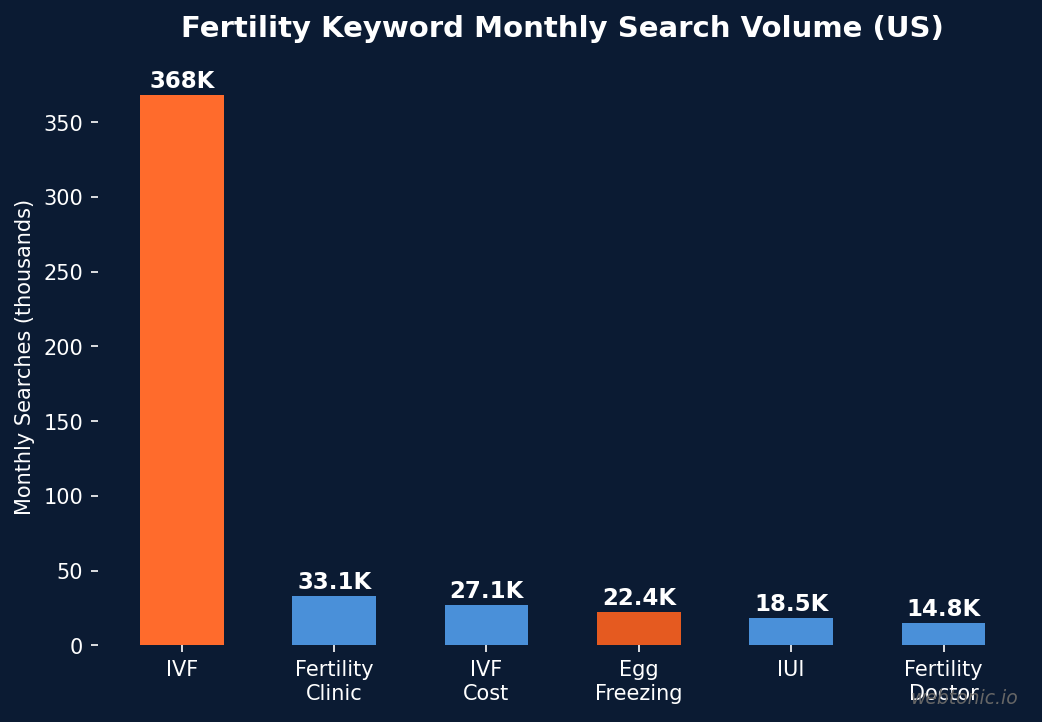
- "IVF" averages 368,000 monthly searches in the US — the single highest-volume fertility keyword, followed by "fertility clinic" (33,100) and "IVF cost" (27,100).
- Long-tail keywords (4+ words) account for 62% of fertility search traffic, with queries like "IVF success rates by age" and "how much does IVF cost with insurance" driving high-intent visits.
- Question-based fertility queries grew 48% in 2025, reflecting patient demand for educational, trustworthy content about treatment options.
- Fertility-related keywords have an average CPC of $4.80–$12.50 in Google Ads, confirming the high commercial value of organic rankings for these terms.
- "Egg freezing" search volume increased 67% since 2023, the fastest-growing fertility sub-category, driven by employer-sponsored fertility benefit programs.
Content Marketing and SEO Performance
Content is the engine of fertility clinic SEO. Educational articles build authority under Google's YMYL guidelines while driving organic traffic and patient trust through transparent, expert-reviewed information.
| Content Metric | Benchmark | Impact |
|---|---|---|
| Blog posts per month (high performers) | 4–8 articles | 3.5× more organic traffic |
| Average article length (top rankers) | 1,800–2,500 words | 56% more backlinks |
| Video content on fertility pages | 32% of top clinics | +88% time on page |
| FAQ schema implementation | Only 18% of clinics | +28% CTR from SERPs |
| Success rate pages (custom) | Top 15% of clinics | Highest-converting page type |
| Patient story content | 42% of clinics | 2.1× social shares |
Clinics with dedicated IVF success rate calculators or cost estimator tools rank 34% higher for commercial-intent keywords than those without interactive content. These tools also generate 4.2× more backlinks from healthcare publishers and parenting blogs.
Technical SEO and Site Performance
Technical SEO forms the foundation of organic visibility. For fertility clinics operating under Google's YMYL framework, technical issues can disproportionately impact rankings because crawlability and security signals factor into trust evaluation.
- The average fertility clinic website scores 52 on Google PageSpeed Insights (mobile), below the recommended 90+ threshold — a significant competitive gap.
- Core Web Vitals compliance among fertility sites is just 38%, with Largest Contentful Paint (LCP) the most common failure point due to large hero images.
- HTTPS adoption is near-universal at 97%, but 22% of fertility clinic sites still serve mixed content warnings, undermining trust signals.
- Schema markup adoption remains low at 14% for MedicalBusiness and 18% for FAQPage — clinics implementing both see +28% rich result impressions.
- Mobile usability issues affect 45% of fertility clinic websites, primarily tap target sizing and text readability on treatment comparison pages.
E-E-A-T and YMYL Compliance
Fertility and IVF content falls squarely within Google's Your Money or Your Life (YMYL) classification. Meeting Experience, Expertise, Authoritativeness, and Trustworthiness standards is essential for ranking — not optional. The data intelligence behind E-E-A-T signals guides how clinics should structure their web presence.
| E-E-A-T Signal | Adoption Rate | Ranking Impact |
|---|---|---|
| Physician-authored content | 35% of clinics | +41% avg. ranking position |
| Author bio with credentials | 28% of clinics | +23% organic CTR |
| Medical review badges | 19% of clinics | +18% trust score |
| Citation of peer-reviewed studies | 24% of clinics | +31% backlink acquisition |
| SART data integration | 41% of clinics | +36% for success rate queries |
Clinics with physician-authored and medically reviewed content rank an average of 41% higher in organic search for competitive fertility keywords. The gap widens for YMYL-sensitive queries about treatment risks, success rates, and costs.
Backlink Profile and Authority Building
Backlinks remain a critical ranking factor for fertility clinic websites, particularly given the YMYL classification that demands high domain authority. Building a strong link profile accelerates organic growth.
- Top-ranking fertility clinics average 850–2,400 referring domains, compared to 120–350 for average clinics — a 5–7× authority gap.
- Healthcare-specific backlinks (medical journals, health publications) carry 3.2× more ranking weight than general directory links for fertility sites.
- Fertility clinics that actively build links see 85–173% organic traffic increases within 6 months, with the strongest results from content-driven outreach strategies.
- Guest posts on parenting and health websites generate an average DA of 45+, making them the most accessible high-quality link source for fertility clinics.
- Digital PR campaigns featuring original fertility research data earn 4.7× more backlinks than standard promotional content, according to healthcare link building agencies.
Competitive SEO Landscape by Market
The SEO competition landscape for fertility clinics varies significantly across geographic markets, directly impacting the investment required to achieve top rankings.
| Market Size | Keyword Difficulty | Avg. Time to Page 1 | Monthly SEO Investment |
|---|---|---|---|
| Major metros (NYC, LA, Chicago) | KD 55–75 | 12–18 months | $8,000–$15,000 |
| Mid-tier (Denver, Austin, Raleigh) | KD 35–55 | 6–12 months | $4,000–$8,000 |
| Smaller metros (Boise, Tucson) | KD 15–35 | 3–6 months | $2,000–$5,000 |
In major metros, achieving page 1 rankings for core fertility keywords requires 12–18 months and $8,000–$15,000/month in SEO investment, but the patient lifetime value ($15,000–$50,000+ per IVF cycle) makes the return highly favorable for clinics that commit to the long game.
AI Search and Future SEO Trends
AI-generated search results (Google AI Overviews, Bing Copilot, ChatGPT search) are reshaping fertility content visibility. Clinics must adapt their SEO strategies to maintain traffic as search behavior evolves.
- 34% of fertility informational queries now trigger an AI Overview in Google Search, pulling answers from top-ranking pages.
- Clinics cited in AI Overviews see a 12% traffic reduction to the cited page but gain brand visibility lift of 28% in subsequent direct searches.
- Structured data (FAQ, HowTo, MedicalCondition schema) increases AI citation probability by 2.3× according to early AI search optimization studies.
- Voice search for fertility topics grew 45% in 2025, with most queries matching People Also Ask patterns — a hint at optimization priorities.
- Zero-click searches account for 42% of fertility informational queries, making featured snippet and knowledge panel optimization critical for visibility.
Mobile SEO and User Experience
Mobile search behavior shapes how patients discover and evaluate fertility clinics online. With 68% of fertility-related searches happening on mobile, mobile optimization is inseparable from SEO strategy.
- Fertility clinic websites that pass Core Web Vitals on mobile rank 15% higher on average than those failing the assessment, with LCP being the most impactful metric.
- Mobile page load time directly impacts bounce rate — sites loading under 2.5 seconds retain 78% of visitors, while those above 4 seconds lose over half of traffic.
- Click-to-call functionality drives 41% of first-contact interactions from mobile organic results, making prominent phone placement critical for conversion.
- AMP adoption among fertility clinic sites is just 6%, though fast-loading mobile pages correlate with higher organic ranking positions regardless of AMP implementation.
SEO ROI and Lead Generation
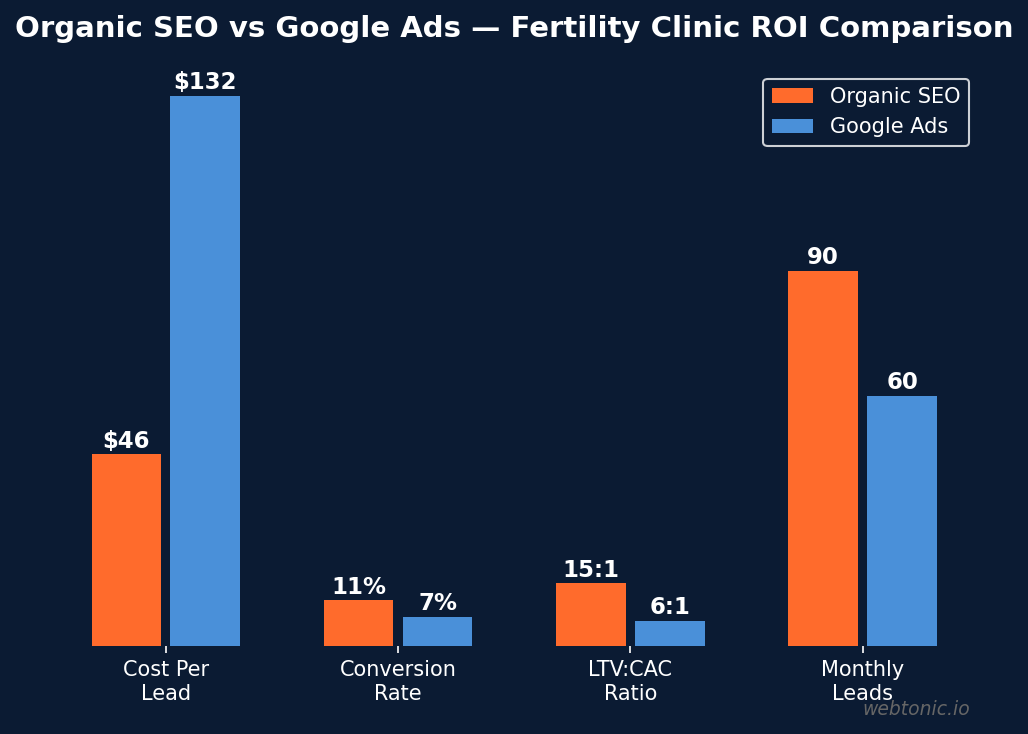
Fertility clinic SEO delivers exceptional ROI when executed strategically. The high patient lifetime value ($15,000–$50,000+ per treatment cycle) means even modest organic traffic gains translate to significant revenue.
| ROI Metric | Organic SEO | Google Ads (comparison) |
|---|---|---|
| Cost per lead | $28–$65 | $85–$180 |
| Lead-to-patient conversion | 8–14% | 5–9% |
| Monthly qualified leads (mature program) | 60–120 | 40–80 |
| LTV:CAC ratio | 12:1 – 18:1 | 4:1 – 8:1 |
| Channel sustainability | Compounds over time | Stops when spend stops |
Organic SEO leads convert at nearly 2× the rate of paid search leads for fertility clinics, likely because organic visitors tend to be further along in their research journey. A clinic investing $4,000–$8,000/month in SEO can expect to reach a positive ROI within 4–8 months, with returns compounding as domain authority and content library grow.
Frequently Asked Questions
How long does SEO take to work for a fertility clinic?
Most fertility clinics begin seeing ranking improvements within 3–4 months and significant traffic increases by 6–9 months. Competitive keywords like "IVF clinic" or "fertility doctor" in major metros may take 12–18 months to crack the top 5. The timeline depends heavily on existing domain authority, content quality, and the competitive landscape in the clinic's geographic market.
What type of content ranks best for fertility clinics?
Long-form educational content (1,800–2,500 words) about IVF procedures, success rates, costs, and patient experiences consistently ranks highest. Success rate comparison pages convert at the highest rate, while comprehensive IVF cost guides attract the most backlinks. Adding physician-authored bylines and citing peer-reviewed studies significantly boosts YMYL compliance and rankings.
Is SEO or Google Ads better for fertility clinic marketing?
Both channels serve different purposes. SEO delivers lower-cost leads ($28–$65 vs $85–$180) with higher conversion rates, but requires 4–8 months to reach ROI. Google Ads delivers immediate visibility but stops producing leads when the budget is paused. The optimal approach is a combined strategy where Google Ads drives leads immediately while SEO builds long-term compounding returns.
How does AI search impact fertility clinic SEO?
AI Overviews appear for 34% of fertility informational queries, reducing click-through to traditional organic results by roughly 12%. However, clinics cited in AI responses see a 28% brand visibility lift. The best defense is structured data (FAQ, Medical schema), comprehensive E-E-A-T signals, and content that answers complex multi-step questions AI summaries struggle to fully address.
What E-E-A-T signals matter most for fertility clinic websites?
Physician-authored content provides the strongest ranking uplift (+41% average position), followed by citation of peer-reviewed clinical studies (+31% backlink acquisition) and SART data integration (+36% for success rate queries). Author bios with medical credentials, medical review badges, and clear editorial policies collectively signal the expertise Google requires for YMYL health content.
Sources
Benchmarketing — Fertility Clinics Marketing Benchmarks 2026
BrightLocal — Local SEO Statistics and Trends
FoundryCRO — Healthcare Marketing Benchmarks by Specialty
Zelst — Healthcare SEO Case Studies
Digitechniks — Fertility Clinic SEO and Organic Growth
BadAss Backlinks — Healthcare Link Building Insights
Irresist.io — Fertility Clinic Analytics and Tracking
Semrush — Healthcare SEO Trends and Best Practices