Table of contents

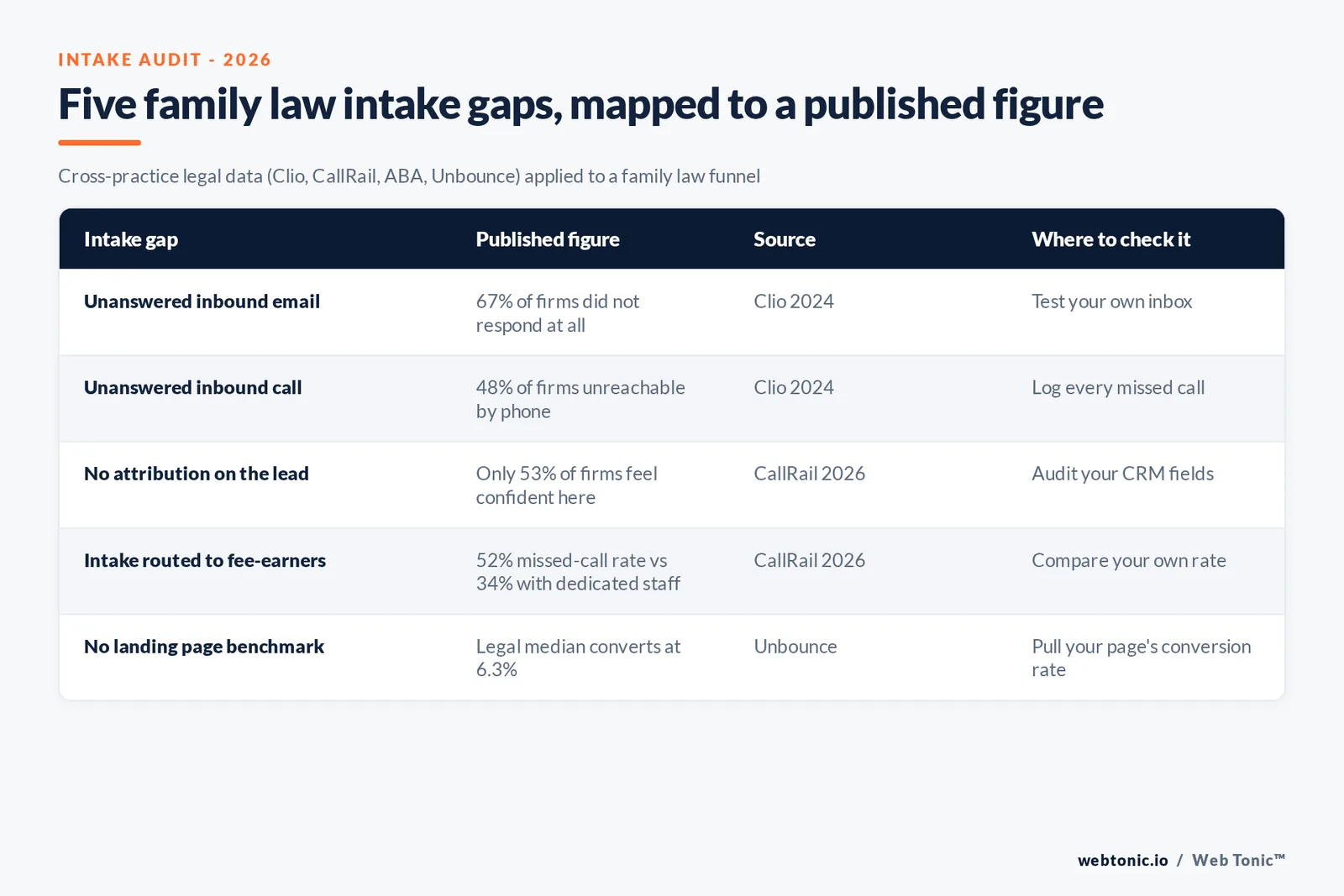
No study prices or times a family law firm's intake funnel on its own, so this page audits the funnel with the cross-practice legal data that does exist and marks every number that is not family-law-specific. Two studies did test family law inquiries directly - Clio's 2019 and 2024 mystery-shop responsiveness research - and those are called out below.
Key Takeaways
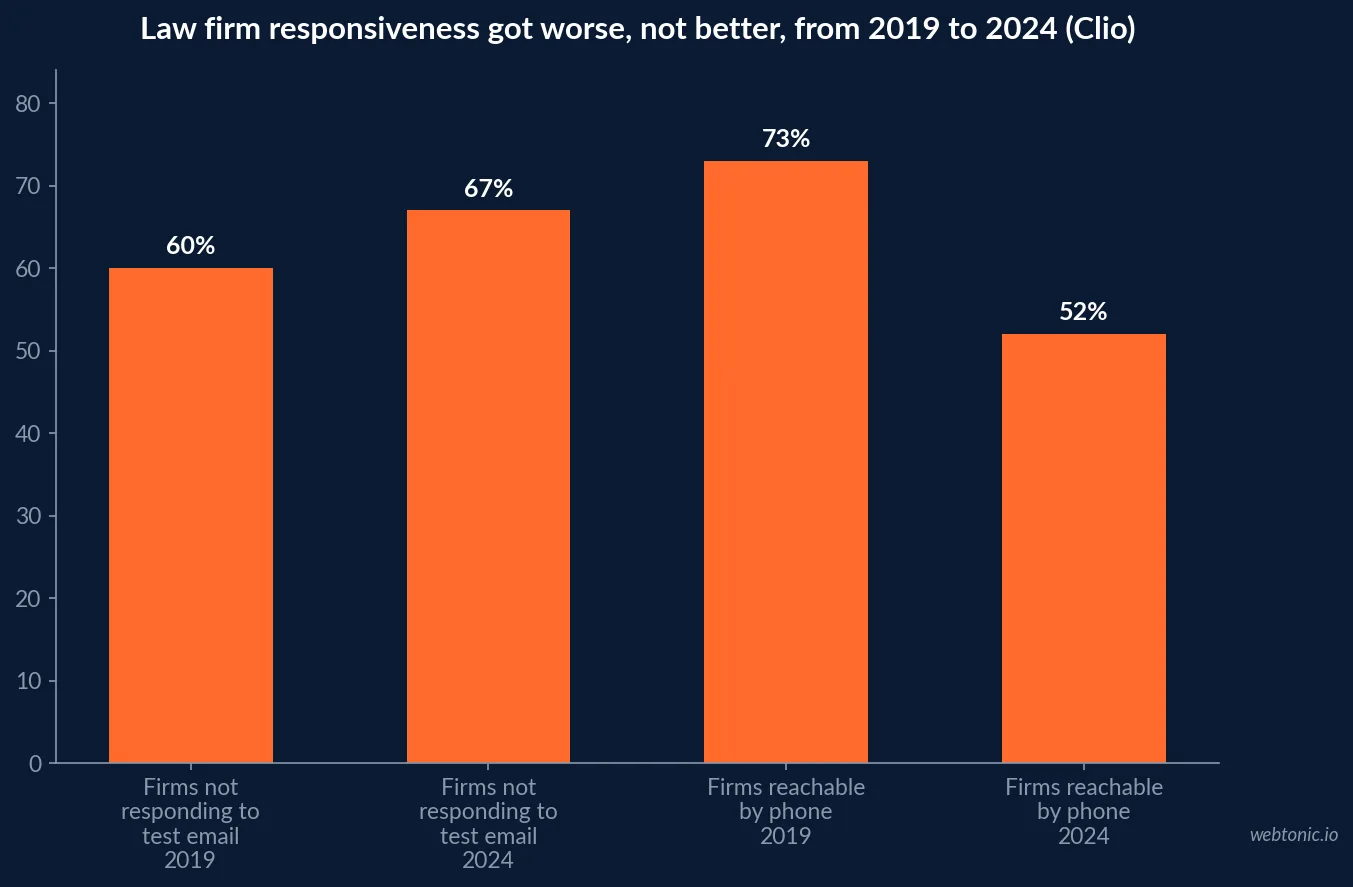
- 67% of firms did not respond to a test email at all in 2024, up from 60% in 2019.
- Only 52% of firms answered or returned a test phone call, down from 73% in 2019.
- 48% of firms could not be reached by phone at all in Clio's 2024 test.
- 81% of firms report losing business to slow responses (CallRail, 2026).
- 35% of firms say that lost business reached 11-25% of revenue.
- Only 53% of firms call themselves confident in attribution or ROI measurement.
- 69% say phone calls and email are still the first contact channel, against 36% for text.
- 68% of law firms route intake through lawyers and paralegals rather than dedicated staff.
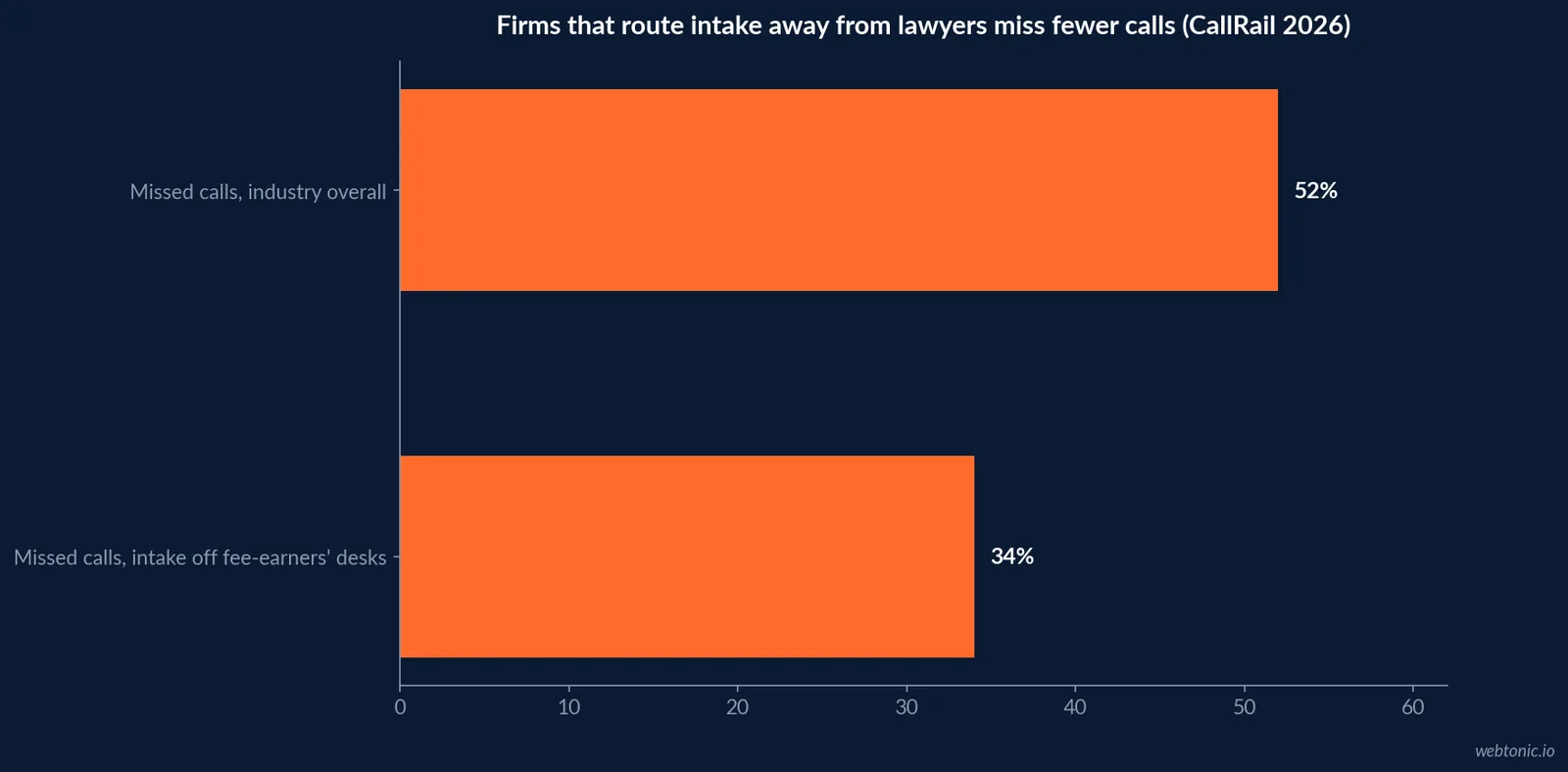
- Firms that route intake elsewhere report missed calls at 34%, against 52% overall.
- Growing firms use 15% more of their intake/CRM software's features than stable firms.
- And 44% more than shrinking firms in the same cohort analysis.
- 70% of clients say it was easy to find and hire their last lawyer.
- 24% say they would be unlikely to rehire that same lawyer.
- The median legal landing page converts at 6.3%, against a 6.6% all-industry baseline.
- Family law's average lawyer hourly rate is USD 343, one of the higher rates Clio tracks.
- Only 57% of firms expect to raise marketing budgets in 2026, down from 86% a year earlier.
- Email investment leads planned 2026 budget increases at 51% among growing firms.
- Firms responding to email did so within two business days, 84% within eight hours.
Why family law needs its own funnel audit, not a borrowed one
A family law inquiry is rarely a single lead. It is often a custody question this week and a support-modification question next year, from a client who is emotionally strained and comparing firms while still deciding whether to call at all. That makes intake speed and record-keeping worth more here than in a transactional practice area, yet the published data is almost entirely cross-practice. Clio's 2025 Legal Trends Report surveyed 1,702 US and Canadian legal professionals as its base sample; it is not a family-law-only study, and this page treats it as such throughout.
The one place family law shows up by name in Clio's responsiveness testing is the practice-area list its 2019 and 2024 mystery-shop studies used to script test inquiries, which specifically included a family law (child custody) scenario alongside criminal, bankruptcy and other issue types. That detail is the honest anchor for everything else on this page.
The responsiveness numbers that should worry every intake desk
Clio's 2024 Legal Trends Report hired a third-party research firm to email and phone 1,000 US law firms with realistic client questions across five practice areas, including family law. 67% of firms did not respond to the email at all, worse than the 60% non-response rate Clio measured in 2019. By phone, only 40% of firms answered live, and combining answered calls with call-backs still leaves only 52% of firms reachable - meaning 48%, nearly half, could not be reached by phone at all. Voicemail return rates fell from 43% in 2019 to just 20% in 2024.
Firms that did respond were not slow: every email response arrived within two business days, and 84% arrived within eight hours. The gap is not response speed once someone engages. It is whether anyone engages at all.
| Responsiveness metric (US law firms) | 2019 | 2024 | Direction | Source |
|---|---|---|---|---|
| Firms that did not respond to test email | 60% | 67% | Worse | Clio Legal Trends Report |
| Firms that answered the test phone call live | 56% | 40% | Worse | Clio Legal Trends Report |
| Firms reachable by phone (answer or callback) | 73% | 52% | Worse | Clio Legal Trends Report |
| Firms unreachable by phone at all | 27% | 48% | Worse | Clio Legal Trends Report |
| Firms that returned a voicemail | 43% | 20% | Worse | Clio Legal Trends Report |
What CallRail's 2026 legal survey adds on top
CallRail's 2026 Legal Marketing Outlook Report, its own survey of law firm marketers, puts a revenue number on the same problem Clio measured qualitatively: 81% of firms say they have lost business to slow responses, and 35% say that loss reached 11% to 25% of revenue. It also found 69% of firms still name phone calls and email as the first contact channel, against 36% naming text, and that 68% of firms route client intake through lawyers and paralegals rather than a dedicated intake role.
The gap that matters most for tracking: firms that route intake away from fee-earners report missed calls at 34%, versus 52% for the industry overall. Whoever answers the phone is, functionally, the firm's real conversion rate optimization team.
| CallRail 2026 survey finding | Figure | What it measures |
|---|---|---|
| Firms reporting lost business from slow responses | 81% | Self-reported revenue impact |
| Firms reporting the loss was 11-25% of revenue | 35% | Severity of the impact |
| Firms confident in attribution or ROI measurement | 53% | Marketing analytics maturity |
| Firms naming phone/email as first contact channel | 69% | Channel still dominates intake |
| Firms routing intake through lawyers/paralegals | 68% | Who actually answers the phone |
| Missed-call rate, intake NOT on fee-earners' desks | 34% | Effect of dedicated intake staffing |
| Missed-call rate, industry overall | 52% | Baseline against the figure above |
What clients say about finding and rehiring a lawyer
Clio's 2025 report also surveyed consumers directly. 70% of clients who hired a lawyer recently said it was easy to find and hire one, largely through referrals and internet searches. Satisfaction and loyalty diverge, though: 24% said they would be unlikely to rehire the same lawyer even when the outcome was fine, which is a retention-tracking problem most intake systems are not built to catch because the client never complains - they just don't call back next time.
For a family law practice, where the same client can return years later for a modification or a new matter, that 24% figure is arguably more relevant to lifetime revenue than any single intake conversion number.
Where the analytics maturity gap actually sits
Clio's cohort analysis - comparing growing, stable and shrinking firms already using its platform - found growing firms use 12% more Clio products overall than stable firms and 15% more, and use 15% more of their intake and CRM product's features than stable firms, 44% more than shrinking firms. Within Clio Manage specifically, growing firms use 13% more of the software than stable firms and 46% more than shrinking firms. None of this proves the software caused the growth, but it is a consistent, repeated gap across every product line Clio measured.
| Clio cohort adoption gap | Growing vs stable firms | Growing vs shrinking firms |
|---|---|---|
| Overall Clio product adoption | +12% | +15% |
| Clio Manage feature adoption | +13% | +46% |
| Clio Grow (intake/CRM) feature adoption | +15% | +44% |
| Clio Payments feature adoption | +13% | +33% |
Where the tracking budget is actually going in 2026
CallRail found only 57% of firms expect to raise marketing budgets in 2026, a sharp drop from 86% who expected the same a year earlier, and only 11% plan to cut budgets outright. Among firms still planning increases, the largest destinations are email at 51%, influencer marketing at 49%, and paid social at 47%, while trade shows (25%) and traditional advertising (12%) see the smallest planned increases. The ABA's 2023 Websites and Marketing TechReport separately found that, where firms could name who has access to web analytics, one lawyer having sole access was the most common answer, followed by 22% naming firm marketing staff and 21% naming outside consultants - meaning at a large share of firms, analytics access is not distributed at all.
| Who has access to the firm's web analytics | Share of firms (ABA 2023 TechReport) |
|---|---|
| One lawyer only | Most common single answer |
| Firm marketing staff | 22% |
| Outside consultants | 21% |
| Office administrator/manager | 18% |
| More than one lawyer | 16% |
| Firm technology staff | 12% |
| Firm webmaster | 7% |
The one page-level benchmark that exists
Unbounce's Conversion Benchmark Report, built from its own landing-page platform data, puts the median conversion rate for legal landing pages at 6.3%, just under its 6.6% all-industry baseline. It is not split by practice area, so a family law intake page cannot be benchmarked against a family-law-specific figure - but 6.3% is the closest published number to compare a custody-consultation request page against, and any family law page converting meaningfully below it has a tracking-visible, fixable gap.
| Practice area | Avg. lawyer hourly rate | Avg. non-lawyer rate | Avg. law firm rate |
|---|---|---|---|
| Family | USD 343 | USD 181 | USD 294 |
| Criminal | USD 217 | USD 188 | USD 212 |
| Immigration | USD 361 | USD 317 | USD 342 |
| Bankruptcy | USD 456 | USD 205 | USD 386 |
| Personal injury | USD 335 | USD 163 | USD 284 |
Family law's average hourly rate sits well above criminal defense and close to bankruptcy, per Clio's 2025 report, which is exactly why a missed call or an unanswered email in this practice area is not a small tracking gap - it is a high-value lead disappearing into a phone that nobody logged. Our data and analytics practice builds the attribution layer that turns "we think referrals work" into a number a managing partner can act on.
A five-point audit a family law firm can run this week
- Time every inbound email response against the 84%-within-eight-hours bar the minority of responsive firms already clear.
- Log every missed call, not just answered ones, and compare the rate against the 34% figure firms with dedicated intake staffing report.
- Ask who has analytics access - if it is one lawyer, per the ABA's finding, no one else can act on the data even if it exists.
- Track rehire intent, not just satisfaction, given the 24% of clients who would not rehire an otherwise satisfactory lawyer.
- Benchmark the intake page's conversion rate against Unbounce's 6.3% legal median rather than against no number at all.
If the audit turns up gaps in attribution or reporting, our breakdown of what paid channels actually cost is a useful next read before the budget conversation, and talking to us is the faster route to a working dashboard.
Frequently Asked Questions
Is there family-law-specific intake and analytics data?
Almost none is published at the practice-area level. Clio's Legal Trends Report and CallRail's Legal Marketing Outlook Report both survey the legal industry as a whole, though Clio's 2019 and 2024 responsiveness studies specifically included family law inquiries (child custody questions) in the sample of issues its researchers phoned and emailed to firms. Where a figure is cross-practice, this page says so rather than repackaging it as family-law-only.
How many family law inquiries actually get a response?
Clio's 2024 Legal Trends Report tested 1,000 US law firms across five practice areas, including family law, with real client-style emails and phone calls. Across the sample, 67% of firms never responded to the email at all, and firms only answered or returned 52% of phone calls, meaning 48% of firms could not be reached by phone at all. Both figures got worse since Clio's 2019 baseline, not better.
What is the single biggest tracking gap CallRail found?
According to CallRail's 2026 Legal Marketing Outlook Report, 81% of law firms say they have lost business to slow responses, and 35% say the lost business reached 11-25% of revenue. Only 53% of firms call themselves confident in attribution or ROI measurement, which means roughly half the industry is still guessing at which channel produced the client sitting in the waiting room.
Does using intake software actually change outcomes?
Clio's cohort analysis of firms already on its platform found growing firms use 15% more of their intake and CRM product's features than stable firms, and 44% more than shrinking firms - a within-Clio adoption gap, not a controlled experiment, but a consistent one. CallRail separately found firms that route intake outside the lawyer/paralegal default report missed calls at 34% versus 52% for firms that keep intake on fee-earners' desks.
What conversion rate should a family law intake page be measured against?
Unbounce's Conversion Benchmark Report puts the median conversion rate for legal landing pages at 6.3%, just under its 6.6% all-industry baseline - a page-level, cross-practice figure, not a family-law number, but the closest published yardstick for a divorce or custody consultation-request page.
Sources
Clio - 2025 Legal Trends Report
Clio - 2024 Legal Trends Report (responsiveness study)
CallRail - 2026 Legal Marketing Outlook Report
American Bar Association - 2023 Websites and Marketing TechReport
Google Business Profile Help - Understand your Business Profile performance & insights
Unbounce - Legal industry conversion rate benchmarks
WordStream by LocaliQ - 2025 Google Ads Benchmarks