Table of contents

Family law is not priced on its own in Google's data - it sits inside Attorneys and Legal Services, the single most expensive advertising category tracked, at $9.87 a click and $131.63 a lead. Every family law campaign is competing inside that number, and the ABA's advertising rules shape what the ad can say to earn it back.
Key Takeaways
- Attorneys and Legal Services averages $9.87 per click on Google Ads, the highest of 23 industries.
- The same category averages $131.63 per lead, also the highest tracked.
- The all-industry average cost per click is $5.42, roughly half the legal figure.
- The all-industry average cost per lead is $66.69, less than half the legal figure.
- Facebook lead-campaign CPC for attorneys is $4.10, the second-highest tracked.
- Attorney Facebook lead-campaign conversion rate is 10.53%, up 31% year over year.
- Attorney Facebook CTR rose 80% year over year, the single largest jump measured.
- Attorney Facebook cost per lead fell 77% year over year even as CPC rose.
- 92.4% of legal consumers research online before ever calling a firm.
- 58% of law firms report running Google Ads (PPC) as a marketing channel.
- 672,502 divorces and annulments were recorded in the US in 2023.
- ABA Model Rules 7.1-7.3 govern what a legal ad can claim or solicit.
The category family law is priced inside
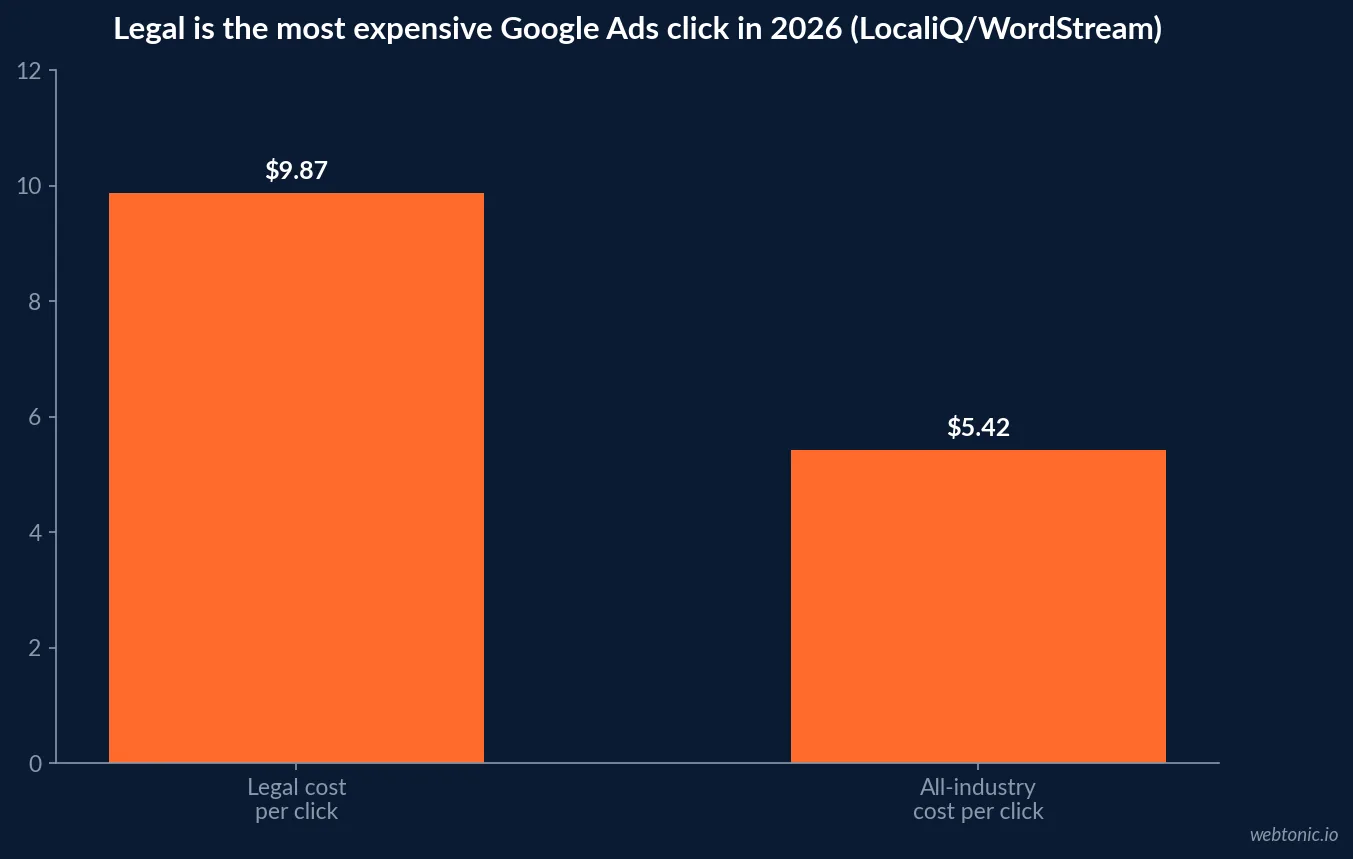
LocaliQ/WordStream's 2026 Google Ads benchmarks, built from 13,474 search campaigns, report Attorneys and Legal Services as the single most expensive of 23 tracked industries on both headline cost metrics: $9.87 average cost per click, against a $5.42 all-industry average, and $131.63 average cost per lead, against a $66.69 all-industry average. No search-benchmark publisher currently isolates family law from the wider legal category, so every figure here is stated honestly as a legal-services-wide number that family law campaigns sit inside, not a family-law-specific figure.
| Metric (2026, Google/Microsoft Ads) | Attorneys & Legal Services | All-industry average |
|---|---|---|
| Cost per click | $9.87 | $5.42 |
| Cost per lead | $131.63 | $66.69 |
| Rank among 23 industries (CPC) | 1st (highest) | - |
| Rank among 23 industries (CPL) | 1st (highest) | - |
Why the category clears such a high price
The arithmetic is client value, not inefficiency. A contested divorce or custody matter can run into many thousands of dollars in fees over months of representation, which lets firms bid well past what a lower-value category could sustain. The category is also structurally crowded: personal injury, family, criminal defense and estate planning firms frequently compete on the same broad "lawyer near me" and "attorney near me" terms even though their case value and timelines differ sharply, which pushes the blended average higher than any single practice area would set on its own.
Martindale-Avvo's 2026 consumer research reinforces the demand side of that price: 92.4% of legal consumers research online before ever placing a call, which means the paid click is frequently the first real touchpoint a family law prospect has with a firm, not a follow-up to an existing relationship.
| Why legal CPC/CPL runs high | Evidence |
|---|---|
| High case lifetime value supports aggressive bids | Multi-thousand-dollar fees on contested matters |
| Broad terms shared across practice areas | Personal injury, family, criminal and estate law overlap on "lawyer near me" |
| Buyers do not compare-shop casually | 92.4% research before contacting a firm (Martindale-Avvo 2026) |
| Google's search benchmark methodology | Legal ranked highest CPC and CPL of 23 industries (WordStream 2026) |
What happens once the click lands: a Meta proxy
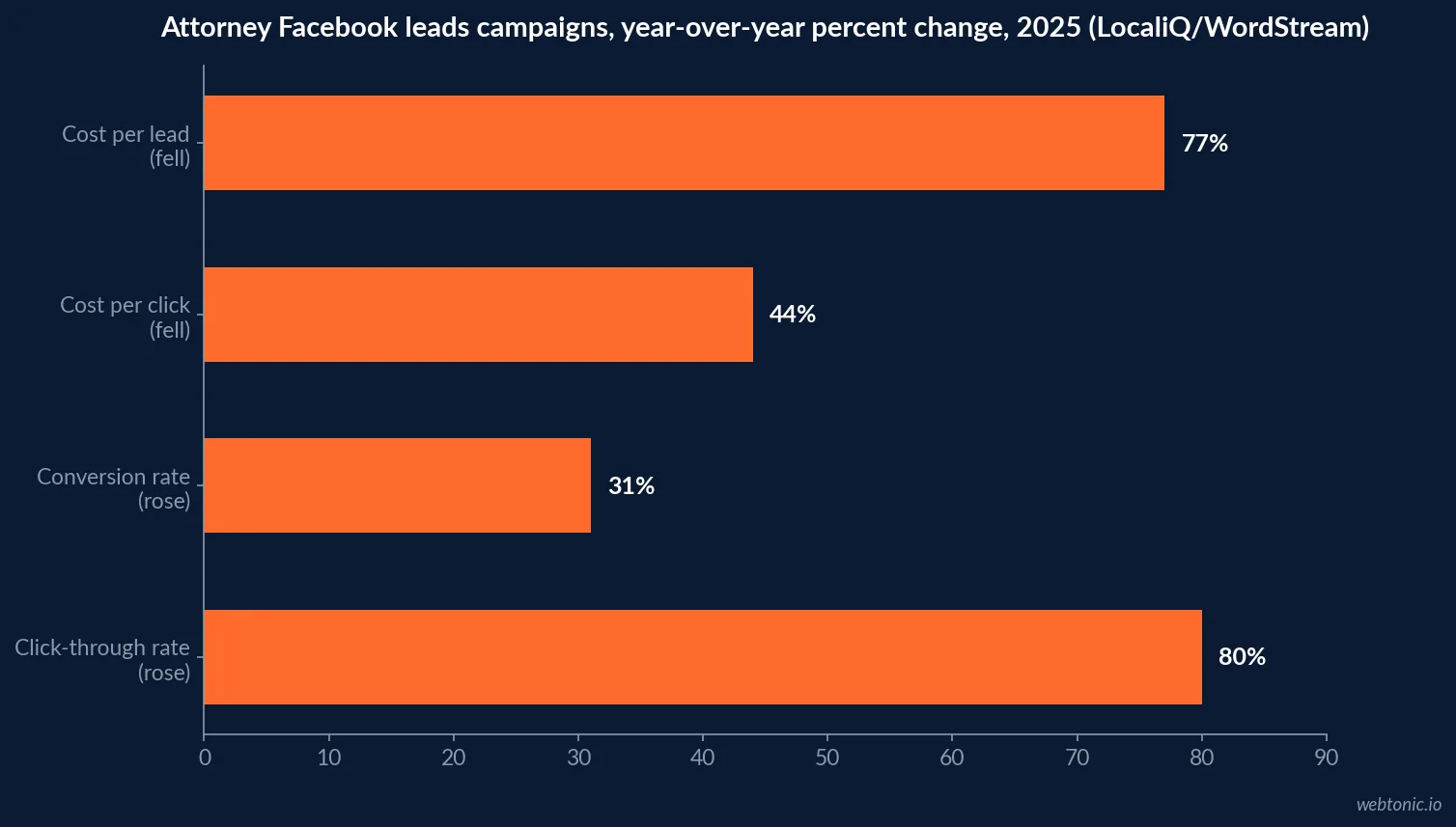
Search conversion rate for legal specifically isn't published, but LocaliQ/WordStream's Facebook benchmarks offer a useful proxy for how legal audiences behave once they engage: Attorneys and Legal Services posted a leads-objective conversion rate of 10.53%, up 31% year over year, and its click-through rate for leads campaigns rose 80% year over year, the largest jump of any industry measured. At the same time, cost per lead for attorneys on Facebook fell 77% year over year even as cost per click rose to $4.10 - a sign that legal advertisers got sharply better at converting the clicks they were already paying more for.
| Attorneys & Legal Services, Facebook leads objective | 2025 figure | Year-over-year change |
|---|---|---|
| Click-through rate | n/a (base not isolated) | Up 80%, largest of any industry |
| Conversion rate | 10.53% | Up 31% |
| Cost per click | $4.10 | Down 44% |
| Cost per lead | n/a | Down 77% |
The rules that shape what the ad is allowed to say
Unlike a retail or SaaS category, legal advertising is governed state by state under the ABA Model Rules of Professional Conduct 7.1 through 7.3, adopted with local variations by every state bar. Rule 7.1 prohibits false or misleading communications about a lawyer's services - guaranteed outcomes or implied settlement values are the most common violations in paid search copy. Rule 7.3 restricts live person-to-person solicitation of someone the lawyer knows or should know needs legal services in a specific matter, which is directly relevant to family law's use of court-record or public-filing based targeting: an ad that appears to address a named individual's pending divorce or custody filing risks crossing the solicitation line even though the underlying data is public record.
A family law campaign built around urgency ("served with papers? call now") sits closer to that line than a campaign built around informational intent ("what does a contested custody case cost"), which is one more reason the category's cost per lead reflects careful, reviewed copy rather than aggressive claims.
| Campaign decision | Evidence behind it | Rule/data it answers to |
|---|---|---|
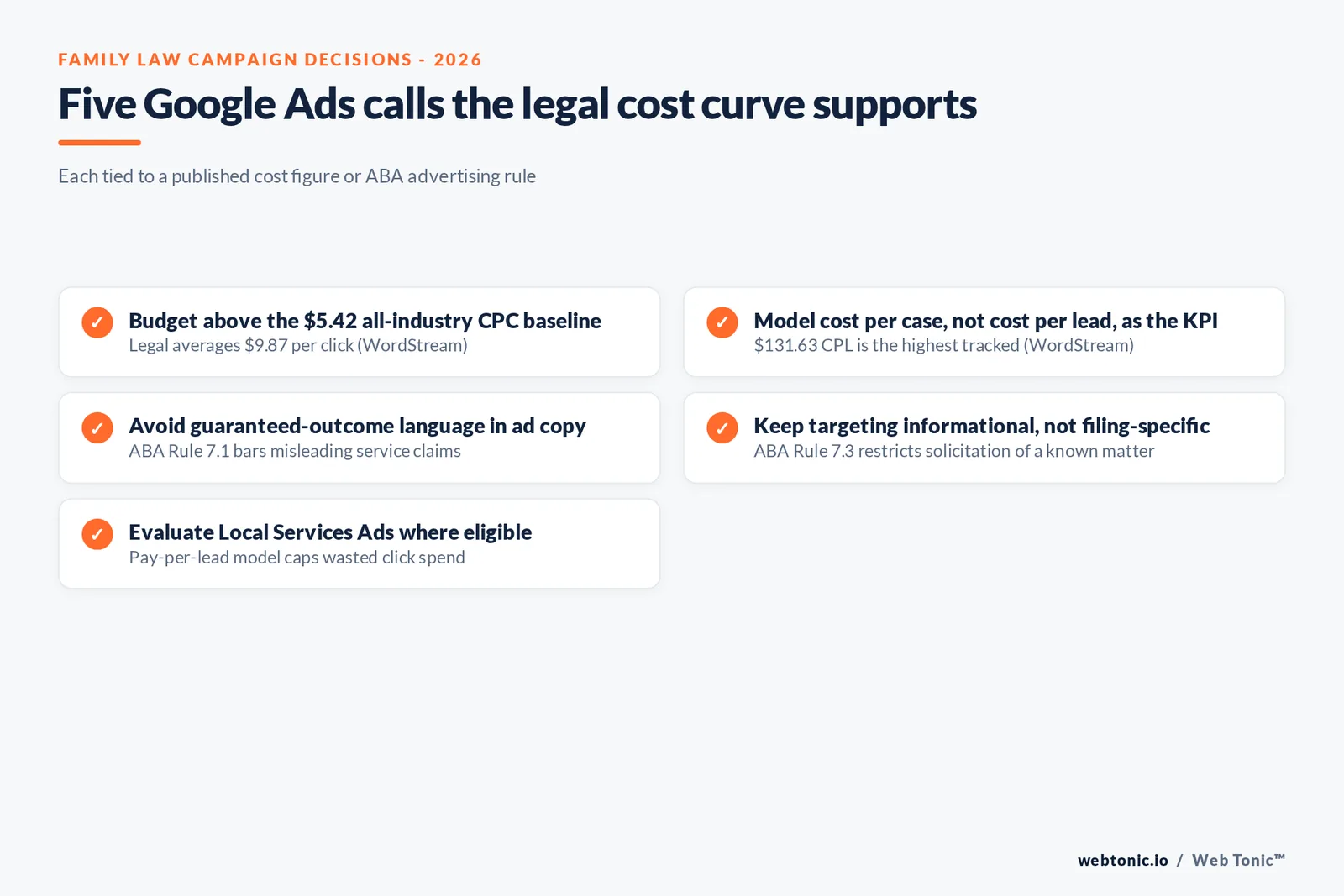
| Budget above the $5.42 all-industry CPC baseline | Legal averages $9.87 per click | WordStream 2026 |
| Model cost per case, not cost per lead, as the KPI | $131.63 CPL is the highest tracked | WordStream 2026 |
| Avoid guaranteed-outcome language in ad copy | Rule 7.1 bars misleading service claims | ABA Model Rules |
| Keep targeting informational, not filing-specific | Rule 7.3 restricts solicitation of a known matter | ABA Model Rules |
| Evaluate Local Services Ads for qualifying markets | Pay-per-lead model removes wasted click spend | Google Screened program |
A pay-per-lead alternative worth testing
Google's Local Services Ads program, described in Google's and Clio's own program materials, runs on a pay-per-lead rather than pay-per-click model and requires firms to pass a "Google Screened" background and license check before their ad can appear with that badge. Because the firm only pays when a qualified lead makes contact through the ad, it removes the risk of paying the category's $9.87 average click cost for traffic that never converts - though eligibility is limited by market and practice area, and the screening process takes longer to clear than launching a standard Search campaign.
The trade-off is control: a Local Services Ads listing surfaces on a Google-ranked basis rather than a keyword-and-bid basis, so a firm cannot target "child custody attorney" specifically the way a Search campaign can. Most family law advertisers end up running both - Local Services Ads for the pay-per-lead floor, Search for the keyword-level targeting the category's cost data above is priced around.
| Local Services Ads vs. standard Search, for family law | Local Services Ads | Search campaigns |
|---|---|---|
| Pricing model | Pay per qualified lead | Pay per click ($9.87 category average) |
| Eligibility | Google Screened background/license check required | Open, subject to policy compliance |
| Targeting control | Google-ranked placement, limited keyword control | Full keyword and bid control |
| Best fit | Capping wasted click spend in qualifying markets | Precise intent terms like "custody lawyer near me" |
What this means for a family law budget
Budget against the category's real cost per lead, not against a lower-cost industry's benchmark, and treat every claim in the ad copy as reviewed against Rule 7.1 before it ships. Where a market qualifies, test Local Services Ads alongside Search to cap wasted click spend, and lean campaign messaging toward informational intent rather than urgency tied to a specific pending filing.
For the organic side of the same client journey, see our companion research on what Google Ads costs across industries, our guide to building a Google Ads strategy, or talk to us about building a legal-vertical campaign that survives both the cost curve and the compliance review.
Frequently Asked Questions
How much does a family law Google Ads click and lead actually cost?
There is no family-law-only figure published; family law is reported inside the broader Attorneys and Legal Services category. LocaliQ/WordStream's 2026 benchmarks, from 13,474 search campaigns, put that category's average cost per click at $9.87, the highest of 23 industries, and its cost per lead at $131.63, also the highest tracked. Family law campaigns bidding on high-intent terms like "divorce lawyer near me" typically sit at or above the category average, since those terms carry commercial intent comparable to a paid consultation.
Why is the legal category the most expensive one in Google Ads?
Client lifetime value. A single contested divorce or custody case can be worth many thousands of dollars in fees, so firms can profitably bid well above what a lower-value category would tolerate. The category is also crowded with practice areas that compete on the same broad terms - personal injury, family, criminal defense, and estate planning firms often bid on overlapping "lawyer near me" search terms even though their client value and case timelines differ sharply.
Do family law ads perform any better once a click happens?
Search conversion data isn't split out by legal practice area, but Meta's leads-objective data is a useful proxy for how legal ads convert once someone engages: LocaliQ/WordStream's Facebook benchmarks found Attorneys and Legal Services posted a leads-campaign conversion rate of 10.53%, up 31% year over year, well above several other high-CPC categories, even as its Facebook CPC rose to $4.10. Legal audiences that click tend to be seriously in-market, which is consistent with family law's crisis-driven search behavior.
What advertising rules limit what a family law ad can promise?
The ABA's Model Rules of Professional Conduct 7.1 through 7.3 govern lawyer advertising and solicitation in every US state bar (with local variations): Rule 7.1 bars false or misleading communications about a lawyer's services, and Rule 7.3 restricts live person-to-person solicitation of a specific person known to need legal services, with exceptions. A family law ad promising a guaranteed outcome, a specific settlement amount, or contacting a named individual directly about their pending case can cross both rules and most state bar advertising codes at once.
Is Google's Local Services Ads program a cheaper alternative for family law firms?
It can be, for firms that qualify. Local Services Ads runs pay-per-lead rather than pay-per-click and requires the firm to pass a Google Screened background and license check before the badge and placement are granted, according to Google's and Clio's own program descriptions. Because a firm only pays when a qualified lead contacts them through the ad, it removes the risk of paying the category's $9.87 average click cost for a click that never converts - the trade-off is eligibility limits and a slower approval process than standard Search campaigns.
Sources
LocaliQ/WordStream - 2026 Google Ads industry benchmarks
LocaliQ/WordStream - 2025 Facebook ads industry benchmarks
Martindale-Avvo/FindLaw - State of the Legal Consumer 2026
American Bar Association - Model Rules of Professional Conduct 7.1-7.5
CDC/NCHS - FastStats: Marriage and Divorce
Clio - Google Local Services Ads for Lawyers