Table of contents
Ethos in advertising is persuasion by credibility: the brand convinces you to act because of who is speaking, not because of the argument or the emotion. It is one of Aristotle's three modes of persuasion, alongside pathos (emotion) and logos (logic).
Ethos is also the appeal most advertisers get wrong, because credibility cannot be claimed in a headline — it has to be evidenced, borrowed or earned.
Key Takeaways
- Aristotle set out three modes of persuasion in the Rhetoric: ethos, pathos and logos. Ethos is the appeal from character.
- Only about 1 in 10 Americans rate the honesty of advertising practitioners as high in Gallup's long-running ethics poll — the credibility deficit every ad starts with.
- Ethos comes from five practical sources: expertise, endorsement, longevity, transparency and social proof.
- Nielsen's trust research repeatedly finds recommendations from people you know the most trusted advertising format of all, ahead of any paid channel.
- Nike's 1984 Michael Jordan signing and its 2018 Colin Kaepernick campaign are the two clearest examples of borrowed and staked ethos.
- Borrowed credibility is now regulated: the FTC endorsement guides require any material connection between brand and endorser to be disclosed.
- The strongest campaigns rarely use one appeal — most high-performing ads combine ethos with pathos and logos in a roughly 1:1:1 balance.
What ethos means, precisely
Ethos is Greek for character. In Aristotle's Rhetoric, persuasion happens through the character of the speaker, the emotional state of the audience, or the argument itself. The Stanford Encyclopedia of Philosophy's treatment of the Rhetoric makes an important point that marketers skip: for Aristotle, ethos is produced within the speech. Reputation helps, but the audience judges character from how you speak to them right now.
That is why an unknown brand can still build ethos in a 30-second spot, and why a household name can destroy it in one. Purdue's writing lab summarises the same triad in modern terms in its guide to rhetorical strategies, and the rhetorical triangle is the version most commercial teams find usable.
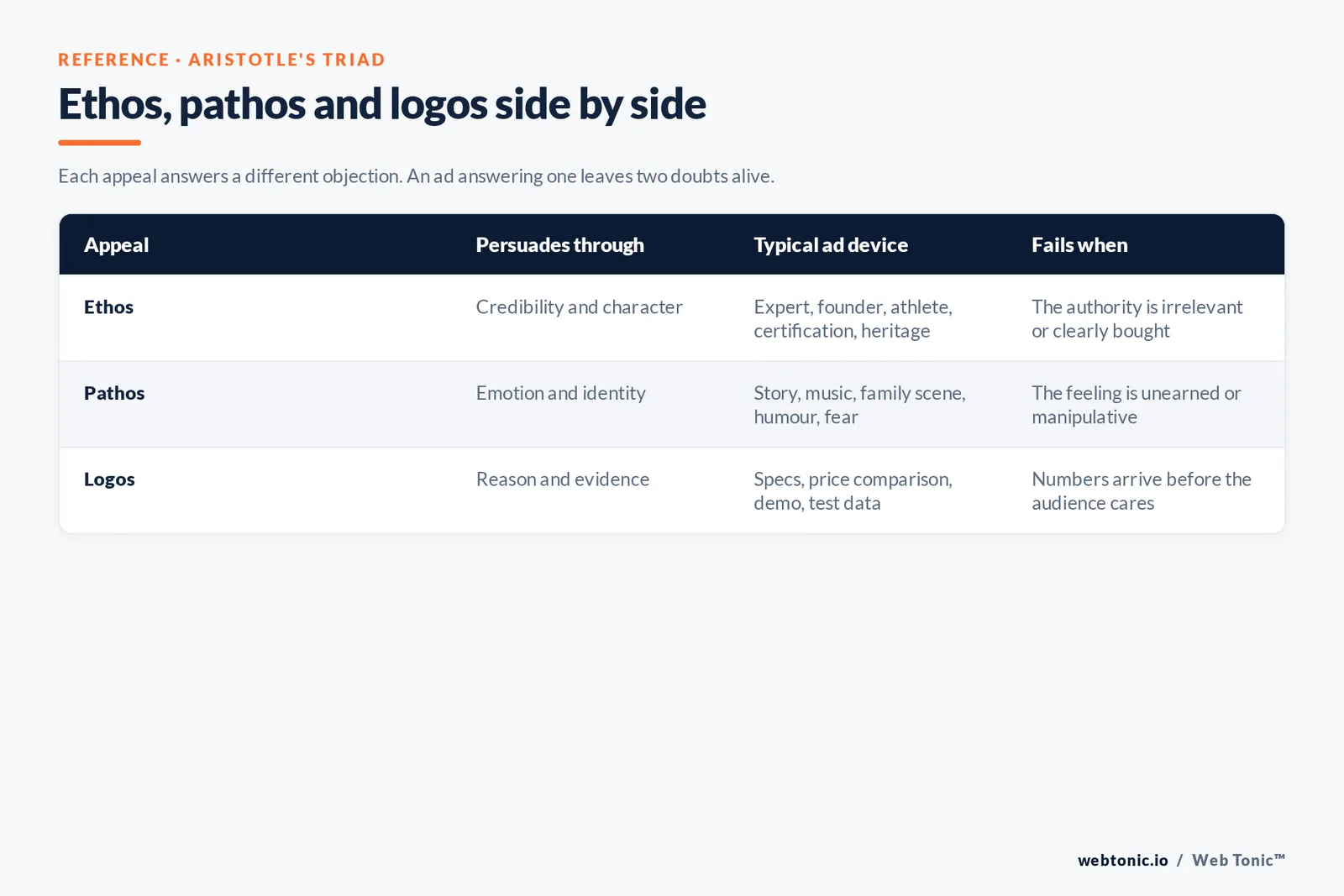
Ethos, pathos and logos side by side
The three appeals answer three different objections. Ethos answers "why should I believe you". Pathos answers "why should I care". Logos answers "why is this the right choice". An ad that answers only one leaves the other two doubts alive.
| Appeal | Persuades through | Typical ad device | Fails when |
|---|---|---|---|
| Ethos | Credibility and character | Expert, founder, athlete, certification, heritage claim | The authority is irrelevant or clearly bought |
| Pathos | Emotion and identity | Story, music, family scene, humour, fear | Feeling is unearned or manipulative |
| Logos | Reason and evidence | Specs, price comparison, demo, test data | Numbers arrive before the audience cares |
Jib Fowles' influential inventory of 15 basic appeals in advertising sits underneath this triad rather than replacing it: needs for attention, prominence, guidance and autonomy are the specific emotional and status buttons an ad presses, while ethos, pathos and logos describe the route the message travels. Fowles' "need for guidance" is, in practice, ethos in consumer form — the desire to be told what to do by someone worth trusting.
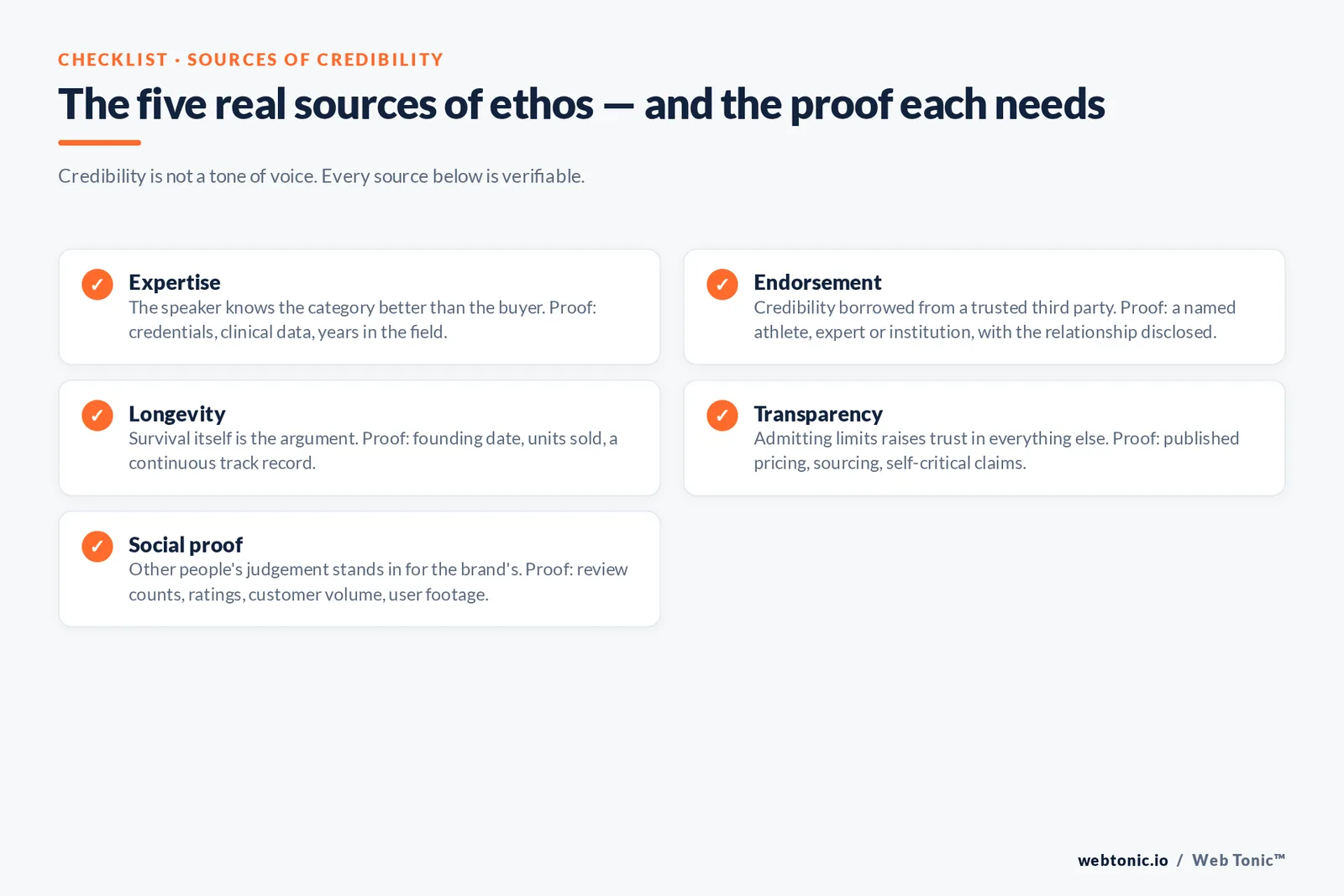
The five real sources of ethos
Credibility is not a tone of voice. It comes from one of five places, and each is verifiable.
| Source | How it works | Evidence the ad must show |
|---|---|---|
| Expertise | The speaker knows the category better than the buyer | Credentials, clinical data, years in the field |
| Endorsement | Credibility is borrowed from a trusted third party | Named athlete, expert, institution, disclosed relationship |
| Longevity | Survival itself is an argument | Founding date, units sold, continuous track record |
| Transparency | Admitting limits raises trust in the rest | Published pricing, sourcing, self-critical claims |
| Social proof | Other people's judgement stands in for the brand's | Review counts, ratings, customer volume, user footage |
Sequence matters. Transparency and social proof are the two sources available to a brand with no fame and no budget, which is why review-led creative outperforms polished brand films for young companies. Endorsement is the fastest but the most fragile: it is rented, and the rent can rise.
Ethos examples in advertising that worked
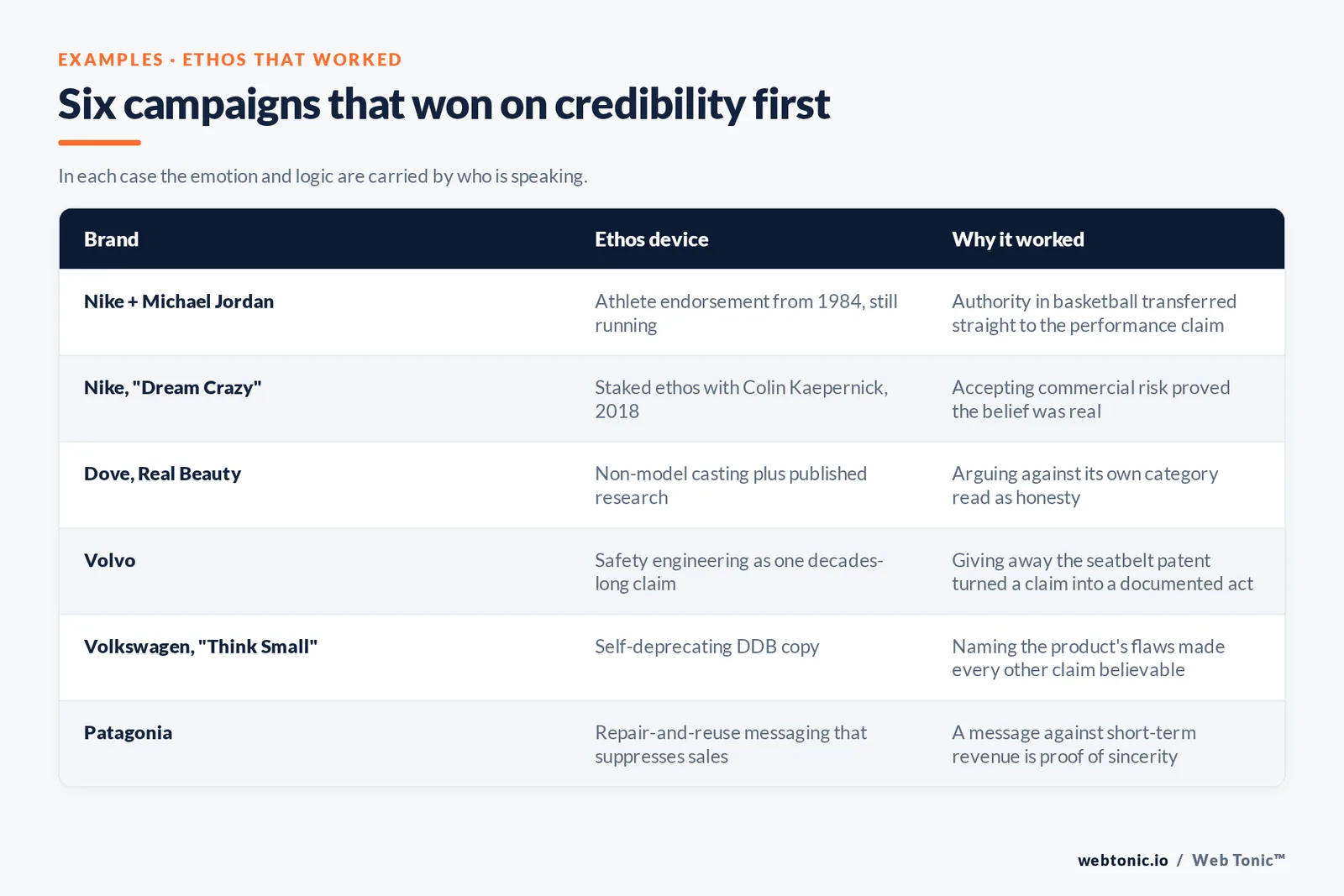
Each of these campaigns wins on credibility first. The emotion and the logic are real, but they are carried by who is speaking. All 12 pre-date any single ad format, which is why they still read as credible decades later.
| Brand | Ethos device | Why it worked |
|---|---|---|
| Nike + Michael Jordan | Athlete endorsement from 1984, still running | Jordan's authority in basketball transferred directly to the product's core claim: performance |
| Nike, "Dream Crazy" | Staked ethos with Colin Kaepernick, 2018 | Accepting commercial risk proved the belief was real, which is the only way a values claim earns credibility |
| Dove, Real Beauty | Non-model casting plus published research | The brand argued against the beauty category's own conventions, and self-criticism reads as honesty |
| Volvo | Safety engineering as a decades-long single claim | Giving away the three-point seatbelt patent turned a marketing claim into a documented act |
| Volkswagen, "Think Small" | Doyle Dane Bernbach's self-deprecating copy | Naming the product's flaws made every other claim in the ad believable |
| Colgate | Dentist recommendation framing | Category-relevant professional authority beats celebrity fame for health products |
| Apple | Designer-as-authority and consistent product craft | Ethos accumulated through delivery, so launch claims are pre-believed |
| IBM | Research and enterprise track record | Institutional longevity de-risks a high-consideration purchase |
| Patagonia | Repair-and-reuse messaging that suppresses sales | A message against short-term revenue is the strongest possible proof of sincerity |
| Microsoft accessibility work | Product built with the community it serves | Co-creation is evidence, not assertion |
| Toothpaste and skincare clinicals | Published trial results with sample sizes | Specific, checkable numbers convert expertise into logos-backed ethos |
| Amazon review counts | Aggregated social proof at scale | Thousands of ratings substitute for any brand claim at the point of decision |
Nike keeps its campaign archive and athlete announcements on its corporate newsroom, which is the primary source worth checking before repeating any figure attached to those campaigns.
Why ethos is now the scarcest appeal
Advertising begins from a trust deficit. Gallup's annual honesty and ethics ranking has placed advertising practitioners near the bottom of the professions for decades, with only around 10% of Americans rating their honesty high or very high. Nielsen's work on trust in advertising shows the flip side: the formats people trust most are the ones that come from other people — recommendations from friends and family, then editorial content, then branded channels.
Meanwhile the volume keeps rising. Statista's global advertising data tracks a market in the hundreds of billions of dollars, and Sprout Social's social statistics put 5.66 billion people on social platforms using an average of 6.75 networks each month. More messages competing for the same attention means the deciding variable is rarely reach — it is whether the source is believed.
Video amplifies both effects. Google's own video research shows creator and how-to formats carrying disproportionate influence over purchase decisions, because a face that has been useful before starts the ad with credibility already banked.
How to build ethos into a campaign
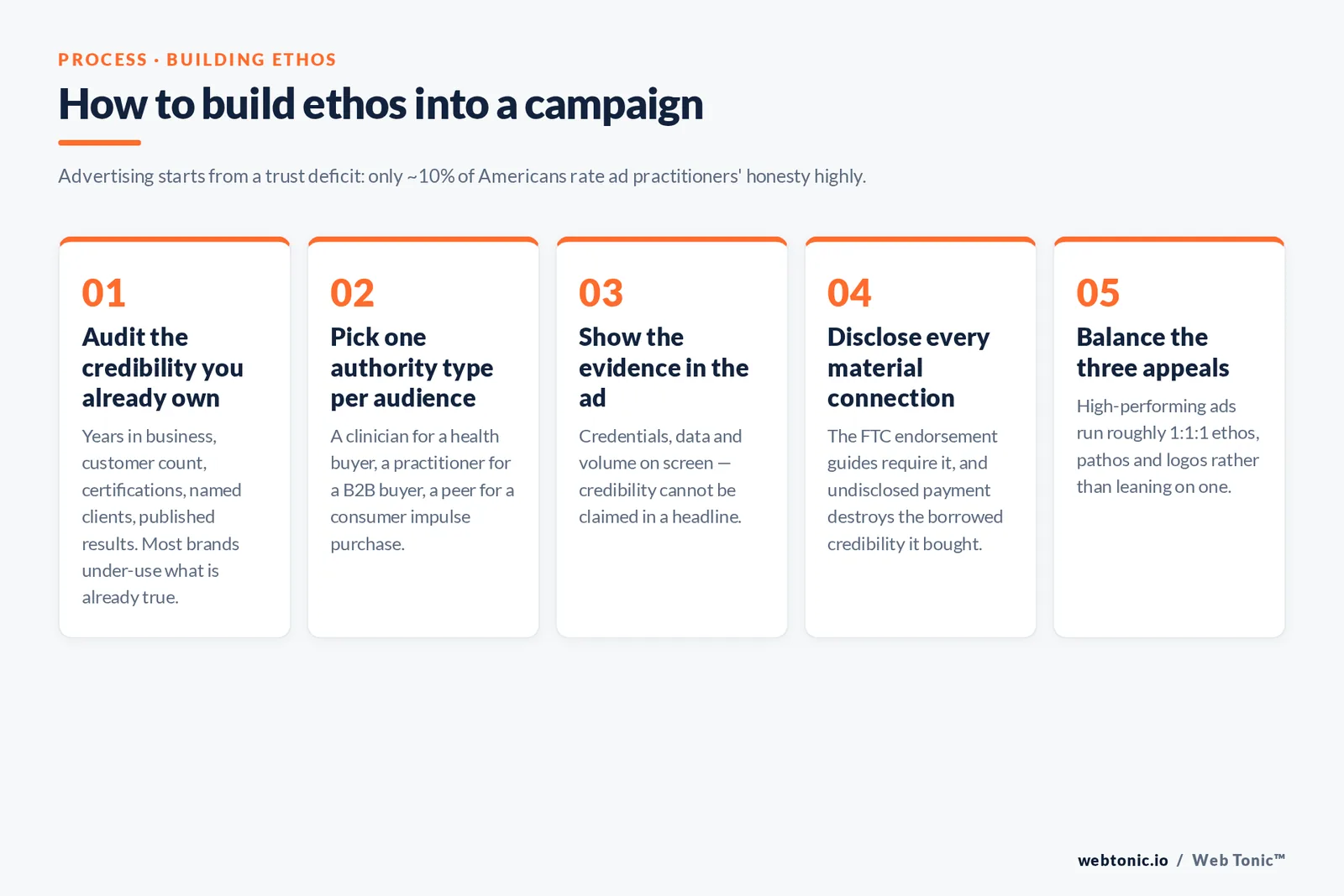
- Audit the credibility you already own. Years in business, customer count, certifications, named clients, published results. Most brands under-use what is already true.
- Pick one authority type per audience. A clinician for a health buyer, a practitioner for a B2B buyer, a peer for a consumer impulse purchase.
- Show the evidence in the frame. One number, one date, one name, one badge — 4 concrete artefacts beat 40 adjectives. Ethos asserted without artefacts reads as bluster.
- Disclose every paid relationship. The FTC endorsement guides require clear disclosure of material connections, and an undisclosed endorsement costs more credibility than the endorsement bought.
- Say one uncomfortable true thing. A limitation, a price, a use case you are wrong for. This is the cheapest trust gain in advertising.
- Then add pathos and logos. Credibility earns the hearing; emotion creates the want; logic closes the objection.
- Measure trust, not just clicks. Brand-lift studies, review sentiment, assisted conversions and repeat rate move before CTR does.
Applied to a real funnel, this usually means restructuring creative rather than rewriting headlines — the work our performance creative and growth marketing teams do together. If you want the appeal audited against your current ads, talk to us, or browse more strategy breakdowns on the Web Tonic blog.
Ethos in creator and influencer marketing
The creator economy is an ethos market. What a brand buys when it pays a creator is not reach, it is the credibility that creator accumulated over hundreds of unpaid posts. That asset is real, and it is also spendable: a creator who takes every partnership on offer burns the trust that made the first partnership valuable. Sprout Social's data on social behaviour shows users spending roughly 2 hours 40 minutes a day across an average of 6.75 networks, and 73% saying they will switch to a competitor if a brand fails to respond to them — responsiveness is itself an ethos signal, measured in hours.
Three rules keep borrowed credibility intact. First, relevance beats reach: a specialist with 20,000 engaged followers in the category usually outperforms a generalist with 2 million, because category authority is what transfers. Second, disclose in the first line, not in a hashtag block — the FTC's guidance is explicit that disclosures must be hard to miss, and audiences penalise concealment far more than they penalise sponsorship. Third, let the creator keep their own voice; a script that erases the person also erases the credibility being rented.
The same logic applies to owned assets. Case studies with named clients and real numbers, engineers explaining trade-offs on camera, founders publishing pricing, support teams answering hard questions in public — each is an ethos artefact that costs nothing but honesty. Brands that publish at least one genuinely self-critical piece of content per quarter consistently find it becomes among their most-shared, because in a feed of claims, the only surprising thing left is candour.
Persuasive techniques advertisers pair with ethos
Ethos rarely travels alone in a real advertisement. Advertisers layer it with a small set of persuasive techniques that consumers now recognise instantly, and the combination is what turns a credible message into a commercial result. The most common pairings, in rough order of how often they appear in modern ads:
- Testimonials. Real customers describing a specific outcome. Testimonials are the cheapest ethos device available to a small business, and 3 short customer clips usually beat one polished brand film.
- Celebrity endorsements. Fame borrowed at a price. Effective when the celebrity's expertise matches the product; wasteful when the audience can see the fee doing the talking.
- Expert and industry authority. Dentists for toothpaste, mechanics for oil, developers for software. Category-matched authority is the highest-converting form of endorsement for considered products.
- Statistics and demonstrations. Logical evidence that props up the credibility claim, such as a side-by-side test or a published trial with a stated sample size.
- Emotional storytelling. Pathos does the wanting while ethos does the believing; the two appeals reinforce rather than compete.
- Scarcity and social momentum. Useful, but the weakest of the group, because urgency without credibility reads as pressure.
Consumers are more fluent in these techniques than most marketing plans assume. Audiences raised on creator content decode a sponsored advertisement in seconds, so the practical test for any campaign is simple: strip out the music, the celebrity and the urgency, and ask whether the remaining message would still be believed. If the answer is no, the ad is carried entirely by devices and the brand is buying attention rather than trust.
This is also why the best-performing advertisements in high-consideration categories look almost editorial. Nike sells performance products with athletes because the athlete is the proof; a software business earns the same effect by putting the engineer who built the feature on camera. Values-led marketing works on the same logic — a stated value is only persuasive when the business has paid something for it. The measurable outcomes follow: higher brand-lift scores, better review sentiment, more repeat customers, and lower media cost per conversion because fewer exposures are needed before a decision. That is the commercial case for treating credibility as an asset rather than a tone.
Where ethos backfires
Three patterns destroy credibility faster than no ethos at all. Mismatched authority: a famous face with no connection to the category, which reads as a transaction rather than a testimony. Unfalsifiable superlatives: "the world's best" invites disbelief because nothing can verify it, while "4.7 from 12,000 reviews" cannot be argued with. Values without cost: any position a brand adopts while risking nothing is read, correctly, as decoration. Purdue's note on logical fallacies in argument is a useful checklist here — appeals to false authority and bandwagon reasoning are exactly the failure modes ad copy drifts into.
FAQ
What is ethos in advertising?
Ethos in advertising is the appeal to credibility: persuading an audience through the character, authority or trustworthiness of the source rather than through emotion or evidence. It appears as expert spokespeople, celebrity and athlete endorsements, professional certifications, heritage claims and customer social proof. Aristotle named it as one of the three modes of persuasion alongside pathos and logos.
How does ethos help build trust with consumers?
Ethos gives the audience a reason to accept a claim before they have any way to test it. Because most purchases are made without direct experience of the product, buyers substitute a judgement about the source for a judgement about the item. Credentials, disclosed endorsements, published data, a long track record and large volumes of independent reviews all reduce the perceived risk of being wrong.
What are some effective examples of ethos in advertising?
Nike's decades-long Michael Jordan partnership and its 2018 Colin Kaepernick campaign, Dove's Real Beauty casting, Volvo's safety record, Volkswagen's self-deprecating "Think Small" copy, Colgate's dentist-recommendation framing and Patagonia's repair-over-replace messaging. Each grounds the claim in a source the audience already believes, or in an act that costs the brand something.
How do ethos, pathos and logos differ and work together?
Ethos persuades through credibility, pathos through emotion and logos through logic. In practice they are sequenced rather than chosen: ethos earns attention, pathos creates desire, logos justifies the decision afterwards. Ads relying on a single appeal tend to underperform because they leave the other two objections unanswered.
Why is ethos important for brand reputation?
Ethos compounds. Every campaign that proves accurate makes the next one cheaper to believe, and every overstated claim raises the evidentiary cost of all future messaging. Because trust in advertising is already low, brands with accumulated credibility need less frequency and less spend to move the same audience.
Sources: Aristotle, Rhetoric (MIT Classics Archive) · Stanford Encyclopedia of Philosophy, Aristotle's Rhetoric · Purdue OWL, rhetorical strategies and logic in argumentative writing · MindTools, the rhetorical triangle · Nike Newsroom · Gallup, honesty and ethics of professions · Nielsen, trust in advertising · Statista, global advertising market · Sprout Social, social media statistics · Think with Google, video research · US Federal Trade Commission, endorsement guides.