Table of contents
Key Takeaways
- Enterprise Resource Planning (ERP) is software that integrates core business processes — finance, supply chain, HR, manufacturing, and procurement — into a single unified platform so every department shares one real-time data source.
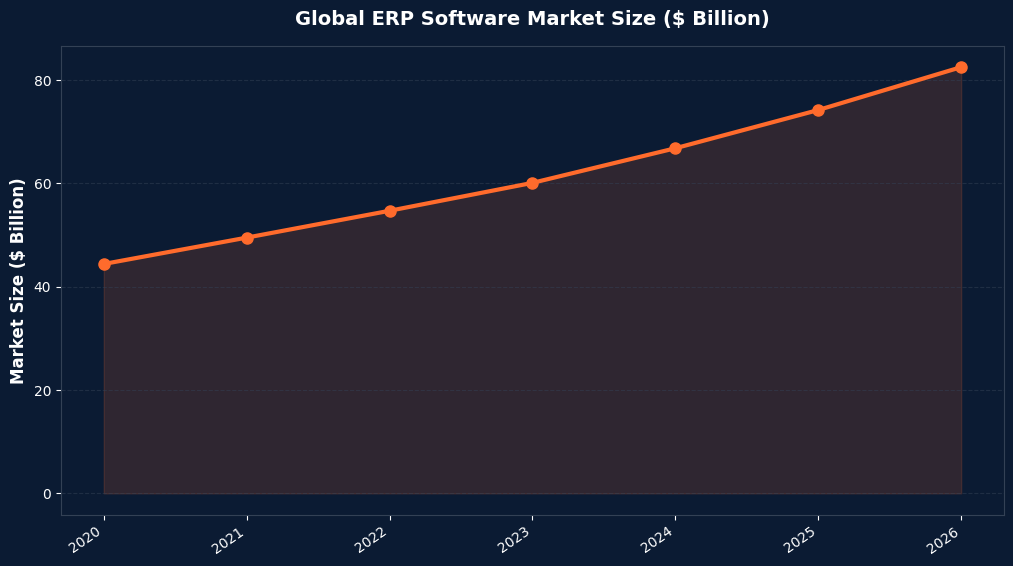
- The global ERP software market reached $74.2 billion in 2025 and is on track to surpass $82 billion by the end of 2026, according to Gartner and Fortune Business Insights.
- Organizations that deploy modern cloud-based ERP systems report 20–30% operational cost reductions by eliminating data silos, reducing manual processes, and accelerating reporting cycles.
- 95% of companies that implemented ERP said it improved at least one major business process, with the greatest gains in financial close time, inventory accuracy, and order fulfillment speed.
- Cloud-hosted ERP now accounts for over 65% of new deployments, displacing legacy on-premise installations because of lower upfront investment and continuous feature updates.
- Average ERP implementation timelines range from 6 to 18 months, though modular cloud platforms like NetSuite and Microsoft Dynamics 365 can go live in under 90 days for mid-market companies.
What Is ERP?
Enterprise Resource Planning (ERP) is a category of integrated business software that unifies an organization's core operational functions — finance, supply chain management, human resources, manufacturing, procurement, and customer relationship management — into one centralized platform. Instead of running separate tools for accounting, warehouse operations, and payroll, an ERP system connects them so every team works from the same real-time dataset.
The term "enterprise resource planning" was coined by Gartner in the early 1990s, evolving from earlier Material Requirements Planning (MRP) systems used in manufacturing. Today, modern ERP goes far beyond factory floors. It serves businesses across every industry — from a central hub for managing finance, HR, supply chain, and operations — by acting as a single source of truth for operational data. Understanding how enterprise resource planning works is the starting point for any digital transformation initiative. Explore more business strategy insights on our blog.
| Component | What It Manages | Key Benefit | Common Module Names |
|---|---|---|---|
| Finance & Accounting | General ledger, AP/AR, budgeting, consolidation | Automated financial close, real-time visibility | SAP FI/CO, Oracle Financials, NetSuite GL |
| Supply Chain | Procurement, inventory, logistics, demand planning | Reduced stockouts and carrying costs | SAP SCM, Oracle SCM Cloud, Dynamics 365 SCM |
| Human Resources | Payroll, benefits, talent, workforce planning | Unified employee records and compliance | SAP SuccessFactors, Workday HCM |
| Manufacturing | Production scheduling, BOM, quality control | Higher throughput, lower waste | SAP PP, Oracle MFG, Infor CloudSuite |
| CRM & Sales | Pipeline, quotes, order management, service | 360-degree customer view, faster quoting | Dynamics 365 Sales, SAP CX, NetSuite CRM |
| Procurement | Vendor management, POs, sourcing, contracts | Cost savings through spend visibility | SAP Ariba, Oracle Procurement Cloud |
How ERP Systems Work
An ERP platform operates on a shared database architecture. Every department — finance, operations, HR — reads from and writes to the same centralized data layer. When a sales order is entered, the system automatically updates inventory counts, triggers procurement if stock is low, schedules production, and posts the revenue entry to the general ledger. This eliminates the manual handoffs and spreadsheet reconciliations that cause errors and delays in disconnected tool stacks.
Modern cloud-based ERP platforms like IBM S/4HANA Cloud, Oracle Fusion Cloud, and Microsoft Dynamics 365 deliver this functionality through modular architectures. Companies select the modules they need — starting with finance and expanding to supply chain, HR, or manufacturing — without replacing the entire stack. API-first designs allow ERP platforms to connect with 200+ external applications via pre-built connectors, from e-commerce storefronts to data intelligence platforms and warehouse management tools.
On-premise deployments still serve large enterprises with complex regulatory requirements, but cloud ERP adoption has accelerated rapidly — Gartner estimates that more than 65% of new ERP projects now launch in the cloud. Cloud solutions remove the capital expenditure of dedicated servers, provide automatic updates, and enable remote access for distributed teams.
Core Benefits of Enterprise Resource Planning
Organizations invest in ERP because it directly solves the operational fragmentation that slows growth and increases costs. Here are the primary advantages backed by industry data:
Operational efficiency gains of 20–30% are common after an ERP deployment matures, according to Panorama Consulting Group's annual ERP report. The savings come from automating manual processes — three-way invoice matching, production scheduling, payroll calculations — that previously consumed hundreds of staff hours each month.
Real-time reporting replaces month-end guesswork. With every transaction flowing into one database, financial dashboards update continuously. CFOs can view cash positions, departmental spending, and revenue forecasts without waiting for spreadsheet consolidations. Companies using ERP reduce their financial close cycle by 20–50%.
Compliance and audit readiness improve significantly. Built-in controls, approval workflows, and audit trails ensure that transactions follow policy. Regulated industries like healthcare and financial services rely on ERP audit logging for SOX, HIPAA, and GDPR compliance.
Scalability for growth is a defining strength that supports any growth marketing initiative. A mid-market company that doubles in revenue can add modules, users, and geographies within the same platform rather than stitching together new point solutions. Cloud ERP platforms support multi-currency, multi-language, and multi-entity operations out of the box, making international expansion far simpler. Contact our team to discuss how technology integration supports your growth roadmap.
| Benefit | Before ERP | After ERP | Typical Improvement |
|---|---|---|---|
| Financial Close | 10–15 business days | 3–5 business days | 50–70% faster |
| Inventory Accuracy | 70–80% | 95–99% | 20–25 point gain |
| Order-to-Cash Cycle | 8–12 days | 3–5 days | 40–60% reduction |
| Reporting Time | Days to weeks | Real-time dashboards | Eliminated lag |
| Procurement Savings | Fragmented vendor spending | Consolidated sourcing | 5–15% cost reduction |
| IT Maintenance | Multiple legacy systems | Single platform | 30–40% lower IT spend |
Types of ERP Deployment
Choosing the right deployment model is one of the first decisions in any ERP initiative. Three primary options exist, each suited to different organizational needs.
Cloud ERP (SaaS) hosts the application and database on the vendor's infrastructure. Updates are automatic, upfront costs are minimal (subscription-based), and the platform scales elastically. Cloud ERP is the default choice for companies under $5 billion in revenue and for any organization that prioritizes speed-to-value. Microsoft Dynamics 365, NetSuite, and SAP S/4HANA Cloud Public Edition lead this segment.
On-premise ERP runs on company-owned servers inside private data centers. It gives full control over data residency and customization, but demands large capital investment and $500K–$2M+ in infrastructure costs, dedicated IT teams, and manual upgrade cycles. On-premise remains common in defense, government, and heavily regulated utilities.
Hybrid ERP combines cloud modules with on-premise core systems. Organizations might run financials in the cloud while keeping a legacy manufacturing execution system on-premise. Hybrid is typically a transitional architecture — most companies plan to move fully to the cloud within 3–5 years.
Top ERP Platforms Compared
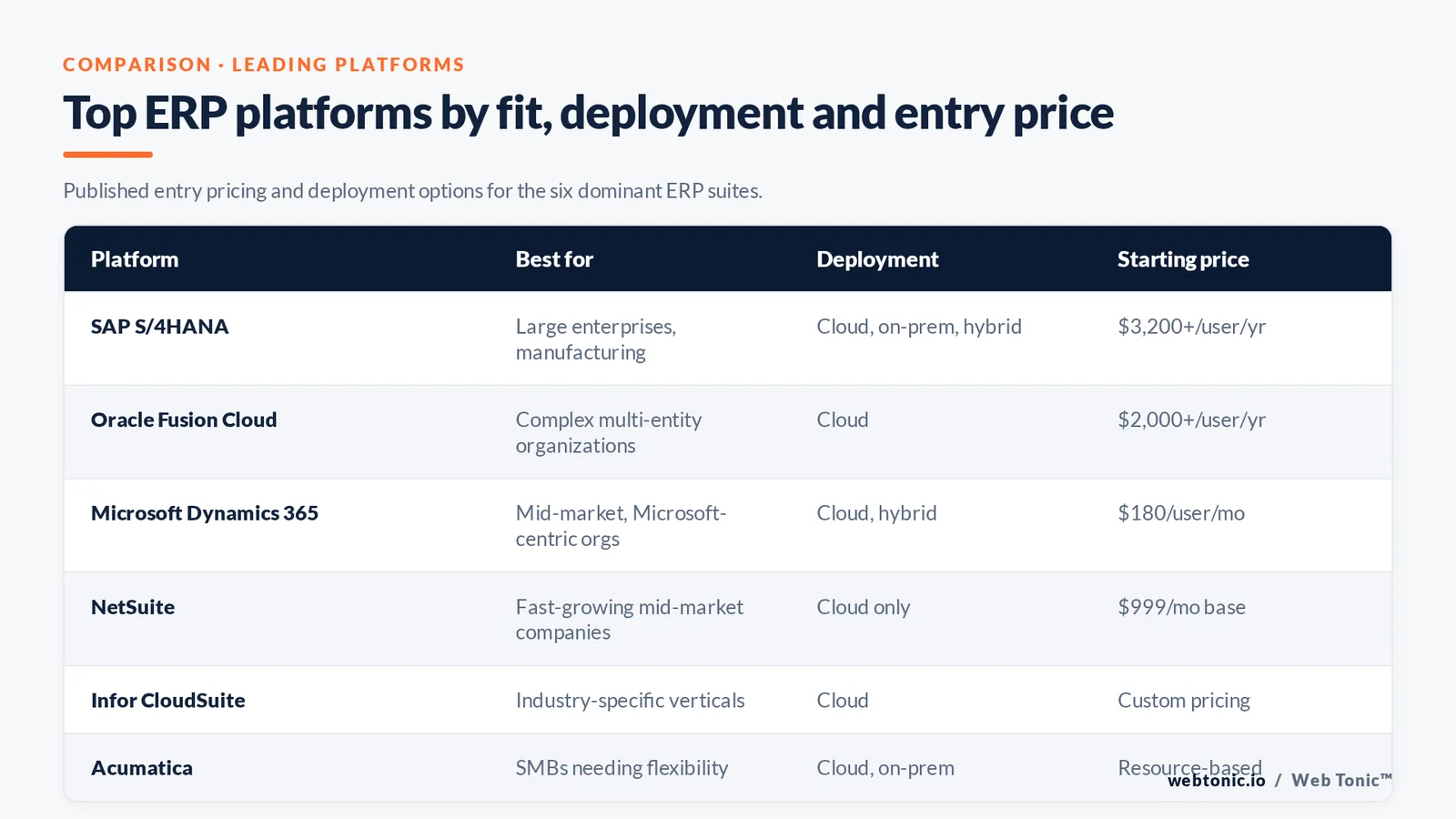
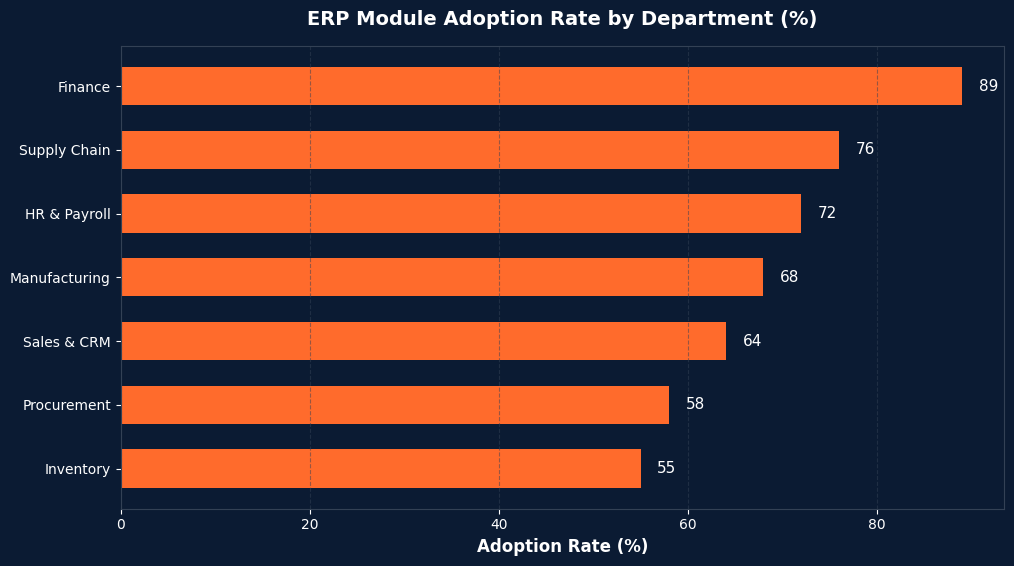
The ERP landscape is dominated by a handful of platforms, each with distinct strengths. Selecting the right one depends on company size, industry, complexity, and budget. SAP holds approximately 22% of global ERP market share, followed by Oracle at roughly 12%, and Microsoft Dynamics at around 8%, per SelectHub ERP research.
| Platform | Best For | Deployment | Starting Price | Key Strength |
|---|---|---|---|---|
| SAP S/4HANA | Large enterprises, manufacturing | Cloud, on-prem, hybrid | $3,200+/user/yr | Deepest industry functionality |
| Oracle Fusion Cloud | Complex multi-entity organizations | Cloud | $2,000+/user/yr | Advanced financials and analytics |
| Microsoft Dynamics 365 | Mid-market, Microsoft-centric orgs | Cloud, hybrid | $180/user/mo | Native Microsoft 365 integration |
| NetSuite | Fast-growing mid-market companies | Cloud only | $999/mo base | Built-in CRM + ecommerce |
| Infor CloudSuite | Industry-specific verticals | Cloud | Custom pricing | Micro-vertical configuration |
| Acumatica | SMBs needing flexibility | Cloud, on-prem | Resource-based pricing | Unlimited user licensing |
ERP Implementation: What to Expect
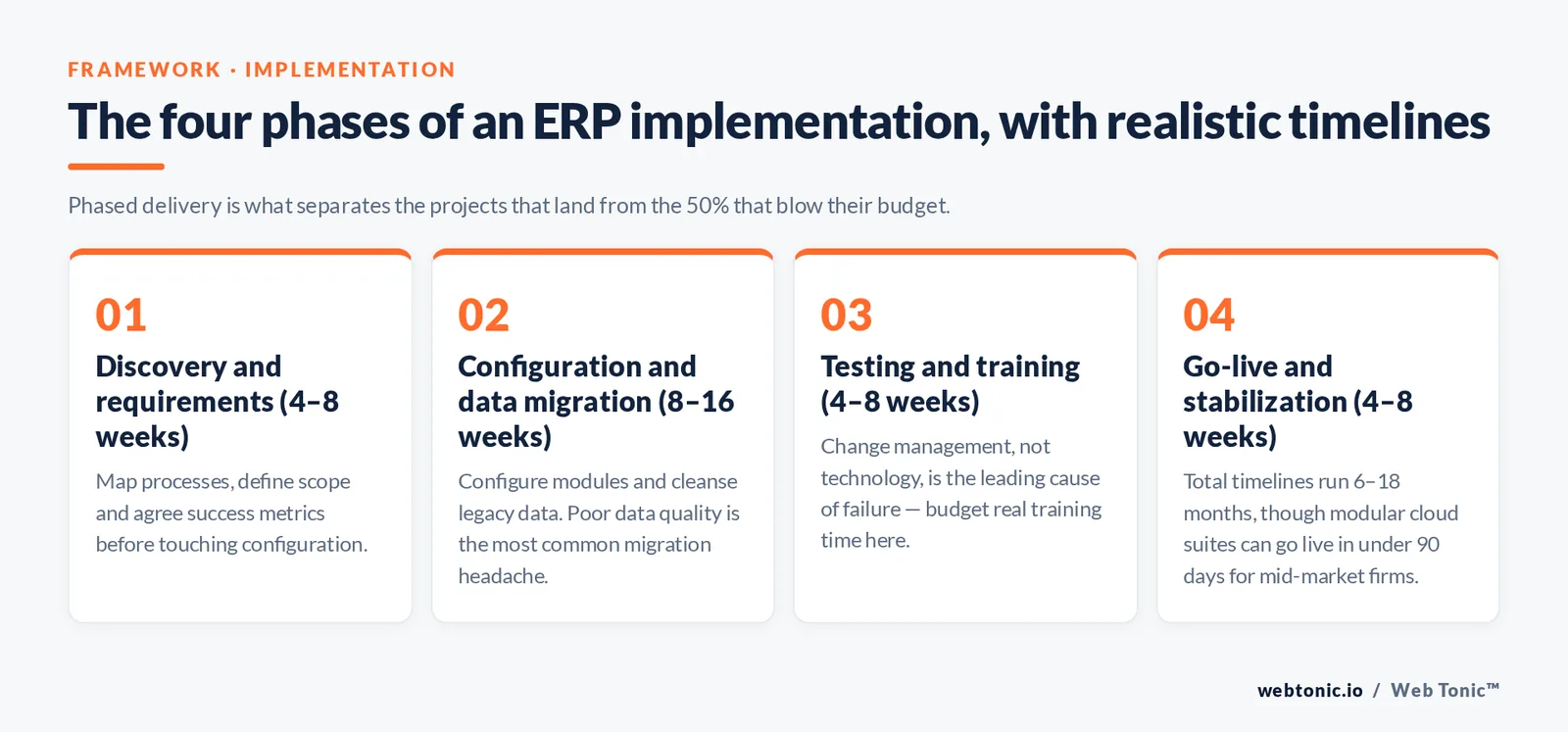
Implementing an ERP system is one of the most significant technology investments a company makes. Average implementation costs range from $150,000 for a basic cloud setup to over $10 million for large-scale, multi-country deployments. Timeline, budget, and organizational readiness determine success or failure — and studies show that roughly 50% of ERP projects exceed their original budget.
Successful implementations follow a phased approach: discovery and requirements gathering (4–8 weeks), system configuration and data migration (8–16 weeks), testing and training (4–8 weeks), and go-live plus stabilization (4–8 weeks). The most common cause of failure is not technology — it is organizational change management. Employees resist new workflows, executives underestimate training needs, and data quality from legacy systems creates migration headaches.
Key success factors include executive sponsorship, a dedicated internal project team, realistic timeline expectations, and thorough data cleansing before migration. Companies that invest in change management alongside technical configuration achieve significantly higher adoption rates than those that treat ERP as a purely IT-driven initiative.
ERP Trends Reshaping the Market
The enterprise resource planning landscape is evolving faster than at any point in its history. Several macro trends are redefining what modern platforms deliver.
AI and machine learning are embedded into core ERP workflows. SAP, Oracle, and Microsoft have all introduced AI copilots that automate invoice matching, predict supply chain disruptions, and generate financial forecasts. By 2027, Gartner predicts that 70% of ERP transactions will include an AI-assisted recommendation.
Composable ERP architectures let companies replace monolithic deployments with modular, best-of-breed components connected through APIs. Rather than buying a full-suite platform, a company might combine a specialized web development front-end with cloud financials and a third-party warehouse management system — all sharing data through integration middleware.
Industry-cloud ERP packages preconfigured workflows for specific verticals — healthcare, construction, food and beverage, automotive — reducing implementation time by 30–40% compared to generic deployments compared to generic deployments. SAP's industry cloud and Infor's CloudSuite Industrial are leading this shift.
Sustainability and ESG reporting modules are becoming standard. New regulatory mandates (EU CSRD, SEC climate disclosure rules) require companies to track carbon emissions, supply chain labor practices, and environmental metrics. Modern ERP platforms integrate ESG data into the same financial reporting layer, eliminating the manual data collection that historically made sustainability reporting unreliable. This covers real time, cloud based, planning erp, what erp considerations that shape effective outcomes. This covers decision making, business functions considerations that shape effective outcomes.
FAQ
What does ERP stand for?
ERP stands for Enterprise Resource Planning. It refers to integrated software platforms that unify core business operations — finance, supply chain, human resources, manufacturing, and procurement — into a single system with a shared database. The term was first coined by Gartner in the early 1990s as an evolution of earlier MRP (Material Requirements Planning) tools.
How much does an ERP system cost?
Costs vary dramatically based on company size, deployment model, and scope. Small and mid-market cloud ERP subscriptions start around $150 per user per month (NetSuite, Acumatica), while enterprise implementations on SAP or Oracle can exceed $10 million including licensing, customization, and consulting fees. Total cost of ownership over five years is the better benchmark.
What is the difference between cloud ERP and on-premise ERP?
Cloud ERP runs on the vendor's infrastructure with subscription pricing, automatic updates, and remote access. On-premise ERP is installed on company-owned servers, offering full data control but requiring dedicated IT staff and manual upgrades. Cloud ERP now represents over 65% of new deployments globally.
How long does ERP implementation take?
Typical timelines range from 3 months for a focused cloud deployment to 18+ months for a complex multi-entity on-premise rollout. Modular cloud platforms like NetSuite or Dynamics 365 Business Central can achieve go-live in 60–90 days for mid-market companies with straightforward requirements.
Do small businesses need ERP?
Small businesses benefit from ERP once they outgrow spreadsheets and disconnected tools — typically when manual processes cause errors, slow down fulfillment, or make financial reporting unreliable. Cloud ERP platforms with resource-based pricing (like Acumatica) and entry-level tiers (like NetSuite SuiteSuccess) make it accessible for companies with as few as 10 employees.
Sources: IBM — What Is ERP · Oracle — ERP Explained · TechTarget — ERP Definition · Microsoft — ERP Overview · SelectHub — ERP Guide · Panorama Consulting — ERP Report 2025 · CIO — ERP Solutions · Oracle — ERP Overview