Table of contents

Only 12% of contractors actually use their analytics to make business decisions — and 39% of electrician websites have no tracking at all. Here are the statistics that show how data-driven electrical contractors outperform their competition in 2026.
Key Takeaways
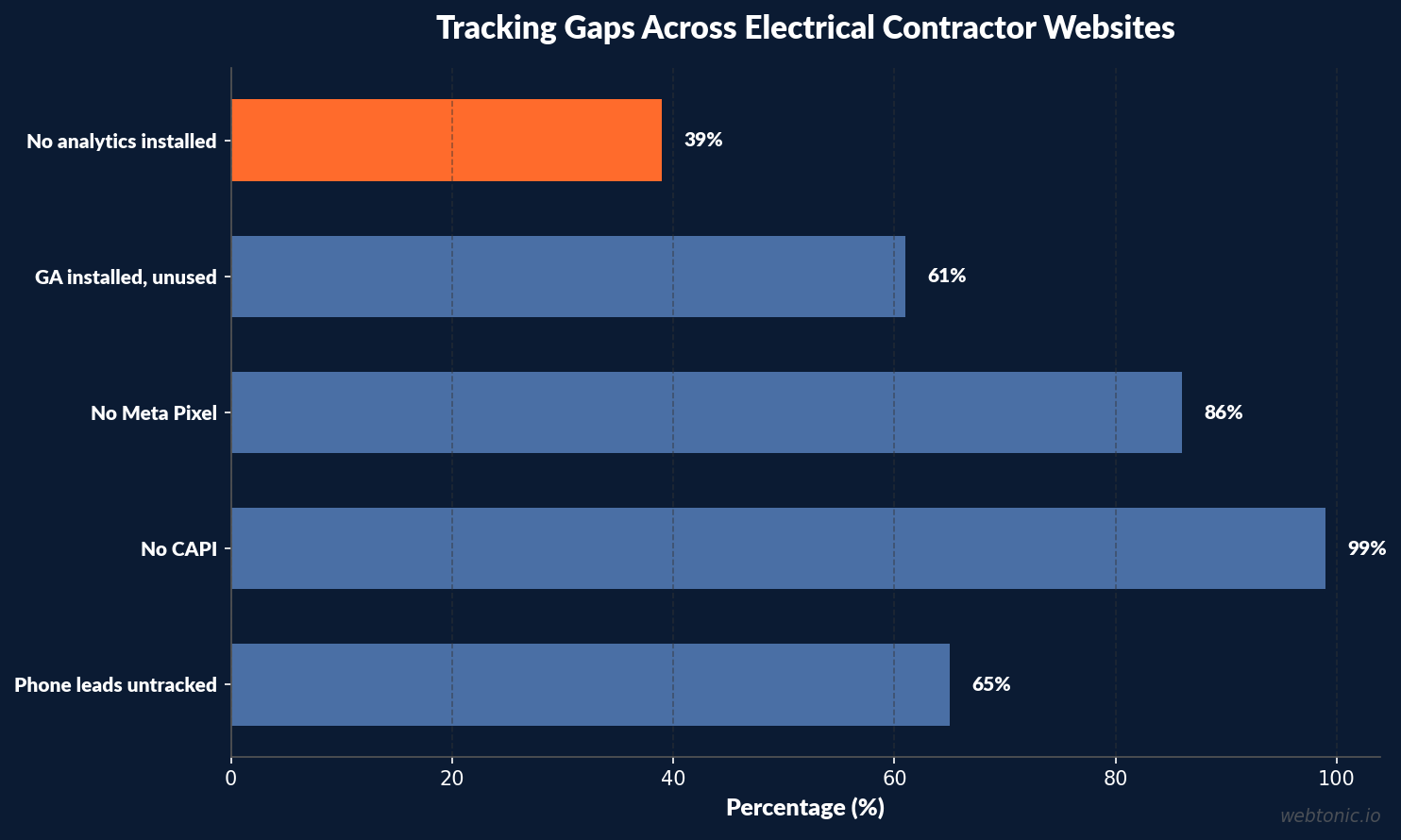
- 39% of electrician websites have zero analytics installed, leaving them blind to lead sources and campaign ROI (ElectricianAudit.co, 2026 audit of 1,259 sites).
- 73% of small businesses have Google Analytics installed but only 12% use it to make decisions — the gap between collection and action is massive (PipelineOn, 2026).
- 86% of electrical Meta advertisers have no Pixel installed and 99% lack Conversions API, losing 30–50% of trackable conversions (PipelineOn Q2 2026).
- 65% of home service leads come through phone calls, yet most contractors only track form submissions (PipelineOn, 2026).
- Server-side tracking recovers 20–40% of leads that browser-based tracking misses due to ad blockers and iOS restrictions (Zubayer Islam, 2026).
- Top-performing electrical contractors run 20%+ net margins — roughly 3x the 7.5% industry average — driven by job-costing visibility and data discipline (Simpro, 2026).
Electrical Services Analytics Adoption at a Glance
Table 1. Analytics adoption and usage rates across the electrical services industry (2026).
| Metric | Statistic | Source |
|---|---|---|
| No analytics installed | 39% of electrician websites | ElectricianAudit.co (1,259 sites) |
| GA installed but unused | 73% installed, only 12% act on data | PipelineOn 2026 |
| No Meta Pixel | 86% of electrical advertisers | PipelineOn Q2 2026 |
| No Conversions API | 99% of electrical advertisers | PipelineOn Q2 2026 |
| Phone call leads untracked | 65% of leads come via phone | PipelineOn 2026 |
| Leads lost to browser gaps | 20–40% unrecoverable without server-side | Zubayer Islam 2026 |
| Call tracking tool cost | $45–$100/month | PipelineOn 2026 |
Website Analytics and Tracking Gap Statistics
The analytics gap in the electrical industry is one of the widest in home services. When ElectricianAudit.co audited 1,259 electrician websites, they found that 39% had no analytics code whatsoever — meaning nearly four in ten electrical contractors cannot identify which marketing channels generate leads.
Even among contractors who do install tracking, usage remains superficial. According to PipelineOn's GA4 analysis, 73% of small businesses have Google Analytics installed but only 12% use it to make decisions. The default GA4 setup misses phone calls — which account for 65% of home service leads — so electricians using out-of-the-box tracking are blind to most of their lead flow.
Enhanced conversions can recover 15–30% of conversion data lost to privacy changes, but adoption among electrical contractors remains low. Most shops tracking anything only measure pageviews while the metrics that matter — call volume, form completions, revenue per channel — go unmonitored.
Conversion Tracking and Attribution Statistics
Conversion tracking is where the electrical industry's analytics weakness becomes most costly. PipelineOn's Q2 2026 Meta Ads benchmark analyzed 143 electrical advertisers running 647 ads and found staggering tracking gaps:
- 86% of electrical Meta advertisers have no Pixel installed on their website — they spend on ads with no ability to measure results.
- 99% lack Conversions API (CAPI), the server-side tracking layer that Meta recommends for accurate attribution.
- Median landing page LCP is 7.8 seconds, more than double the 2.5-second threshold Google recommends.
Without proper conversion tracking, iOS attribution loss runs 30–50% of conversions going untracked, according to Elev8 Operations' 2026 contractor data. Installing CAPI lifts trackable conversions by 30–50%, and Smart Bidding algorithms optimize significantly better when fed accurate data.
Server-side tracking via tools like Stape.io recovers 20–40% of electrician leads that browser tracking misses due to ad blockers, iOS Safari restrictions, and cross-device journeys. For Google Ads, storing the GCLID in the CRM and uploading offline conversions allows Smart Bidding to optimize toward closed jobs rather than form fills.
Call Tracking and Lead Attribution Statistics
Phone calls dominate the electrical lead funnel, yet they are the least-tracked conversion action. PipelineOn reports that 65% of home service leads come through phone calls, and without call tracking, contractors cannot distinguish between a panel upgrade inquiry and a spam call.
Dynamic number insertion services like CallRail, CallTrackingMetrics, and WhatConverts assign unique phone numbers to each marketing channel. Visitors from Google Ads see one number, organic visitors see another, and Facebook visitors see a third. This granularity costs $45–$100/month for most contractor plans.
Contractors who implement call tracking gain measurable advantages: they can see that 47 people clicked the phone number last week, 12 submitted the contact form, and 8 came from Google Business Profile. That level of channel-specific data is what separates data-driven shops from the 39% running completely blind.
37% of phone leads close on the first call, according to Elev8 Operations, making call tracking not just an analytics tool but a revenue protection measure. Contractors who answer within 5 minutes see significantly higher booking rates.
Analytics ROI and Performance Benchmarks
Table 2. Key performance benchmarks for data-driven electrical contractors vs. industry averages (2026).
| Benchmark | Industry Average | Top Performers | Source |
|---|---|---|---|
| Net profit margin | 7.5% | 20%+ | Simpro 2026 |
| Marketing spend (% of revenue) | 5–10% | 8–10% (optimized) | Elev8 Operations 2026 |
| Google Ads ROAS (top quartile) | 2–3x | 5.8x | Elev8 Operations 2026 |
| LSA cost per lead | $53 (all trades) | $39 (electrical) | SearchLight Digital 2026 |
| Conversion rate (click to lead) | 7.52% (all industries) | 9.08% (electrical) | BaaDigi / LocaliQ 2026 |
| Website conversion rate | 2.8% | 4.5% (optimized LPs) | CuFinder 2026 |
Simpro's 2026 industry analysis reveals that top-performing electrical contractors run 20%+ net margins — roughly 3x the 7.5% industry average. The gap is not about volume but about margin discipline, work mix, and job-costing visibility, all of which depend on analytics.
The top 50 U.S. electrical contractors collectively posted $59.5 billion in revenue in 2025, signaling concentration at the top. These firms use closed-loop analytics — connecting ad spend to completed jobs — to identify which marketing channels drive profitable work versus which ones generate leads that never convert.
Contractor marketing spend should benchmark at 5–10% of gross revenue. Below 5% signals under-investment; above 12% sustained indicates broken unit economics. The difference between profitable and wasteful spend depends entirely on analytics quality.

Marketing Technology Stack for Electrical Analytics
The analytics technology stack for electrical contractors has expanded significantly. Beyond basic Google Analytics, contractors now need integrated systems connecting marketing data to job-costing outcomes.
- Google Analytics 4 (GA4) — Free; installed on 73% of small business sites but requires custom event configuration for calls and forms.
- Call tracking (CallRail, WhatConverts) — $45–$100/month for dynamic number insertion attributing phone leads to campaigns.
- CRM integration (ServiceTitan, Housecall Pro, Jobber) — Links marketing data to job completion and revenue for closed-loop attribution.
- Server-side tracking (Stape.io, GTM server) — Recovers 20–40% of lost conversions; essential for offline conversion uploads.
- AI-powered attribution tools — Connect digital dashboards to job-costing data, providing closed-loop ROI visibility per campaign and keyword.
The U.S. electrical industry is projected to reach $347.5 billion in revenue in 2026 across approximately 262,000 electrician businesses (Simpro, 2026). With that many firms competing, those with superior analytics infrastructure gain a compounding advantage in lead quality and margin management.
Data-Driven Decision-Making in Electrical Services
The gap between data collection and data action is the industry's biggest analytics problem. While 73% install tracking code, the 12% who actually use it to adjust campaigns, reallocate budgets, and optimize channels see dramatically different results.
Key practices that separate top-performing electrical contractors:
- Channel-level ROI tracking — Knowing that LSA generates leads at $39 vs. Google Search at $93.69 shifts budget allocation immediately.
- Job-costing integration — Connecting ad clicks to completed jobs reveals true customer acquisition cost, not just cost per lead.
- Speed-to-lead monitoring — Phone-form leads convert at 46% industry-wide, but only when responded to within 5 minutes.
- Seasonal trend analysis — Electricians who track seasonal patterns pre-position campaigns for peak demand periods like summer cooling season and holiday lighting.
Workforce analytics add another dimension: with 818,700 electricians employed in the U.S. and employment projected to grow 9% from 2024–2034 (classified as "much faster than average"), electrical firms need analytics not just for marketing but for recruitment pipeline management.
Electrical Analytics Compared to Other Home Services
Table 3. Analytics adoption and marketing performance: electrical vs. other home service trades (2026).
| Metric | Electrical | HVAC | Plumbing | Roofing |
|---|---|---|---|---|
| Avg. CPC (Google Ads) | $12.18 | $9.50 | $11.81 | $7.85 |
| LSA cost per lead | $39 | $47 | $52 | $61 |
| Conversion rate | 9.08% | 8.2% | 7.9% | 6.5% |
| Avg. job ticket (LSA) | $1,434 | $2,100 | $890 | $8,500 |
| LSA booking rate | 43.4% | 44% | 41% | 38% |
Electrical services carry the highest CPC in home services at $12.18 — above even dentists — yet also post the lowest LSA cost per lead at $39 (BaaDigi / SearchLight Digital, 2026). This spread creates a data-driven directive: contractors who track channel-level costs shift budget from expensive search ads toward LSAs and achieve 8.5x ROAS.
The 9.08% conversion rate for electrical search ads outperforms the 7.52% all-industry average, suggesting that electrical search intent converts well when analytics can attribute those conversions back to specific keywords. Without tracking, the $12.18 CPC looks wasteful; with it, the unit economics are highly favorable for high-ticket services.
Best Practices for Electrical Services Analytics
- Install GA4 with custom event tracking for phone calls, form submissions, and quote requests — not just pageviews.
- Implement call tracking with dynamic number insertion to attribute phone leads to specific campaigns and keywords.
- Set up server-side tracking to recover the 20–40% of conversions lost to browser restrictions.
- Connect CRM to ad platforms — upload offline conversions so bidding algorithms optimize toward closed jobs and revenue.
- Install Meta Pixel and CAPI — 86% of electrical advertisers lack even basic Pixel tracking, making this the highest-impact upgrade.
- Track cost per closed job, not cost per lead — the true metric is customer acquisition cost after accounting for close rate and job value.
- Benchmark marketing spend at 5–10% of gross revenue and use analytics to confirm channel-level ROI meets that threshold.
- Review analytics weekly — join the 12% who act on data rather than the 73% who collect it passively.
Related reading
- Most Cleaners Fly Blind Without Tracking: Cleaning Services Analytics Data
- Most Funeral Providers Lack Digital Tracking: Services Tracking and Analytics Statistics
- Electrical Email Marketing Statistics 2026
- Marketing Analytics services at Web Tonic
Frequently Asked Questions
What percentage of electrician websites have no analytics?
According to a 2026 audit of 1,259 electrician websites by ElectricianAudit.co, 39% have no analytics code installed. These contractors cannot identify which marketing channels generate their leads or measure campaign ROI.
How much does call tracking cost for electrical contractors?
Call tracking services like CallRail and WhatConverts typically cost $45–$100 per month for contractor plans. This investment provides channel-specific attribution for the 65% of leads that come through phone calls — leads that standard web analytics miss entirely.
What is the ROI gap between data-driven and average electrical contractors?
Top-performing electrical contractors who use analytics for decisions run 20%+ net margins compared to the 7.5% industry average — a 3x difference. The top quartile using Google Ads achieves 5.8x ROAS versus 2–3x for average performers (Elev8 Operations, 2026).
Why do most electrical advertisers lack conversion tracking?
PipelineOn's Q2 2026 benchmark found 86% of electrical Meta advertisers have no Pixel and 99% lack CAPI. The main reasons are technical complexity of server-side setup, reliance on web developers who install basic tracking without custom events, and the misconception that phone-dominant businesses do not need digital tracking.
How much conversion data does server-side tracking recover?
Server-side tracking through tools like Stape.io recovers 20–40% of leads that browser-based tracking misses. Ad blockers, iOS Safari restrictions, and cross-device journeys prevent browser tags from firing, but server-side containers bypass these limitations, sending conversion data directly to Google Ads, Meta, and GA4 from the server.
Sources
electricianaudit.co/blog/how-to-setup-google-analytics-electrician
pipelineon.com/blog/ga4-home-services-setup
pipelineon.com/research/home-service-meta-ads-q2-2026/electrical
zubayerislam.com/google-ads-conversion-tracking-for-electricians
simprogroup.com/blog/electrical-industry-statistics-2026
elev8operations.com/guides/contractor-marketing-statistics-2026
baadigi.com/tools/benchmarks/electrical
bluegridmedia.com/google-ads-conversion-tracking-contractors
cufinder.io/blog/benchmarks/construction